
Welcome to the Step Up Japanese blog archive!
Although I’m not currently adding new posts to the blog, you’ll find plenty of Japanese learning tips, study advice, and resources to explore here.
Browse the blog index to view a complete list of posts.
For the latest news, course updates, and Japanese learning tips from Step Up Japanese, sign up for my newsletter.
Search this blog:
Walking the Shikoku 88 Pilgrimage (Part 3) - What To Wear

When I told my Japanese friends I was planning to walk the Shikoku Henro trail, several of them said the same thing. "Are you going to wear a hat?"
For many people, the image of a walker in a bamboo hat is the first thing that comes to mind when they think of the pilgrimage.
But what "should" you wear on the Shikoku 88, a Buddhist pilgrimage trail?
Some pilgrims don't wear any special gear at all - just normal walking clothes. That's fine. But some walkers choose to wear special clothes, many of which have symbolic significance.
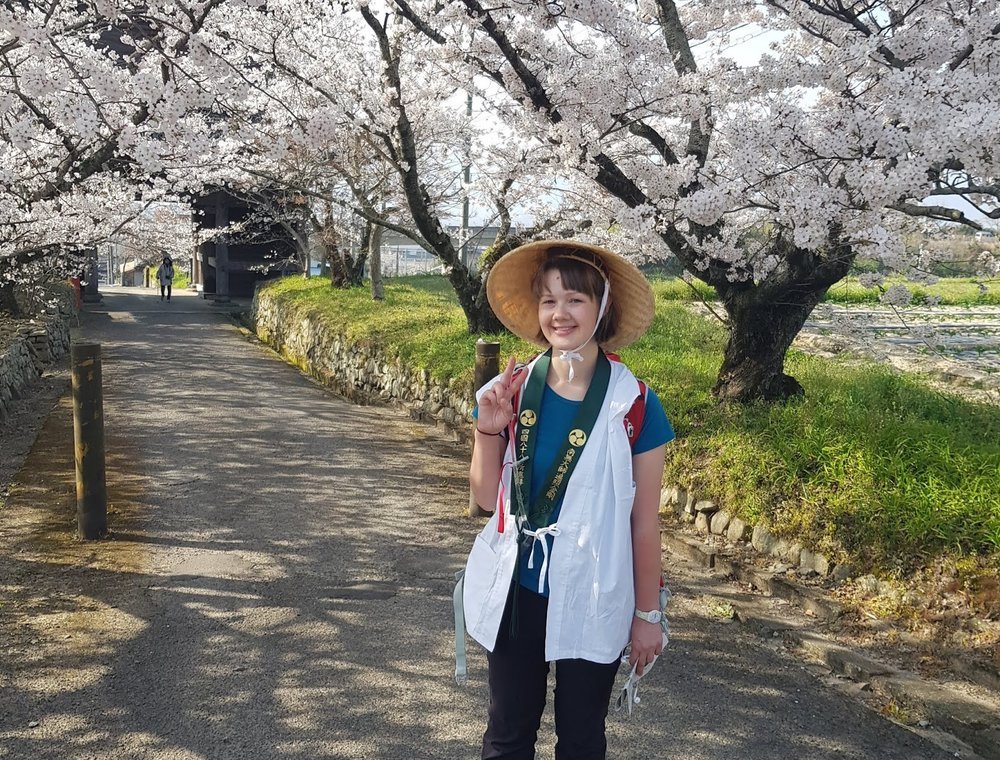
Many people wear a white jacket to walk the trail. It's called a 白衣 hakui. This is the first piece of pilgrim garb I bought, at temple number 1. Some have sleeves; mine is sleeveless.
Wearing the white jacket signals to people that you are a pilgrim. So if you want to talk with lots of people on Shikoku, wearing pilgrim clothes is a great conversation starter.

Actually, some pilgrims wear all white. I met a lovely older gentleman several times on the trail, who had just turned 80. He was all in bright white, and looked very striking.
According to Nippon.com:
"White is worn because long ago some pilgrims would collapse from the physical exertion and die during the pilgrimage, and the white robes could serve as their burial clothes.I prefer the second meaning, I think!
The colour white also carries the meaning that all pilgrims are equal in front of the Buddha."
Even if you don't wear white, it's be good to wear lighter colours - I saw a lot of people in light coloured clothes. I didn't know this when I planned my trip, so my walking clothes are all dark.
If I buy new kit before I go back, I might try and buy lighter coloured clothes. I didn't get the impression it matters too much though.

I met another lovely Japanese man named Shinichi, who kindly showed me around various rituals, explaining aspects of the temple and the praying process to me.
I'm not Buddhist, but I really enjoyed and appreciated the ritual of praying at each temple. I found it fascinating, and very calming.

After lighting incense and a candle, you give an offering at each hall of an osamefuda (納め札), a slip of paper onto which you can write your name, address and a message of good will.
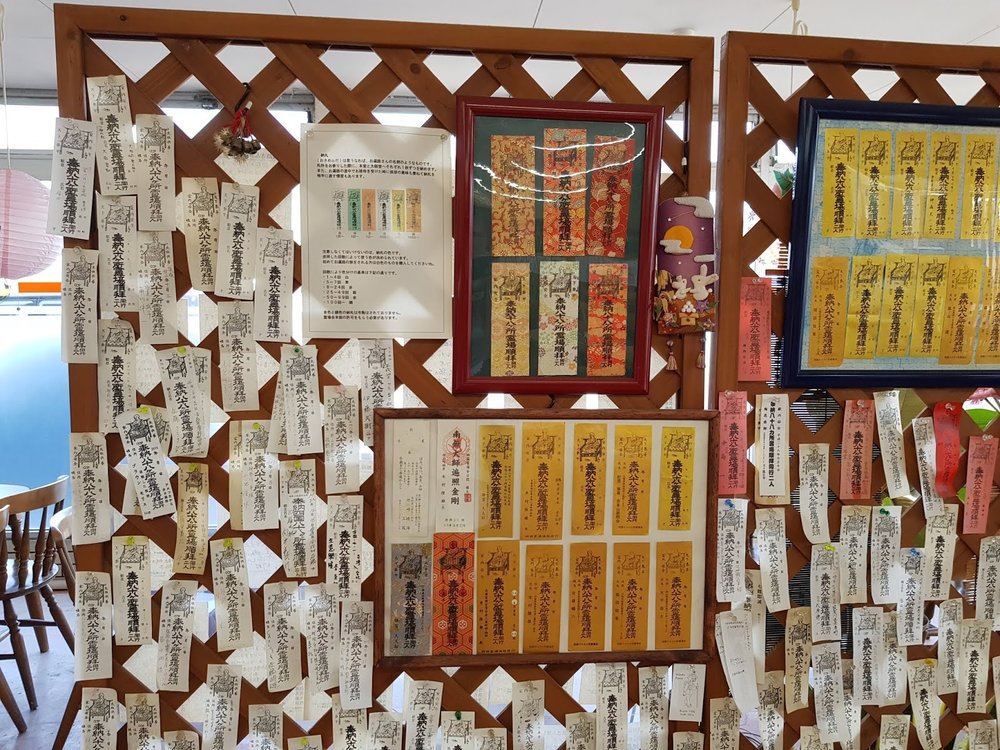
In the stamp office, the staff doing calligraphy were often surprised to see a non-Japanese visitor, and would usually ask where I was from and if I was walking the whole route.
I had a lot of pleasant conversations with the men and women in the stamp offices. Again, I think wearing the pilgrim kit helps here.
Later on, I got a 菅笠 suge-gasa, a bamboo sedge hat. This conical hat keeps the sun out of your eyes, and it works as a rain-hat too.
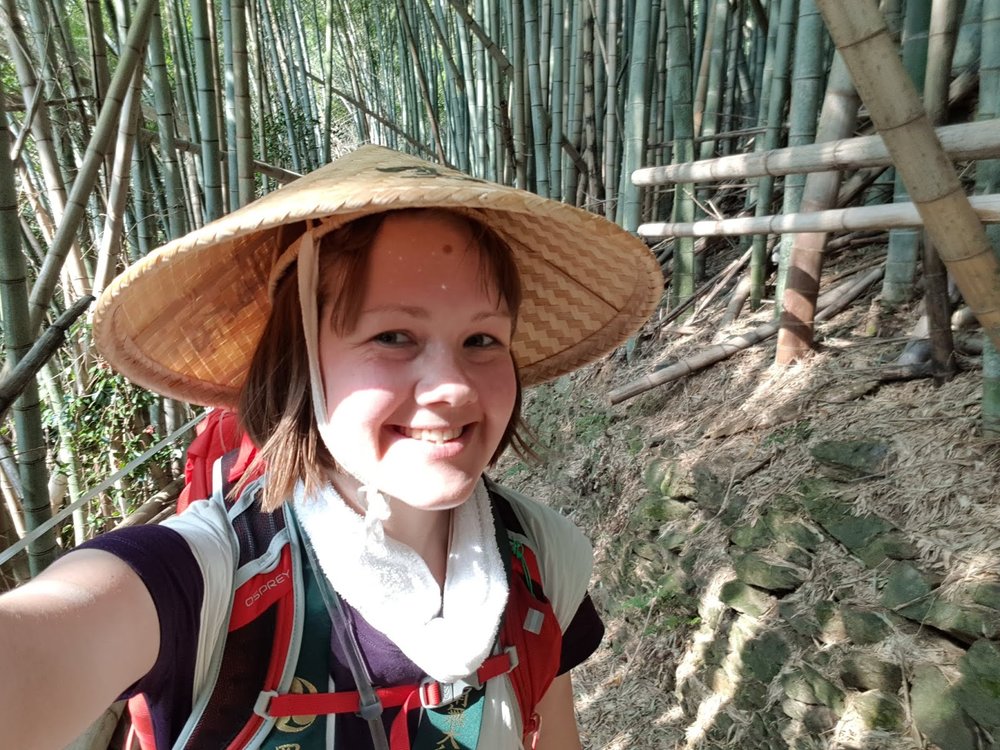
The suge-gasa was surprisingly sturdy - when I wasn't wearing it, I strapped it to the back of my backpack, and despite getting bashed about a bit (sorry, hat!) it still looks as good as new.
Now, back in England, it's sitting in my office waiting for my next trip...
A bit further into the week, I acquired a 輪袈裟 wagesa, a kind of stole or scarf . Traditionally, this is an item worn by monks, but now it just symbolises that the wearer is a pilgrim.
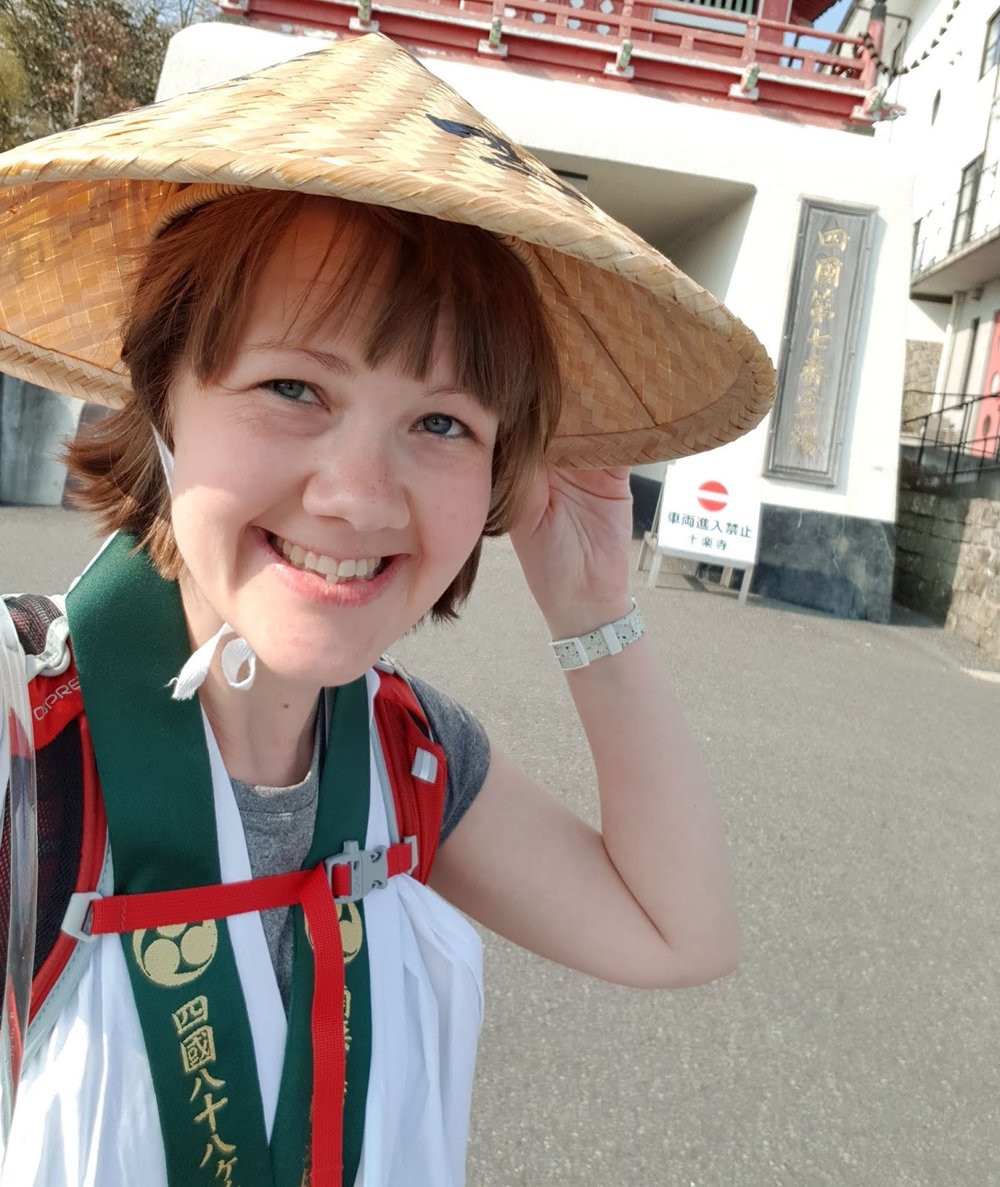
↓ You have to take the wagesa off when eating or washing. This public toilet even had a hook outside to hang your stole on.

Many people also walk with a 金剛杖 kongou-zue, a wooden walking stick. The stick symbolises Kōbō Daishi himself, the monk in whose footsteps pilgrims walk.
Pilgrims are supposed to take care of the stick before they care for themselves - washing the bottom of the stick before washing your own feet, and so forth.
The nicer sticks have a bell hanging from the top, and according to the fantastic site Shikoku Henro Trail:
"The intent of the bell is to keep pulling your attention back to the present; back to reality and what you are doing so that you don't just day dream all day as you walk."The bell is also good for alerting bears and wild boar to your presence, so they won't be startled by you. And you can hit the stick on the ground as you walk to scare away snakes.
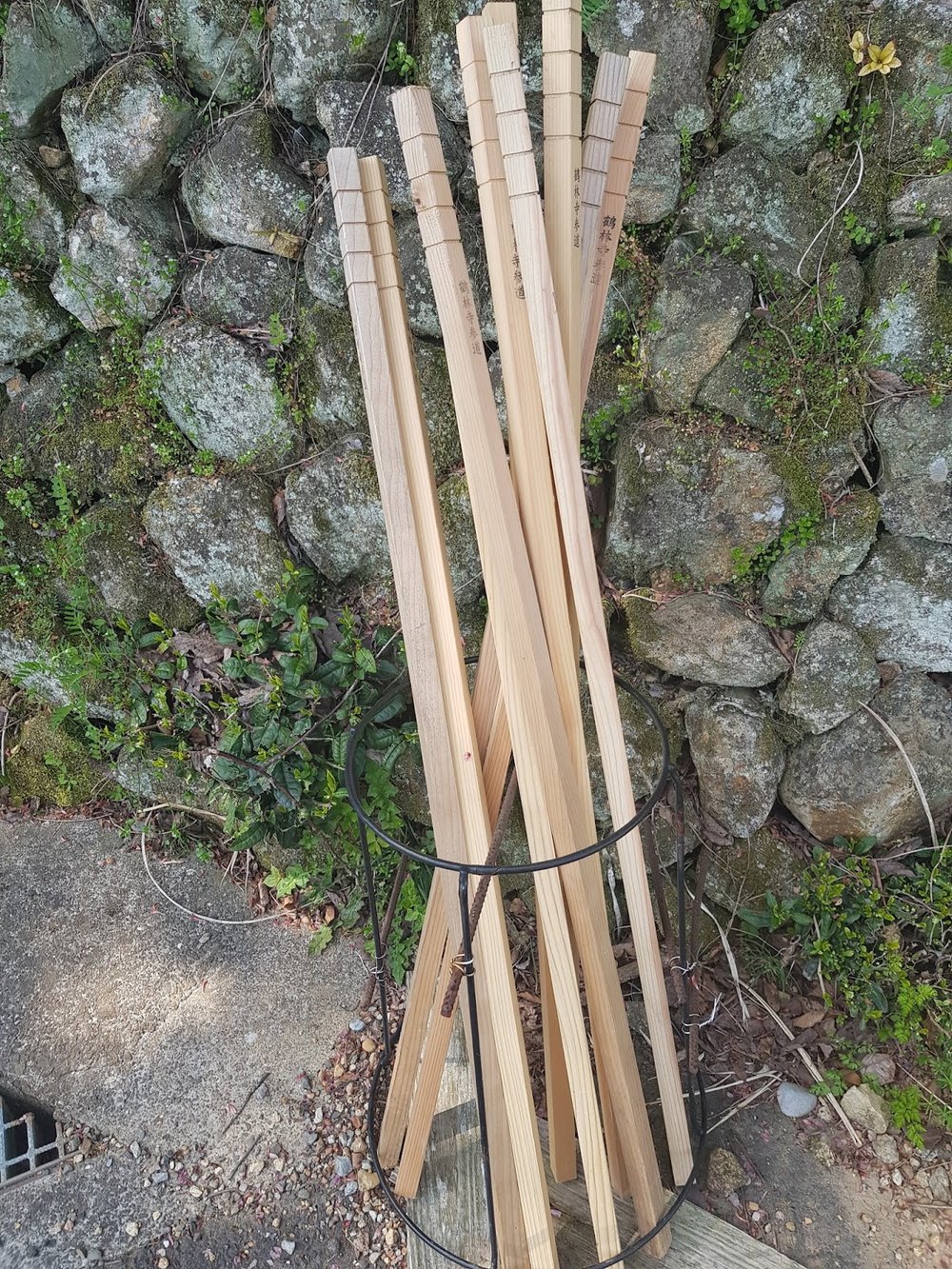
I didn't get a stick (personally I don't really like walking with a stick, even a spiritually significant one). But I might get one next time, or just a bell, to scare off wild animals.
People seem to pick and choose from the pilgrimage clothes available. I saw many tour groups wearing full and matching outfits. They looked good, but the set-up costs are expensive.
The white jacket and hat are definitely a really good conversation starter though.

Related posts:
Walking the Shikoku 88 Pilgrimage (Part 1) - Plan, plan, plan!
Walking the Shikoku 88 Pilgrimage (Part 2) - The Best First Day in Japan

Walking the Shikoku 88 Pilgrimage (Part 1) - Plan, plan, plan!
Are you a planner? Or a no-planner?
Some people like to "wing it" when they travel. They book a ticket and turn up, deciding what to do once they arrive.
Me, I like to have things planned out. Especially when the trip involves a week of solo walking in Japan!
I've always wanted to do a long-distance walk in Japan. And the Shikoku 88 pilgrimage is Japan's most famous pilgrimage trail.
This page contains affiliate links, which means I may earn a small commission, at no extra cost to you, when you click through and buy the book. Thanks for your support!
Are you a planner? Or a no-planner?
Some people like to "wing it" when they travel. They book a ticket and turn up, deciding what to do once they arrive.
Me, I like to have things planned out. Especially when the trip involves a week of solo walking in Japan!
I've always wanted to do a long-distance walk in Japan. And the Shikoku 88 pilgrimage is Japan's most famous pilgrimage trail.
My original plan was to walk the trail when I lived in Japan. I hoped to squeeze it in before returning to the UK in 2014, but that never quite happened. I figured maybe I'd go back and do it someday though.
The Shikoku 88 pilgrimage (known in Japanese as 四国八十八ヶ所巡り Shikoku hachijuu hakkasho meguri) is a 1200km (750 mile) walking route around the southern island of Shikoku. It's an ancient Buddhist pilgrimage trail, taking in 88 temples.
Shikoku ↓

(Image: Wikipedia)
Many of the temples are connected to Kōbō Daishi, 8th-century Buddhist monk and the founder of Shingon Buddhism.
It's said that Kōbō Daishi spent time on Shikoku in training, and that those who walk the pilgrimage are therefore walking in his footsteps.
↓ Kōbō Daishi, also known as Kūkai

Image: Wikipedia
I'd never been to Shikoku before. But late last year I decided 2018 would be the year that I start the Shikoku pilgrimage.
Spring seemed like the perfect time - we have two weeks off from class at Easter. I decided to spend one week walking, with a few days on either side catching up with old friends.
One week doesn't get you very far into a 750-mile pilgrimage, but I calculated I could at least walk the first 21 temples (even at a fairly leisurely pace).
My planned route from temples 1 to 21 ↓

Original image: Nippon.com
There's a lot of information about the pilgrimage online, but I wasn't sure I'd have internet access while I was actually in Japan, so the first thing I did was buy a guidebook.
Well actually, I bought three.
First, this マップル (mappuru) travel magazine. This was fun to read, picture-heavy, and got me excited about the trip. But it wasn't specific enough to help me work out how long I could walk for or where to stay.

Next, and determined to use a Japanese-language guidebook, I ordered this route guide. This had great maps, and details about the temples, but not much else.

What I was hoping for was maps and travel information. And eventually I found it, Goldilocks-style, in the third place I looked.
The Shikoku 88 Route Guide* is a pocket-sized guidebook with detailed maps, information about each temple, and lots of useful before-you-go tips. Perfect!

It even contains this guide to temple etiquette, and a romaji version of the hannya shingyou (Heart Sutra):

↓ Detailed bilingual maps and temple info

Unfortunately for me (I really wanted to use a Japanese guidebook!), it's in English. But if you don't read Japanese, obviously that's really useful.
Armed with information, I set about making a plan. As I would be going by myself, I wanted to book all my accommodation in advance.
I planned to walk between 10 and 15 miles a day. (Compared to most pilgrims, that's pretty easy going). Using the guidebook, a lot of google, and a bit of guessing, I worked out where I wanted to stay.
I booked some of my accommodation online, but some places didn't have websites, so I called them. With the time difference, this meant making phone calls at 6am UK time.
(Talking on the phone in Japanese at 6am is not my favourite activity, but it needed to be done.)
To my surprise, some accommodation was already booked up four months in advance! That made me a bit nervous. Conversely, other places said they didn't take bookings in advance, and asked me to call back closer to the time.
Soon, I had a long and extremely detailed word document full of crossed out and rewritten accommodation names, distances between temples, and even possible places to get lunch.
I had a plan.

Coming up in part 2: A Perfect Day in Japan!
Click here to read Hiking the Shikoku 88 Pilgrimage Trail in 2018 - A Round-Up.
Links with an asterisk* are affiliate links, which means I may earn a small commission, at no extra cost to you, when you click through and buy the book. Thanks for your support!
First published 25th May 2018; updated 10th November 2021

















Like many people in the UK, I studied French in school. I liked French. I thought it was really fun to speak another language, to talk with people, and to try and listen to what was going on in a new country. (Still do!)
When I was 14 we went on a school exchange to the city of Reims, in northeastern France. I was paired with a boy, which I’m sure some 14-year-olds would find very exciting but which I found unbearably awkward. He was very sweet and we completely ignored each other.
That was nearly 20 years ago, and I didn’t learn or use any more French until, at some point in lockdown, I decided on a whim to take some one-to-one lessons with online teachers. Here are some things I learned about French, about language learning, and about myself.