Hi! This blog is no longer updated, but on this page you can find an archive of my blog posts, 2016-2022. Click here to view the blog index (a list of all posts).
For the latest news about Step Up Japanese, sign up to my newsletter.
Search this blog:
What's it like to be a Step Up Japanese student? Student Interview - Sara
Sara has recently completed the STEP 1 course. We caught up with her about her experience as a Step Up Japanese student, and how she has gained confidence in spoken Japanese.
And she tells us her favourite question for starting conversations in Japanese!
Watch the video, or scroll down to read a transcript:
Sara has recently completed the STEP 1 course. We caught up with her about her experience as a Step Up Japanese student, and how she has gained confidence in spoken Japanese.
And she tells us her favourite question for starting conversations in Japanese!
Watch the video, or scroll down to read a transcript:
Why did you start learning Japanese?
[I’m a] long time anime fan, basically I started watching it as a teenager, and always found little bits online – back when downloading PDFs was a thing I got a hiragana and katakana chart for a dollar online, and printed them out, and I was quite excited about it, and kind of [did] all bits and pieces but never actually was able to keep on it, and that’s when I chose to come to classes.
I really wanted the speaking practice, which is what I was very much missing.
And as I found out when I went on holiday there [to Japan], I knew the question, but as soon as I would go to say it to someone, my brain went blank. So I was like: “I need to practise!”
I’m getting more confident in my speaking, and I’m learning more words.
What are the classes like?
It’s informal chat at first, and then you give us a good idea of what we’re going to do that day, and how long it’s going to be, so we’re mentally prepared for what we’re doing.
It’s a lot of talking which is quite nice, it’s not you standing [at the whiteboard] and going “and this means this, and this means this”. It’s actually putting it into practise, and having things to talk about with people.
I do like the ‘Free Talk’ section, as well – we’re getting there. It’s hard. I’ve learned a question, and I always open with that question:
週末は何をしますか。(Shuumatsu wa nani wo shimasu ka? What will you do at the weekend?)
[Then your partner has] a few extra questions, and they kind of push you to go a bit further.
And then you think “I’ve just spoken in Japanese for ten minutes!”
How do you practise Japanese outside of class?
Out of class it’s mostly writing, so I tend to use the apps, like duolingo and memrise, and then I’ve just got folders where I try and write things down to cement them into my head. And then hopefully I’m going to start practising kanji as well.
So [outside of class] it’s more reading and writing, and then class is more, chatting and learning vocab, and taking that home with me.
Will you be using your Japanese in Japan on your upcoming trip? How will that be?
A bit easier now. I think I’ll feel more confident going into a shop and asking for things we’re looking for. When you go in and everything’s labelled up with kanji, you feel a bit…
But it will help me more, when I go to Tower Records and I’m looking for things via alphabetical order. I know hiragana now, so I can look for the ones I want.
How does it feel when you use Japanese to communicate with someone?
It’s rewarding, actually.
It’s one of those things where, it’s quite hard at first and then you push yourself.
That’s one of the things I like about the classes, it’s not like school, where everyone’s like: “don’t make a mistake, don’t say anything if you don’t know exactly 100% what [it] means, or what it is. Whereas we’re just, nope, we’ll just say it. If it’s wrong it’s wrong. I think we’re right most of the time.
How was today’s class?
Very good vocab practice. I did something that, I’m not entirely sure why I made Jaye [Sara’s classmate!] laugh so much, but he found it very entertaining whatever it was I said.
I quite like that game. It was funny.
And I still remember the new word from last week which was shippo (尻尾, tail).
Ok, let’s talk in Japanese!
日本に行ったことがありますか。
(Have you ever been to Japan?)
東京行きました。 *
(I went to Tokyo.)
たくさん歩き[ました]。
(I walked a lot.)
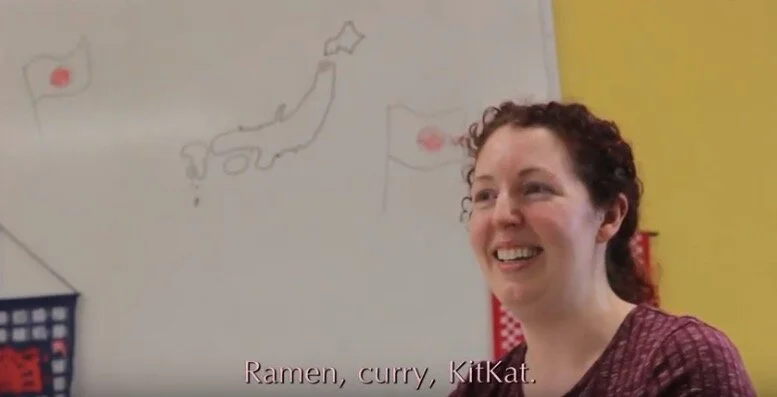
何を食べましたか。
(What did you eat?)
ラーメン、カレー、キットカット。
(Ramen…curry…kit-kats.)
どうしてステップアップジャパニーズで日本語を勉強しようと思ったんですたか。
(Why did you decide to study Japanese at Step Up Japanese?)
話す練習をします。
(To get speaking practice.)
日本語のレッスンはどんな感じですか。(What are the lessons like?)
皆さん楽しい[です]。
(Everybody is fun.)
Would you recommend Step Up Japanese?
I think Step Up Japanese is a really good way to go, it’s really good practice, it’s a really relaxed atmosphere, and Fran’s such a good teacher.
I have fun, and then I go home and think: “right I’m gonna do this!” I feel motivated to keep going at the weekends.
* I edited the Japanese slightly in the transcription of some of these answers for clarity.
Thanks very much to Step Up Japanese student Daniel Sheen for making this video!
This is the English version of an article I wrote last year which is now published in a Japanese book! 日本語多読 上 ~広がり深化する多読 (Nihongo Tadoku Jou: Hirogaru Shinka Suru Tadoku) is an introduction to Japanese extensive reading that incorporates new practices, research, and knowledge.
How I discovered Tadoku
Ever since a short trip to Japan when I was 19, I’ve been obsessed with the Japanese language. After university I moved to Japan, where I worked in Nagoya city for four years. On returning to the UK in 2014, I started teaching Japanese in Brighton at my school, Step Up Japanese…
A special guest post from Step Up Japanese student Phil Kinchington!
Anki is a flashcard app that uses a Spaced Repetition System (SRS) to help you learn and memorise information by creating strong, long-lasting memories. It does this by aiming to present you with a flashcard exactly at the point you were about to forget it.
You should be able to recall the information, but at a slight stretch. If you remember the card correctly, it will increase the length of time before it shows it to you again. If you can’t remember (or remember incorrectly) it will show it to you again sooner. It was originally developed for language learning (being named after the Japanese word for ‘memorisation’) but has since been applied to many subjects, including medical studies…
Elly is the Edinburgh-based Japanese teacher behind Ippo Ippo Japanese. Did you know, Ippo Ippo means “step by step” in Japanese? I think that’s a great approach to learning Japanese - one step at a time.
In this mini interview I asked Elly some questions about the Japanese language, and we talked about tips for learners who are just getting started.
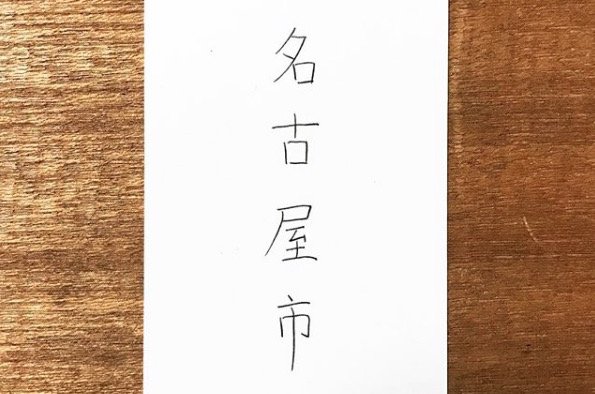
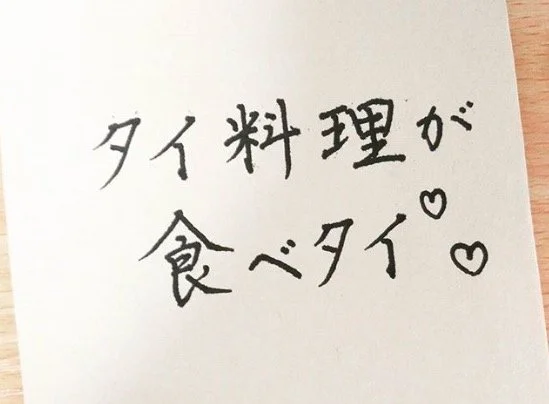
Uchiyama is a designer from Yokohama, Japan.
He posts clean, minimalist Japanese handwriting on a separate handwriting Instagram account.
I'm not even sure if you can call it calligraphy, it's so gloriously simple. But he's got nice handwriting, and I love having it in my feed.
Hello and welcome to the third instalment of "Amazing Japanese Calligraphers on Instagram", where I introduce amazing artists making Japanese calligraphy - and sharing it online.
Isawo Murayama is a busy mum-of-four who makes time to create new pieces daily.
Her work feels a bit like a diary - together with her descriptive Instagram captions, her calligraphy offers up a little slice of her day-to-day life.
Traditional Japanese calligraphy uses a brush which is dipped into ink, but Murayama uses a 筆ペン (fude-pen) or "brush pen".
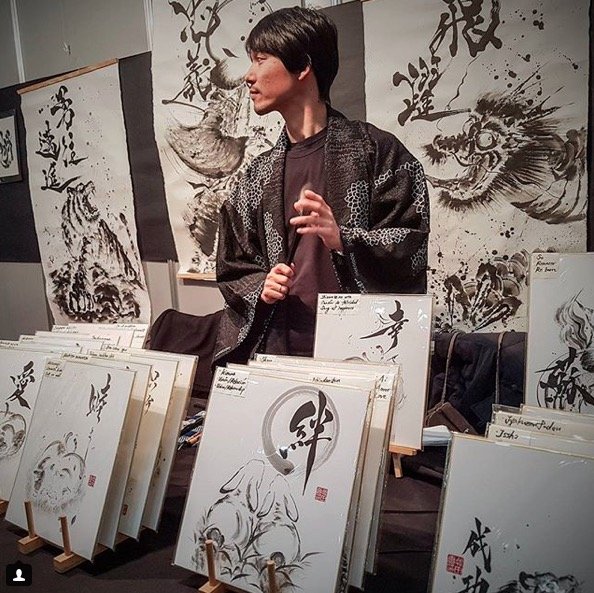
Mitsuru Nagata was born in Kyoto, and works extensively in Spain. His work combines elements of calligraphy with sumi-e (Japanese ink painting) techniques.
He performs at "live-painting" events, where he produces huge calligraphy paintings in front of a live audience.
These large-scale performances are often at festivals…
I can't believe I wrote an entire blog post about calligrapher Emi Yogai and forgot to include this amazing pun…
I absolutely love kanji - Chinese characters that are also used in Japanese writing.
But calligraphy is not my strong point. My writing is good, but not particularly beautiful.
I have, however, recently become slightly obsessed with instagrammers who post Japanese calligraphy photos.
So I thought it might be fun to share some with you!
I first discovered @yogai888emi via this adorable story about falling asleep on the train…
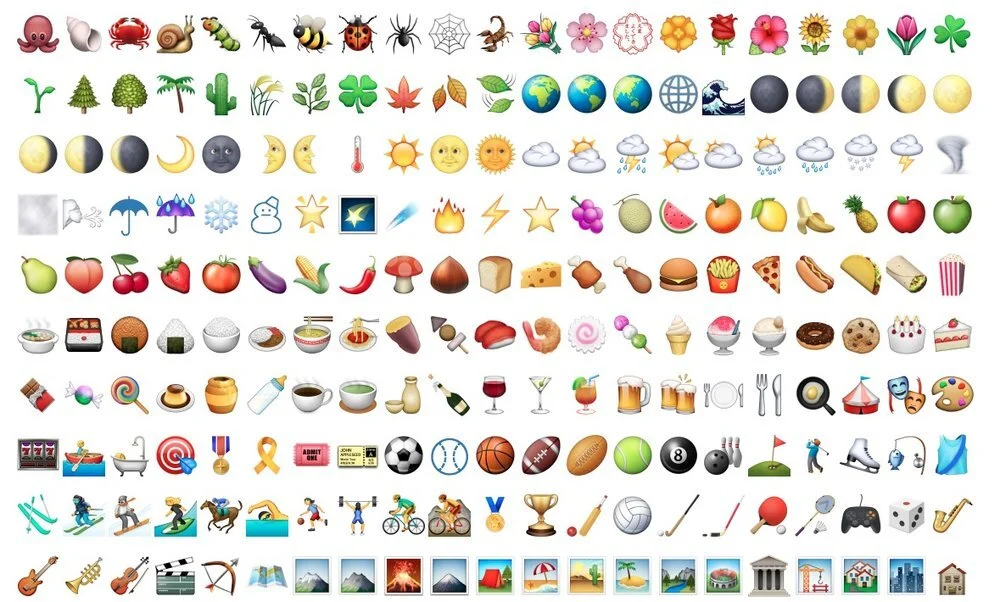
Do you remember the first time you used an emoji?
I do. It was kind of overwhelming. I scrolled and scrolled through my new Japanese phone, and wondered what all these little pictures could possibly be for.
Because emoji originated in Japan, some of them are quite specific to Japanese culture.
Some are obvious - but others might not mean what you think! Let’s take a look at some specifically Japanese emoji.
"Wait, is it douzo? In the book it says dōzo..."
It's both. And it's neither!
In beginner classes I use often rōmaji (English letters) to write Japanese in class. This is to give you a head start in learning to speak.
Some people think you shouldn't use rōmaji at all, because it will give you bad pronunciation.
That might be true if you're studying by yourself…
Thank you to everyone (including those not pictured) who came to our student picnic at the weekend!
We had fun meeting up outdoors, drinking tea, eating Japanese snacks and talking about Japan-related (and non-Japan-related) things.
It was so good to see students in person after such a long time!
My student shared the funny song "Ippon Demo Ninjin" with us recently.
It's pretty pun-tastic, and very catchy.
It's also a good way to learn and practice some more counters (little words we put on the end of numbers in Japanese, depending on what's being counted).
"Why does this homework say the Japanese word for food is ryouri? I thought you said the word for food was tabemono?"
I love it when students ask questions like this. It shows you’re really thinking about the language.
So, what’s the difference between ryouri and tabemono? Consider the following:
Potatoes are tabemono, but they're not ryouri.
So, you’ve learned different ways to say "Nice to meet you!" in Japanese. One way to say “nice to meet you” is “yoroshiku onegai shimasu”.
But yoroshiku onegai shimasu isn't just for the first time you meet someone. It has a whole host of different uses.
Let's look at the main different meanings of this magical, multipurpose Japanese word.
1. Yoroshiku means "Please!"…
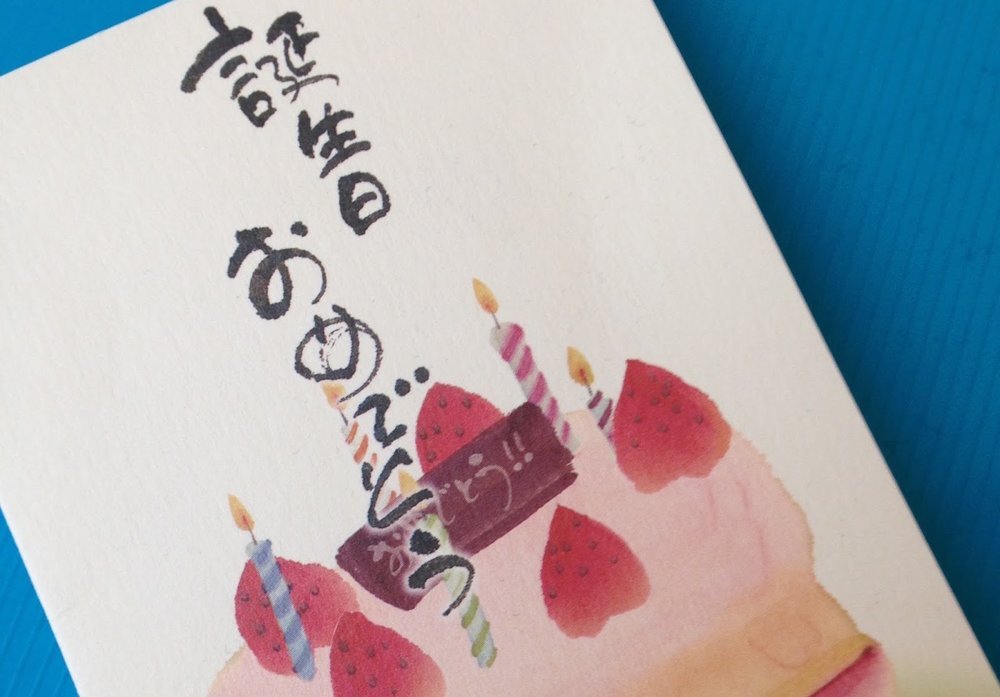
So you want to wish your Japanese-speaking friends "happy birthday" in Japanese.
Whether you're sending a birthday card, or just writing a message, here are six different ways to share the love.
First of all, let's say “Happy Birthday”:
Did you know Japan has the most umbrellas per person, of any country in the world? For every person in Japan, there are 3.3 umbrellas.
At least three of them are mine, left outside shops and restaurants…
In 2011, I had just moved to Japan and I moved into my new flat on the outskirts of Nagoya city. At the weekends I'd head to Daiso, the 100-yen shop, to buy bits and pieces for my new flat.
One day, I left my umbrella in the stand outside the 100-yen shop. It was quite a nice umbrella - a neat little folding one, and it had been a present from my brother, so I went back to the shop the next day.
My little blue umbrella wasn't in the rack, so I asked at the till.
After the excitement of our first school Summer Barbecue, I spent the day in bed watching one of my favourite films in Japanese.
It wasn’t a Japanese film though. I watched Hot Fuzz (or to give its Japanese title ホット・ファズ -俺たちスーパーポリスメン "Hot Fuzz: We Are The Super-Policemen!")
Watching British comedies dubbed into Japanese might not be the "purest" way to listen to Japanese. But if you enjoy it, it's definitely worth doing. Dubbed films are easy to watch, too, assuming you've seen the film before and know the plot already.
Anyway, there's a little scene in the Hotto Fazzu dub that's a nice example of Japanese plurals in action, so I thought I'd share it with you.
Tadoku (多読), also called Extensive Reading, is the practice of learning a foreign language by reading lots of easy books. It's a really fun way to explore the Japanese language, without feeling pressure to understand every word.
This footage is from the 2019 Tadoku Summer Course at Step Up Japanese in Brighton, UK. In summer 2020, we also held our first Online Tadoku course.
Thanks to Daniel Sheen for making this video!
Watch the video, or scroll down to read a transcript. Click "CC" to turn on the subtitles 👍
On Games in Japanese (日本語でゲーム), we practise communicating in Japanese by playing games!
This footage is from the 2019 Games in Japanese Summer Course at Step Up Japanese in Brighton, UK. In summer 2020, we also held our first Online Games in Japanese course.
Thanks to Daniel Sheen for making this video!
Watch the video, or scroll down to read a transcript.
Hurray! You've met another Japanese-speaking person. Time to introduce yourself.
But how do you say "It's really nice to meet you" in Japanese? The first phrase you'll want is:
はじめまして。Hajimemashite. "Nice to meet you"
Hajimemashite literally means "we are meeting for the first time". So you can only use it the first time you meet someone.
When I first moved back to Brighton from Japan I had a lot of time on my hands. I also didn't have a job, so I was desperate for free Japanese reading material.
So I started borrowing Japanese books from the library.
This plan was not exactly a success. It turns out reading Twilight in Japanese is only slightly more entertaining than reading it in English.
But we are really lucky to live in a world where, if you have internet access, you can read just about anything you want in Japanese online. And the news is a great place to start.
I'll let you into a secret. I used to hate katakana.
Students of Japanese tend to start with its two phonetic alphabets. We start with hiragana, the loopy, flowing letters that make up all the sounds of Japanese.
Then we move on to katakana - all the same sounds, but in angular blocky font.
Hiragana seems fairly straightforward, I think. And when you start learning Japanese everything you read is written in hiragana, so by reading you constantly reinforce and remember.
Katakana? Not so much.
How do you keep practising Japanese, even when it doesn’t seem relevant? How do you stay motivated, when your life and your motivations change?
At the beginning of 2019, I decided to set myself a series of monthly Japanese study challenges. I’d do one every other month, and blog about it.
In January, I tried to speak Japanese every day for a month. This was probably the hardest challenge, from a logistical perspective. I don’t live in Japan, and we don’t speak Japanese at home (much). At the time, I was also working another job three days a week, where I wasn’t using Japanese at all. So speaking Japanese every day was, quite literally, a challenge.
If you watch Japanese TV or anime (or are paying attention in class) you've probably come across the Japanese word mina-san (皆さん) meaning "everybody".
But what's the difference between mina and minna? What's mina-sama all about? And ... does it actually matter?
I finally got around to going through the mid-course feedback from my students and drawing up plans to incorporate some of what you asked for into the rest of the course. Several learners mentioned the importance of learning the kana early on.
Learning to read Japanese can be a daunting task. The Japanese language has three distinct "alphabets" (four if you count romaji!) and learning kanji is a task that takes years. You can learn the kana (hiragana and katakana) pretty quickly, though, if you use the most efficient way to memorise them - mnemonics.
Do you remember the first conversation you ever had in a foreign language?
The first three years I was learning Japanese I basically studied quite hard for tests and barely opened my mouth. I liked kanji, and what I saw as the oddness of the Japanese language. Three "alphabets"! A million different ways of counting things! I liked hiragana - so pretty! I studied hard and thought my university Japanese exams were easy.
Then, on holiday in China, I met a Japanese woman (at a super-interesting Sino-Japanese cultural exchange club, but that's a story for another time). I tried to speak to her in Japanese. And I couldn't say anything.
Did you know there's a dedicated Japanese vegetable farm right here in Sussex?
I spent a Saturday with the Brighton Japan Club at Namayasai, near Lewes. Namayasai a Japanese vegetable farm owned by Robin and Ikuko, from Devon and Japan respectively, and is a Natural Agriculture farm - a specific type of organic farming that uses no pesticides / herbicides / artificial fertilisers.
The worst job interview I ever had started with the interviewer asking me to tell him a joke.
I sat there flustered for a while before mumbling something about a man walking into a bar. The interviewer rolled his eyes.
I didn't get the job.
Sitting in a smokey cafe after the interview I remembered The Michael Jackson Joke which is probably the best beginner-Japanese joke of all time. I should've told him that one! Although he probably would have rolled his eyes at that too...
When I tell people I'm a Japanese teacher they quite often ask: how did you learn Japanese? And I don't find this question particularly easy to answer.
Sometimes I give a quick answer which is that I used to live there.
But you can live in Japan for years and not learn Japanese.
I've met lots of people like this (and there's nothing wrong with that, unless learning Japanese is the reason you moved to Japan).
The long and more honest answer to "how come you speak Japanese?":
Like many people in the UK, I studied French in school. I liked French. I thought it was really fun to speak another language, to talk with people, and to try and listen to what was going on in a new country. (Still do!)
When I was 14 we went on a school exchange to the city of Reims, in northeastern France. I was paired with a boy, which I’m sure some 14-year-olds would find very exciting but which I found unbearably awkward. He was very sweet and we completely ignored each other.
That was nearly 20 years ago, and I didn’t learn or use any more French until, at some point in lockdown, I decided on a whim to take some one-to-one lessons with online teachers. Here are some things I learned about French, about language learning, and about myself.