
Welcome to the Step Up Japanese blog archive!
Although I’m not currently adding new posts to the blog, you’ll find plenty of Japanese learning tips, study advice, and resources to explore here.
Browse the blog index to view a complete list of posts.
For the latest news, course updates, and Japanese learning tips from Step Up Japanese, sign up for my newsletter.
Search this blog:

2021 Student Summer Picnic!
Thank you to everyone (including those not pictured) who came to our student picnic at the weekend!
We had fun meeting up outdoors, drinking tea, eating Japanese snacks and talking about Japan-related (and non-Japan-related) things.
It was so good to see students in person after such a long time!
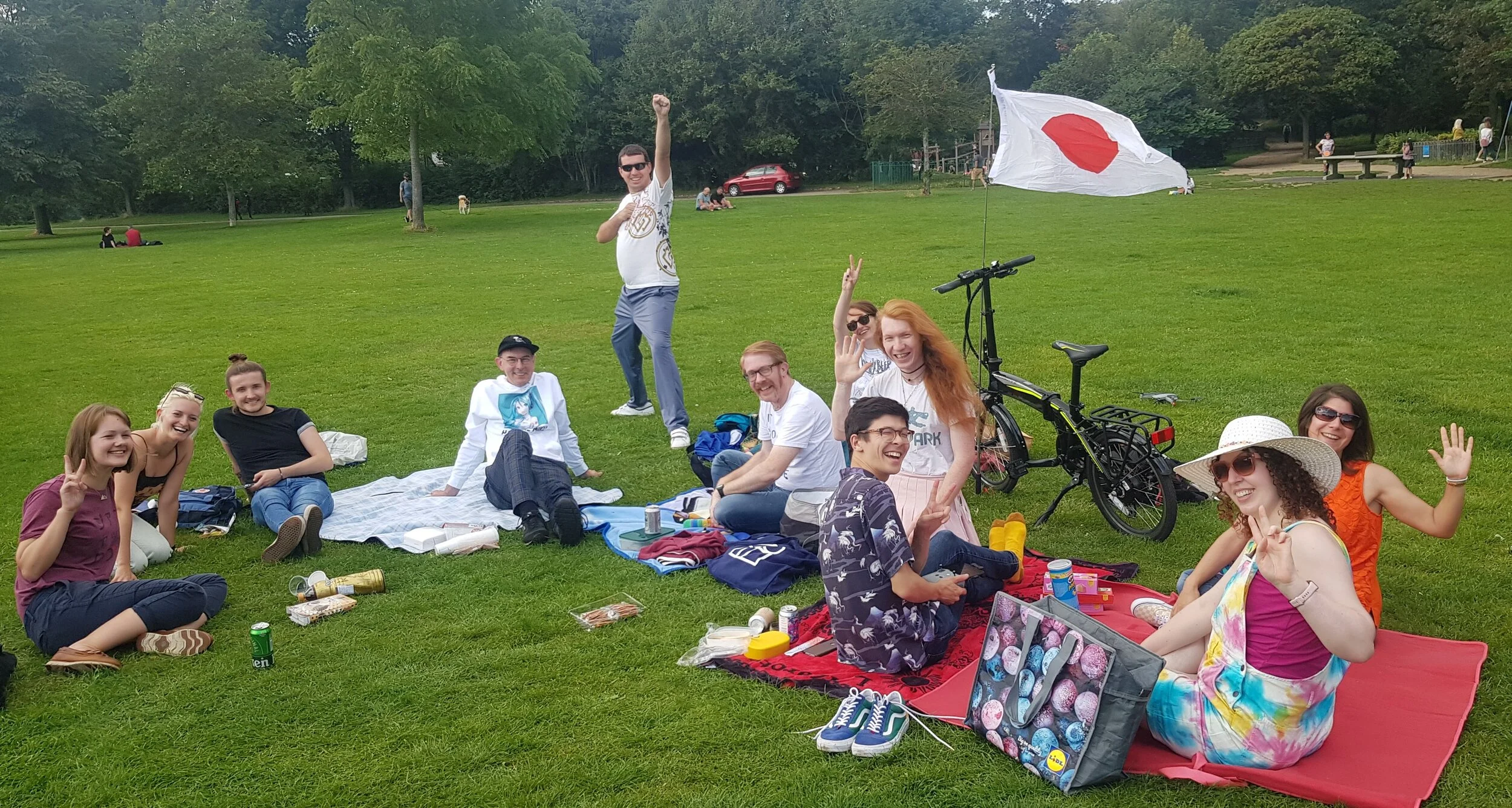
Thank you to everyone (including those not pictured) who came to our student picnic at the weekend!
We had fun meeting up outdoors, drinking tea, eating Japanese snacks and talking about Japan-related (and non-Japan-related) things.
It was so good to see students in person after such a long time!
Although all my teaching is online now, I still plan to run occasional social events in Brighton for students. I’m looking forward to seeing you all again soon.

More Ways of Counting in Japanese with "Ippon Demo Ninjin"
My student shared the funny song "Ippon Demo Ninjin" with us recently.
It's pretty pun-tastic, and very catchy.
It's also a good way to learn and practice some more counters (little words we put on the end of numbers in Japanese, depending on what's being counted).
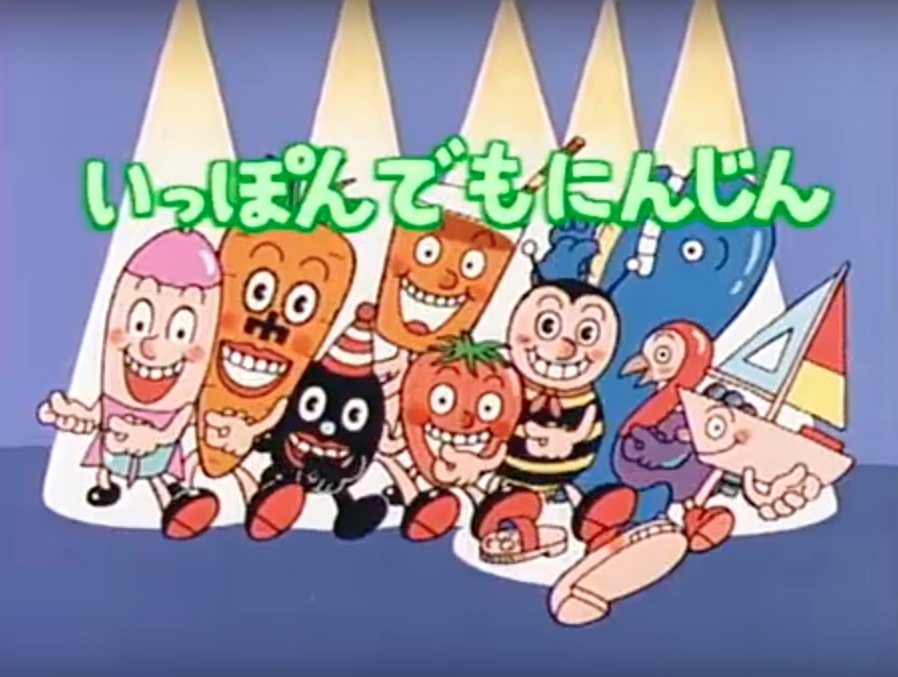
My student shared the funny song "Ippon Demo Ninjin" with us recently.
It's pretty pun-tastic, and very catchy.
It's also a good way to learn and practice some more counters (little words we put on the end of numbers in Japanese, depending on what's being counted).
(Part 1)
1! いっぽん でも にんじん Ichi! Ippon demo ninjin
2! にそく でも サンダル Ni! Nisoku demo sandaru
3! さんそう でも ヨット San! Sansou demo yotto
4! よつぶ でも ごましお Yon! Yotsubu demo gomashio
5! ごだい でも ロケット Go! Godai demo roketto
6! ろくわ でも しちめんちょう Roku! Rokuwa demo shichimencho
7! しちひき でも はち Shichi! Shichihiki demo hachi
8! はっとう でも くじら Hachi! Hattou demo kujira
9! きゅうはい でも ジュース Kyuu! Kyuuhai demo juusu
10! じゅっこ でも いちご Juu! Jukko demo ichigo
いちご、 にんじん、 サンダル、 ヨット、 ごましお、 ロケット、しちめんちょう 、はち、くじら、ジュース
Ichigo, ninjin, sandaru, yotto, gomashio, roketto, shichimencho, hachi, kujira, juusu
Strawberry, carrot, sandal, yacht, sesame and salt, rocket, turkey, bee, whale, juice
(Dance break)
(Repeat Part 1)
いっぽん、 にそく、 さんそう、 よつぶ、 ごだい、ろくわ、しちひき、はっとう、きゅうはい、 じゅっこ!
Ippon, nisoku, sansou, yotsubu, godai, rokuwa, shikihiki, hattou, kyuuhai, jukko!
One long thin thing, two shoes, three boats, four small round things, five vehicles, six birds, seven small animals, eight large animals, nine cups, ten small things!

The beginning of ninjin (carrot) sounds like "ni" (two) but there's only one carrot.
And the beginning of sandaru (sandles) sounds like "san" (three) but...there are only two sandals!
We could translate いっぽん でも にんじん Ippon demo ninjin, therefore, as:
"It's only one, but it's a carrot."
or
"Even if there's only one, a carrot is ninjin."
(Trust me, it sounds better in Japanese.)
Anyway, listen again and try and sing along.
I haven't translated the whole thing for you, just bits. See if you can work the rest of it out!
First published Nov 2017. Updated August 2021.

Tadoku - Let's Read! Course Introduction Video (and transcript)
Tadoku (多読), also called Extensive Reading, is the practice of learning a foreign language by reading lots of easy books. It's a really fun way to explore the Japanese language, without feeling pressure to understand every word.
This footage is from the 2019 Tadoku Summer Course at Step Up Japanese in Brighton, UK. In summer 2020, we also held our first Online Tadoku course.
Thanks to Daniel Sheen for making this video!
Watch the video, or scroll down to read a transcript. Click "CC" to turn on the subtitles 👍
Tadoku (多読), also called Extensive Reading, is the practice of learning a foreign language by reading lots of easy books. It's a really fun way to explore the Japanese language, without feeling pressure to understand every word.
This footage is from the 2019 Tadoku Summer Course at Step Up Japanese in Brighton, UK. In summer 2020, we also held our first Online Tadoku course.
Thanks to Daniel Sheen for making this video!
Watch the video, or scroll down to read a transcript. Click "CC" to turn on the subtitles 👍
What is Tadoku?
David: Tadoku is the practice of reading lots and lots of books, with the focus being on skipping things you don’t understand.
Fran: I think that lack of pressure’s really important, isn’t it? Skipping things, and… it doesn’t matter if you don’t understand everything.
Let’s take a look inside a Tadoku class at Step Up Japanese (filmed in 2019):
Fran: What did you read today? How was it? What was your favourite part? What was your least favourite part?
Snippets from students’ conversations about books:
A: I work in a publishing company – we make books – and this is from my publishing company.
B: Oh really?
A: And that one, yeah.
C: She’s actually a ghost! Oh no! And he’s really scared.
What do you like about Tadoku?
Sara: It’s quite nice just to kind of come back from work and just sit and you’re getting your practice in but it doesn't feel quite so much like practice, because you are focusing on the story, and I quite like the whole rules of the whole thing, which is like, you know, don’t sit there looking words up, just try and work it out from the context of it all, but yeah, I do actually sit and enjoy little stories more, that way.
David: I enjoy Tadoku, as it gives me the opportunity to read Japanese, without the pressure of understanding every single word.
Fran: I really like that experience as well, like you’re reading a book and then like a couple pages on you’re like “Oh, that’s what that word means!” – you didn’t need to look it up.
Sara: It’s like a little gold star for yourself as well, like: “Oh, I did know that!”
Would you recommend Step Up Japanese?
David: I would recommend Step Up Japanese to friends and family, and have. I really enjoy classes, I really enjoy the teacher, I really enjoy all of the students as well, it’s just like a really friendly bunch, and I’d like for more people to be part of the Step Up Japanese family.

Games in Japanese - Course Introduction Video (and transcript)
On Games in Japanese (日本語でゲーム), we practise communicating in Japanese by playing games!
This footage is from the 2019 Games in Japanese Summer Course at Step Up Japanese in Brighton, UK. In summer 2020, we also held our first Online Games in Japanese course.
Thanks to Daniel Sheen for making this video!
Watch the video, or scroll down to read a transcript.
On Games in Japanese (日本語でゲーム), we practise communicating in Japanese by playing games!
This footage is from the 2019 Games in Japanese Summer Course at Step Up Japanese in Brighton, UK. In summer 2020, we also held our first Online Games in Japanese course.
Thanks to Daniel Sheen for making this video!
Watch the video, or scroll down to read a transcript. Click "CC" to turn on the subtitles 👍
What is Games in Japanese?
David: In 日本語でゲーム (Games in Japanese), we play a variety of games, only ever using the Japanese language.
Showing students how to play:
Fran: どれですか。(Which one is it?)
Fran: そうですね。木が同じです。(That’s right! KI [tree] is the same)
Fran: 3,2,1、はい。(3, 2, 1, go!)
Fran: あ!あ!ハサミ!(Ah! “Scissors!”)
Fran: 私は取ります。(So, I take the card)
Sara: You’ve got all the numbers, the names out on the floor, and it’s the reading and trying to get to it before everyone else, which is quite funny.
N: クエスチョン、はてなマーク (“question mark”)
What do you like about “Games in Japanese”?
David: I find it difficult to play games in only Japanese, but I really relish the challenge to speak only Japanese. It really makes me have to think in a way that maybe I wouldn't have the opportunity to do if I wasn't taking the course.
David: サングラス (“sunglasses”) (Laughter)
Sara: It’s very good vocab practice. I think it’s more, the games we have, it’s a lot more sort of random words so I feel like you’re a lot faster with it, so you tend to do a bit less thinking about the words that you want, you just kind of go like “that word, quick!”
Fran: はい (OK, let’s go)
A:ピエロ (“clown”)
Sara: So you’re trying to beat everyone else to it, so it's a bit more, a bit more silly.
Fran: 音楽 (“music”)…音楽 (“music”) (Laughter)
A: クモ (“spider”)
Sara: ドラゴン (“dragon”)
B: 花 (“flower”)
Sara: I quite like that game, it was funny.
Would you recommend Step Up Japanese?
Sara: I think Step Up Japanese is really good way to go, it’s really good practice, it’s a really relaxed atmosphere, and Fran’s such a good teacher. I’ll go home and I’m like, right, “I’m gonna do this”, I feel motivated to keep going at the weekends.

Your First Ever Beginner Japanese Class
You've signed up, bought the textbook and are on your way to class. The day is here! It's your first ever Japanese lesson!
So, what are we going to do? What are you going to learn?
Your first class can be exciting, but also a bit daunting. I've taught lots of first-ever Japanese classes to beginners over the years. Here's what to expect from your first lesson at Step Up Japanese.

You've signed up, bought the textbook and are on your way to class. The day is here! It's your first ever Japanese lesson!
So, what are we going to do? What are you going to learn?
Your first class can be exciting, but also a bit daunting. I've taught lots of first-ever Japanese classes to beginners over the years. Here's what to expect from your first lesson at Step Up Japanese.
A brief introduction to the Japanese writing system
Lots of people are really interested in the Japanese writing system, and it's a bit complex. So I usually start with a quick rundown of the three "alphabets" used in Japanese.
The main reason I start with this is that it helps you with pronunciation.
Pronouncing words in a new language can be difficult. Especially when those words are as long as:
Hajimemashite. Yoroshiku onegaishimasu.
"Nice to meet you."
Understanding the sounds of Japanese from the start will help you pronounce words correctly.
Introduce yourself!
Next, we learn to introduce ourselves in Japanese:
"Nice to meet you!"
"My name is..."
"I'm from..."
"I'm a teacher / engineer / lawyer, etc."
You'll learn to say your job, of course - not just the generic ones in the textbook. This is important.
By this point, you've learned to introduce yourself politely. And to tell a Japanese-speaking person something about yourself. Awesome.
Time for a break, and a cup of ホットコーヒー (hot coffee) from the reception cafe.
Question time!
Next up, we learn some questions:
"What's your name?"
"Where are you from?"
"What's your job?"
We'll practice them over and over, until they're glued into your brain.
Depending on how much time we have, we might practice introducing each other:
"This is Agnes. She's from Poland. She's a structural engineer."
With lots and lots of practice, that's probably all we have time for. But look what you'll have learned in one lesson!
Hopefully, you'll go home with your head full of new phrases, ready to test out on the dog.

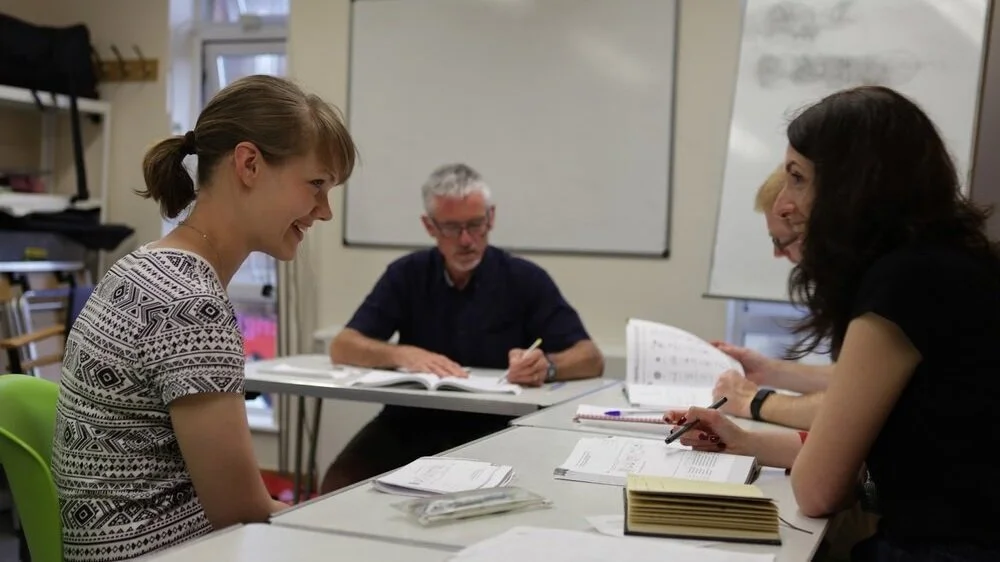
(Pictured: graduating Beginner class students, 2016-17)
How Do I Know if a Group Language Class is For Me?
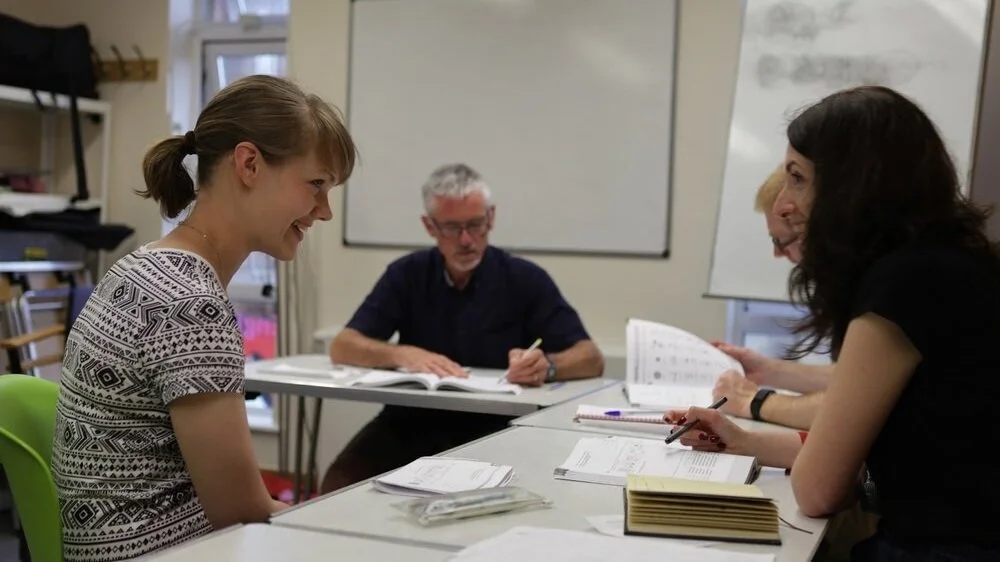
If you’re thinking about taking Japanese lessons, one of the first things you’ll have to decide is whether you want to join a group class, or take one-to-one lessons.
There are pros and cons to all methods of learning a language. Here, I’ll look at some of the key advantages of joining a group.
If you’re thinking about taking Japanese lessons, one of the first things you’ll have to decide is whether you want to join a group class, or take one-to-one lessons.
There are pros and cons to all methods of learning a language. Here, I’ll look at some of the key advantages of joining a group.
1) Meet other language learners
Classes give you access to a teacher, but a group class also provide you with an instant group of other people with the same interest as you.
You can speak in your target language together, go out for dinner and order in Japanese, and message each other asking "what was last week's homework again?"
(Just kidding - thanks to the course outline I'll provide you with, you'll always know what this week's homework is.)
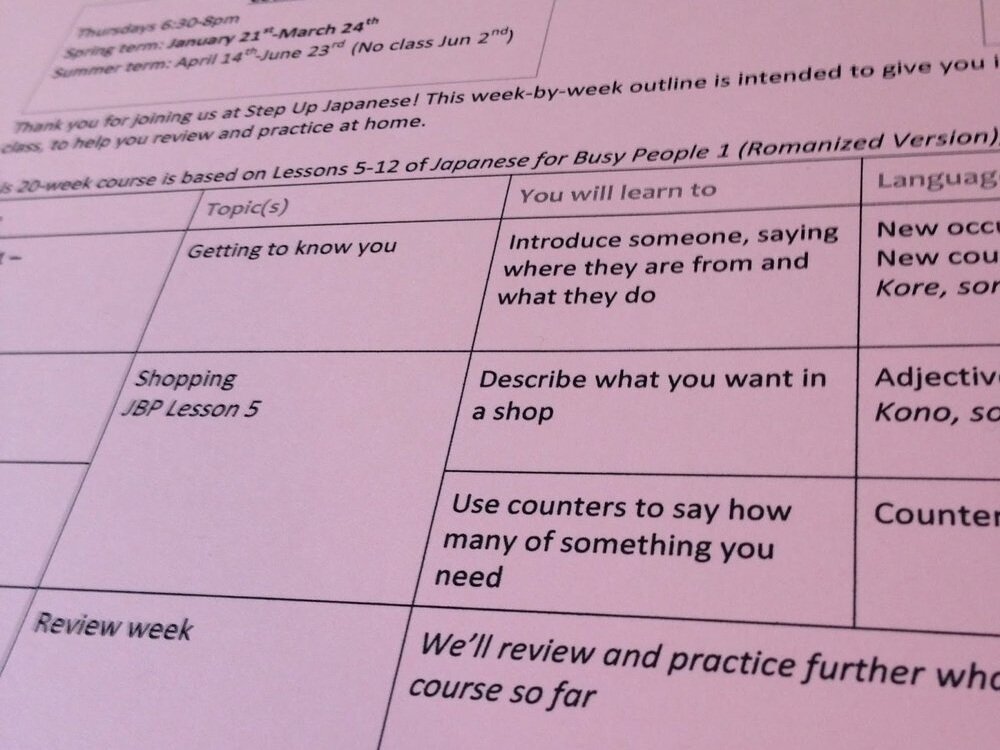
In a group class, students can support and help each other. It's obvious to me that my lovely students gain a lot from each others' support!
2) Keep a regular schedule
To gain any skill, you need to practice regularly. The great thing about having class on a regular day is it forces you to practice. Unlike exclusive self-study where you'll always have an excuse to procrastinate, weekly classes require you to be prepared for every class so you can get the most out of it.
Practice makes perfect, after all.
3) It's your class
You might feel like the only way to get a class tailored to your needs is to take one-to-one lessons. But a good group class - especially one for a small group of students - should be tailored to the students in it as much as a private lesson would be.
That's why I ask my students to give me regular feedback (informally, and through anonymous questionnaires) about how class is going and where you want it to go next.
It's your class, not mine, and we can focus on what you want to focus on.
That doesn't mean I'm going to do the hard work for you. If you want to get good at Japanese, you'll need to find ways of practicing and exposing yourself to the language as much as possible outside of class too.
But a group class can provide the basis of your knowledge, a structure to work with, and a group of friendly faces to answer your questions.
It also gives you a great excuse to go to that great Japanese restaurant again with your classmates.


First published June 2016; updated 9th January 2020.

2019 忘年会 (bo-nen-kai) End-of-Year Party!
December in Japan is bounenkai season, when workplaces and social groups gather for end-of-year parties.
忘年会 (bounenkai, end-of-year party) is one of my favourite Japanese words.
忘 means “forget”, 年 means “year”, and 会 in this context means “party”, so a bounenkai is a “forget-the-year party”. Isn’t that great?
We have a bounenkai at Step Up Japanese too! About half the time I forget it’s a bounenkai and call it a “Christmas Party”, but I think that’s ok.
December in Japan is bounenkai season, when workplaces and social groups gather for end-of-year parties.
忘年会 (bounenkai, end-of-year party) is one of my favourite Japanese words.
忘 means “forget”, 年 means “year”, and 会 in this context means “party”, so a bounenkai is a “forget-the-year party”. Isn’t that great?
We have a bounenkai at Step Up Japanese too! About half the time I forget it’s a bounenkai and call it a “Christmas Party”, but I think that’s ok.

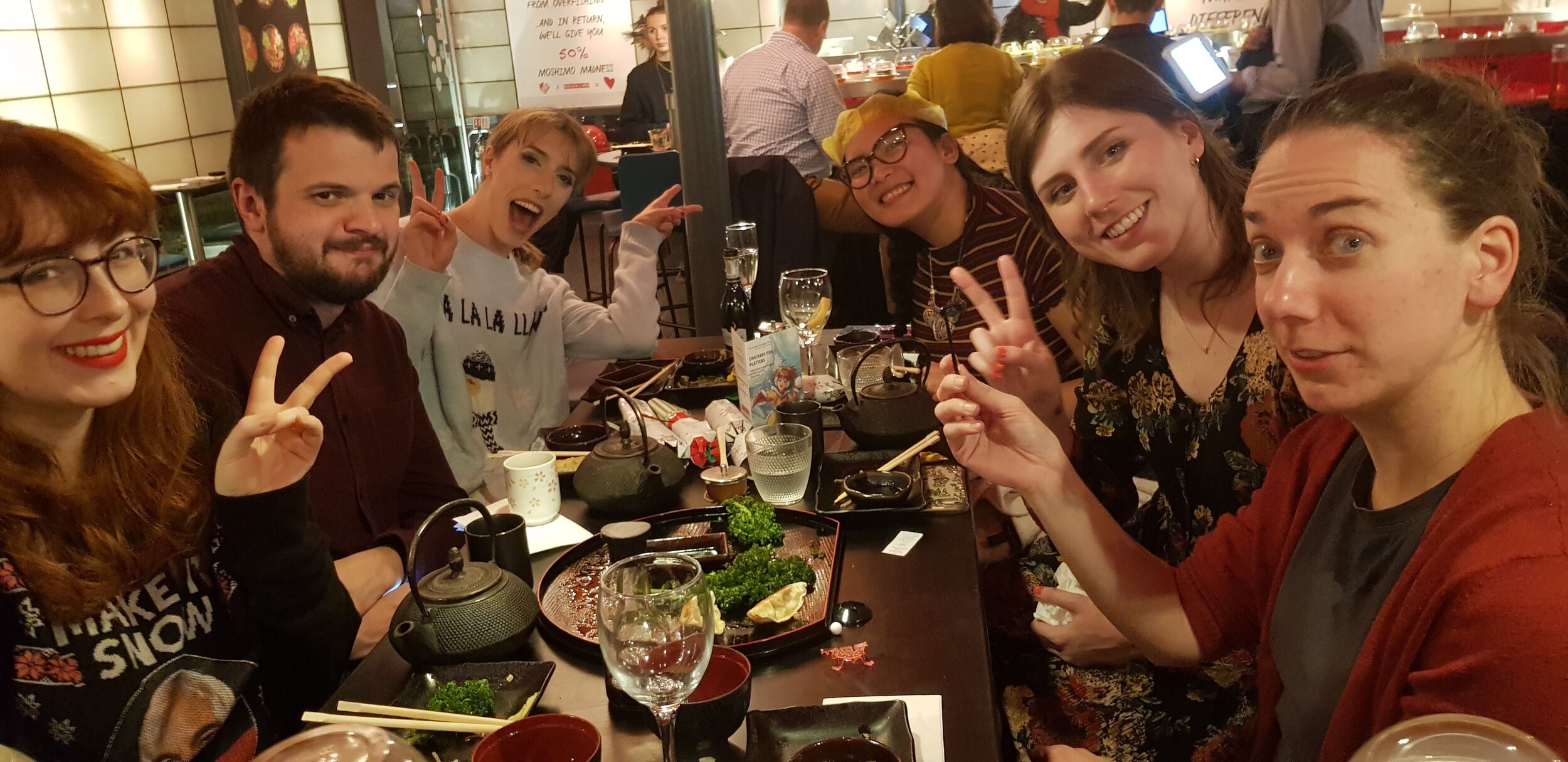









I hope 2019 brought you some things to remember, not just things to forget!











Want to buy Japanese lessons for a friend or relative? Send a gift card