
Welcome to the Step Up Japanese blog archive!
Although I’m not currently adding new posts to the blog, you’ll find plenty of Japanese learning tips, study advice, and resources to explore here.
Browse the blog index to view a complete list of posts.
For the latest news, course updates, and Japanese learning tips from Step Up Japanese, sign up for my newsletter.
Search this blog:

The Magic of Tadoku: “Extensive reading” in Japanese
This is the English version of an article I wrote last year which is now published in a Japanese book! 日本語多読 上 ~広がり深化する多読 (Nihongo Tadoku Jou: Hirogaru Shinka Suru Tadoku) is an introduction to Japanese extensive reading that incorporates new practices, research, and knowledge.
How I discovered Tadoku
Ever since a short trip to Japan when I was 19, I’ve been obsessed with the Japanese language. After university I moved to Japan, where I worked in Nagoya city for four years. On returning to the UK in 2014, I started teaching Japanese in Brighton at my school, Step Up Japanese…
This is the English version of an article I wrote last year which is now published in a Japanese book! 日本語多読 上 ~広がり深化する多読 (Nihongo Tadoku Jou: Hirogari Shinka Suru Tadoku) is an introduction to Japanese extensive reading that incorporates new practices, research, and knowledge.
How I discovered Tadoku
Ever since a short trip to Japan when I was 19, I’ve been obsessed with the Japanese language. After university I moved to Japan, where I worked in Nagoya city for four years. On returning to the UK in 2014, I started teaching Japanese in Brighton at my school, Step Up Japanese.
At Step Up Japanese, I teach group classes from beginner to intermediate level. Sometimes I have Japanese volunteers who come and help me out, but usually I teach all the classes myself.
My students are all adults, who typically come once a week for a 90-minute class. They’re often learning Japanese in order to travel to Japan, or as a hobby. Most students have English as their first language, and for many of them, studying Japanese is the first time they will have encountered a language that uses a different writing system to the Latin alphabet.
Learning to read and write Japanese is not easy. And since my students only have one class a week, some find it difficult to memorise hiragana and katakana (the two basic “alphabets” of the Japanese writing system). At the intermediate stage, too, I knew that my students wanted to read books and manga in Japanese, but I noticed that they often struggled to find level-appropriate reading material.
I could see that students at all levels would benefit from more reading practice, so in 2018 I decided to start a new course devoted to reading.
Up until that point, I’d mostly assigned reading practice as homework – conventional “reading comprehension” tasks. My students would often say that this kind of homework was difficult. I was using materials from the workbooks that accompany the textbooks used in class, but the exercises were often more challenging than the textbook material we’d studied in class. Students could only read these texts if they used a dictionary. And even where they could understand the exercises, they didn’t seem to find them particularly interesting.
In higher level classes, we’d tried other things such as reading yonkoma manga (four-panel comic strips) together, but students usually found this difficult too. Students enjoyed the yonkoma manga class, but I’d end up translating into English so they could understand.
I had started to wonder if there might be another way. There were so many interesting books and manga that my students would enjoy, yet here they were, reading uninspiring comprehension texts. I looked online, and that’s when I discovered the Tadoku study method.
Tadoku, sometimes called extensive reading, is the practice of learning a language by reading lots of books. In Tadoku, you read materials that are slightly below your current study level. You’re encouraged to skip words and phrases you don’t understand, and the focus is on reading for pleasure.
I thought this could be great to try out with my students, so I ordered some graded readers from NPO Tadoku.
I was a bit nervous about starting a Tadoku course. What would I, as the teacher, do while students were reading – just sit there? If students wanted to practise solo reading, they could just do that at home, couldn’t they? Who was going to sign up for a reading course where you read silently on your own...?
Seeking reassurance, I bought NPO Tadoku’s book, Nihongo kyoushi no tame no tadoku jugyou nyuumon (“An Introduction to Tadoku for Teachers of Japanese”), which had lots of useful case studies and practical advice. I was particularly encouraged to read that all you need to start a Tadoku group is a few basic components: level-appropriate books, a place to read, and a teacher (or “supporter”).
The Tadoku books arrived from Japan, and they seemed a good level for my students. But I was still apprehensive – would my adult students really want to read ‘The Three Little Pigs’ in Japanese?
I flipped through the book, and was surprised – it was so fun! The writing flowed beautifully, and the pictures were cute too. Before I knew it, I was reading the book aloud to myself.
2018: Trying out Tadoku
My Tadoku courses are short – six sessions of 55 minutes each. In each session, the first 45 minutes is devoted to solo reading, and the final 10 minutes are for “book talk”, when students chat in small groups about what they’ve read (mostly in English, but sometimes in Japanese).
All I had prepared for that first course was the set of graded readers from NPO Tadoku, and some free Tadoku books I’d printed from online. However, in the very first session I realised I was going to need more books! I actually didn’t think my students could read so fast in Japanese. Pleasantly surprised, I ordered more graded readers from Japan.
A reading revolution...?
I started learning Japanese in 2007, but it was 2012 before I read a whole book in the language.
When I started to study Japanese, I dreamed of one day being able to read Haruki Murakami’s ‘Norwegian Wood’ in the original Japanese. I did try and read manga and novels quite early on, but they were too difficult and I’d soon give up. There were so many words I didn’t know, and I’d look each word up in the dictionary, so the process was slow and a bit painful.
(Now, I love reading Japanese novels. But it frustrates me that it took so long to get to this point, and that it wasn’t always an enjoyable process…)
That summer in 2018, halfway through the Tadoku course, I went to Lisbon on holiday. I drank beer on the beach and read ‘Convenience Store Woman’ in the original Japanese.
This time, I didn’t use a dictionary at all. I just tried to read according to Tadoku principles, skipping over unfamiliar words and phrases – and it was a lot of fun. I finished the book much more quickly than I expected, and because I wasn’t using a dictionary, I was able to truly lose myself in the story.
I’d never experienced this with a Japanese book before. I realised that my concept of what it means to “read Japanese” had changed completely.
So Tadoku has been revolutionary for my students - but it had a huge impact on me too.
If only I’d known about Tadoku in 2007 – I could have read a lot of fun books in those first five years!
2019: Adding manga and picture books to the mix
The feedback from students was great, so in 2019 I held another 6-week summer course, and about half of the students were returnees who had attended the previous year.
As well as the graded readers, I added in some more easy-ish manga as well as some picture books. Children’s picture books with simple Japanese, like Tarō Gomi’s Dareka ga imasu (“Somebody’s There”) and Katsu Kiuchi’s Yasai no onaka (“Inside Vegetables”) were popular with my students, especially the beginners.
2020: Trying online Tadoku
Due to the covid-19 pandemic, in March 2020 I moved all my teaching online, and so the 2020 Tadoku course moved online too. As before, it was six sessions, with a maximum of 12 students, and it sold out quickly.
(Also, because this course was online for the first time and all the materials we used were free online resources, I offered this course at half price.)
At the start of each Zoom session, I’d show students some new books and resources, and then I’d put them each into their own individual breakout rooms for the reading session. I’d visit each student in turn, checking they were okay, talking to them about what they were reading, and making suggestions where appropriate.
As before, the last 10 minutes was devoted to “book talk”, where students talk in pairs or threes. This year, I also suggested that students keep a reading log of what they’d read and what they thought of it.
My impression is that more students listened to the audio files that accompany the graded readers, probably because these materials were easier to access when attending an online course. I also showed them some YouTube videos of kids’ books being read aloud, which proved popular too.
Students’ responses to Tadoku
Tadoku is probably the most popular course I run at Step Up Japanese.
Sara has been a student of mine for several years. I interviewed her about Tadoku in Summer 2019, when she was at Upper Beginner level, and reading Level 0 and 1 Tadoku books. Here’s what she had to say:
“It’s just reading, really, in my case the simplest books there are, but they’re actually really cute little stories. And it’s quite nice to come back from work and just sit there, and you’re getting your practice in but it doesn't feel quite so much like practice, because you’re focusing on the story.”
We asked Sara what she’d read that day, and to tell us what happens in the story:
“The country mouse went to the town mouse’s house, and found out how scary everything was, because there’s people and cats, and all the rest of it. It took me to nearly the end of the book and suddenly I realised I did actually recognise the kanji for ‘town’, and then I figured out what the two words in front of ‘mouse’ were.”
From this comment, we can see that Sara was able to follow the story, a Japanese translation of ‘The Town Mouse and the Country Mouse’, well. She skipped over words and phrases she didn’t understand, and then afterwards, she was able to realise what the word machi ( “town”) meant.
David has attended Tadoku courses at Step Up Japanese three summers in a row, and when I interviewed him in 2019 he was reading at around Level 2:
“I enjoy Tadoku, as it gives me the opportunity to read Japanese, without the pressure of trying to understand every single word.”
Of course, not all the feedback is positive all the time! Some students feel that it’s simply impossible to read without using a dictionary, and some aren’t interested in reading children’s books.
Because we are in the UK, some students don’t come into any contact with any Japanese outside of our lessons. For some of these beginner students, who are still learning hiragana and katakana, even at Level 0 there are some Tadoku books which are too difficult. In the classroom, I’d be able to recommend kids’ picture books to those students, or suggest easier books within the Level 0 framework. Online, I guided them towards YouTube videos of kids’ books being read aloud.
After our first session of the 2020 Online Tadoku course, I got this email from another student. He’d read the book Tamago (“Eggs”) once in the Tadoku session, and then read it again after the session because he enjoyed it so much:
Translation:
“Tamago (‘Eggs’)
I first read Tamago in Tadoku class. Today I read it again. I like books about food, so Tamago was fun. I learned some new words.”
This student usually emails me in English, and this is the first reasonably long email he’s sent me in Japanese.
There are some grammar mistakes in his Japanese message, but it’s clear exactly what he wants to say. But why, after the first Tadoku session, did he think to email me in Japanese?
He read a fun book, enjoyed it, and felt confident to write an email in Japanese. That’s amazing, isn’t it? And some of this confidence must have come from Tadoku.
What’s next?
Building on the 2020 Online Tadoku course, I’d love to run Tadoku courses not only as summer courses, but also as short courses at other times of the year too.
I’ve run a “Learn Japanese with Netflix” course before, where students watched Japanese drama and reality TV shows together, but we haven’t tried “solo watching” yet. I’d really like to try out a Ta-kan (“watch-a-lot”) course with my students too! Maybe next year...
- Fran Wrigley, Step Up Japanese, Brighton, UK
- More about Step Up Japanese: www.stepupjapanese.com
- Watch a video report (in English/Japanese with subtitles) about Tadoku at Step Up Japanese: https://www.youtube.com/watch?v=Abn6vzQNmT0
- Follow Fran on:
Twitter twitter.com/stepupjapanese
Instagram instagram.com/stepupjapanese
Facebook facebook.com/stepupjapanese

Dr. Anki or, How I Learned to Stop Worrying and Embrace Multiple Decks (GUEST POST!)
A special guest post from Step Up Japanese student Phil Kinchington!
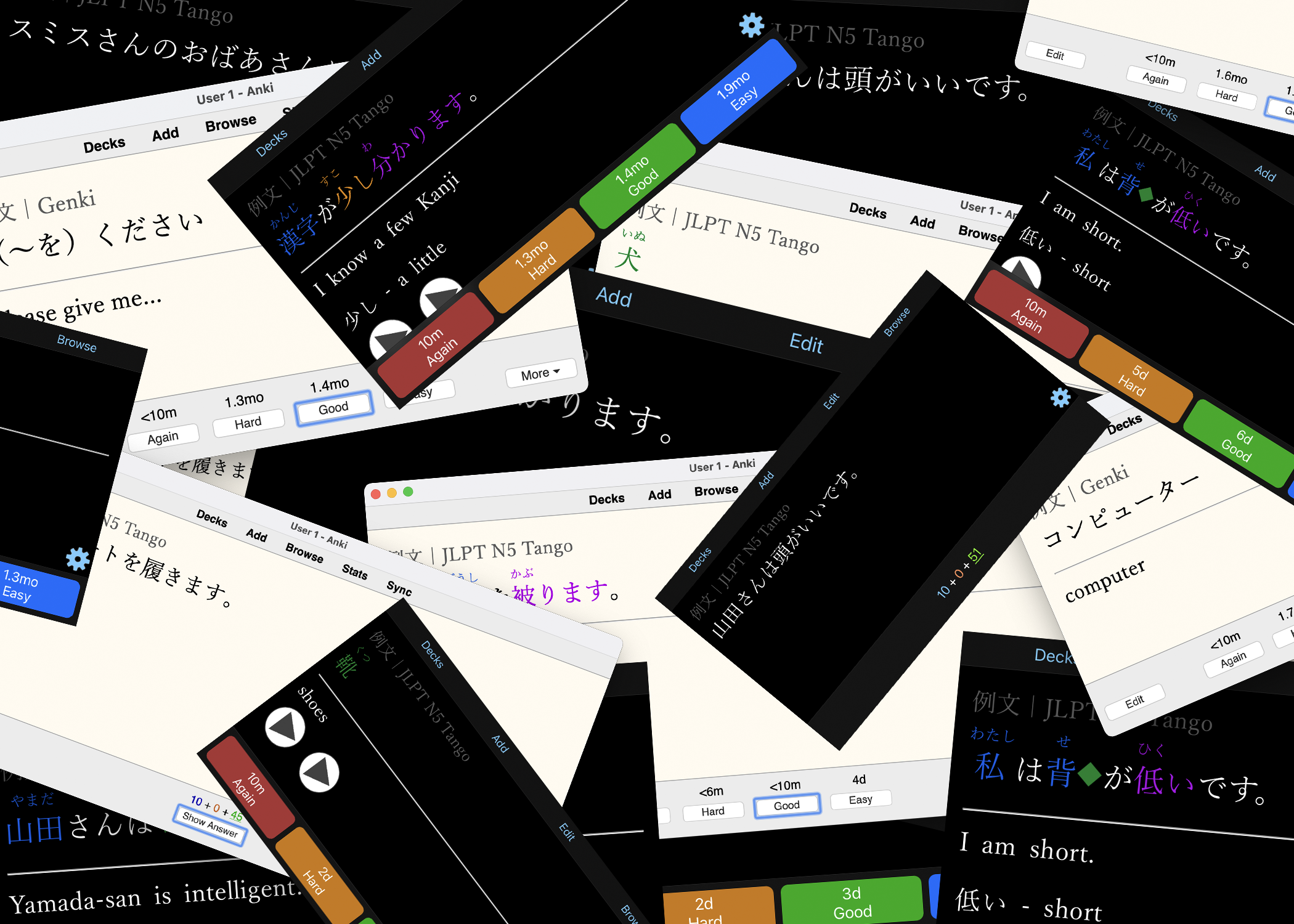
Anki is a flashcard app that uses a Spaced Repetition System (SRS) to help you learn and memorise information by creating strong, long-lasting memories. It does this by aiming to present you with a flashcard exactly at the point you were about to forget it.
You should be able to recall the information, but at a slight stretch. If you remember the card correctly, it will increase the length of time before it shows it to you again. If you can’t remember (or remember incorrectly) it will show it to you again sooner. It was originally developed for language learning (being named after the Japanese word for ‘memorisation’) but has since been applied to many subjects, including medical studies…
A special guest post from Step Up Japanese student Phil Kinchington!
Anki is a flashcard app that uses a Spaced Repetition System (SRS) to help you learn and memorise information by creating strong, long-lasting memories. It does this by aiming to present you with a flashcard exactly at the point you were about to forget it.
You should be able to recall the information, but at a slight stretch. If you remember the card correctly, it will increase the length of time before it shows it to you again. If you can’t remember (or remember incorrectly) it will show it to you again sooner. It was originally developed for language learning (being named after the Japanese word for ‘memorisation’) but has since been applied to many subjects, including medical studies.
While I saw Anki mentioned and recommended everywhere, I could never figure out a way to use it that really worked for me. Some people recommended that you should download a pre-made deck to match the textbook you are using (there is a huge library of decks submitted by users accessible from within Anki.) But I felt this would mean that it would start automatically adding vocabulary past the point I’d got to in the book.
(Note from Fran - you can “suspend” all the cards and manually “unsuspend” them as you work your way through a textbook, although I appreciate this is a bit fiddly!)
A lot of people recommended that you should use a single deck, and dump everything you came across into it, which seems a bit too messy for my liking. Also, I'd then be constantly having the dilemma of "do I put this in, or is it not worth it, or how can I add this in a meaningful way, that I'd understand why it was there when I came back to it?"
A big part of the problem is how open and flexible the system is. Anki doesn’t guide you or force you to work with it in a specific way, and the design of the cards is almost infinitely configurable. Of course, this is also the reason it has been possible to adapt it for so many different subjects.
I’d pretty much given up trying, and then I discovered the Alivia’s Japanese Nook YouTube channel. On that channel Alivia has a video specifically about using Anki to study Japanese that has been very useful to me. It's a bit long, as it covers every detail of how to use it, and exactly how she has all the settings configured. But if you’ve never used Anki at all, it’s a very good guide to getting it set up and starting to use it.
As a result of watching this video, I have developed a way of using Anki that seems to be working for me. I have multiple decks. Firstly I have a 'Genki' deck, which I'm manually populating with the vocabulary from the vocab pages in each chapter. This way, I can control how far ahead it goes. The other deck is the one recommended in this video called 'JLPT Tango N5 MIA Japanese' (it is a deck that has been built to go along with the JLPT Tango N5 study book*.) Over a month later and it still seems to be working for me, which is better than I've ever managed with it - every time I've tried, I've bounced off pretty hard and pretty fast.
The JLPT deck mostly uses the vocabulary in phrases, which is more useful for remembering and understanding the usage (although, I've just been through a batch where it felt it was essential to go through every month of the year, and also a whole load of one person, two people, three people, six people, etc.)
It also uses kanji from the start, and you don't get the furigana until you click through to the answer, which could be a bit harsh depending on how many kanji you‘ve already been exposed to. But so far they've all been pretty common kanji that I was already comfortable with. Each card also has full voice recordings that automatically play when you click to show the answer. Sometimes several versions with different voices.
So now my method is: look at the card, read the phrase aloud, then say aloud "that means" followed by saying my translation aloud. When I click through to the answer, depending on whether I've got it right or not I'll click either 'Good' or ‘Again’. I don't use the ‘Easy’ or 'Hard' options at all. As far as I'm concerned it was either Good/Satisfactory or Again/Wrong.
I give myself a bit more leeway on the translation of, for example, words like 'international/foreign student' or 'nice/pleased to meet you, how do you do, etc.' But when it comes to the Japanese, I try to be pretty hard on myself regarding kanji recognition, pronunciation, etc. Better to practice something a little more than you needed to, rather than less than you required.
Now that I’ve found that there’s no need to worry about getting overwhelmed by having multiple decks, I’m thinking of adding more. First candidate is all of the sentences from the first book or two in the Unko Sensei series. This will have the advantage that it will force me to develop my own English translations, adding an extra layer of study.
How do you study Japanese with Anki? How are your decks set up? Let us know in the comments!
Links with an asterisk* are affiliate links, which means I (Fran) may earn a small commission, at no extra cost to you, when you click through and buy the book. Thanks for your support!
Click here for more guest posts from Step Up Japanese students!

Mini-interview with Elly Darrah of Ippo Ippo Japanese
Elly is the Edinburgh-based Japanese teacher behind Ippo Ippo Japanese. Did you know, Ippo Ippo means “step by step” in Japanese? I think that’s a great approach to learning Japanese - one step at a time.
In this mini interview I asked Elly some questions about the Japanese language, and we talked about tips for learners who are just getting started.

Elly is the Edinburgh-based Japanese teacher behind Ippo Ippo Japanese. Did you know, Ippo Ippo means “step by step” in Japanese? I think that’s a great approach to learning Japanese - one step at a time.
In this mini interview I asked Elly some questions about the Japanese language, and we talked about tips for learners who are just getting started.
Have you lived in Japan before? Do you have any favourite memories you think of at this time of year?
Yes, I previously lived in Hyogo (near Kobe) and Osaka, and this time of year brings back a lot of memories of Japanese spring. In particular, I remember getting the train from Hyogo to Osaka and seeing cherry blossoms all along the river when I was on my way to a hanami (cherry blossom viewing) picnic with friends. I actually miss riding the train in Japan quite a lot - at least out of rush hour!
Do you have a favourite kanji?
There are so many kanji I love for so many different reasons! However, one I’ve recently been reminded of is 傘 (umbrella) because it visually reminds me of what it means: people (人) being protected from the rain.
What tips do you have for anyone thinking of starting to learn Japanese?
My biggest tip is to not worry about doing things the “right” way. You can spend hours and hours looking for the perfect textbook or perfect study method, but the main factor in improving in a language is simply spending time on it. That said, if your study method of choice turns out not to motivate you, don’t be afraid to change things up and find something you enjoy. For me, I (unexpectedly) got really into Japanese dramas and music. Keep exploring and you’ll find something that grabs your interest too!
Elly and I are co-hosting Explore Japanese, an online event all about getting started in Japanese. Click here to find out more -29th March or 6th April.
Amazing Japanese Calligraphers on Instagram (Part 4) - Uchiyama Kenichi
Uchiyama is a designer from Yokohama, Japan.
He posts clean, minimalist Japanese handwriting on a separate handwriting Instagram account.
I'm not even sure if you can call it calligraphy, it's so gloriously simple. But he's got nice handwriting, and I love having it in my feed.
Welcome to Part 4 of Amazing Calligraphers on Instagram, and this week we're keeping things super simple with Uchiyama Kenichi.
The Japanese way of giving names is to put the family name (Uchiyama) first, and then the given name (Kenichi).
That's the Japanese way, so I'll keep it that way too.
Also, I have a friend with exactly the same name, so I'll call my friend Kenichi Uchiyama and the calligrapher Uchiyama Kenichi. It keeps things simple.
Uchiyama is a designer from Yokohama, Japan.
He posts clean, minimalist Japanese handwriting on a separate handwriting Instagram account.
I'm not even sure if you can call it calligraphy, it's so gloriously simple. But he's got nice handwriting, and I love having it in my feed.
↓ こんにちは konnichiwa ("hello!")
Challenge time!
Can you read these next three?
Did you get it? These are the three Japanese "alphabets": ひらがな hiragana, カタカナ katakana, and 漢字 kanji. Each is written in its own alphabet, of course.
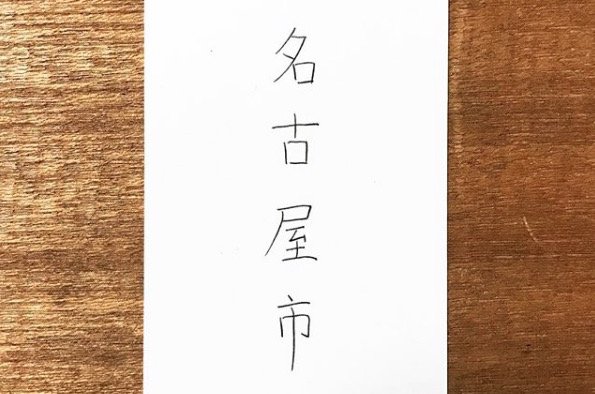
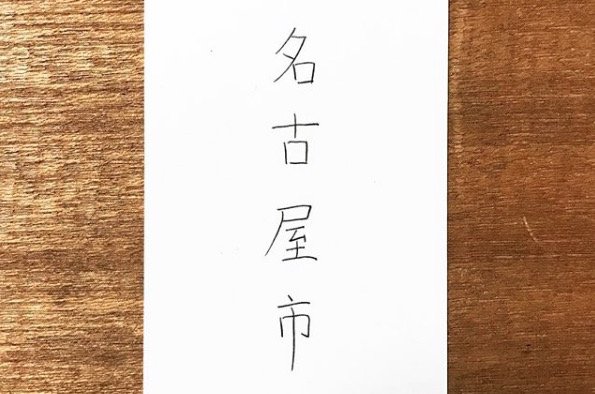
What I love most though is Uchiyama's series of Japanese placenames:
↓ 北海道 Hokkaido
↓ 名古屋市 Nagoya-shi (Nagoya city)
I love the balance and simplicity in Uchiyama’s writing. It's not big or ostentatious. It has a quiet confidence, I think.
Follow Uchiyama Kenichi here on his writing-only Instagram account at @u.handwriting.
Read more in this series:
Amazing Japanese Calligraphers on Instagram (Part 1) - Emi Yogai 恵美・曄涯
Amazing Japanese Calligraphers on Instagram (Part 1.5 bonus!) - Emi Yogai 恵美・曄涯
Amazing Japanese Calligraphers on Instagram (Part 2) - Mitsuru Nagata
Amazing Calligraphers on Instagram (Part 3) - Isawo Murayama
First published 30th Mar 2018; updated 30th Nov 2021

Amazing Japanese Calligraphers on Instagram (Part 3) - Isawo Murayama
Hello and welcome to the third instalment of "Amazing Japanese Calligraphers on Instagram", where I introduce amazing artists making Japanese calligraphy - and sharing it online.
Isawo Murayama is a busy mum-of-four who makes time to create new pieces daily.
Her work feels a bit like a diary - together with her descriptive Instagram captions, her calligraphy offers up a little slice of her day-to-day life.
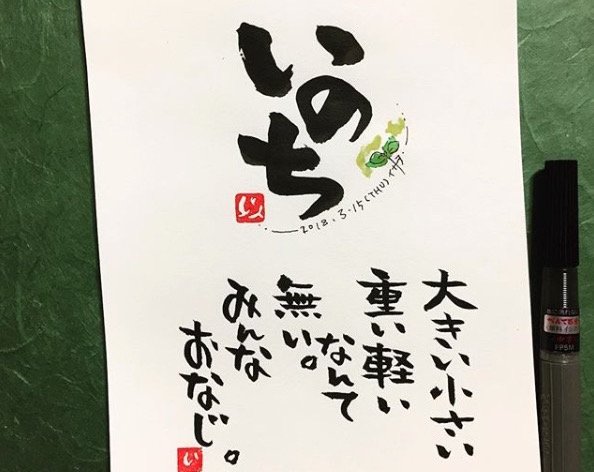
Traditional Japanese calligraphy uses a brush which is dipped into ink, but Murayama uses a 筆ペン (fude-pen) or "brush pen".
Hello and welcome to the third instalment of "Amazing Japanese Calligraphers on Instagram", where I introduce amazing artists making Japanese calligraphy - and sharing it online.
Isawo Murayama is a busy mum-of-four who makes time to create new pieces daily.
Her work feels a bit like a diary - together with her descriptive Instagram captions, her calligraphy offers up a little slice of her day-to-day life.
Traditional Japanese calligraphy uses a brush which is dipped into ink, but Murayama uses a 筆ペン (fude-pen) or "brush pen".
A brush pen is like a fountain pen with a soft nib. It handles like a pen, but writes like a brush.
I love her stories and the little explanations behind her words, as well as the bold, small lettering.
In this first one she talks about the importance of two words: ごめん "sorry" and ありがとう "thank you".
ごめんと言える勇気とありがとうと言える素直さと。
Gomen to ieru yuuki to arigatou to ieru sunao-sa to.
The courage to say sorry, and the grace to say thank you.
Some of her posts are like little motivational speeches:
自分を信じることから始めよう。
Jibun o shinjiru koto kara hajimeyou.
"Start by believing in yourself."
I really like the juxtaposition of big thoughts on small paper here.
As well as telling stories about her kids in her captions, Murayama also writes powerfully about the advice she would like to give her younger self:
あなたを思ってくれる人はたくさんいる / 気づいて... /心...ひらいて
Anata o omotte kureru hito wa takusan iru / kizuite / kokoro hiraite
"There are lots of people who care about you / Realise this... / Open your heart"
Isn't that lovely?
You can find Isawo Murayama (@isaisa5963) on Instagram here, or read more on her (Japanese-language) blog.
Read more in this series:
Amazing Japanese Calligraphers on Instagram (Part 1) - Emi Yogai 恵美・曄涯
Amazing Japanese Calligraphers on Instagram (Part 1.5 bonus!) - Emi Yogai 恵美・曄涯
Amazing Japanese Calligraphers on Instagram (Part 2) - Mitsuru Nagata
Amazing Calligraphers on Instagram (Part 4) - Uchiyama Kenichi
First published 16th Mar 2018; updated 30th Nov 2021
Amazing Japanese Calligraphers on Instagram (Part 2) - Mitsuru Nagata
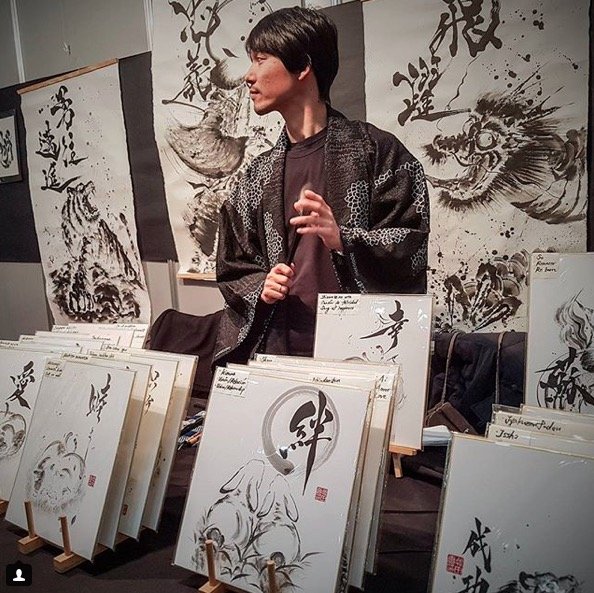
Mitsuru Nagata was born in Kyoto, and works extensively in Spain. His work combines elements of calligraphy with sumi-e (Japanese ink painting) techniques.
He performs at "live-painting" events, where he produces huge calligraphy paintings in front of a live audience.
These large-scale performances are often at festivals…

Mitsuru Nagata was born in Kyoto, and works extensively in Spain. His work combines elements of calligraphy with sumi-e (Japanese ink painting) techniques.
He performs at "live-painting" events, where he produces huge calligraphy paintings in front of a live audience.
These large-scale performances are often at festivals:
I love the simplicity of Nagata's work, like this stunning commission, with the traditional thatched roof home in the background:
おかえりなさい (o kaeri nasai) "Welcome home"
(Calligraphy is a good opportunity to get your eyes used to vertical writing, too!)
If hiragana's not your thing, there's plenty of complex kanji to get your teeth into too.
Like this new year's post, with a pug for the year of the dog (2018):
謹賀新年 (kinga shinnen) "Happy New Year"
I love the movement in these videos, and the combination of precision brushwork and watery ink.
This one's a promo for one of Nagata's live performances in Spain - a beckoning cat saying おいでね! (oide ne!) "Please come!"
Follow Mitsuru Nagata (@nagatayakyoto) on Instagram, or find out more on his website.
Read more in this series:
Amazing Japanese Calligraphers on Instagram (Part 1) - Emi Yogai 恵美・曄涯
Amazing Japanese Calligraphers on Instagram (part 1.5 bonus!) - Emi Yogai 恵美・曄涯
Amazing Japanese Calligraphers on Instagram (Part 3) - Isawo Murayama
Amazing Japanese Calligraphers on Instagram (Part 4) - Uchiyama Kenichi
First published 13th Feb 2018; updated 30th Nov 2021
Amazing Japanese Calligraphers on Instagram (Part 1) - Emi Yogai 恵美・曄涯
I absolutely love kanji - Chinese characters that are also used in Japanese writing.
But calligraphy is not my strong point. My writing is good, but not particularly beautiful.
I have, however, recently become slightly obsessed with instagrammers who post Japanese calligraphy photos.
So I thought it might be fun to share some with you!
I first discovered @yogai888emi via this adorable story about falling asleep on the train…

I absolutely love kanji - Chinese characters that are also used in Japanese writing.
But calligraphy is not my strong point. My writing is good, but not particularly beautiful.
I have, however, recently become slightly obsessed with instagrammers who post Japanese calligraphy photos.
So I thought it might be fun to share some with you!
I first discovered @yogai888emi via this adorable story about falling asleep on the train.
↓ Look at those lovely clean lines. I immediately had serious handwriting envy.
If kanji's not your thing, you can find beautiful hiragana and katakana on her page too.
↓ ハナゲ (hanage) "nose hair"
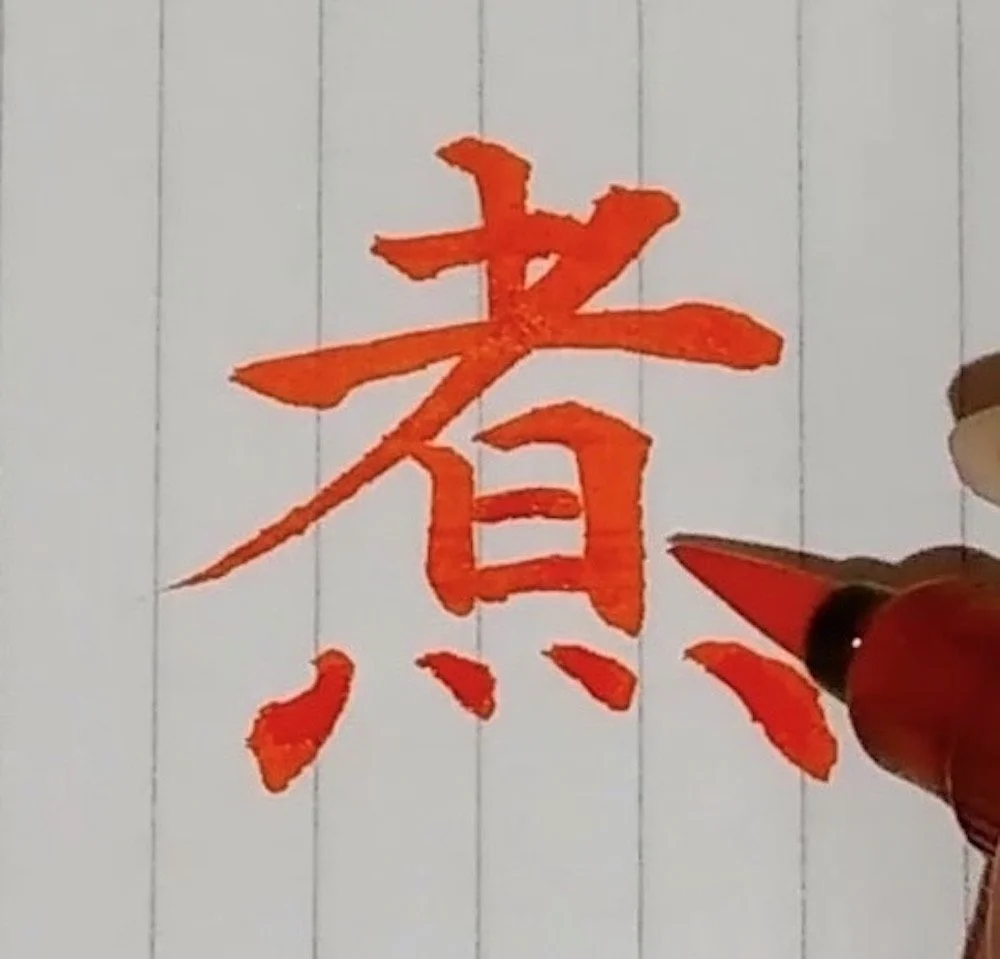
There are videos, too, if you like watching calligraphy. I do - I find it super relaxing.
↓ 煮える (nieru) to boil, to be cooked. This one's from the height of summer!
You can find heaps more of her work at @yogai888emi's instagram page. I hope you enjoy exploring it as much as I do.
Just looking at calligraphy won't make your handwriting more beautiful though - unfortunately!
Read more in this series:
Amazing Japanese Calligraphers on Instagram (Part 1.5 bonus!) - Emi Yogai 恵美・曄涯
Amazing Japanese Calligraphers on Instagram (Part 2) - Mitsuru Nagata
Amazing Calligraphers on Instagram (Part 3) - Isawo Murayama
Amazing Calligraphers on Instagram (Part 4) - Uchiyama Kenichi
First published 25th Jan 2018; updated 30th Nov 2021











Like many people in the UK, I studied French in school. I liked French. I thought it was really fun to speak another language, to talk with people, and to try and listen to what was going on in a new country. (Still do!)
When I was 14 we went on a school exchange to the city of Reims, in northeastern France. I was paired with a boy, which I’m sure some 14-year-olds would find very exciting but which I found unbearably awkward. He was very sweet and we completely ignored each other.
That was nearly 20 years ago, and I didn’t learn or use any more French until, at some point in lockdown, I decided on a whim to take some one-to-one lessons with online teachers. Here are some things I learned about French, about language learning, and about myself.