
Welcome to the Step Up Japanese blog archive!
Although I’m not currently adding new posts to the blog, you’ll find plenty of Japanese learning tips, study advice, and resources to explore here.
Browse the blog index to view a complete list of posts.
For the latest news, course updates, and Japanese learning tips from Step Up Japanese, sign up for my newsletter.
Search this blog:
Amazing Japanese Calligraphers on Instagram (Part 4) - Uchiyama Kenichi
Uchiyama is a designer from Yokohama, Japan.
He posts clean, minimalist Japanese handwriting on a separate handwriting Instagram account.
I'm not even sure if you can call it calligraphy, it's so gloriously simple. But he's got nice handwriting, and I love having it in my feed.
Welcome to Part 4 of Amazing Calligraphers on Instagram, and this week we're keeping things super simple with Uchiyama Kenichi.
The Japanese way of giving names is to put the family name (Uchiyama) first, and then the given name (Kenichi).
That's the Japanese way, so I'll keep it that way too.
Also, I have a friend with exactly the same name, so I'll call my friend Kenichi Uchiyama and the calligrapher Uchiyama Kenichi. It keeps things simple.
Uchiyama is a designer from Yokohama, Japan.
He posts clean, minimalist Japanese handwriting on a separate handwriting Instagram account.
I'm not even sure if you can call it calligraphy, it's so gloriously simple. But he's got nice handwriting, and I love having it in my feed.
↓ こんにちは konnichiwa ("hello!")
Challenge time!
Can you read these next three?
Did you get it? These are the three Japanese "alphabets": ひらがな hiragana, カタカナ katakana, and 漢字 kanji. Each is written in its own alphabet, of course.
What I love most though is Uchiyama's series of Japanese placenames:
↓ 北海道 Hokkaido
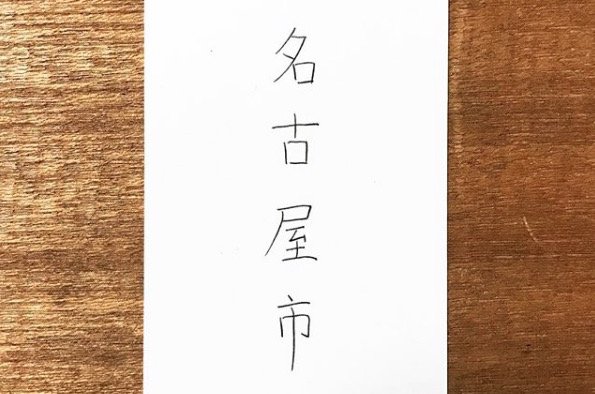
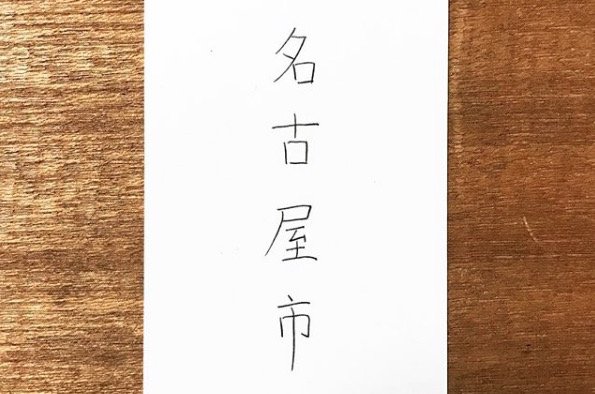
↓ 名古屋市 Nagoya-shi (Nagoya city)
I love the balance and simplicity in Uchiyama’s writing. It's not big or ostentatious. It has a quiet confidence, I think.
Follow Uchiyama Kenichi here on his writing-only Instagram account at @u.handwriting.
Read more in this series:
Amazing Japanese Calligraphers on Instagram (Part 1) - Emi Yogai 恵美・曄涯
Amazing Japanese Calligraphers on Instagram (Part 1.5 bonus!) - Emi Yogai 恵美・曄涯
Amazing Japanese Calligraphers on Instagram (Part 2) - Mitsuru Nagata
Amazing Calligraphers on Instagram (Part 3) - Isawo Murayama
First published 30th Mar 2018; updated 30th Nov 2021

Amazing Japanese Calligraphers on Instagram (Part 3) - Isawo Murayama
Hello and welcome to the third instalment of "Amazing Japanese Calligraphers on Instagram", where I introduce amazing artists making Japanese calligraphy - and sharing it online.
Isawo Murayama is a busy mum-of-four who makes time to create new pieces daily.
Her work feels a bit like a diary - together with her descriptive Instagram captions, her calligraphy offers up a little slice of her day-to-day life.
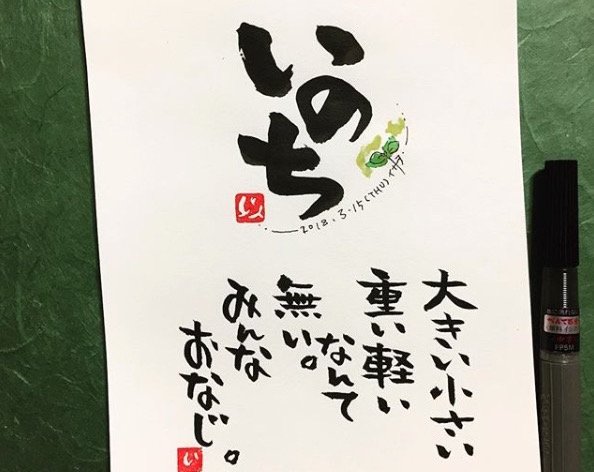
Traditional Japanese calligraphy uses a brush which is dipped into ink, but Murayama uses a 筆ペン (fude-pen) or "brush pen".
Hello and welcome to the third instalment of "Amazing Japanese Calligraphers on Instagram", where I introduce amazing artists making Japanese calligraphy - and sharing it online.
Isawo Murayama is a busy mum-of-four who makes time to create new pieces daily.
Her work feels a bit like a diary - together with her descriptive Instagram captions, her calligraphy offers up a little slice of her day-to-day life.
Traditional Japanese calligraphy uses a brush which is dipped into ink, but Murayama uses a 筆ペン (fude-pen) or "brush pen".
A brush pen is like a fountain pen with a soft nib. It handles like a pen, but writes like a brush.
I love her stories and the little explanations behind her words, as well as the bold, small lettering.
In this first one she talks about the importance of two words: ごめん "sorry" and ありがとう "thank you".
ごめんと言える勇気とありがとうと言える素直さと。
Gomen to ieru yuuki to arigatou to ieru sunao-sa to.
The courage to say sorry, and the grace to say thank you.
Some of her posts are like little motivational speeches:
自分を信じることから始めよう。
Jibun o shinjiru koto kara hajimeyou.
"Start by believing in yourself."
I really like the juxtaposition of big thoughts on small paper here.
As well as telling stories about her kids in her captions, Murayama also writes powerfully about the advice she would like to give her younger self:
あなたを思ってくれる人はたくさんいる / 気づいて... /心...ひらいて
Anata o omotte kureru hito wa takusan iru / kizuite / kokoro hiraite
"There are lots of people who care about you / Realise this... / Open your heart"
Isn't that lovely?
You can find Isawo Murayama (@isaisa5963) on Instagram here, or read more on her (Japanese-language) blog.
Read more in this series:
Amazing Japanese Calligraphers on Instagram (Part 1) - Emi Yogai 恵美・曄涯
Amazing Japanese Calligraphers on Instagram (Part 1.5 bonus!) - Emi Yogai 恵美・曄涯
Amazing Japanese Calligraphers on Instagram (Part 2) - Mitsuru Nagata
Amazing Calligraphers on Instagram (Part 4) - Uchiyama Kenichi
First published 16th Mar 2018; updated 30th Nov 2021
Amazing Japanese Calligraphers on Instagram (Part 2) - Mitsuru Nagata
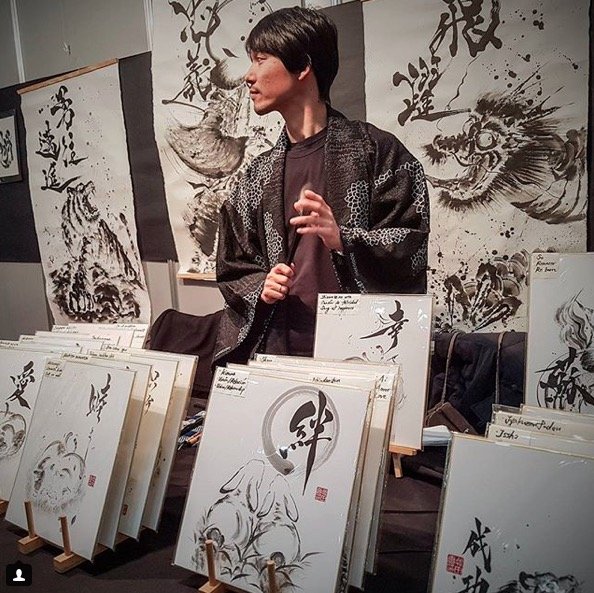
Mitsuru Nagata was born in Kyoto, and works extensively in Spain. His work combines elements of calligraphy with sumi-e (Japanese ink painting) techniques.
He performs at "live-painting" events, where he produces huge calligraphy paintings in front of a live audience.
These large-scale performances are often at festivals…

Mitsuru Nagata was born in Kyoto, and works extensively in Spain. His work combines elements of calligraphy with sumi-e (Japanese ink painting) techniques.
He performs at "live-painting" events, where he produces huge calligraphy paintings in front of a live audience.
These large-scale performances are often at festivals:
I love the simplicity of Nagata's work, like this stunning commission, with the traditional thatched roof home in the background:
おかえりなさい (o kaeri nasai) "Welcome home"
(Calligraphy is a good opportunity to get your eyes used to vertical writing, too!)
If hiragana's not your thing, there's plenty of complex kanji to get your teeth into too.
Like this new year's post, with a pug for the year of the dog (2018):
謹賀新年 (kinga shinnen) "Happy New Year"
I love the movement in these videos, and the combination of precision brushwork and watery ink.
This one's a promo for one of Nagata's live performances in Spain - a beckoning cat saying おいでね! (oide ne!) "Please come!"
Follow Mitsuru Nagata (@nagatayakyoto) on Instagram, or find out more on his website.
Read more in this series:
Amazing Japanese Calligraphers on Instagram (Part 1) - Emi Yogai 恵美・曄涯
Amazing Japanese Calligraphers on Instagram (part 1.5 bonus!) - Emi Yogai 恵美・曄涯
Amazing Japanese Calligraphers on Instagram (Part 3) - Isawo Murayama
Amazing Japanese Calligraphers on Instagram (Part 4) - Uchiyama Kenichi
First published 13th Feb 2018; updated 30th Nov 2021
Amazing Japanese Calligraphers on Instagram (part 1.5 bonus!) - Emi Yogai 恵美・曄涯
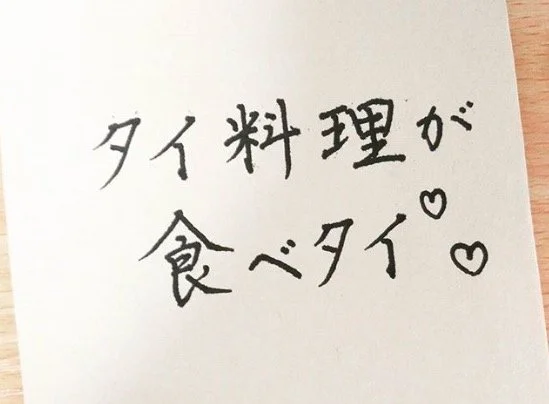
I can't believe I wrote an entire blog post about calligrapher Emi Yogai and forgot to include this amazing pun…

I can't believe I wrote an entire blog post about calligrapher @yogai888emi and forgot to include this amazing pun.
タイ料理が食べタイ
tai ryouri ga tabe-tai
"I want to eat Thai food."
What's the Japanese word for "Thai?" it's タイ (tai). And how do you say "want to eat" in Japanese? You stick -tai on the end of the verb.
It's funny, right?
Cute, too ♡
Read more in this series:
Amazing Japanese Calligraphers on Instagram (Part 1) - Emi Yogai 恵美・曄涯
Amazing Japanese Calligraphers on Instagram (Part 2) - Mitsuru Nagata
Amazing Calligraphers on Instagram (Part 3) - Isawo Murayama
Amazing Calligraphers on Instagram (Part 4) - Uchiyama Kenichi
First published 25th Jan 2018; updated 30th Nov 2021
Amazing Japanese Calligraphers on Instagram (Part 1) - Emi Yogai 恵美・曄涯
I absolutely love kanji - Chinese characters that are also used in Japanese writing.
But calligraphy is not my strong point. My writing is good, but not particularly beautiful.
I have, however, recently become slightly obsessed with instagrammers who post Japanese calligraphy photos.
So I thought it might be fun to share some with you!
I first discovered @yogai888emi via this adorable story about falling asleep on the train…

I absolutely love kanji - Chinese characters that are also used in Japanese writing.
But calligraphy is not my strong point. My writing is good, but not particularly beautiful.
I have, however, recently become slightly obsessed with instagrammers who post Japanese calligraphy photos.
So I thought it might be fun to share some with you!
I first discovered @yogai888emi via this adorable story about falling asleep on the train.
↓ Look at those lovely clean lines. I immediately had serious handwriting envy.
If kanji's not your thing, you can find beautiful hiragana and katakana on her page too.
↓ ハナゲ (hanage) "nose hair"
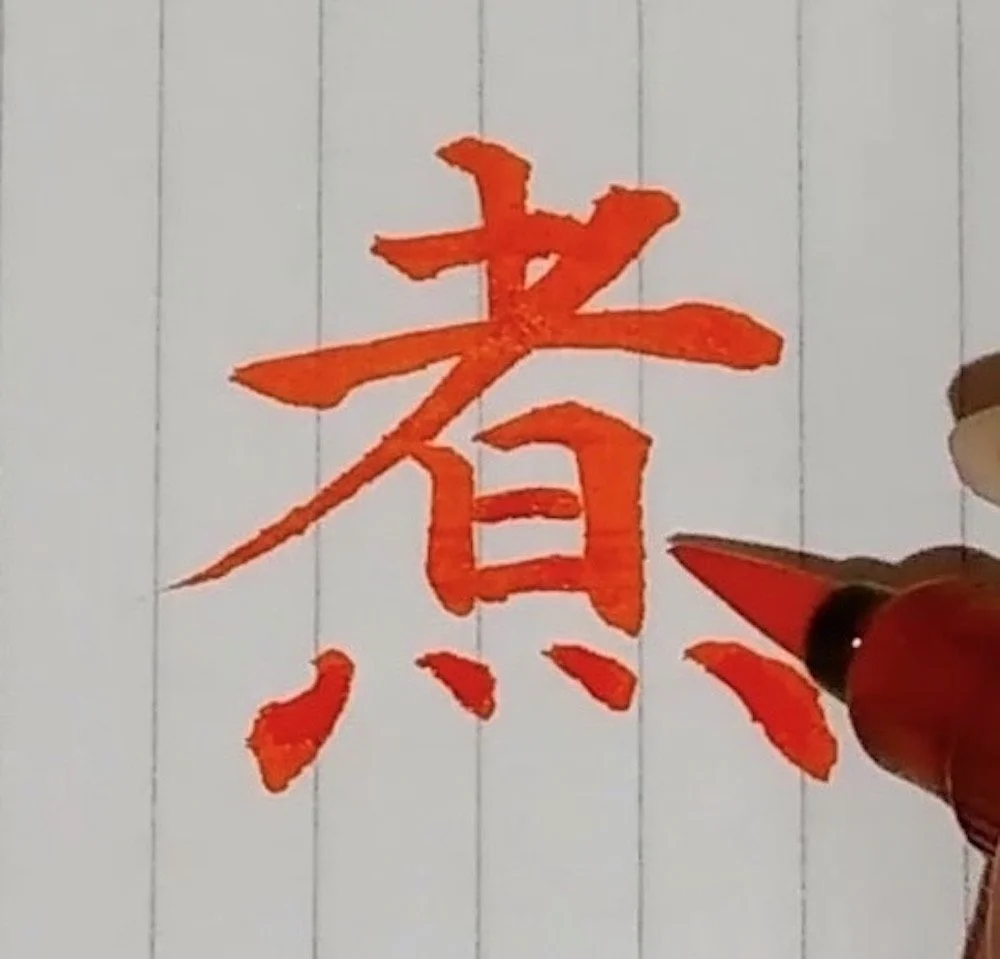
There are videos, too, if you like watching calligraphy. I do - I find it super relaxing.
↓ 煮える (nieru) to boil, to be cooked. This one's from the height of summer!
You can find heaps more of her work at @yogai888emi's instagram page. I hope you enjoy exploring it as much as I do.
Just looking at calligraphy won't make your handwriting more beautiful though - unfortunately!
Read more in this series:
Amazing Japanese Calligraphers on Instagram (Part 1.5 bonus!) - Emi Yogai 恵美・曄涯
Amazing Japanese Calligraphers on Instagram (Part 2) - Mitsuru Nagata
Amazing Calligraphers on Instagram (Part 3) - Isawo Murayama
Amazing Calligraphers on Instagram (Part 4) - Uchiyama Kenichi
First published 25th Jan 2018; updated 30th Nov 2021
A Brief Guide to Japanese Emoji: Food
Do you remember the first time you used an emoji?
I do. It was kind of overwhelming. I scrolled and scrolled through my new Japanese phone, and wondered what all these little pictures could possibly be for.
Because emoji originated in Japan, some of them are quite specific to Japanese culture.
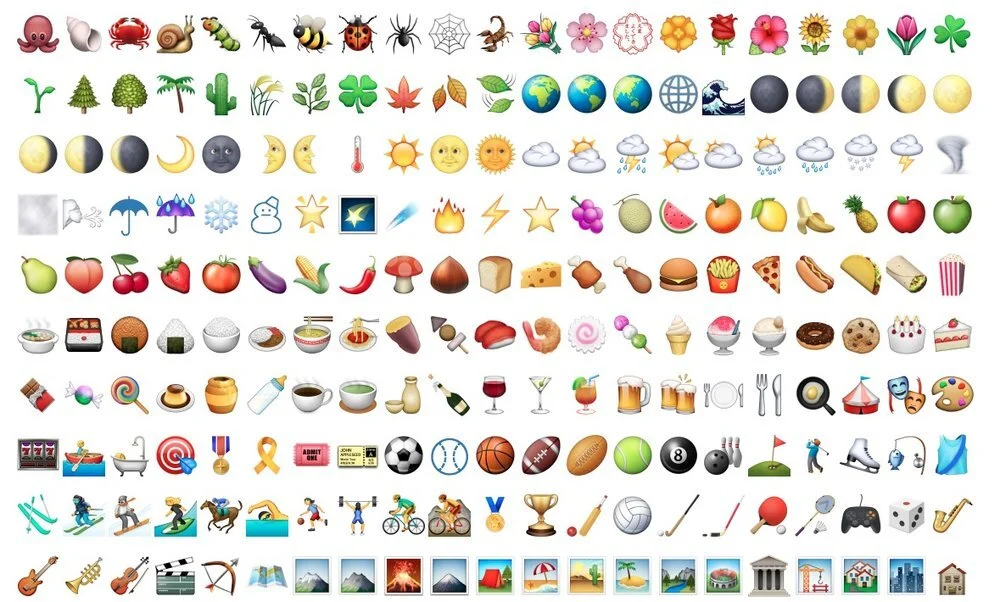
Some are obvious - but others might not mean what you think! Let’s take a look at some specifically Japanese emoji.
Do you remember the first time you used an emoji?
I do. It was kind of overwhelming. I scrolled and scrolled through my new Japanese phone, and wondered what all these little pictures could possibly be for.
Because emoji originated in Japan, some of them are quite specific to Japanese culture.
Some are obvious - but others might not mean what you think! Let’s take a look at some specifically Japanese emoji.
せんべい Rice Cracker

(Emoji images from emoji.ichinoku.com)
"What's that brown circle with the square on it?" せんべい (senbei, or sembei) are crispy, crunchy rice crackers. Usually savoury, they're made from Japan's staple crop - rice.
This one in the emoji picture is partly wrapped in a sheet of dried のり (nori) seaweed. Yum!
弁当 Bento Box
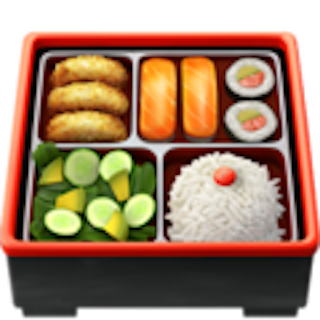
A 弁当 (bentō or bentou) is a boxed lunch containing rice, usually with fish or meat, and often with pickled vegetables.
Look closely - this bentō box has sushi in it too!
団子 Dango
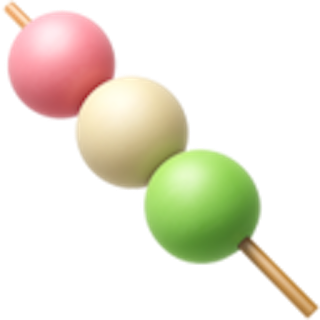
Dango are Japanese sweets made from sticky rice and sugar. They're chewy and squishy. I'm a big fan!
Dango are served on a stick to make it easier to eat.
These coloured ones are also called 三色 (sanshoku or "three-coloured") dango, or 花見 (hanami or "flower-viewing") dango.
エビフライ Fried Prawn
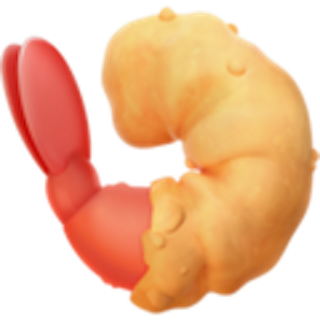
エビフライ (ebi-furai) or "fried prawn" is a specialty food of Nagoya, where I lived from 2011-2014.
I can't eat prawns though, so it's not my favourite food. You can have mine.
マンガ肉 Manga Meat
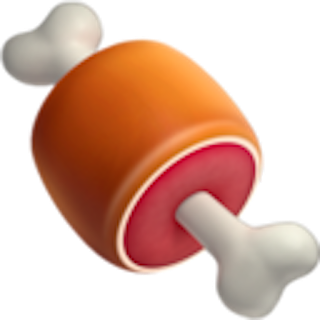
マンガ肉 (manga niku) is meat on the bone stylised like the cartoon meat you see in anime and manga.
Also known as あの肉 (ano niku) "that meat".
In a glorious case of life imitating art, you can actually get manga niku some places. We had it in the Capcom bar in Shinjuku, Tokyo a few years ago:

おでん Oden
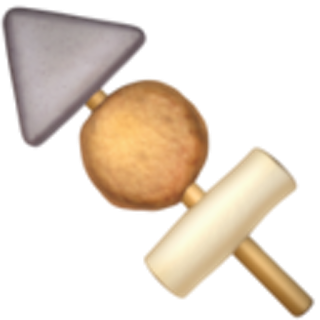
A classic winter comfort food, おでん (oden) is a hot-pot made by simmering various ingredients in
dashi fish broth.
Some of the ingredients are skewered - again, to make them easier to eat.
The triangle on the top of the skewer in this emoji is こんにゃく (konnyaku), a gelatinous speckled grey food that tastes better than it looks.
Next time you're scrolling through the emoji on your phone, see if there are any Japanese food emoji that are new to you!
First published Dec 2017
Updated Sept 2021

Umbrellas Lost And Found - The Hundred Yen Shop
Did you know Japan has the most umbrellas per person, of any country in the world? For every person in Japan, there are 3.3 umbrellas.
At least three of them are mine, left outside shops and restaurants…
In 2011, I had just moved to Japan and I moved into my new flat on the outskirts of Nagoya city. At the weekends I'd head to Daiso, the 100-yen shop, to buy bits and pieces for my new flat.
One day, I left my umbrella in the stand outside the 100-yen shop. It was quite a nice umbrella - a neat little folding one, and it had been a present from my brother, so I went back to the shop the next day.
My little blue umbrella wasn't in the rack, so I asked at the till.

Did you know Japan has the most umbrellas per person, of any country in the world? For every person in Japan, there are 3.3 umbrellas.
At least three of them are mine, left outside shops and restaurants…
In 2011, I had just moved to Japan and I moved into my new flat on the outskirts of Nagoya city. At the weekends I'd head to Daiso, the 100-yen shop, to buy bits and pieces for my new flat.
One day, I left my umbrella in the stand outside the 100-yen shop. It was quite a nice umbrella - a neat little folding one, and it had been a present from my brother, so I went back to the shop the next day.
My little blue umbrella wasn't in the rack, so I asked at the till.
My Japanese was quite limited then, but I knew how to say 傘を忘れました (kasa o wasuremashita, "I left my umbrella").
The shop assistant looked a bit bemused, but wanted to help me, so she asked me what the umbrella looked like.
I told her the umbrella was 小さい (chiisai, “small”). I gestured to show it was very small.
She asked me:
ああ、折りたたみですか。
Aa, oritatami desu ka?
Oh, is it "oritatami"?
I didn't know what "oritatami" meant, and I didn't have a dictionary with me (it was 2011, and I didn’t own a smartphone), so I repeated that it was small.
The shop assistant bustled about, murmuring:
"Oritatami, oritatami, oritatami..."
She went off to look somewhere else, and then came back and apologised profusely. My umbrella was gone.
I walked home. It started to rain.
At home, I pulled out my romaji dictionary. And that was the day I learned that “oritatami” means "folding", as in, a folding umbrella.
! I'll never forget that word, I thought.
I lost my little umbrella, but I gained a new word in my vocabulary. You need a lot more than 3.3 words per person, after all!








Like many people in the UK, I studied French in school. I liked French. I thought it was really fun to speak another language, to talk with people, and to try and listen to what was going on in a new country. (Still do!)
When I was 14 we went on a school exchange to the city of Reims, in northeastern France. I was paired with a boy, which I’m sure some 14-year-olds would find very exciting but which I found unbearably awkward. He was very sweet and we completely ignored each other.
That was nearly 20 years ago, and I didn’t learn or use any more French until, at some point in lockdown, I decided on a whim to take some one-to-one lessons with online teachers. Here are some things I learned about French, about language learning, and about myself.