
Welcome to the Step Up Japanese blog archive!
Although I’m not currently adding new posts to the blog, you’ll find plenty of Japanese learning tips, study advice, and resources to explore here.
Browse the blog index to view a complete list of posts.
For the latest news, course updates, and Japanese learning tips from Step Up Japanese, sign up for my newsletter.
Search this blog:
Amazing Japanese Calligraphers on Instagram (part 1.5 bonus!) - Emi Yogai 恵美・曄涯
I can't believe I wrote an entire blog post about calligrapher Emi Yogai and forgot to include this amazing pun…

I can't believe I wrote an entire blog post about calligrapher @yogai888emi and forgot to include this amazing pun.
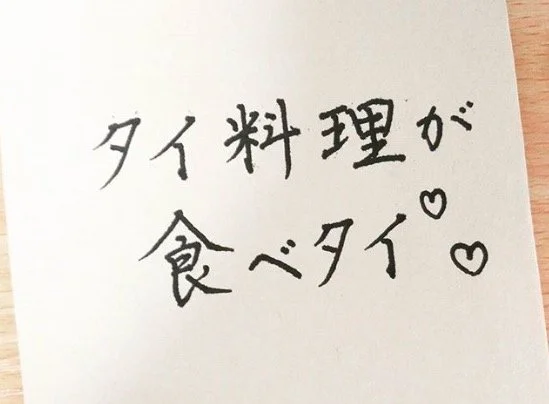
タイ料理が食べタイ
tai ryouri ga tabe-tai
"I want to eat Thai food."
What's the Japanese word for "Thai?" it's タイ (tai). And how do you say "want to eat" in Japanese? You stick -tai on the end of the verb.
It's funny, right?
Cute, too ♡
Read more in this series:
Amazing Japanese Calligraphers on Instagram (Part 1) - Emi Yogai 恵美・曄涯
Amazing Japanese Calligraphers on Instagram (Part 2) - Mitsuru Nagata
Amazing Calligraphers on Instagram (Part 3) - Isawo Murayama
Amazing Calligraphers on Instagram (Part 4) - Uchiyama Kenichi
First published 25th Jan 2018; updated 30th Nov 2021
Amazing Japanese Calligraphers on Instagram (Part 1) - Emi Yogai 恵美・曄涯
I absolutely love kanji - Chinese characters that are also used in Japanese writing.
But calligraphy is not my strong point. My writing is good, but not particularly beautiful.
I have, however, recently become slightly obsessed with instagrammers who post Japanese calligraphy photos.
So I thought it might be fun to share some with you!
I first discovered @yogai888emi via this adorable story about falling asleep on the train…

I absolutely love kanji - Chinese characters that are also used in Japanese writing.
But calligraphy is not my strong point. My writing is good, but not particularly beautiful.
I have, however, recently become slightly obsessed with instagrammers who post Japanese calligraphy photos.
So I thought it might be fun to share some with you!
I first discovered @yogai888emi via this adorable story about falling asleep on the train.
↓ Look at those lovely clean lines. I immediately had serious handwriting envy.
If kanji's not your thing, you can find beautiful hiragana and katakana on her page too.
↓ ハナゲ (hanage) "nose hair"
There are videos, too, if you like watching calligraphy. I do - I find it super relaxing.
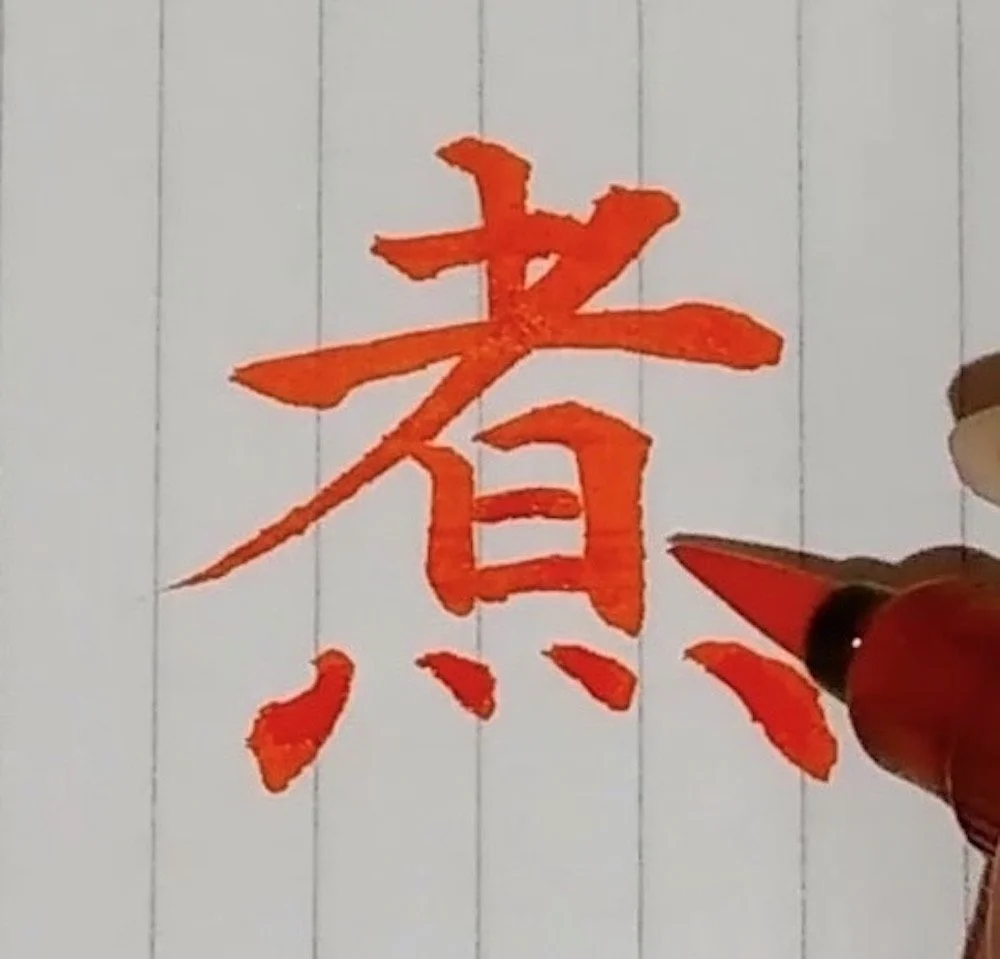
↓ 煮える (nieru) to boil, to be cooked. This one's from the height of summer!
You can find heaps more of her work at @yogai888emi's instagram page. I hope you enjoy exploring it as much as I do.
Just looking at calligraphy won't make your handwriting more beautiful though - unfortunately!
Read more in this series:
Amazing Japanese Calligraphers on Instagram (Part 1.5 bonus!) - Emi Yogai 恵美・曄涯
Amazing Japanese Calligraphers on Instagram (Part 2) - Mitsuru Nagata
Amazing Calligraphers on Instagram (Part 3) - Isawo Murayama
Amazing Calligraphers on Instagram (Part 4) - Uchiyama Kenichi
First published 25th Jan 2018; updated 30th Nov 2021
Six Ways To Say "Happy Birthday" In Japanese
So you want to wish your Japanese-speaking friends "happy birthday" in Japanese.
Whether you're sending a birthday card, or just writing a message, here are six different ways to share the love.
First of all, let's say “Happy Birthday”:
Help launch something new! Join our pilot round and be among the first to master Hiragana with our course.
So you want to wish your Japanese-speaking friends "happy birthday" in Japanese.
Whether you're sending a birthday card, or just writing a message, here are six different ways to share the love.
First of all, let's say “Happy Birthday”:
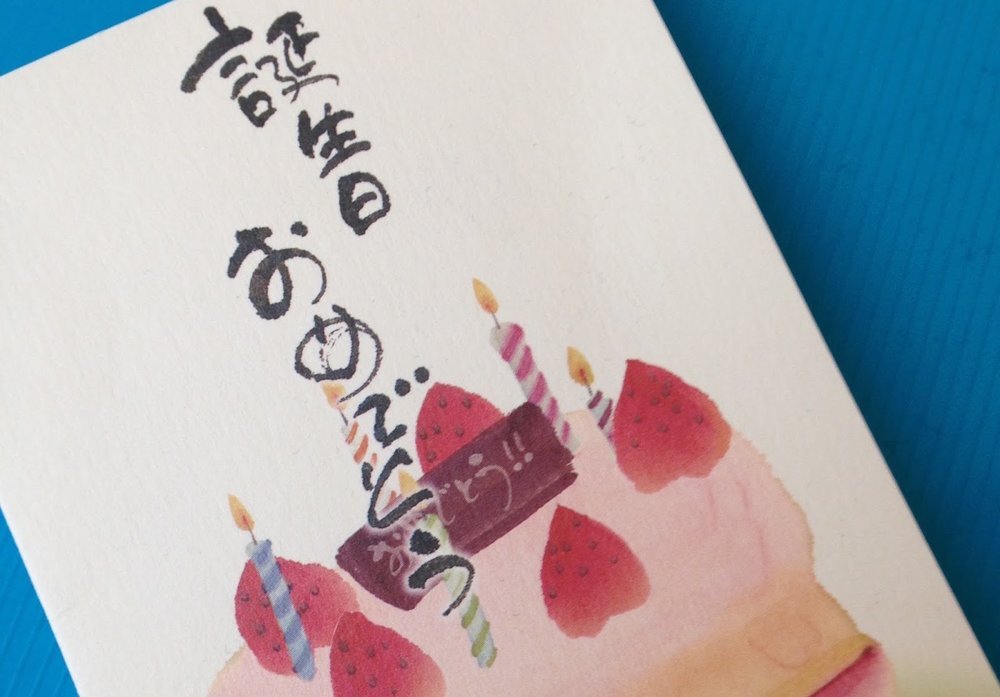
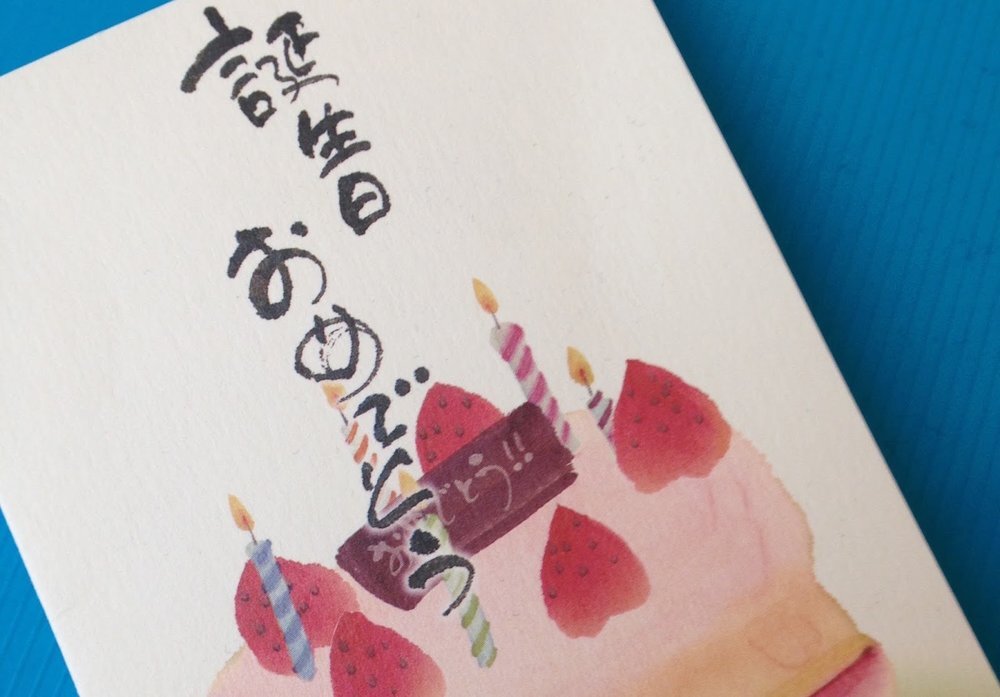
1) お誕生日おめでとう! o-tanjoubi omedetou
Simple and classic, this one means "happy birthday", or literally "congratulations on your birthday".
2) お誕生日おめでとうございます。 o-tanjoubi omedetou gozaimasu
Stick a "gozaimasu" on the end to make it more polite.
Good for people older than you, people you know less well, and definitely good for your boss.
3) ハッピーバースデー!happii baasudee!
This one is actually one of my favourites - a Japan-ified version of the English phrase “happy birthday”.
If you're writing a message, it's good to follow up after the birthday greeting by also wishing the person well:
1) 楽しんでください tanoshinde kudasai
"Have fun!"
e.g. お誕生日おめでとう!楽しんでください ^ ^
"Happy birthday! Have fun :)"
2) 素敵な一日を sutekina ichinichi o
"Have a great day."
e.g. お誕生日おめでとう!素敵な一日を〜
"Happy birthday! Have a great day."
3) 素晴らしい1年になりますように subarashii ichinen ni narimasu you ni
"I hope it's a wonderful year for you."
e.g. お誕生日おめでとうございます。素晴らしい1年になりますように。
"Happy birthday. I hope you have a wonderful year."
As you may have noticed, birthday messages wishing someone well for the year are kind of similar to a New Years' Greeting in Japanese.
それじゃ、素敵な一日を! sutekina ichinichi o!
And with that, I hope you have a wonderful day!
Learn beginner Japanese:
Tuesdays, 12:00pm (UK time) | Online Group Course
Starts 15th Sept 2026 | 36 weeks
Who this course is for
This course is for true beginners or early beginners who already know a little Japanese (e.g. ~10-20 hiragana characters) and want to build a solid foundation.
If you are starting completely from zero, I recommend a few 1:1 lessons before joining.
You will already be able to:
Recognise a small number of hiragana characters (or are beginning to learn them)
Feel comfortable learning slowly and step-by-step
In this course you will learn to:
Introduce yourself and ask simple questions
Talk about family, friends, likes and dislikes
Order food and drinks in a restaurant
Ask and answer simple questions about places you are staying
Talk about where people and things are located
Build confidence reading hiragana and begin katakana
Start recognising a small number of common kanji
The focus is on practical, everyday Japanese for absolute communication basics.
Course details
Duration: 36 weeks (3 x 12-week terms)
Day/time: Tuesdays, 12pm (UK time), 55-minute lessons
Textbook: Irodori: Japanese for Life in Japan - Starter (starting from Lesson 3, free online)
Not sure if this is right for you?
Book a free 30-minute Zoom consultation or email me for advice.
Get my newsletter:
Updated 10th August 2021
Walking the Shikoku 88 Pilgrimage (Part 8) - O-settai, or, "I'll treasure this tissue case"
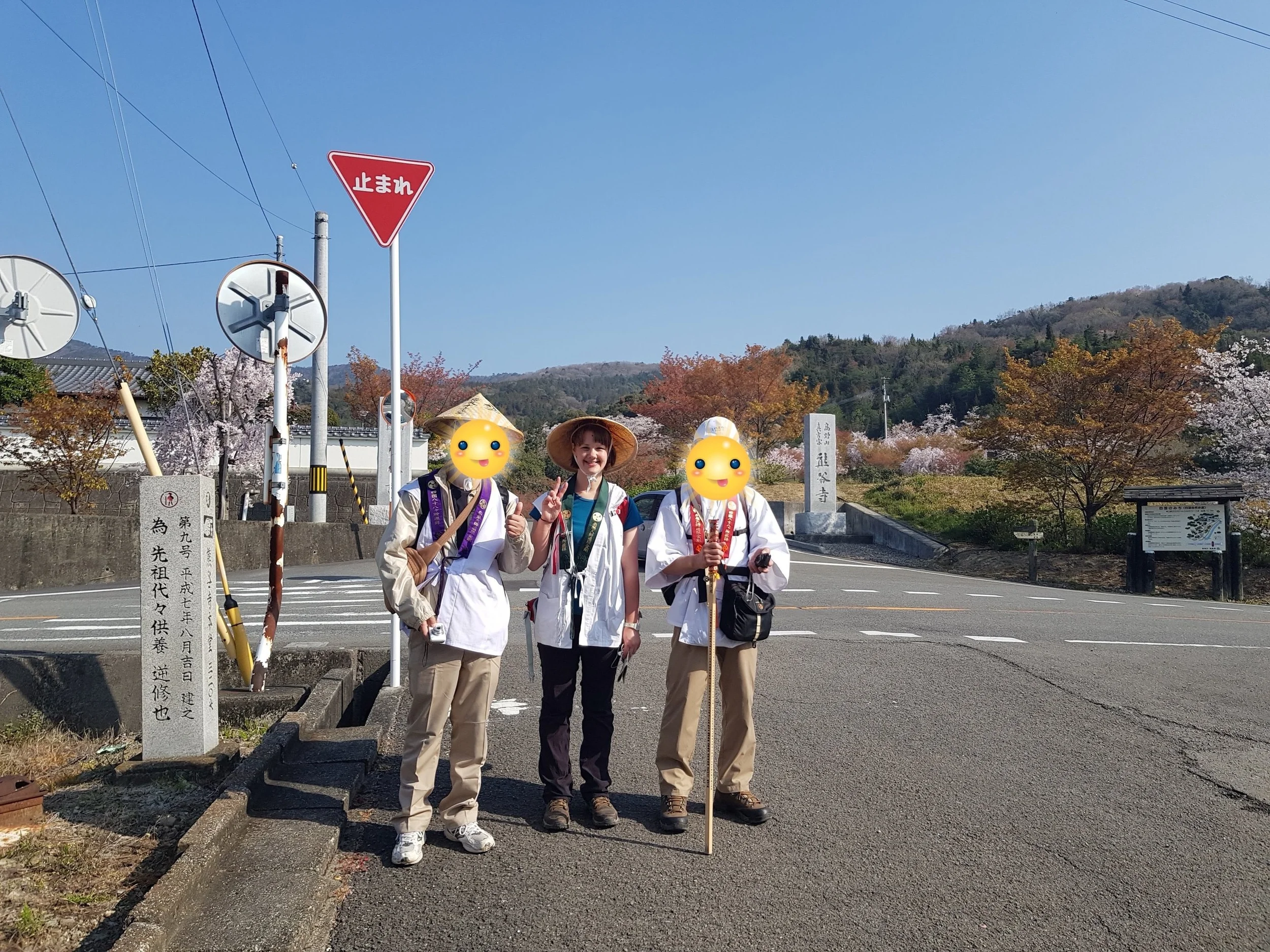
Near Kumadani-ji, temple number 8, we had stopped in front of some glorious cherry blossom, and I got chatting to two older gentlemen who were walking the trail. One told me he had never spoken to a gaijin-san, foreigner, before.
(The cynic in me wonders if that’s really true, or if by “foreigner” he meant “white person”…)
We took some pictures in front of the cherry blossom, and walked up the hill together.
Further up the road, a lady came out of her house and gave us some hard-boiled sweets ...
“Wait here. I want to give you o-settai.”
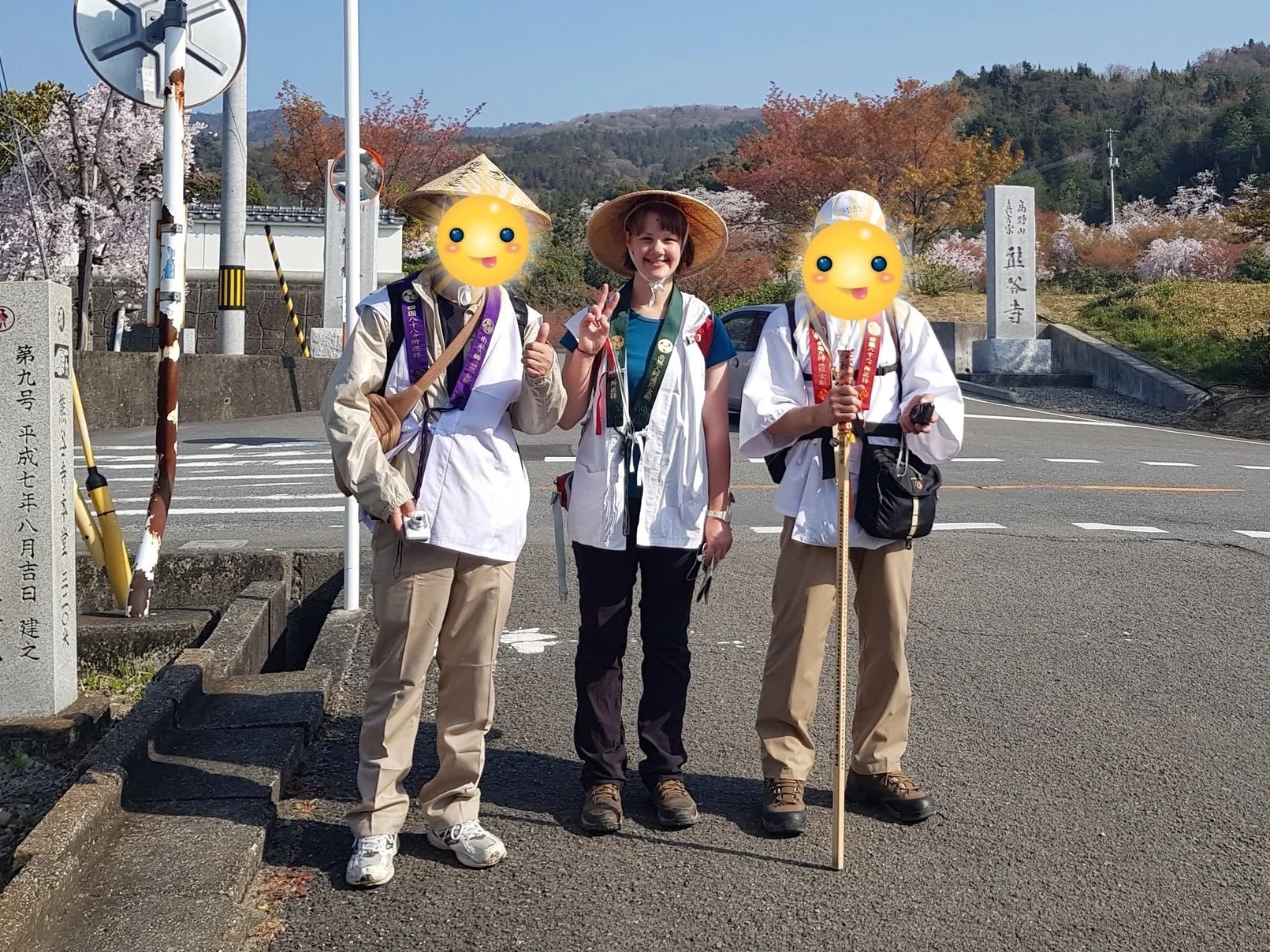
Near Kumadani-ji, temple number 8, we had stopped in front of some glorious cherry blossom, and I got chatting to two older gentlemen who were walking the trail. One told me he had never spoken to a gaijin-san, foreigner, before.
(The cynic in me wonders if that’s really true, or if by “foreigner” he meant “white person”…)
We took some pictures in front of the cherry blossom, and walked up the hill together.
Further up the road, a lady came out of her house and gave us some hard-boiled sweets.
The sweets were a form of o-settai, small gifts given to walking pilgrims. Traditionally, pilgrims didn't carry money, so they were helped along their way by gifts of food, lodging and other acts of generosity from local people.
“Wait here,” she said when she saw me, “I have something else for you.”
She came back with a colourful children’s section of the newspaper – a visual guide to the Shikoku pilgrimage, with readings for the kanji characters written above in hiragana.
It was several years old. I wondered if she had been saving it for a passing foreigner.
I briefly considered attempting to refuse it: I already had a good map, and I can read kanji, so I didn't need a children’s guide. The next non-Japanese person she met might have more use for it.
But explaining that would have felt arrogant, and you’re supposed to accept o-settai graciously, so I thanked her, and we went on our way.

The next day, I heard it again. “Wait here. I want to give you o-settai.”
I was alone this time. I had stopped to rest on a fading bench outside a children’s centre, and was enjoying my first iced can coffee in a couple of years.
There were no houses on this side of the road, but an elderly lady had come out of her house and crossed the busy road to strike up a conversation with me.
She referred to herself in the third person as obaa-chan, grandmother. She was 82.
The obaa-chan had walked the whole pilgrimage twice, she told me, and had hoped to do it a third time.
“But I’m too old to walk it again now, so I give o-settai instead.”
She went back into the house, and I saw her in the front room with a cardboard box. She did look frail. I wondered if I should follow her over the road so she didn't have to cross it again, but I didn't want to intrude.
“I must have given out hundreds of these,” she said proudly when she came back.
Inside the box were dozens of cotton tissue cases, in all different colours, each with a small packet of tissues inside.
“Did you make these?”
“Of course! Choose one.”
I picked out one with black cats sitting by front doors.
“Thank you very much. I’ll take good care of it.”
The tissue case had a secondary compartment, and inside that was a paper insert. It was a photocopy of handwriting - guidance for living a good life. “I like these words, so I included them too,” she added.
“When you use it, please remember the 82-year-old obaa-chan from Shikoku.”
The tissue case has travelled 6000 miles with me back to England, but I haven’t opened the tissues yet. I’m know she wanted me to use it; but I just want to keep it safe.
It smells faintly of incense.
I think about the obaa-chan sewing tissue cases. I wonder if she waits by the window in pilgrimage season – spring and autumn – waiting for walkers to pass by.
She gave me much more than a tissue case. She made me feel welcome, and showed me kindness. Perhaps that’s what o-settai is…? It’s about human connection. It’s not about things, it’s about people.
I’ll treasure this tissue case, I promise.

Related posts:
Walking the Shikoku 88 Pilgrimage (Part 1) - Plan, plan, plan!
Walking the Shikoku 88 Pilgrimage (Part 2) - The Best First Day in Japan
Walking the Shikoku 88 Pilgrimage (Part 3) - What To Wear
Walking the Shikoku 88 Pilgrimage(Part 4) - How to Talk to Strangers in Japanese
Walking the Shikoku 88 Pilgrimage (Part 5) - Signs of Shikoku
Walking the Shikoku 88 Pilgrimage (Part 6) - Shouting at the French
Walking the Shikoku 88 Pilgrimage (Part 7) - Five Types of Rest Stop You'll Find Hiking In Shikoku
And also: "I treasure this pen case"

Japanese guys don’t want your Valentine’s Day chocolate anyway
ハッピーバレンタインデー! Happy Valentine's Day!
Valentine's Day in Japan is pretty different from the U.K. There's honmei choko (chocolate for someone you're into), giri choko (obligation chocolate), and even tomo choko (chocolate for friends)...
And a month later there's White Day to contend with…
ハッピーバレンタインデー! Happy Valentine's Day!
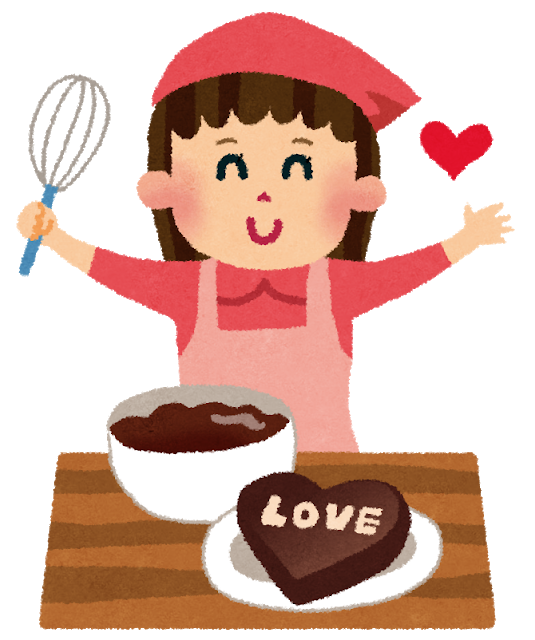
Valentine's Day in Japan is pretty different from the U.K. There's honmei choko (chocolate for someone you're into), giri choko (obligation chocolate), and even tomo choko (chocolate for friends)...
And a month later there's White Day to contend with…
One survey revealed that 90% of Japanese men said they didn't care about getting Valentine's Day chocolate, and wished women wouldn't bother.
Click here to read an article I wrote for SoraNews24 on the subject.
(It's from a couple of years ago, but I think it's still super relevant... especially on Valentine's Day).

落語を見に行ってきた! We Went to See Rakugo at the Brighton Fringe And It Was All Kinds of Awesome
落語を知っていますか。聞いたことありますか。
Rakugo o shitte imasu ka. Kiita koto ga arimasu ka.
Do you know rakugo? Have you ever heard of it?
The first time I heard of rakugo (落語), I was at a weekly Japanese conversation club in Nagoya in 2011, and the teacher was telling me about an event they were holding the following week.
"This man Sunshine-san is very famous," she told me. "He does traditional Japanese comic storytelling in English."
"Hmm," I thought to myself. "I don't want to see a show in English. I didn't come to Japan to watch stuff in English!"

落語を知っていますか。聞いたことありますか。
Rakugo o shitte imasu ka. Kiita koto ga arimasu ka.
Do you know rakugo? Have you ever heard of it?
The first time I heard of rakugo (落語), I was at a weekly Japanese conversation club in Nagoya in 2011, and the teacher was telling me about an event they were holding the following week.
"This man Sunshine-san is very famous," she told me. "He does traditional Japanese comic storytelling in English."
"Hmm," I thought to myself. "I don't want to see a show in English. I didn't come to Japan to watch stuff in English!"
Well, six years later I saw that same show right here in Brighton, and wow, was I wrong.
My teacher wasn't wrong when she told me that Katsura Sunshine is famous. He's the first ever western storyteller in the history of the “Kamigata” Rakugo tradition, and the second western Rakugo performer ever in the history of Japan.
A post shared by Sunshine Rakugo (@katsurasunshine) on May 6, 2017 at 12:34am PDT
Rakugo means "falling words", which perhaps sounds a bit vague in English but makes a bit more sense in Japanese. Raku (落) means fall, and the same kanji as ochi (落ち) which is the Japanese word for "punchline". Each comic story ends with an abrupt turnaround - a punchline.
The storyteller sits on stage in seiza (正座), the formal Japanese kneeling position, and tells stories using only a fan and a small cloth as props.
So I thought this might be an ideal spring trip for my students - accessible and fun! Plus, I really wanted to go and see what all the fuss was about.
A post shared by Sunshine Rakugo (@katsurasunshine) on May 7, 2017 at 3:47am PDT
We went last Sunday, the last night Sunshine was playing at the Brighton Fringe. There were thirteen of us and the theatre was super tiny, so we took up about half the seats.
I needn't have worried about the show being in English - the subject matter is basically all Japan! And there were plenty of jokes about the complexity of the Japanese language, and the entertaining perils of being abroad in Japan. That got a lot of laughs from our group...
A lot of the stories (dialogue etc.) is actually left untranslated from Japanese, which is great I think. You can pick up some Japanese words from context, but the show makes sense even if you don't speak Japanese.
The first half of the show was kind of like stand up (except of course he's sitting down) and the second half is storytelling. It was way more fast-paced than I expected.
↓ Post-rakugo pint

I should probably have gone and seen him in Nagoya six years ago...but I'm glad I got a second chance!
I won't spoil the show for you - you should go and see it if you get the chance - but you can check him out on YouTube if you'd like to hear what rakugo in English might be like.










Like many people in the UK, I studied French in school. I liked French. I thought it was really fun to speak another language, to talk with people, and to try and listen to what was going on in a new country. (Still do!)
When I was 14 we went on a school exchange to the city of Reims, in northeastern France. I was paired with a boy, which I’m sure some 14-year-olds would find very exciting but which I found unbearably awkward. He was very sweet and we completely ignored each other.
That was nearly 20 years ago, and I didn’t learn or use any more French until, at some point in lockdown, I decided on a whim to take some one-to-one lessons with online teachers. Here are some things I learned about French, about language learning, and about myself.