Welcome to the Step Up Japanese blog archive!
Although I’m not currently adding new posts to the blog, you’ll find plenty of Japanese learning tips, study advice, and resources to explore here.
Browse the blog index to view a complete list of posts.
For the latest news, course updates, and Japanese learning tips from Step Up Japanese, sign up for my newsletter.
Search this blog:
Amazing Japanese Calligraphers on Instagram (Part 4) - Uchiyama Kenichi
Uchiyama is a designer from Yokohama, Japan.
He posts clean, minimalist Japanese handwriting on a separate handwriting Instagram account.
I'm not even sure if you can call it calligraphy, it's so gloriously simple. But he's got nice handwriting, and I love having it in my feed.
Welcome to Part 4 of Amazing Calligraphers on Instagram, and this week we're keeping things super simple with Uchiyama Kenichi.
The Japanese way of giving names is to put the family name (Uchiyama) first, and then the given name (Kenichi).
That's the Japanese way, so I'll keep it that way too.
Also, I have a friend with exactly the same name, so I'll call my friend Kenichi Uchiyama and the calligrapher Uchiyama Kenichi. It keeps things simple.
Uchiyama is a designer from Yokohama, Japan.
He posts clean, minimalist Japanese handwriting on a separate handwriting Instagram account.
I'm not even sure if you can call it calligraphy, it's so gloriously simple. But he's got nice handwriting, and I love having it in my feed.
↓ こんにちは konnichiwa ("hello!")
Challenge time!
Can you read these next three?
Did you get it? These are the three Japanese "alphabets": ひらがな hiragana, カタカナ katakana, and 漢字 kanji. Each is written in its own alphabet, of course.
What I love most though is Uchiyama's series of Japanese placenames:
↓ 北海道 Hokkaido
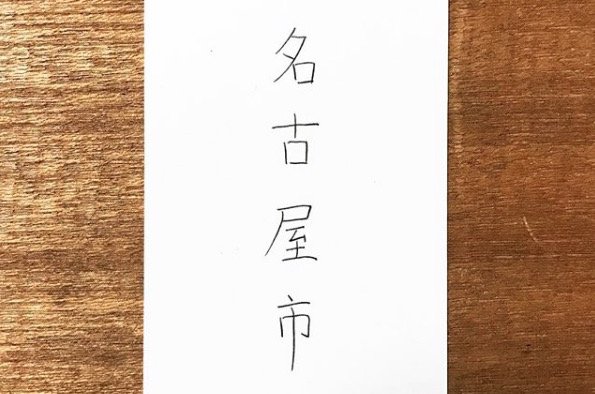
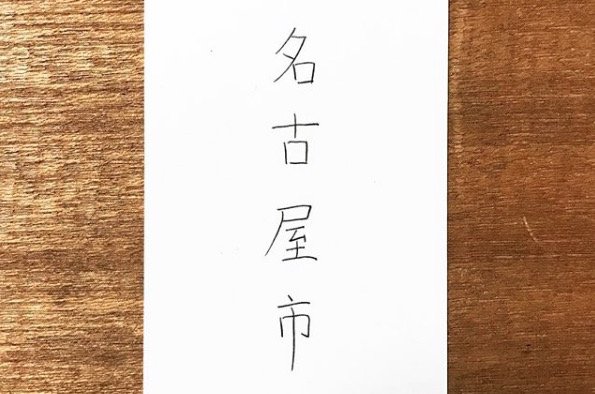
↓ 名古屋市 Nagoya-shi (Nagoya city)
I love the balance and simplicity in Uchiyama’s writing. It's not big or ostentatious. It has a quiet confidence, I think.
Follow Uchiyama Kenichi here on his writing-only Instagram account at @u.handwriting.
Read more in this series:
Amazing Japanese Calligraphers on Instagram (Part 1) - Emi Yogai 恵美・曄涯
Amazing Japanese Calligraphers on Instagram (Part 1.5 bonus!) - Emi Yogai 恵美・曄涯
Amazing Japanese Calligraphers on Instagram (Part 2) - Mitsuru Nagata
Amazing Calligraphers on Instagram (Part 3) - Isawo Murayama
First published 30th Mar 2018; updated 30th Nov 2021

Amazing Japanese Calligraphers on Instagram (Part 3) - Isawo Murayama
Hello and welcome to the third instalment of "Amazing Japanese Calligraphers on Instagram", where I introduce amazing artists making Japanese calligraphy - and sharing it online.
Isawo Murayama is a busy mum-of-four who makes time to create new pieces daily.
Her work feels a bit like a diary - together with her descriptive Instagram captions, her calligraphy offers up a little slice of her day-to-day life.
Traditional Japanese calligraphy uses a brush which is dipped into ink, but Murayama uses a 筆ペン (fude-pen) or "brush pen".
Hello and welcome to the third instalment of "Amazing Japanese Calligraphers on Instagram", where I introduce amazing artists making Japanese calligraphy - and sharing it online.
Isawo Murayama is a busy mum-of-four who makes time to create new pieces daily.
Her work feels a bit like a diary - together with her descriptive Instagram captions, her calligraphy offers up a little slice of her day-to-day life.
Traditional Japanese calligraphy uses a brush which is dipped into ink, but Murayama uses a 筆ペン (fude-pen) or "brush pen".
A brush pen is like a fountain pen with a soft nib. It handles like a pen, but writes like a brush.
I love her stories and the little explanations behind her words, as well as the bold, small lettering.
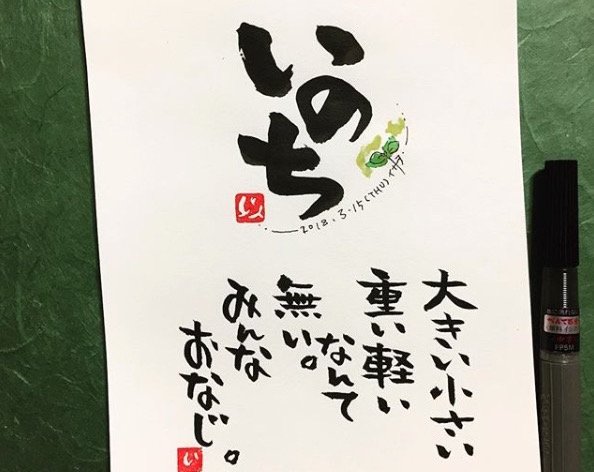
In this first one she talks about the importance of two words: ごめん "sorry" and ありがとう "thank you".
ごめんと言える勇気とありがとうと言える素直さと。
Gomen to ieru yuuki to arigatou to ieru sunao-sa to.
The courage to say sorry, and the grace to say thank you.
Some of her posts are like little motivational speeches:
自分を信じることから始めよう。
Jibun o shinjiru koto kara hajimeyou.
"Start by believing in yourself."
I really like the juxtaposition of big thoughts on small paper here.
As well as telling stories about her kids in her captions, Murayama also writes powerfully about the advice she would like to give her younger self:
あなたを思ってくれる人はたくさんいる / 気づいて... /心...ひらいて
Anata o omotte kureru hito wa takusan iru / kizuite / kokoro hiraite
"There are lots of people who care about you / Realise this... / Open your heart"
Isn't that lovely?
You can find Isawo Murayama (@isaisa5963) on Instagram here, or read more on her (Japanese-language) blog.
Read more in this series:
Amazing Japanese Calligraphers on Instagram (Part 1) - Emi Yogai 恵美・曄涯
Amazing Japanese Calligraphers on Instagram (Part 1.5 bonus!) - Emi Yogai 恵美・曄涯
Amazing Japanese Calligraphers on Instagram (Part 2) - Mitsuru Nagata
Amazing Calligraphers on Instagram (Part 4) - Uchiyama Kenichi
First published 16th Mar 2018; updated 30th Nov 2021

Why Does Everybody Forget Katakana?
I'll let you into a secret. I used to hate katakana.
Students of Japanese tend to start with its two phonetic alphabets. We start with hiragana, the loopy, flowing letters that make up all the sounds of Japanese.
Then we move on to katakana - all the same sounds, but in angular blocky font.
Hiragana seems fairly straightforward, I think. And when you start learning Japanese everything you read is written in hiragana, so by reading you constantly reinforce and remember.
Katakana? Not so much.

I'll let you into a secret. I used to hate katakana.
Students of Japanese tend to start with its two phonetic alphabets. We start with hiragana, the loopy, flowing letters that make up all the sounds of Japanese.
Then we move on to katakana - all the same sounds, but in angular blocky font.
Hiragana seems fairly straightforward, I think. And when you start learning Japanese everything you read is written in hiragana, so by reading you constantly reinforce and remember.
Katakana? Not so much.
The katakana "alphabet" is used extensively on signs in Japan - if you're looking for カラオケ (karaoke) or ラーメン (ramen noodles) you'll need katakana.

But if you're outside Japan, then beyond the letters in foreign names, you probably don't get a lot of exposure to katakana.
I think that's why a lot of beginning students really struggle to remember katakana.
Here are a couple of suggestions:
1) Use mnemonics
I learned katakana using mnemonics. For example, I still think katakana ウ (u) and ワ (wa) look super similar - I remember that ウ has a dash on the top, just like hiragana う (u) .
2) Practice, practice, practice
I'm not a huge fan of having you simply copy letters over and over again, but there is something to be said for "writing things out". By writing letters down, you activate muscle memory, which helps you remember. So get writing katakana!
3) Start learning kanji
It might feel like running before you can walk, but starting to read and write kanji (Chinese characters) before your katakana is completely perfect can be a good option.
Kanji textbooks have the Chinese readings of the characters in katakana, so learning kanji is also really good katakana practice.
And maybe, just maybe, you'll turn into a katakana lover?
Updated 23rd Oct 2020










Like many people in the UK, I studied French in school. I liked French. I thought it was really fun to speak another language, to talk with people, and to try and listen to what was going on in a new country. (Still do!)
When I was 14 we went on a school exchange to the city of Reims, in northeastern France. I was paired with a boy, which I’m sure some 14-year-olds would find very exciting but which I found unbearably awkward. He was very sweet and we completely ignored each other.
That was nearly 20 years ago, and I didn’t learn or use any more French until, at some point in lockdown, I decided on a whim to take some one-to-one lessons with online teachers. Here are some things I learned about French, about language learning, and about myself.