
Welcome to the Step Up Japanese blog archive!
Although I’m not currently adding new posts to the blog, you’ll find plenty of Japanese learning tips, study advice, and resources to explore here.
Browse the blog index to view a complete list of posts.
For the latest news, course updates, and Japanese learning tips from Step Up Japanese, sign up for my newsletter.
Search this blog:

A Brief Guide to Japanese Emoji: Food
Do you remember the first time you used an emoji?
I do. It was kind of overwhelming. I scrolled and scrolled through my new Japanese phone, and wondered what all these little pictures could possibly be for.
Because emoji originated in Japan, some of them are quite specific to Japanese culture.
Some are obvious - but others might not mean what you think! Let’s take a look at some specifically Japanese emoji.

Do you remember the first time you used an emoji?
I do. It was kind of overwhelming. I scrolled and scrolled through my new Japanese phone, and wondered what all these little pictures could possibly be for.
Because emoji originated in Japan, some of them are quite specific to Japanese culture.
Some are obvious - but others might not mean what you think! Let’s take a look at some specifically Japanese emoji.
せんべい Rice Cracker

(Emoji images from emoji.ichinoku.com)
"What's that brown circle with the square on it?" せんべい (senbei, or sembei) are crispy, crunchy rice crackers. Usually savoury, they're made from Japan's staple crop - rice.
This one in the emoji picture is partly wrapped in a sheet of dried のり (nori) seaweed. Yum!
弁当 Bento Box
A 弁当 (bentō or bentou) is a boxed lunch containing rice, usually with fish or meat, and often with pickled vegetables.
Look closely - this bentō box has sushi in it too!
団子 Dango

Dango are Japanese sweets made from sticky rice and sugar. They're chewy and squishy. I'm a big fan!
Dango are served on a stick to make it easier to eat.
These coloured ones are also called 三色 (sanshoku or "three-coloured") dango, or 花見 (hanami or "flower-viewing") dango.
エビフライ Fried Prawn

エビフライ (ebi-furai) or "fried prawn" is a specialty food of Nagoya, where I lived from 2011-2014.
I can't eat prawns though, so it's not my favourite food. You can have mine.
マンガ肉 Manga Meat

マンガ肉 (manga niku) is meat on the bone stylised like the cartoon meat you see in anime and manga.
Also known as あの肉 (ano niku) "that meat".
In a glorious case of life imitating art, you can actually get manga niku some places. We had it in the Capcom bar in Shinjuku, Tokyo a few years ago:

おでん Oden
A classic winter comfort food, おでん (oden) is a hot-pot made by simmering various ingredients in
dashi fish broth.
Some of the ingredients are skewered - again, to make them easier to eat.
The triangle on the top of the skewer in this emoji is こんにゃく (konnyaku), a gelatinous speckled grey food that tastes better than it looks.
Next time you're scrolling through the emoji on your phone, see if there are any Japanese food emoji that are new to you!
First published Dec 2017
Updated Sept 2021

What's The Difference Between Tabemono and Ryouri?
"Why does this homework say the Japanese word for food is ryouri? I thought you said the word for food was tabemono?"
I love it when students ask questions like this. It shows you’re really thinking about the language.
So, what’s the difference between ryouri and tabemono? Consider the following:
Potatoes are tabemono, but they're not ryouri.

"Why does this homework say the Japanese word for food is ryouri? I thought you said the word for food was tabemono?"
I love it when students ask questions like this. It shows you’re really thinking about the language.
So, what’s the difference between ryouri and tabemono? Consider the following:
Potatoes are tabemono, but they're not ryouri.
Fish and chips is tabemono AND ryouri.
Does that give you a clue?
食べ物 (tabemono)
Tabemono is food in quite a general sense. The unprepared ingredients in your fridge are tabemono. The food on your plate is also tabemono.
For example:
好きな食べ物は?
Suki-na tabemono wa?
What's your favourite food?
体に良い食べ物ベスト10!
Karada ni ii tabemono besuto 10!
Top ten foods that are good for you!
料理 (ryouri)
Ryouri, on the other hand, is cooking or cuisine. Specifically, it's food which has been cooked or otherwise prepared.
The food on your plate is ryouri, but the ingredients in your fridge are not ryouri yet.
Some more examples:
その店の料理は美味しかったです。
Sono mise no ryouri wa oishikatta desu.
The food at that restaurant was great.

Ryouri can be the cuisine of a whole country:
フランス料理が大好きです。
Furansu ryouri ga daisuki desu.
I love French food.
イギリス料理はまずいと言われます。
Igirisu ryouri wa mazui to iwaremasu.
It's said that British food is disgusting.
料理をする (ryouri o suru) means "to cook", too:
ロバートさんはあまり料理をしません。
Robaato san wa amari ryouri o shimasen.
Robert doesn't cook very often.
Question time!
Can you answer these questions?
1. 好きな食べ物は何ですか。
(すきな たべものは なんですか。)
2. よく料理をしますか。何を作りますか。
(よく りょうりを しますか。なにを つくりますか。)
Or, you could hop on over to Twitter and ask me a question. I love a good question 😊
Updated 10th August 2021

A Trip to Japanese Vegetable Farm Namayasai, or, Why I Had a Shungiku Omelette for Breakfast this Morning
Did you know there's a dedicated Japanese vegetable farm right here in Sussex?
I spent a Saturday with the Brighton Japan Club at Namayasai, near Lewes. Namayasai a Japanese vegetable farm owned by Robin and Ikuko, from Devon and Japan respectively, and is a Natural Agriculture farm - a specific type of organic farming that uses no pesticides / herbicides / artificial fertilisers.

Hi! This post was originally published 10 March 2017
Did you know there's a dedicated Japanese vegetable farm right here in Sussex?
I spent last Saturday with the Brighton Japan Club at Namayasai, near Lewes. Namayasai a Japanese vegetable farm owned by Robin and Ikuko, from Devon and Japan respectively.
Namayasai is a Natural Agriculture farm - a specific type of organic farming that uses no pesticides / herbicides / artificial fertilisers.
Robin started by giving us a tour of the farm, showing us their rainwater collection system, lots and lots of interesting plants, and compost toilet (I resisted the temptation to take a picture of the compost toilet).
We had a go at eating nettles, identified a nashi pear plant from its buds, spotted some daikon (sadly a bit frosted on top - the non-frosted ones were protected under a sheet so no photos of them):

...and even found some rhubarb!

As well as outdoor crops, the farm has a huge greenhouse filled with Japanese herbs and leafy vegetables.

Tour over, we had a quick stop for cake, and then it was time to do some actual work!
We mixed the compost and Robin told us we were going to plant 113 trays of seeds. That sounded like quite a lot to me, but he seemed confident we would get it all done.
Robin showed us how to plant the seeds with chopsticks (well it is a Japanese farm...)

We planted mitsuba (also known as "Japanese parsley" but more like shiso), shungiku (edible chrysanthemum) and daikon, amongst other things. The daikon seeds were bright orange, which was cool / surprising.
I can't remember what these guys were planting but it looked significantly more fiddly than what I was doing:

When we'd finished planting (yep, all 100-and-something trays), Robin sent us home with bags and bags of vegetables.
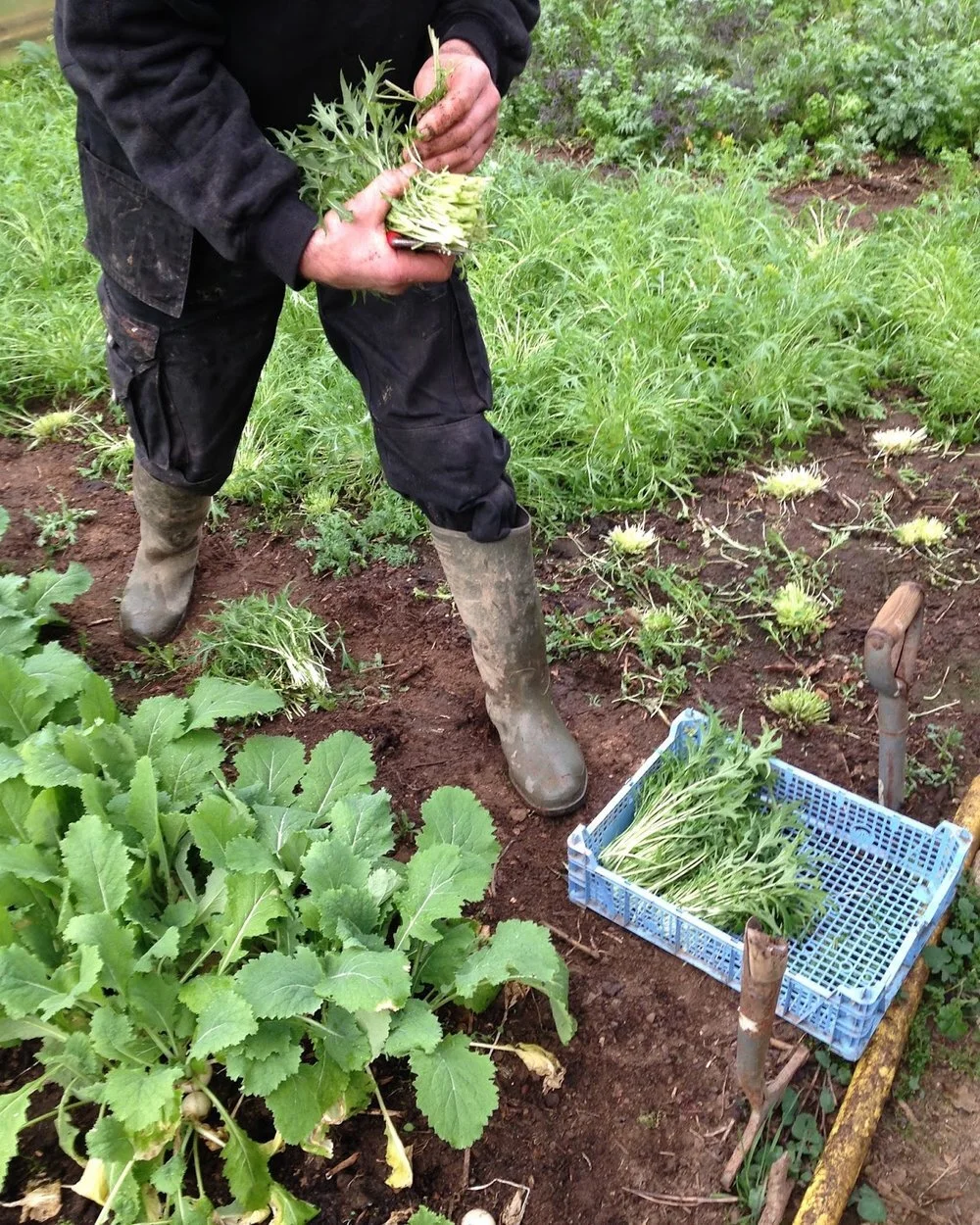

I spent the next four days eating massive amounts of green veg, which made me extremely happy.
It was a lot of fun - massive thanks to Robin for having us, and Tom at the Brighton Japan Club for organising!
As well as locally, Namayasai supplies lots of famous Japanese restaurants in London, and Robin and Ikuko also run a vegetable box scheme with collection points around Sussex which I now have my eye on.
They have lots of info about the veg box, the farm itself and work/volunteer opportunities on their website - please do check it out!

Originally posted 10 March 2017
Updated 31st March 2020
End-of-term Sushi Night! Easter 2018
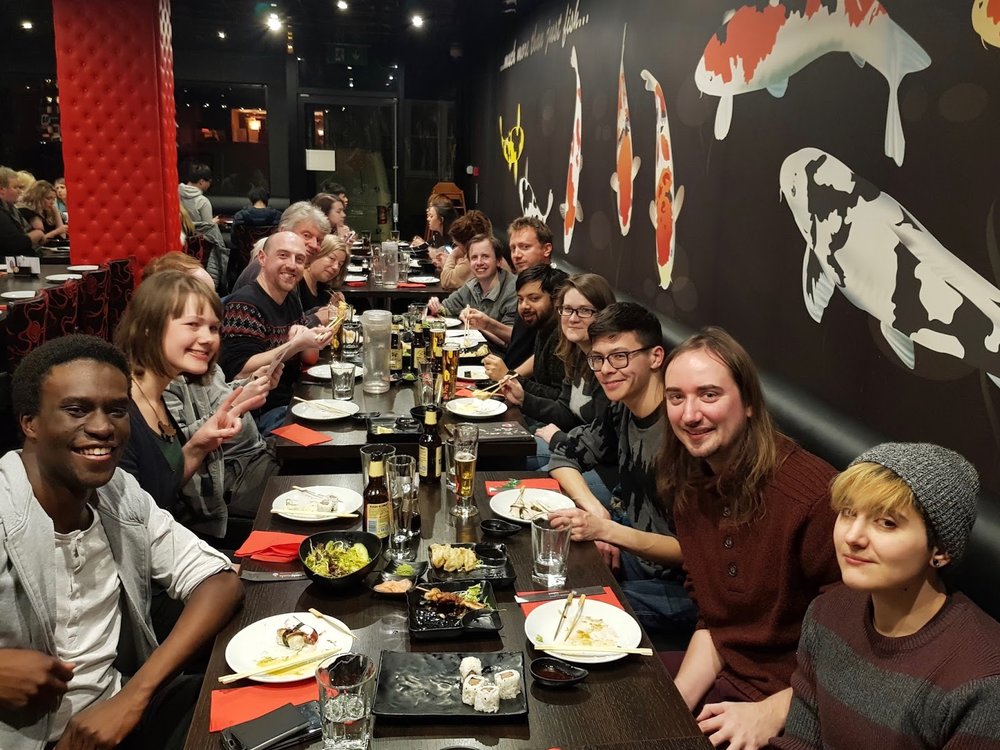
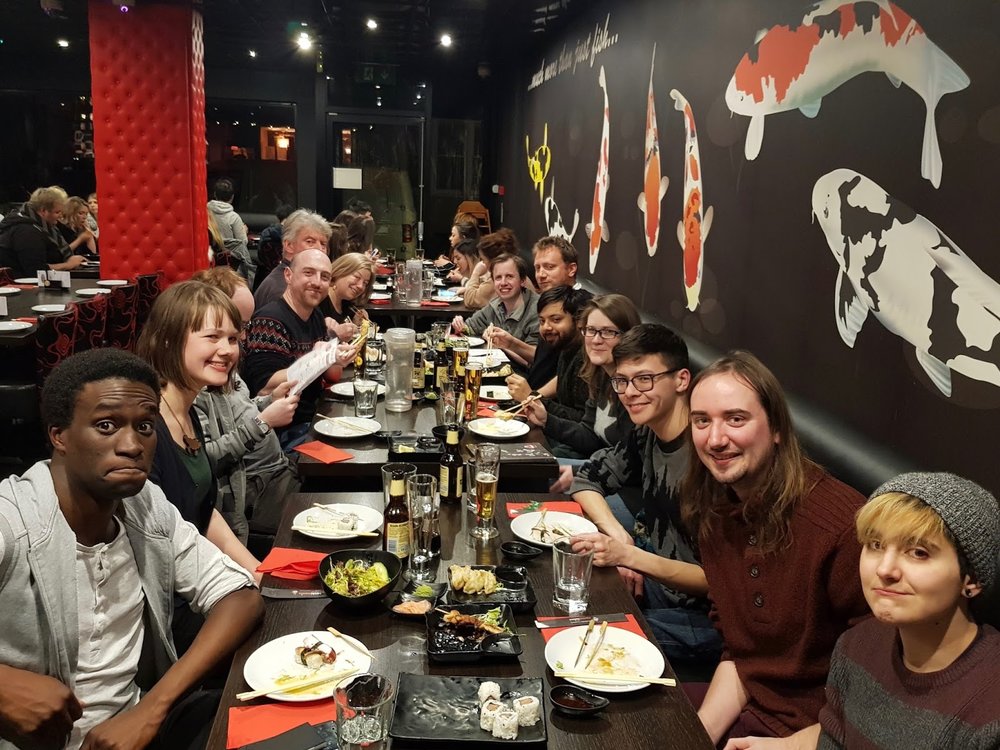


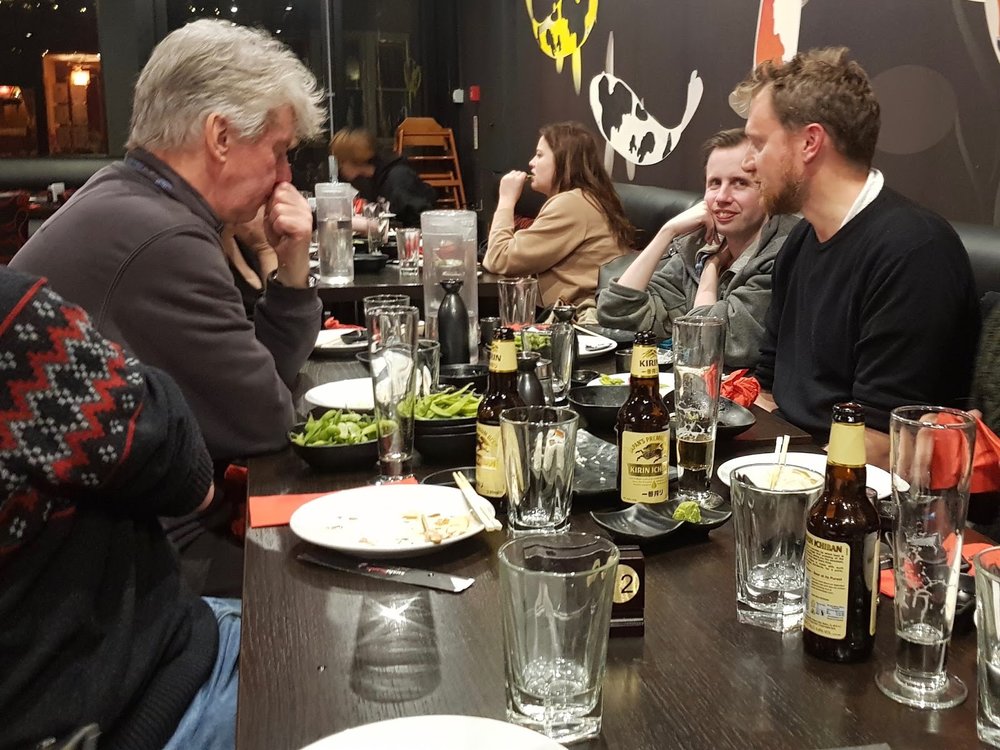
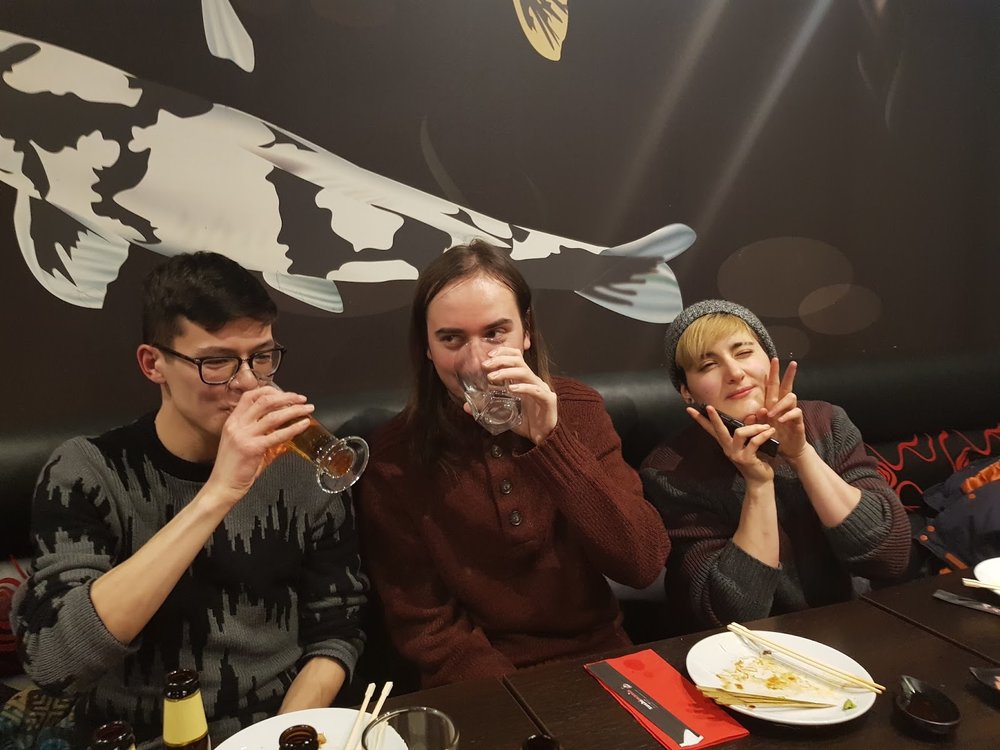

Thanks for coming!
Where shall we go for our next (non-academic) event?

Christmas Party 2017!
Brrrrrrrr, it's cold. Or as they say in Japan, ブルブル "buruburu".
We escaped from the cold snap on Friday night with a Christmas noodle party!

Brrrrrrrr, it's cold. Or as they say in Japan, ブルブル "buruburu".
We escaped from the cold snap on Friday night with a Christmas noodle party!
↓ Off to E-Kagen on Sydney Street. Spot the Step Up Japanese students...

We started the night off with a film title quiz: guess the (non-Japanese) film title from its Japanese translation.
Everybody did well, but there were a few tricky ones in there too.
↓ Intense concentration.


↓ Special thanks to Phil for making an appearance despite having to rush off to host his own event the same night!

It wouldn't be a Christmas party without crackers - these ones had Japan-themed jokes in them too.


I have just realised I didn't take any pictures of the food. Pictures of people are much nicer, don't you think?
The food was great though!
E-Kagen has a real family-style feel, and an open kitchen so you can see your dinner being prepared.
↓ Full bellies. Massive thanks to all the staff at E-Kagen for hosting such a big group of us.

↓ Excellent Christmas jumpers.

↓ Off to the pub for a mulled wine. Or as they say in Japan, ホットワイン ("hotto wain").


↓ Impromptu kanji practice.


Thanks for another great year everyone! It's an absolute pleasure to work with such wonderful students.
メリークリスマス (Merry Christmas) - and stay warm!


Afternoon Tea at Café an-an for World Vegan Day
I was a vegetarian for ten years…then, I moved to Japan. I lasted about two weeks as a vegetarian in Japan, before swiftly abandoning my principles in favour of late-night ramen and fish for breakfast.
That's not to say that being vegetarian - or even vegan - in Japan is impossible. It just wasn't for me. But did you know that lots of wagashi (Japanese sweets) are naturally vegan?
I hadn't really thought about it, until I learned that Cafe an-an in Portslade was running an Afternoon Tea event for World Vegan Day on 1st November.
Here are some pictures of the tasty food I managed to take on the day - before I ate it all.

2021 update: Cafe an-an has moved! Now at 94 Boundary Rd, Hove BN3 4EF. Make sure to pop in and chat some Japanese with Noriko-san while you buy your sweets. She's always very welcoming! The cafe’s opening hours are changeable, so check their Facebook or Instagram before making a trip.
I was a vegetarian for ten years…then, I moved to Japan. I lasted about two weeks as a vegetarian in Japan, before swiftly abandoning my principles in favour of late-night ramen and fish for breakfast.
That's not to say that being vegetarian - or even vegan - in Japan is impossible. It just wasn't for me.
But did you know that lots of wagashi (Japanese sweets) are naturally vegan?
I hadn't really thought about it, until I learned that Cafe an-an in Portslade was running an Afternoon Tea event for World Vegan Day on 1st November.
Here are some pictures of the tasty food I managed to take on the day - before I ate it all.
I got there super early, partly because I got the bus, and partly because I was trying to run on "Japan time", i.e., if you're not early, you're late.
Cafe an-an is run by the lovely Noriko-san, who you can see selling Japanese sweets at lots of events around Brighton.
I meant to get a picture with Noriko too, but she was very busy cooking! Next time...
Anyway, we arrived and were presented with this cute handwritten menu.
Today's reading practice for you! ↓
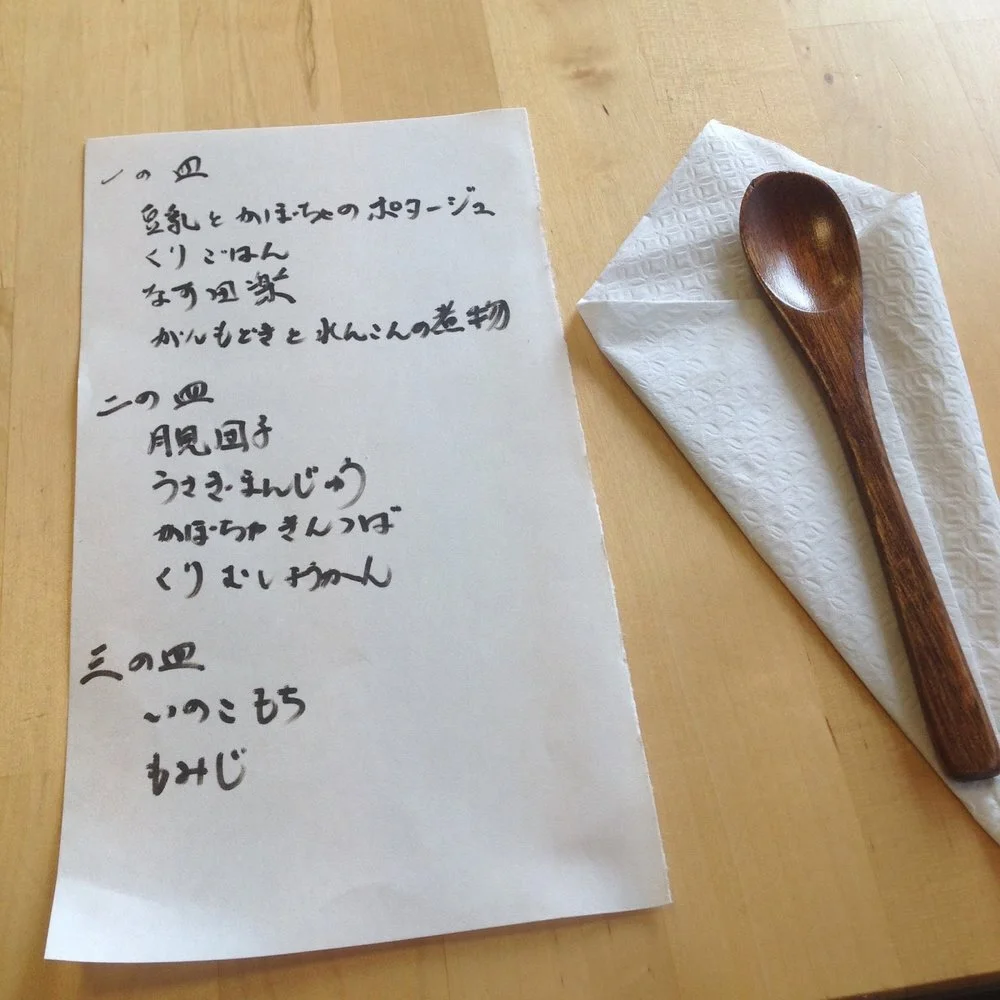
We started the Afternoon Tea with a little soy milk and pumpkin soup. Then chestnut rice, nasu dengaku (glazed aubergine), and ganmodoki (tofu fritters) with lotus root.
You can see from the picture how small the aubergine is. It's a proper tiny Japanese one - sweet and delicious.
I haven't had aubergine that good in a long time...

Next, the sweet bit!Tsukimi dango ("moon-viewing dumplings"), and steamed chestnut yōkan (a jellied sweet made with agar) - that's the purple triangle below.
And pumpkin kintsuba - that's the orange slice that looks a bit like a piece of brie.
Kintsuba is another type of Japanese sweet, popular with people who like their sweets a bit less sweet.

The last little course was i-no-ko mochi ("baby boar rice cake"). Tasty, and of course it doesn't contain any boar...baby or otherwise.
And lastly, we had an awesome little maple leaf shaped sweet. Isn't it pretty?

Finally, my little rabbit manjuu (steamed bun) filled with anko (red bean paste).
He was almost too cute to eat, but I ate him head first.

I felt pretty sorry for the cute bunny. But at least he's vegan! Unlike me...
2021 update: Café an-an has moved! Now at 94 Boundary Rd, Hove BN3 4EF. Make sure to pop in and chat some Japanese with Noriko-san while you buy your sweets. She's always very welcoming! The cafe’s opening hours are changeable, so check their Facebook or Instagram before making a trip.
First published November 2017. Updated August 2021.
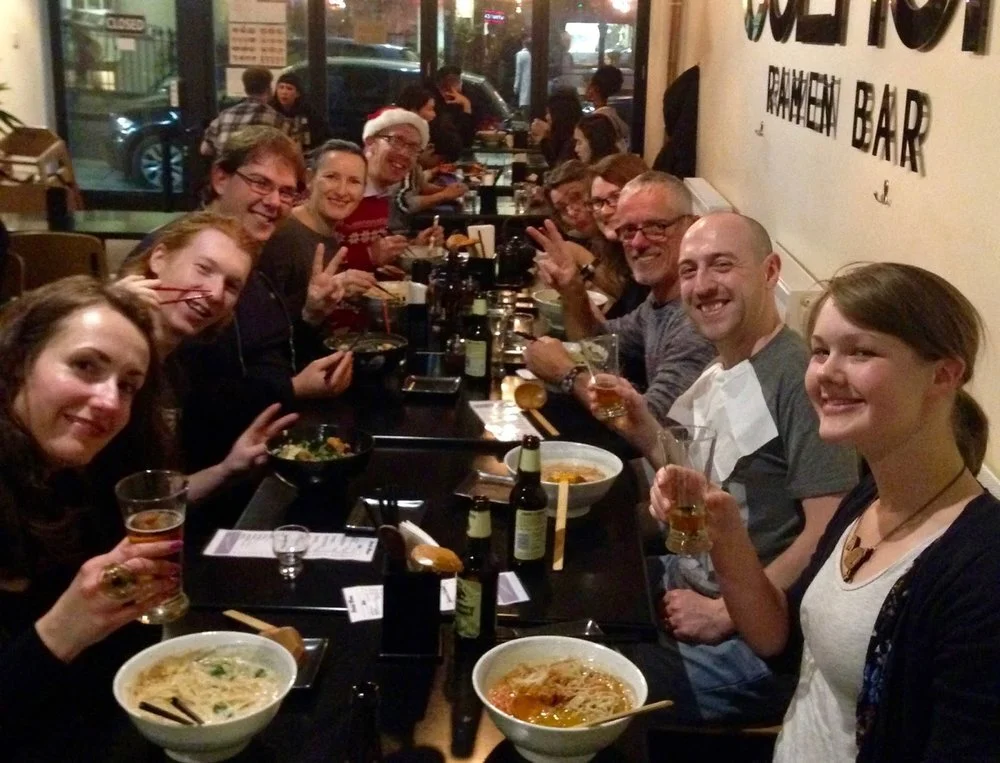
First Annual Step Up Japanese Christmas Party
We went to Goemon - arguably the home of Brighton's best ramen - at the end of term for a celebratory bowl of noodles. The inaugural Step Up Japanese Christmas party!
I wanted to introduce my students in different classes to each other, and to celebrate what you've all achieved in 2016.
Oh, and to eat ramen. I love ramen.
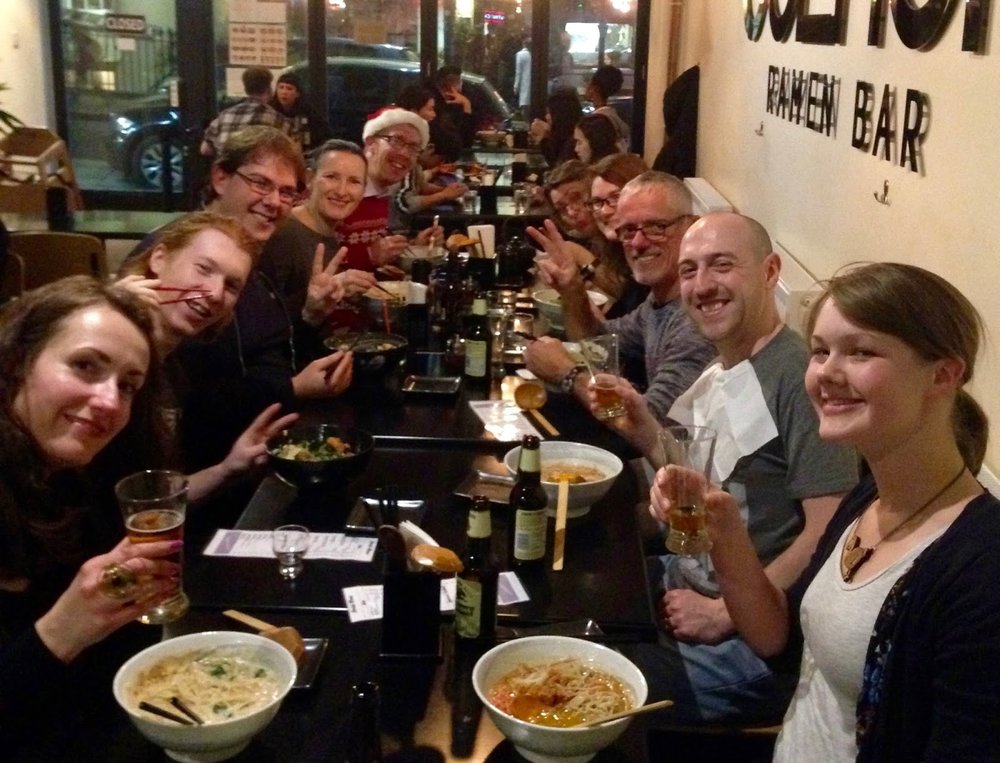
We went to Goemon - arguably the home of Brighton's best ramen - at the end of term for a celebratory bowl of noodles. The inaugural Step Up Japanese Christmas party!
I wanted to introduce my students in different classes to each other, and to celebrate what you've all achieved in 2016.
Oh, and to eat ramen. I love ramen.
I didn't take many photos (oops - too busy having a nice time!) but here they are:
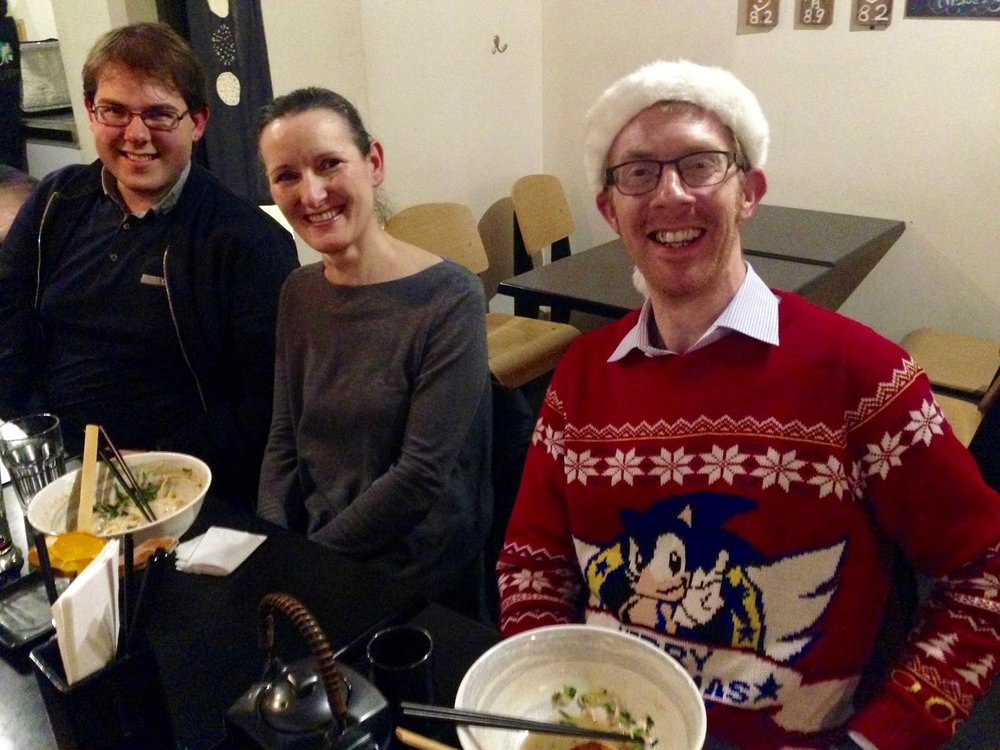


↓ (I know it's blurry but I think it catches the mood! Do you know how to say "blurry" in Japanese?)

Not one to miss a "teachable moment", I also wanted to encourage everybody to order in Japanese.
So we practiced in class the week before. Ordering in restaurants is probably one of the most useful things you can learn how to do in another language.
Everyone ordered confidently, the staff were super helpful, and I was (am!) a very proud teacher.

Thanks SO MUCH for all your support over the last year! メリークリスマス!














Like many people in the UK, I studied French in school. I liked French. I thought it was really fun to speak another language, to talk with people, and to try and listen to what was going on in a new country. (Still do!)
When I was 14 we went on a school exchange to the city of Reims, in northeastern France. I was paired with a boy, which I’m sure some 14-year-olds would find very exciting but which I found unbearably awkward. He was very sweet and we completely ignored each other.
That was nearly 20 years ago, and I didn’t learn or use any more French until, at some point in lockdown, I decided on a whim to take some one-to-one lessons with online teachers. Here are some things I learned about French, about language learning, and about myself.