
Welcome to the Step Up Japanese blog archive!
Although I’m not currently adding new posts to the blog, you’ll find plenty of Japanese learning tips, study advice, and resources to explore here.
Browse the blog index to view a complete list of posts.
For the latest news, course updates, and Japanese learning tips from Step Up Japanese, sign up for my newsletter.
Search this blog:

A Year of Monthly Japanese Learning Challenges
How do you keep practising Japanese, even when it doesn’t seem relevant? How do you stay motivated, when your life and your motivations change?
At the beginning of 2019, I decided to set myself a series of monthly Japanese study challenges. I’d do one every other month, and blog about it.
In January, I tried to speak Japanese every day for a month. This was probably the hardest challenge, from a logistical perspective. I don’t live in Japan, and we don’t speak Japanese at home (much). At the time, I was also working another job three days a week, where I wasn’t using Japanese at all. So speaking Japanese every day was, quite literally, a challenge.

How do you keep practising Japanese, even when it doesn’t seem relevant? How do you stay motivated, when your life and your motivations change?
At the beginning of 2019, I decided to set myself a series of monthly Japanese study challenges. I’d do one every other month, and blog about it.
In January, I tried to speak Japanese every day for a month. This was probably the hardest challenge, from a logistical perspective. I don’t live in Japan, and we don’t speak Japanese at home (much).
At the time, I was also working another job three days a week, where I wasn’t using Japanese at all. So speaking Japanese every day was, quite literally, a challenge.
But this was a great start to the year and probably one of my favourite things I’ve done using Japanese. Plus, I got to eat katsu curry at cafe an-an in Portslade and chalk it up as Japanese practice:
I Tried to Speak Japanese Every Day for a Month (Without Being in Japan)

In March, I tried shadowing every day.
What is shadowing? Most people are familiar with “listen and repeat” in language learning contexts. You listen to a conversation line-by-line and repeat each sentence after the recording.
Shadowing is different from simple “listen and repeat” in that you start speaking while the person on the audio is still talking. The goal is to be able to produce the dialogue with perfect pronunciation, as close to the recorded audio as possible.
I really enjoyed this challenge, and I also discovered that you can practise shadowing (quietly) in hotel rooms, waiting rooms, and even on the bus.
What is Shadowing and Can it Improve Your Spoken Japanese? I Tried Shadowing Every Day for a Month

In May, I read Japanese books every day. This was really fun, too, and not so hard once I got into a routine. If you get in the habit of taking a book with you everywhere you go, reading every day is relatively easy:
How to Read More in Japanese – I Tried Reading in Japanese Every Day for a Month

In July, I decided to play Japanese video games every day for a month, because who says challenges have to be challenging?
I played Japanese video games for about 20 minutes a day for a month, and here’s what I learned: six reasons to play video games in a foreign language.
This is not a “how to” post. I’m not going to tell you how to “learn Japanese in a week just by playing video games” or to claim this is a “quick route to fluency” (it’s not, namely because there is no quick route to fluency, just an endless and potentially very enjoyable road trip).
Instead, I’m just going to share some reflections on the very fun experience that was playing Japanese video games every day.
How to Practise Japanese by Playing Video Games Every Day

(IMAGE SOURCE: NINTENDO)
In September, I tried to watch Japanese TV every day. This is where the monthly challenges really started to come unstuck. September was a busy month, and life got in the way.
I also discovered that when a challenge isn’t very challenging, I don’t personally find it very motivating!
One fantastic thing that came out of this experience, however, was the idea for my new course Learn Japanese with Netflix! … but then covid-19 happened, which meant the Netflix course only ran for a few weeks. I hope to run it, or a similar course, again in the future.
Watching Japanese TV Every Day for a Month (Or, What to Do When Things Don't Go To Plan)

After that I took a two month break, and then in December, I got well and truly back on the horse, and spent a month practising handwriting kanji from memory every day.
I really enjoyed the routine of practising kanji again. I find kanji practice surprisingly relaxing - and I mentioned this to some students, who also said they find kanji writing practice relaxing, even meditative. Little and often is probably key.
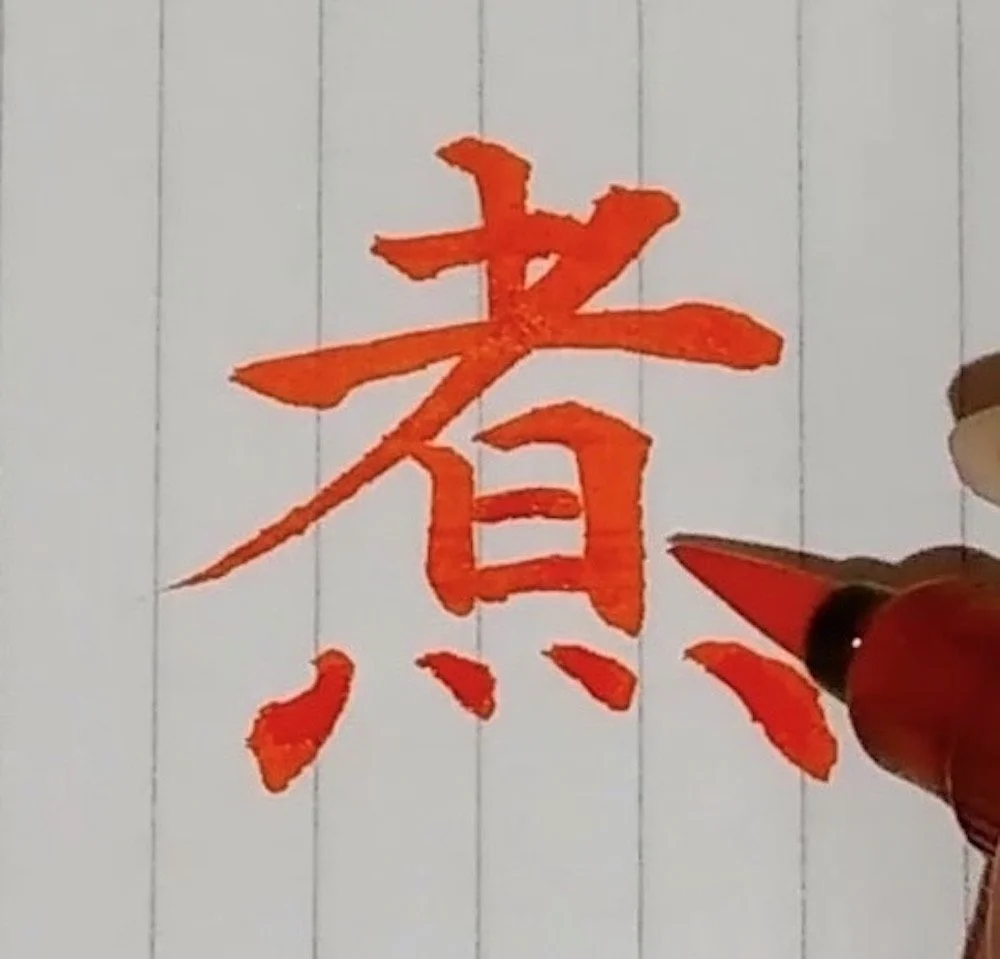
"How Did You Learn Kanji?"

What next?
The process of setting bi-monthly goals was a stimulating and enjoyable experience, and I might repeat it another year, but I’m not doing monthly challenges in 2020.
We’re a few months into 2020, and due to covid-19, this year is already shaping up to be significantly more challenging than 2019.
2020 has already proved to be a year of radical change, for students at Step Up Japanese as well as for people all over the world. In March 2020 I moved all lessons online - another new challenge, but an enjoyable one.
I hope you stay healthy and safe throughout 2020, and that if Japanese study is a part of your life at the moment, that you enjoy it and have fun. And if life gets in the way sometimes….that’s okay too.
What is Shadowing and Can it Improve Your Spoken Japanese? I Tried Shadowing Every Day for a Month
“I can read it and understand it, but I can’t speak like that!”
…Does this sound familiar?
Almost all language learners feel that their production (speaking and writing) is not as strong as their comprehension (listening and reading). This is normal, but it’s still frustrating.
One method that is supposed to improve your listening and speaking is shadowing.
I’d heard of shadowing before, and I’d seen Japanese language learning resources devoted to it – but I’ve never tried it. I decided to try this every day for a month, and see what impact it had.

“I can read it and understand it, but I can’t speak like that!”
…Does this sound familiar?
Almost all language learners feel that their production (speaking and writing) is not as strong as their comprehension (listening and reading). This is normal, but it can be very frustrating.
One method that is supposed to improve your listening and speaking is shadowing.
I’m a Japanese teacher, but as a non-native speaker, I’m a Japanese learner too. I’m confident with my spoken Japanese, but like everybody I stumble over my words sometimes. And I’m aware that my spoken Japanese will never feel quite the same as my native language does.
Earlier in the year, while trying to speak Japanese every day for a month (without being in Japan), I went on a deep dive into Japanese pitch accent.
(Pitch accent In brief: Japanese has high-low tones, and pronouncing a word with the wrong pitch accent pattern makes you sound unnatural.)
I started watching the fantastic “Japanese Phonetics by Dogen” series on YouTube. Dogen recommends two key ideas to improve your spoken Japanese:
1) Record yourself and listen back to the recording, checking for speech errors
2) Practise shadowing every day
I’d heard of shadowing before, and I’d seen Japanese language learning resources devoted to it – but I’ve never tried it. I decided to try this every day in March, and see what impact it had.
I was hoping to improve my phonetic awareness (like most non-native speakers, I had never explicitly learned Japanese pitch accent before this). I also hoped that shadowing practice would work a bit like warm-up exercises to speaking, allowing me to speak more quickly without losing accuracy.
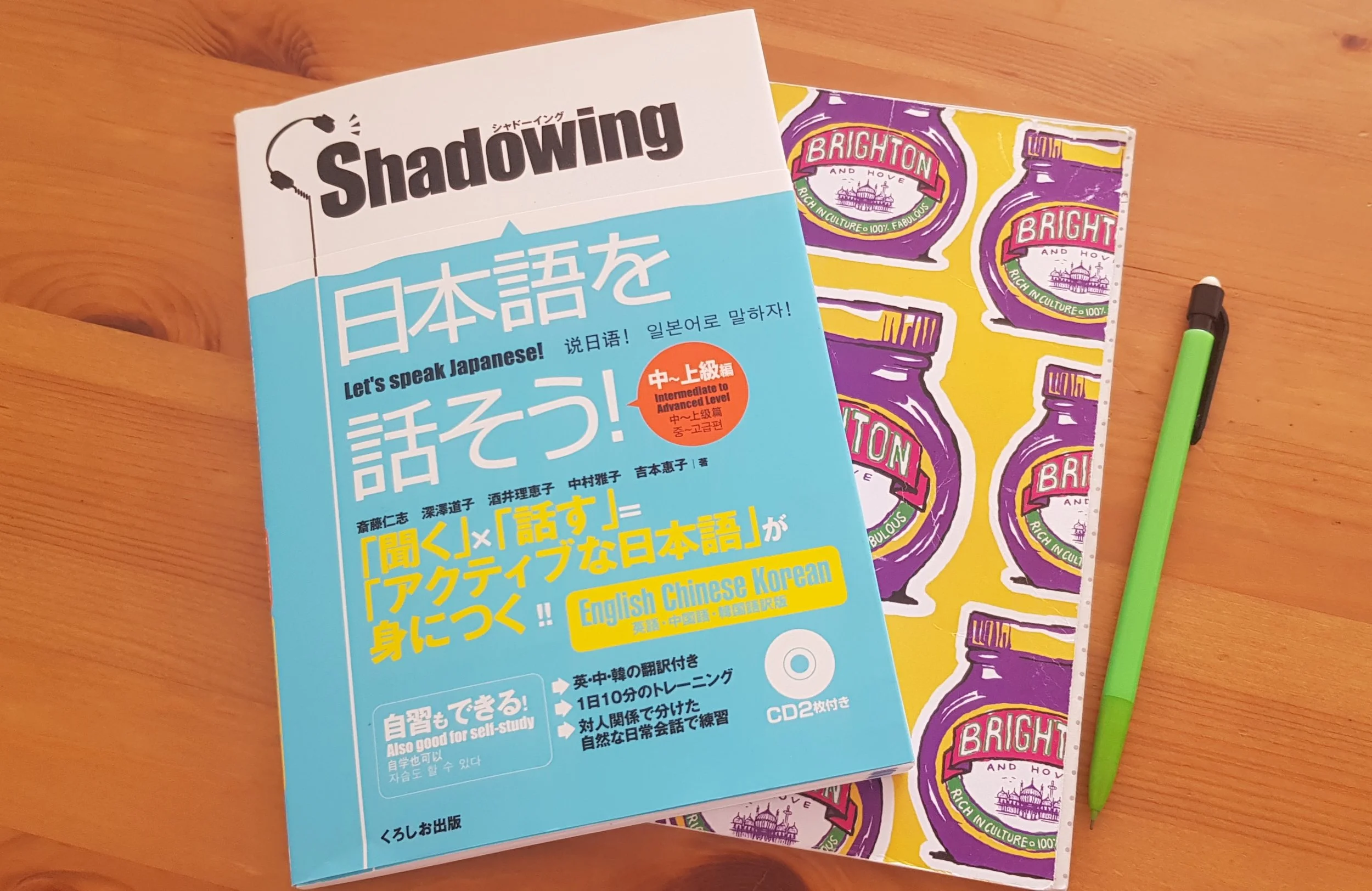
I didn’t have to look far to find a great shadowing resource – there is a popular book and CD combo called Shadowing: Let's Speak Japanese. It comes in two levels - beginner/intermediate, and intermediate/advanced. I ordered the latter from Amazon Japan, and followed the directions in the book. Every day for a month!
What is shadowing?
Most people are familiar with “listen and repeat” in language learning contexts. You listen to a conversation line-by-line and repeat each sentence after the recording.
Shadowing is different from simple “listen and repeat” in that you start speaking while the person on the audio is still talking. You echo the speaker 1 or 2 seconds after they speak, and talk over them.
If you tried to do this with long-form listening materials, even in your native language, it would be impossible – you’d get lost. And you wouldn't gain much phonetics or speaking practice by doing this.
So in shadowing, you use very short passages. The goal is to be able to produce the dialogue with perfect pronunciation, as close to the recorded audio as possible.
To do that, we need to break the process down into steps.
The book I bought was quite prescriptive, which at first seemed intimidating but in practice I found very helpful.
It suggests practising shadowing for 10 minutes a day, and doing one section o of the book (about 10 short conversations of about 4-5 lines each) continuously for 2-3 weeks.
So that’s what I did, following this process from the book to the letter.
How to do shadowing - step by step:
1) Find material at the right level for shadowing. Specifically, choose a short dialogue that is easy to read and understand, but difficult to say with fluency.
[Note from me (Fran): If you already have a Japanese textbook you’re using, you don’t need to buy a separate shadowing book. Use the short dialogues in your textbook.]
2) Listen to the audio and/or read the script, checking that you understand the conversation and looking up any words or expressions you don't know. You’re going to be repeating this conversation over and over, so it’s important that you understand what you’re saying, or the exercise is pointless.
3) Listen to the script and follow along with your finger.
4) Listen to the script and repeat the dialog in your head, without vocalising. That’s right – without speaking or moving your lips, silently repeat the dialogue a few seconds after the speaker.
5) Listen while visually following the script, and say the dialogue aloud a few seconds after the speaker. You’ll be talking over them.“The objective…is to keep up with natural speed, so think of it as a work out for your mouth when you practise.”
6) Without looking at the script, play the audio and say the dialogue aloud a few seconds after the speaker.
7) Without using the script, shadow the audio while thinking about the meaning of the conversation. Think about the emotions of the people in the conversation and the context.
Shadowing moves words and phrases from your passive to your active vocabulary
I followed a few steps from this process every day for at least 10 minutes. In a month, I did two sections of the shadowing book.
That’s not very much, really – 25 or 30 short conversations. But I felt like the words and phrases wormed their way into my spoken Japanese.
Here are a few examples:
1) I was talking to a friend about British weather, and the word 土砂降り(doshaburi, downpour) came out of my mouth. I’ve seen, heard and read that word before. But I don't think it’s ever been a part of my active spoken vocabulary.
2) I went for coffee with a Japanese friend and we were talking about something I feel quite sceptical about, when the phrase そうかな… (sou ka na? “I don’t think so?”) popped out of my mouth. Again, I’ve heard Japanese people say that phrase. But I don't think I’ve ever actually said it before.
Shadowing moved these words from my passive vocabulary into my active vocabulary. I kind of own them now – they’re part of my speech.
This shows how important it is to choose shadowing material that fits the way you want to speak. And it’s a good example of why you probably shouldn't shadow anime, unless you want to sound like a pirate or a robot cat.

Record yourself!
I also watched about half of Dogen’s Japanese Phonetics series on YouTube and made notes. I started to get into the habit of looking up the pitch accent of words I wasn't sure about.
And I recorded myself speaking, and listened back to it, comparing it line by line to the recording.
Like most people, I don't even like listening to recordings of myself in my native language. So listening to myself speak Japanese was quite painful. But I definitely noticed speaking habits I have that I didn't know I had, and little mistakes I didn't know I was making.
The downside of recoding yourself (as opposed to just shadowing) is that recording yourself and listening back to it takes about three times as long as just shadowing would.

Give it a go!
I found it easier to speak over the dialogue wearing headphones. But because shadowing involves talking to yourself, you can’t really do it on public transport. That being said, I found it relatively easy to squeeze 10 minutes of practice into my day. I did it before work, or afterwards when I got home.
Shadowing has its critics (if you want to read more about that, google “does shadowing work?”). But if you want to improve your spoken Japanese, I really recommend that you give it a try. I feel like it worked for me. Maybe it’ll work for you too?
Like me, you might find your vocabulary for British weather expanding! Or you might learn a new way to be sceptical. Same thing really.
Links:
Amazon links with an asterisk* are affiliate links, which means I may earn a small commission, at no extra cost to you, when you click through and buy the book. Thanks for your support!
Japanese Phonetics by Dogen https://www.youtube.com/watch?v=jakXVEUTT48 (some of these fantastic videos are free; the complete series is available to Dogen’s Patreon supporters)
Shadowing: Let's Speak Japanese! Beginner to Intermediate (Book & Audio CD) https://amzn.to/2XSzW0H *
Shadowing: Let's Speak Japanese! Intermediate to Advanced Level (Book & Audio CD) https://amzn.to/2XQCwEk *
Please note that both books are likely to be slightly cheaper on Amazon Japan:
シャドーイング-日本語を話そう-初〜中級編 https://www.amazon.co.jp/シャドーイング-日本語を話そう-初〜中級編-斎藤-仁志/dp/4874243541/
シャドーイング-日本語を話そう-中~上級編 https://www.amazon.co.jp/シャドーイング日本語を話そう-中~上級編-斎藤仁志;深澤道子;酒井理恵子;中村雅子;吉本惠子/dp/4874244955/
















Like many people in the UK, I studied French in school. I liked French. I thought it was really fun to speak another language, to talk with people, and to try and listen to what was going on in a new country. (Still do!)
When I was 14 we went on a school exchange to the city of Reims, in northeastern France. I was paired with a boy, which I’m sure some 14-year-olds would find very exciting but which I found unbearably awkward. He was very sweet and we completely ignored each other.
That was nearly 20 years ago, and I didn’t learn or use any more French until, at some point in lockdown, I decided on a whim to take some one-to-one lessons with online teachers. Here are some things I learned about French, about language learning, and about myself.