
Welcome to the Step Up Japanese blog archive!
Although I’m not currently adding new posts to the blog, you’ll find plenty of Japanese learning tips, study advice, and resources to explore here.
Browse the blog index to view a complete list of posts.
For the latest news, course updates, and Japanese learning tips from Step Up Japanese, sign up for my newsletter.
Search this blog:
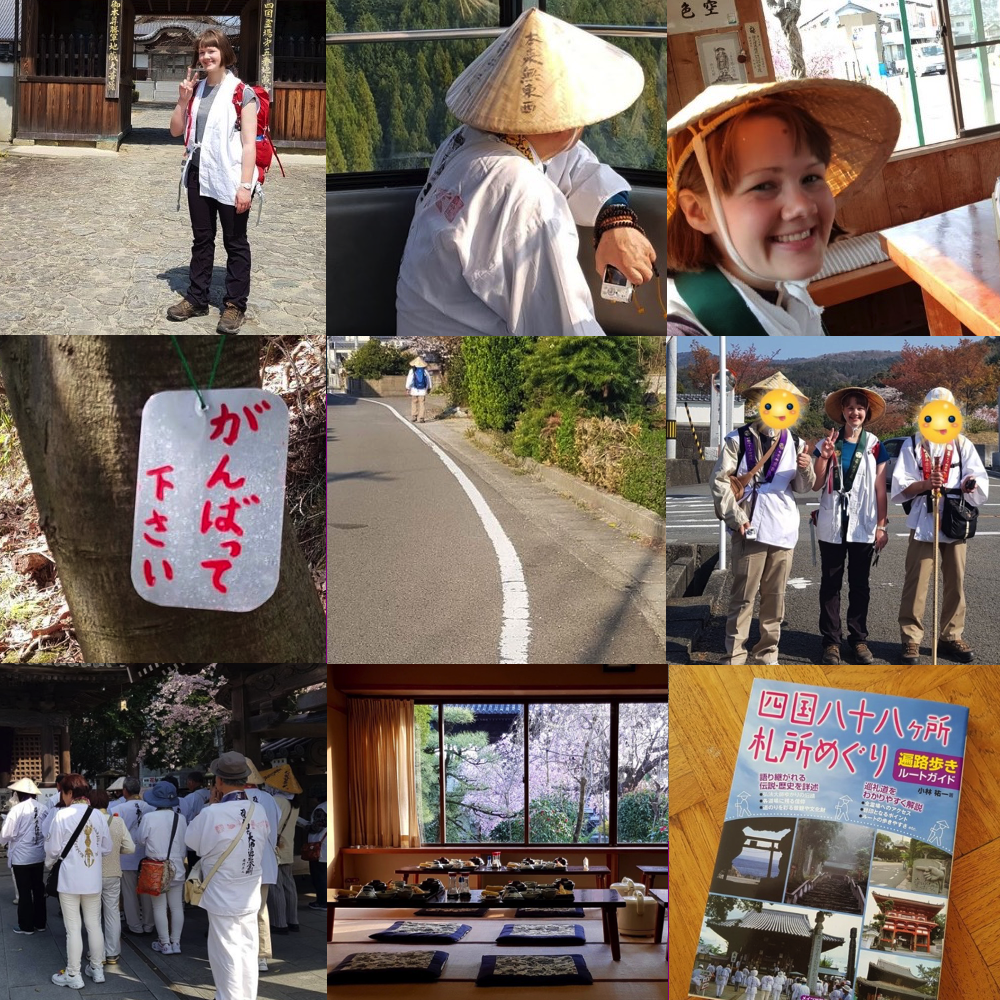
Hiking the Shikoku 88 Pilgrimage Trail in 2018 - A Round-Up
The week I spent last spring walking the first leg of the Shikoku 88 pilgrimage trail was peaceful, thought-provoking, and challenging - often all at once.
Here’s all my writing about that trip in one place.

The week I spent last spring walking the first leg of the Shikoku 88 pilgrimage trail was peaceful, thought-provoking, and challenging - often all at once.
Here’s all my writing about that trip in one place.
Part 1 - Plan, plan, plan!

Are you a planner? Or a no-planner?
Some people like to "wing it" when they travel. They book a ticket and turn up, deciding what to do once they arrive. Me, I like to have things planned out. Especially when the trip involves a week of solo walking in Japan…
Click here to read Part 1 - Plan, plan, plan!
Part 2 - The Best First Day in Japan

Spoiler alert: this post isn't about the Shikoku pilgrimage, although it is about the same trip. It's about what I did with my spare first day in Nagoya: the lost day...
Arriving first thing in the morning on a long-haul flight is not ideal. You're tired, jet-lagged and yet you need to stay awake until a normal bedtime, so you can adjust your body clock.
I had almost 12 hours to kill on that first day, and was waiting for my friends to finish work.
So what do you do with a whole day to yourself?
Ciick here to read Part 2 - The Best First Day in Japan
Part 3 - What To Wear

When I told my Japanese friends I was planning to walk the Shikoku Henro trail, several of them said the same thing. "Are you going to wear a hat?"
For many people, the image of a walker in a bamboo hat is the first thing that comes to mind when they think of the pilgrimage.
But what "should" you wear on the Shikoku 88, a Buddhist pilgrimage trail?
Click here to read Part 3 - What To Wear
Part 4 - How to Talk to Strangers in Japanese

A stranger, they say, is just a friend you haven't met yet.
And talking to strangers is a great way to speak lots of Japanese. I did lots of this while walking the first section of the Shikoku pilgrimage this spring.
But how do you start a conversation with a stranger? Here are some ideas to get you going, even if you're a beginner at Japanese.
Click here to read Part 4 - How to Talk to Strangers in Japanese
Part 5 - Signs of Shikoku

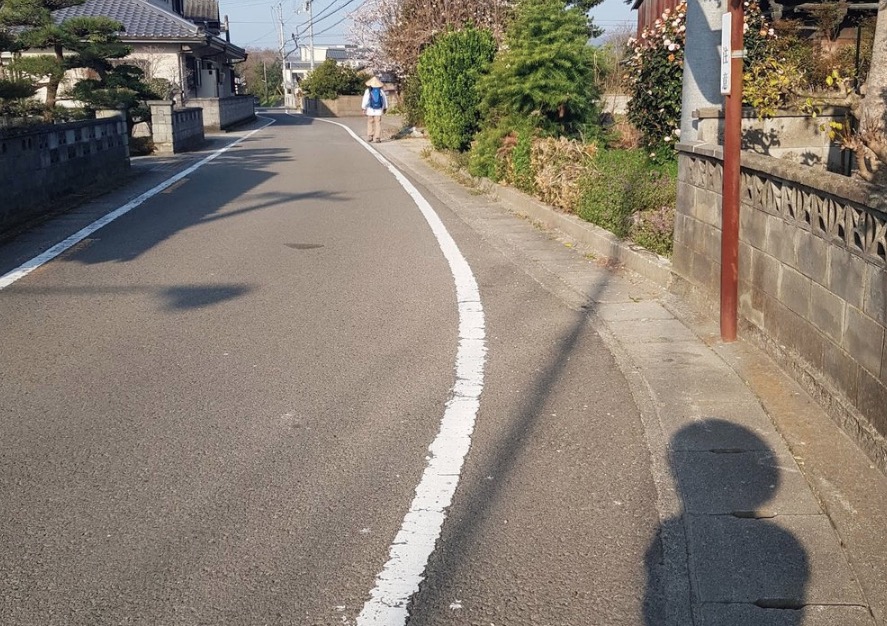
I heard lots of "gambatte kudasai" (“keep going!”) walking the first leg of the Shikoku 88 pilgrimage this spring. It was written everywhere too - in fact there were lots of interesting signs.
The pilgrimage trail is pretty well marked. Signage is consistently spaced, and in many places there's a way-marker every 100 metres.
But it's also endearingly inconsistent in design - on some stretches every sign is different, and many are handmade….
Click here to read Part 5 - Signs of Shikoku
Part 6 - Shouting at the French
"Sumimaseeeeeeeeeeeeeeen!" I shouted. ("Excuse me!")
The couple turned round, but they didn't move.
They were both dressed in full pilgrim garb: long white clothes, their heads protected by conical hats.
"Otoshimono desu!" ("You dropped this!")
They stared at me blankly. I waved the little grey bag with its digital camera inside. "KAMERA!"
I still couldn't make out their faces, but I thought I saw a glimmer of recognition. One of the pair walked towards me, and it was only then that I saw her face.
"I thought you were Japanese," she said, and I heard a European accent I couldn't place.
"I thought you were Japanese," I said…
Click here to read Part 6 - Shouting at the French
Part 7 - Five Types of Rest Stop You'll Find Hiking In Shikoku

Kyūkei shimashou" (休憩しましょう) is one of the first phrases I teach all my students, and it means "let's take a break".
Rest is every bit as important as activity - perhaps more important. In class, it helps you digest and absorb ideas.
And on a long-distance walk, rest stops (called kyūkeijo 休憩所 in Japanese) can be a good place to
strike up a conversation.
Click here to read Part 7 - Five Types of Rest Stop You'll Find Hiking In Shikoku
Part 8 - O-settai, or, "I'll treasure this tissue case"

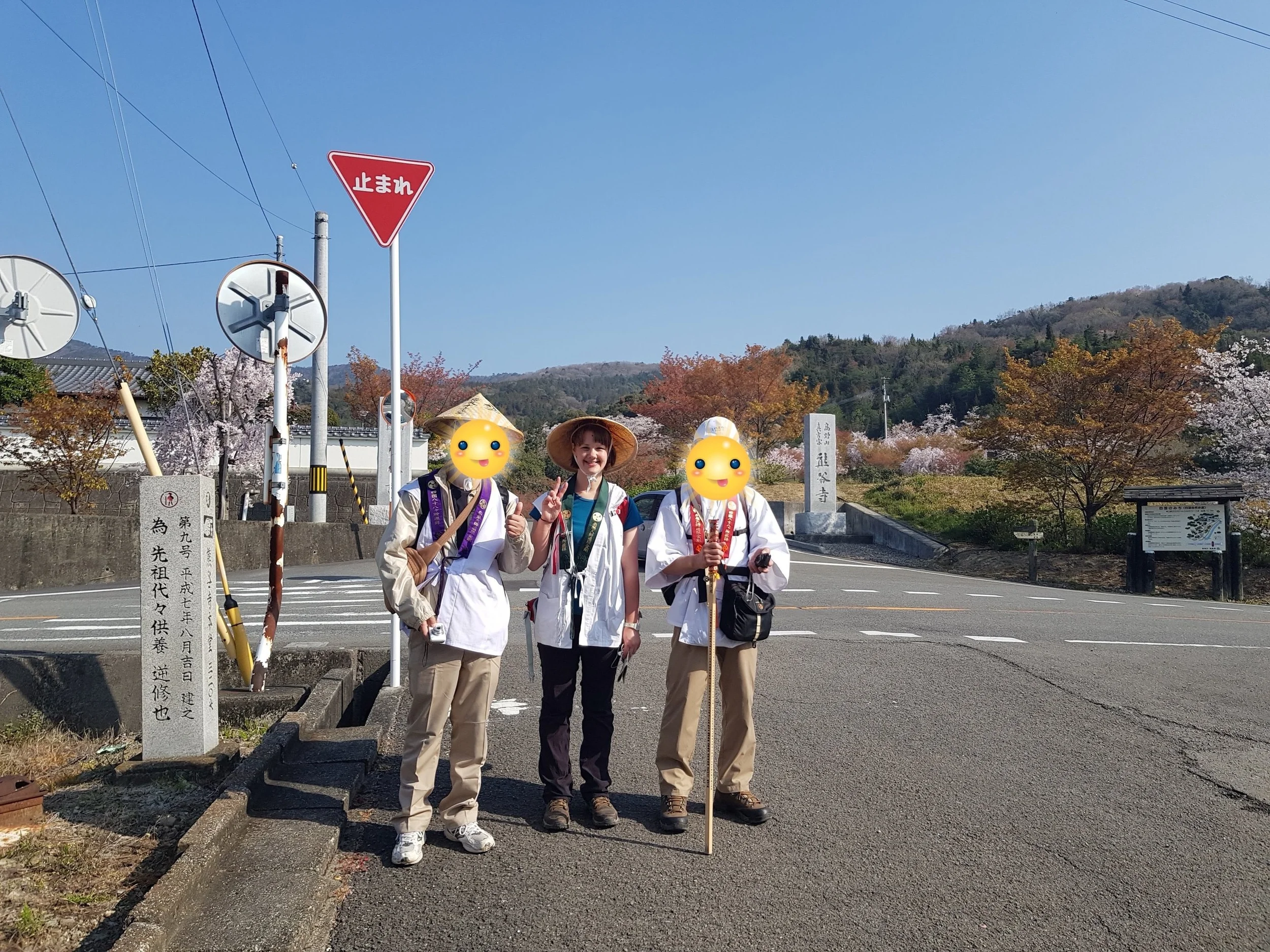
Near Kumadani-ji, temple number 8, we had stopped in front of some glorious cherry blossom, and I got chatting to two older gentlemen who were walking the trail. One told me he had never spoken to a gaijin-san, foreigner, before. We took some pictures in front of the cherry blossom, and walked up the hill together.
Further up the road, a lady came out of her house and gave us some hard-boiled sweets.
The sweets were a form of o-settai, small gifts given to walking pilgrims. Traditionally, pilgrims didn't carry money, so they were helped along their way by gifts of food, lodging and other acts of generosity from local people.
“Wait here,” she said when she saw me, “I have something else for you.”
Click here to read Part 8 - O-settai, or, "I'll treasure this tissue case"
Part 9 - Eating Shōjin Ryōri - Buddhist temple food

The “strange” meals were “quite unlike any food I’ve ever tasted”, wrote one visitor to the Sekishoin Shukubo temple in Mount Kōya, eliciting the blunt reply from one monk:
“Yeah, it’s Japanese monastic cuisine you uneducated fuck.”
Guests online also complained about the lack of heating in the Buddhist temple, the absence of English tour guides, and “basic and vegetarian” food.
I stayed in a couple of shukubo (宿坊) earlier this year…
Click here to read Part 9 - Eating Shōjin Ryōri - Buddhist temple food
Thanks so much for reading! I hope you found it useful and/or interesting.
I can’t wait to go back and walk the next bit…

Walking the Shikoku 88 Pilgrimage (Part 8) - O-settai, or, "I'll treasure this tissue case"
Near Kumadani-ji, temple number 8, we had stopped in front of some glorious cherry blossom, and I got chatting to two older gentlemen who were walking the trail. One told me he had never spoken to a gaijin-san, foreigner, before.
(The cynic in me wonders if that’s really true, or if by “foreigner” he meant “white person”…)
We took some pictures in front of the cherry blossom, and walked up the hill together.
Further up the road, a lady came out of her house and gave us some hard-boiled sweets ...
“Wait here. I want to give you o-settai.”
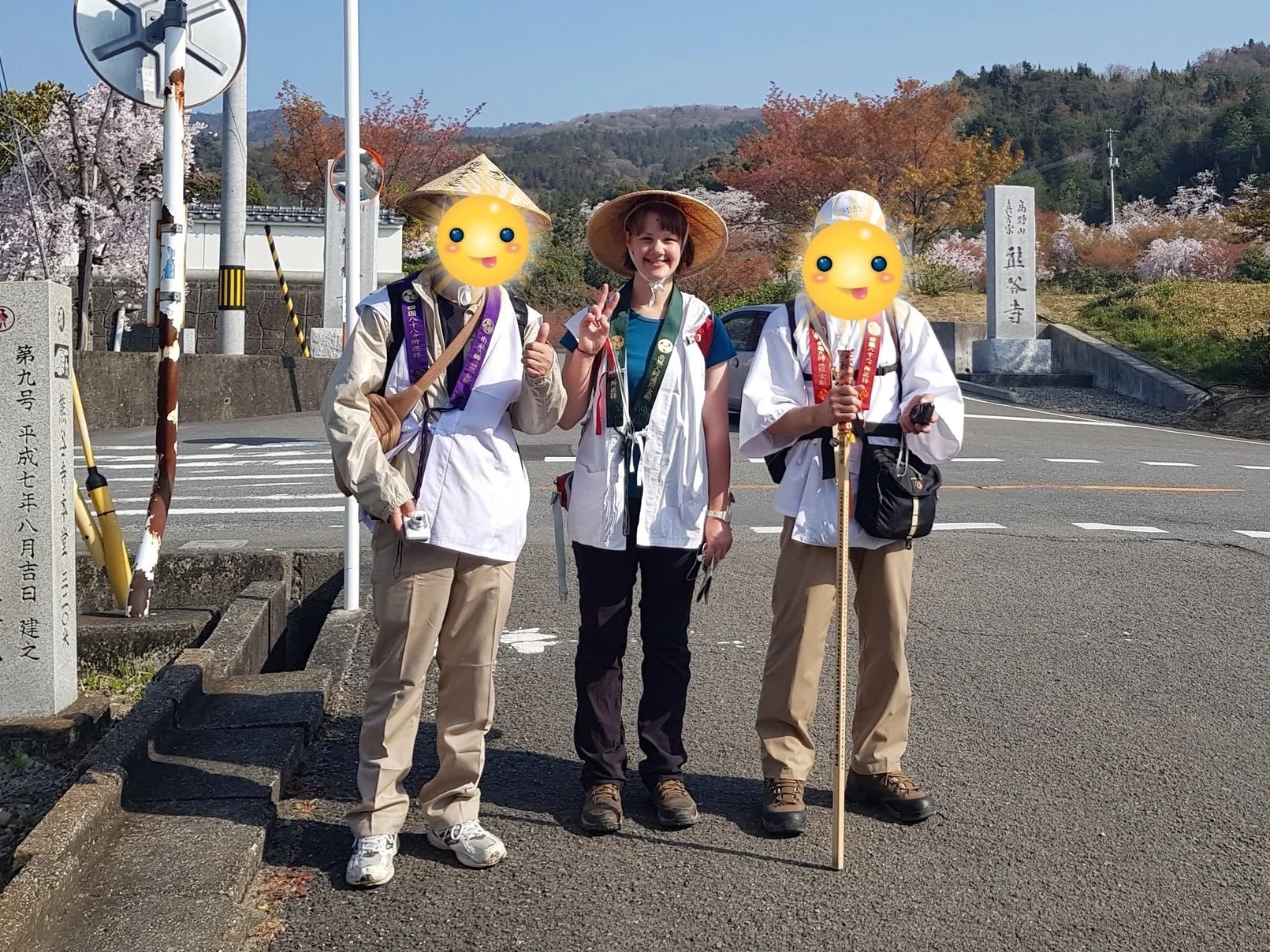
Near Kumadani-ji, temple number 8, we had stopped in front of some glorious cherry blossom, and I got chatting to two older gentlemen who were walking the trail. One told me he had never spoken to a gaijin-san, foreigner, before.
(The cynic in me wonders if that’s really true, or if by “foreigner” he meant “white person”…)
We took some pictures in front of the cherry blossom, and walked up the hill together.
Further up the road, a lady came out of her house and gave us some hard-boiled sweets.
The sweets were a form of o-settai, small gifts given to walking pilgrims. Traditionally, pilgrims didn't carry money, so they were helped along their way by gifts of food, lodging and other acts of generosity from local people.
“Wait here,” she said when she saw me, “I have something else for you.”
She came back with a colourful children’s section of the newspaper – a visual guide to the Shikoku pilgrimage, with readings for the kanji characters written above in hiragana.
It was several years old. I wondered if she had been saving it for a passing foreigner.
I briefly considered attempting to refuse it: I already had a good map, and I can read kanji, so I didn't need a children’s guide. The next non-Japanese person she met might have more use for it.
But explaining that would have felt arrogant, and you’re supposed to accept o-settai graciously, so I thanked her, and we went on our way.

The next day, I heard it again. “Wait here. I want to give you o-settai.”
I was alone this time. I had stopped to rest on a fading bench outside a children’s centre, and was enjoying my first iced can coffee in a couple of years.
There were no houses on this side of the road, but an elderly lady had come out of her house and crossed the busy road to strike up a conversation with me.
She referred to herself in the third person as obaa-chan, grandmother. She was 82.
The obaa-chan had walked the whole pilgrimage twice, she told me, and had hoped to do it a third time.
“But I’m too old to walk it again now, so I give o-settai instead.”
She went back into the house, and I saw her in the front room with a cardboard box. She did look frail. I wondered if I should follow her over the road so she didn't have to cross it again, but I didn't want to intrude.
“I must have given out hundreds of these,” she said proudly when she came back.
Inside the box were dozens of cotton tissue cases, in all different colours, each with a small packet of tissues inside.
“Did you make these?”
“Of course! Choose one.”
I picked out one with black cats sitting by front doors.
“Thank you very much. I’ll take good care of it.”
The tissue case had a secondary compartment, and inside that was a paper insert. It was a photocopy of handwriting - guidance for living a good life. “I like these words, so I included them too,” she added.
“When you use it, please remember the 82-year-old obaa-chan from Shikoku.”
The tissue case has travelled 6000 miles with me back to England, but I haven’t opened the tissues yet. I’m know she wanted me to use it; but I just want to keep it safe.
It smells faintly of incense.
I think about the obaa-chan sewing tissue cases. I wonder if she waits by the window in pilgrimage season – spring and autumn – waiting for walkers to pass by.
She gave me much more than a tissue case. She made me feel welcome, and showed me kindness. Perhaps that’s what o-settai is…? It’s about human connection. It’s not about things, it’s about people.
I’ll treasure this tissue case, I promise.

Related posts:
Walking the Shikoku 88 Pilgrimage (Part 1) - Plan, plan, plan!
Walking the Shikoku 88 Pilgrimage (Part 2) - The Best First Day in Japan
Walking the Shikoku 88 Pilgrimage (Part 3) - What To Wear
Walking the Shikoku 88 Pilgrimage(Part 4) - How to Talk to Strangers in Japanese
Walking the Shikoku 88 Pilgrimage (Part 5) - Signs of Shikoku
Walking the Shikoku 88 Pilgrimage (Part 6) - Shouting at the French
Walking the Shikoku 88 Pilgrimage (Part 7) - Five Types of Rest Stop You'll Find Hiking In Shikoku
And also: "I treasure this pen case"















Like many people in the UK, I studied French in school. I liked French. I thought it was really fun to speak another language, to talk with people, and to try and listen to what was going on in a new country. (Still do!)
When I was 14 we went on a school exchange to the city of Reims, in northeastern France. I was paired with a boy, which I’m sure some 14-year-olds would find very exciting but which I found unbearably awkward. He was very sweet and we completely ignored each other.
That was nearly 20 years ago, and I didn’t learn or use any more French until, at some point in lockdown, I decided on a whim to take some one-to-one lessons with online teachers. Here are some things I learned about French, about language learning, and about myself.