
Welcome to the Step Up Japanese blog archive!
Although I’m not currently adding new posts to the blog, you’ll find plenty of Japanese learning tips, study advice, and resources to explore here.
Browse the blog index to view a complete list of posts.
For the latest news, course updates, and Japanese learning tips from Step Up Japanese, sign up for my newsletter.
Search this blog:
Even More Japanese Loanwords From Languages That Aren't English
Last time I talked about Japanese loanwords - words that Japanese has “borrowed” from other languages - which come from languages other than English.
But there are also some tricky loanwords that look and sound like they came from English - but they didn’t!

Last time I talked about Japanese loanwords - words that Japanese has “borrowed” from other languages - which come from languages other than English.
But there are also some tricky loanwords that look and sound like they came from English - but they didn’t!
Challenge time!
Don’t be fooled. These loanwords look and sound a bit like they came from English - but they didn’t! Can you guess what languages these loanwords come from?
(Hint: not English!)
Koohii コーヒー coffee
Zero ゼロ zero
Pompu ポンプ pump
Botan ボタン button
Koppu コップ cup
Sarada サラダ salad
Kokku コック cook
Scroll down for the answers…!

The Answers:
Did you guess what non-English languages these loanwords come from?
Koohii コーヒー coffee - Portuguese
Zero ゼロ zero - French
Pompu ポンプ pump - Dutch; Flemish
Botan ボタン button - Portuguese
Koppu コップ cup - Dutch; Flemish
Sarada サラダ salad - Portuguese
Kokku コック cook - Dutch; Flemish
Students often ask why there are so many Portuguese and Dutch loanwords in Japanese. Words from these two languages have been used as loanwords in Japanese since the 16th and 17th centuries, when both countries established trade with Japan.
So, just because that katakana word you’ve learned looks like English, doesn’t mean it came from English!

What is the Japanese Calendar, and what year is it?
Did you know that Japan has its own numbering system for the years? As well as the Gregorian calendar (the same calendar used in the west, the one that says it's 2019 now), Japan uses another system which names years after the reign of the emperor.
(The western calendar is commonly used too - and the two systems can be used interchangeably.)
So, what's the date?

Did you know that Japan has its own numbering system for the years? As well as the Gregorian calendar (the same calendar used in the west, the one that says it's 2019 now), Japan uses another system which names years after the reign of the emperor.
(The western calendar is commonly used too - and the two systems can be used interchangeably.)
So, what's the date?
After Emperor Naruhito ascended to the Japanese throne on 1st May 2019, the new Japanese era Reiwa (令和) began.
This means that 2019 has two different names in Japanese: the first part is named after the previous era. And the second part is named after the new era.
So the period between 1st January and 30th April 2019 was 平成31年 (heisei sanjuuichi nen; Heisei 31).
And the period from 1st May to 31st December 2019 is 令和1年 (reiwa ichi-nen; Reiwa 1) or 令和元年 (reiwa gan-nen; gan-nen being a special word referring to the first year of an imperial reign).
1st June 2019, therefore, can be written in Japanese as:
令和1年6月1日
Reiwa ichi-nen roku-gatsu tsuitachi
(Japanese dates go from big to small: year → month → day)
Or even just as:
1/6/1
Cool, huh?
A year in seven days
Emperor Hirohito died in the 64th year of his reign, on 7th January 1989. So the "year" Showa 64 was only seven days long. The rest of 1989 (from January 8th onwards) got the name Heisei 1.
Date-spotting in Japan
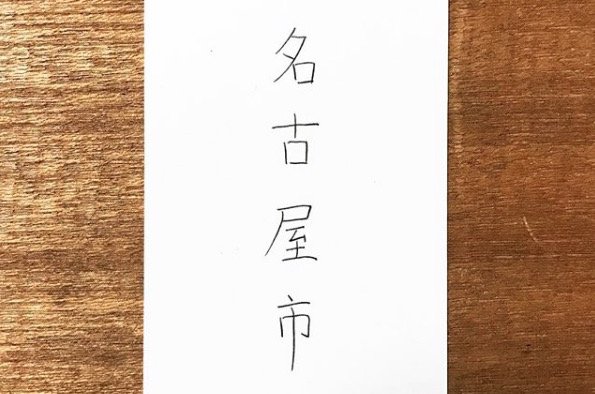
The Japanese date system is commonly used in New Year’s greetings. You might see the year written in kanji on a New Year’s card too.
Can you read the year on this card?

Image source: yubin-nenga.jp
You can also see the Japanese year on coins and banknotes in Japan.
What year is this from?

Image: Wikipedia
You don't need to memorise the dates of all the emperors, though (unless you want to). There are apps and online converters that will tell you any year in the Japanese equivalent.
Should we start calling 2019 “Elizabeth 67”?
If this all seems strange, remember that we do this in other languages, too.
When we talk about "the Victorian era" (the years of Queen Victoria’s rule) or “the Victorians” (people who lived during that time), that's basically the same thing.
We just don’t name the individual years after the current ruler. We could if we wanted, though, I guess...?
Top image source: Wikipedia
First Annual Step Up Japanese Christmas Party
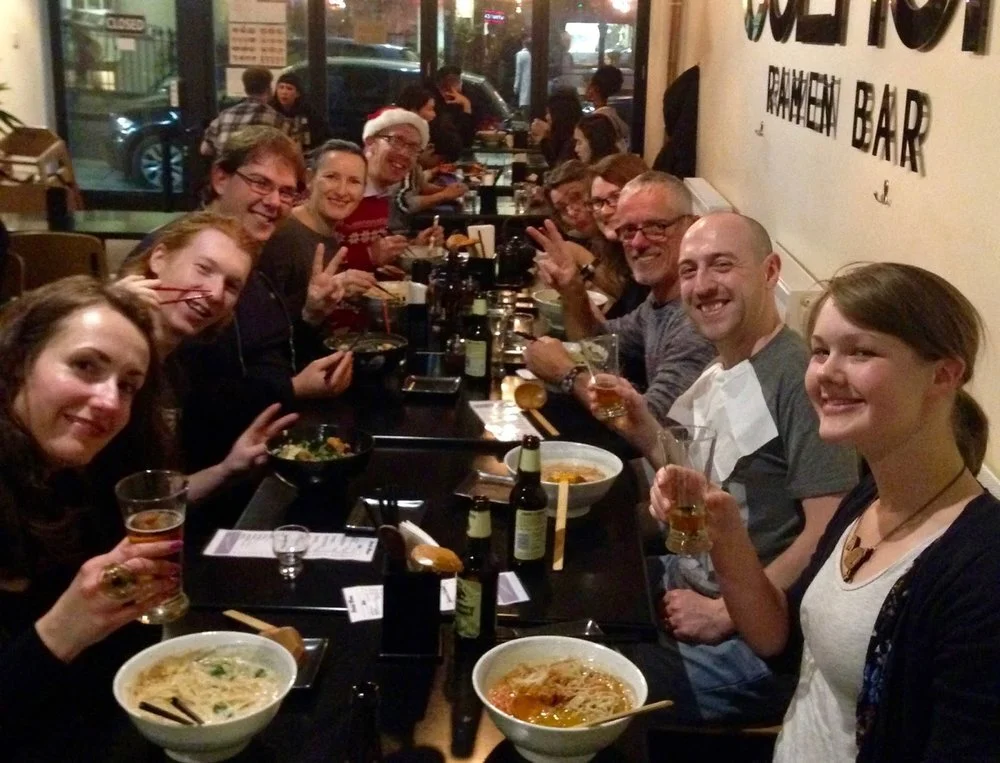
We went to Goemon - arguably the home of Brighton's best ramen - at the end of term for a celebratory bowl of noodles. The inaugural Step Up Japanese Christmas party!
I wanted to introduce my students in different classes to each other, and to celebrate what you've all achieved in 2016.
Oh, and to eat ramen. I love ramen.
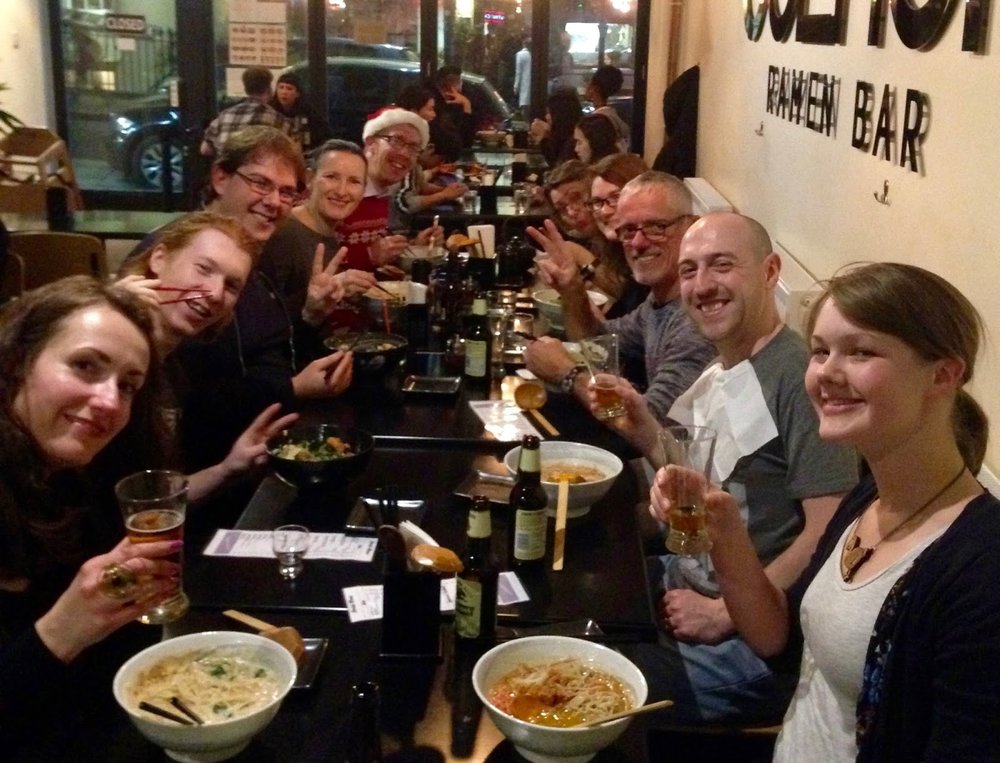
We went to Goemon - arguably the home of Brighton's best ramen - at the end of term for a celebratory bowl of noodles. The inaugural Step Up Japanese Christmas party!
I wanted to introduce my students in different classes to each other, and to celebrate what you've all achieved in 2016.
Oh, and to eat ramen. I love ramen.
I didn't take many photos (oops - too busy having a nice time!) but here they are:
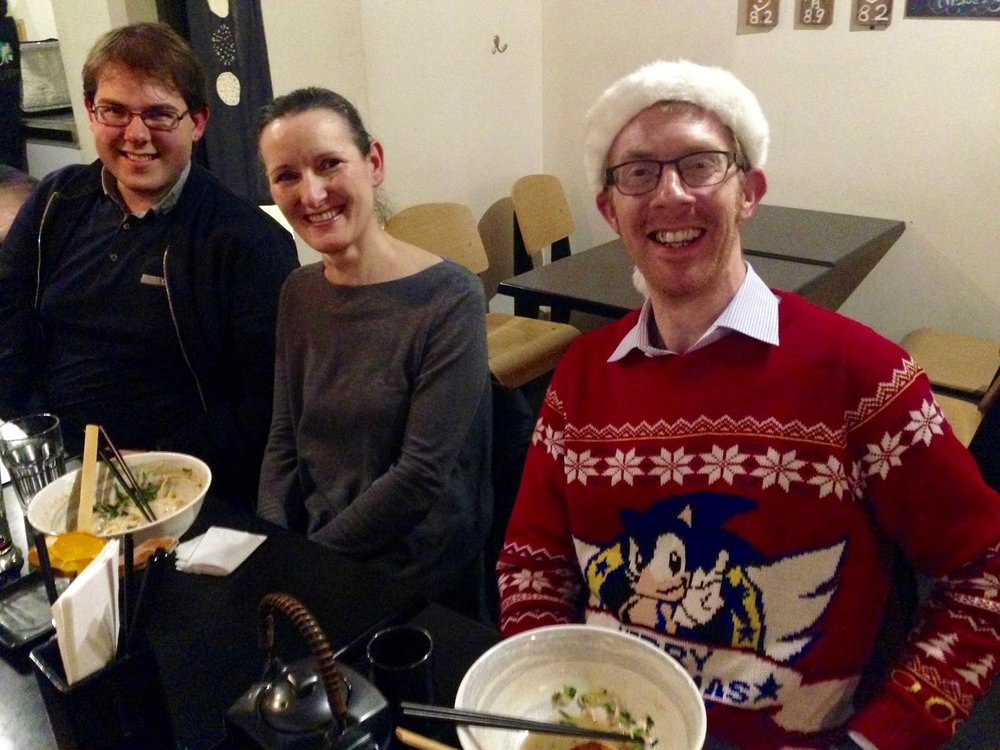
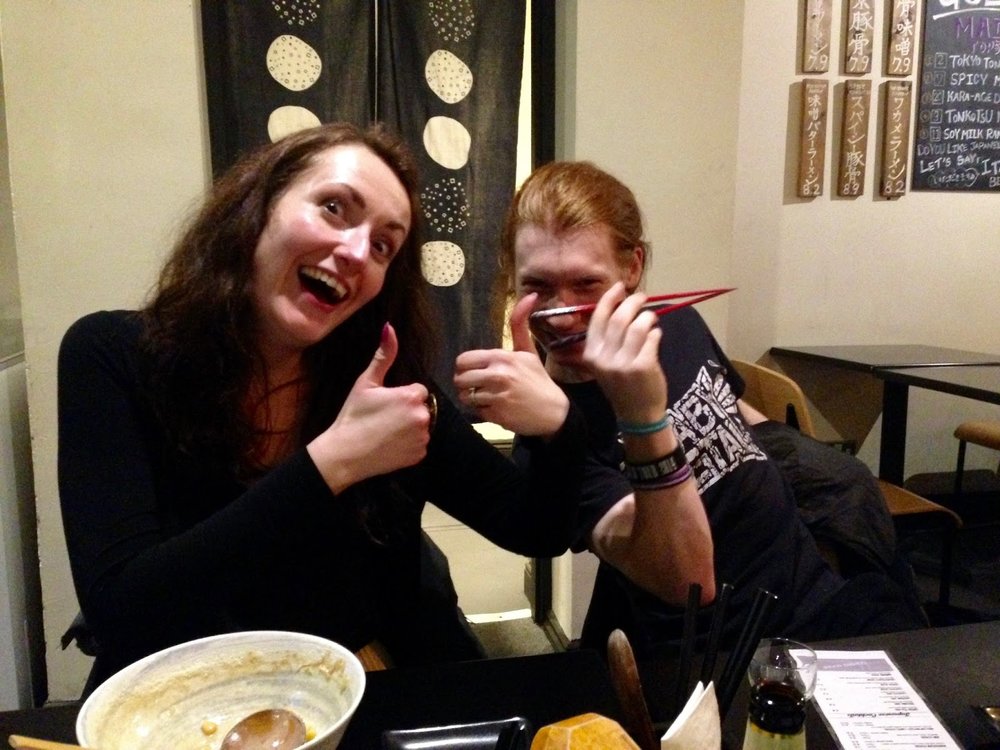

↓ (I know it's blurry but I think it catches the mood! Do you know how to say "blurry" in Japanese?)

Not one to miss a "teachable moment", I also wanted to encourage everybody to order in Japanese.
So we practiced in class the week before. Ordering in restaurants is probably one of the most useful things you can learn how to do in another language.
Everyone ordered confidently, the staff were super helpful, and I was (am!) a very proud teacher.

Thanks SO MUCH for all your support over the last year! メリークリスマス!













Like many people in the UK, I studied French in school. I liked French. I thought it was really fun to speak another language, to talk with people, and to try and listen to what was going on in a new country. (Still do!)
When I was 14 we went on a school exchange to the city of Reims, in northeastern France. I was paired with a boy, which I’m sure some 14-year-olds would find very exciting but which I found unbearably awkward. He was very sweet and we completely ignored each other.
That was nearly 20 years ago, and I didn’t learn or use any more French until, at some point in lockdown, I decided on a whim to take some one-to-one lessons with online teachers. Here are some things I learned about French, about language learning, and about myself.