
Welcome to the Step Up Japanese blog archive!
Although I’m not currently adding new posts to the blog, you’ll find plenty of Japanese learning tips, study advice, and resources to explore here.
Browse the blog index to view a complete list of posts.
For the latest news, course updates, and Japanese learning tips from Step Up Japanese, sign up for my newsletter.
Search this blog:
How Do You Say "Nice to Meet You" in Japanese?
Hurray! You've met another Japanese-speaking person. Time to introduce yourself.
But how do you say "It's really nice to meet you" in Japanese? The first phrase you'll want is:
はじめまして。Hajimemashite. "Nice to meet you"
Hajimemashite literally means "we are meeting for the first time". So you can only use it the first time you meet someone.

Hurray! You've met another Japanese-speaking person. Time to introduce yourself.
But how do you say "Pleased to meet you" in Japanese?
The first phrase you'll want is:
はじめまして。
Hajimemashite.
"Nice to meet you"
Hajimemashite (almost literally) means "we are meeting for the first time". So you can only use it the first time you meet someone.
The other super-useful phrase is:
よろしくおねがいします。
Yoroshiku onegai shimasu.
"Please be kind to me."
Yoroshiku onegai shimasu is hard to translate, but means something like "please be kind to me".
It means that you are looking forward to having a good relationship with someone.
Shop “Nice To Meet You” Japanese necklaces (Step Up Japanese x designosaur):

Make it more polite
Add douzo to make your greeting more polite:
どうぞよろしくおねがいします。
Douzo yoroshiku onegai shimasu.
"Nice to meet you" (polite & a bit formal)
You could also say:
お会いできてうれしいです。
O-ai dekite ureshii desu.
"I'm happy to meet you." (more polite & formal)
or even:
お会いできて光栄です
O-ai dekite kouei desu.
"I'm honoured to meet you." (even more polite & formal)
Keep it casual
If you don't feel like being so polite, you could also say:
どうぞよろしく。
Douzo yoroshiku.
"Nice to meet you" (a bit more casual)
よろしくね。
Yoroshiku ne.
"Nice to meet you" (very casual)
It's good to be nice-mannered when you meet new people though, right?
"Nice to meet you too!"
Last but not least, when someone says yoroshiku onegaishimasu, you can add the feeling of "me too!" by replying with kochira koso ("me too!"):
こちらこそ宜しくお願いします。
Kochira koso yoroshiku onegaishimasu.
"No, I'm pleased to meet you." / "The pleasure is mine."
Now, go and find someone new to speak to, and tell them how pleased you are to meet them.
Yoroshiku ne!
Shop “Nice To Meet You” Japanese necklaces (Step Up Japanese x designosaur):

Updated 26th Oct 2020
What to Write in Japanese New Year's Cards
Every year, Japanese households send and receive New Year’s postcards called nengajō (年賀状). The cards are sent to friends and family, as well as to people you have work connections with.
If you post your cards in Japan before the cut-off date in late December, the postal service guarantees to deliver them on January 1st.
Every year, Japanese households send and receive New Year’s postcards called nengajō (年賀状). The cards are sent to friends and family, as well as to people you have work connections with.

Image: yubin-nenga.jp
If you post your cards in Japan before the cut-off date in late December, the postal service guarantees to deliver them on January 1st.
Card designs often feature the Chinese zodiac animal of the new year. For example, 2016 was the year of the monkey, so lots of designs that year included monkeys!

Cards sold in shops or at the post office usually have a lottery number on the bottom, too:

Nengajō greetings are a good opportunity to practice your Japanese handwriting. You might want to practice on a piece of blank paper before writing on the card itself.
Every year, we use printed templates to write New Year messages in class. I love helping my students write nengajō to their family and friends.

Photo by Bob Prosser
But what should you write in nengajō?
There are two key phrases to remember for writing nengajō:
1. あけましておめでとうございます!
akemashite omedetou gozaimasu
Happy New Year!
2. 今年もよろしくお願いします。
kotoshi mo yoroshiku onegaishimasu
I hope for your favour again in the coming year.
You could also go for something like:
明るく楽しい一年でありますように
Akaruku tanoshii ichinen de arimasu you ni
I hope you have a wonderful year.
or:
旧年中は大変お世話になりました。
Kyuunenjuu wa taihen osewa ni narimashita.
Thank you for your kindness throughout the last year.

Photo by Bob Prosser

Photo by Bob Prosser
A very happy new year from me (Fran), and:
今年もよろしくお願いします!
Kotoshi mo yoroshiku onegaishimasu!
(I hope for your favour again in the coming year)
First published 31st December 2018
Updated 16th December 2019

Say Good Morning to the Room - The Importance of Aisatsu (Greetings) in Japan
By the entrance to the conference room, there was a flip chart with a message: “Please sign in here, and then go through the door and say good morning to the room”.
“OHAYO GOZAIMAAASU!” I yelled. (GOOD MORNING!)
We had practiced this yesterday. “In Japanese workplaces,” they told us, “you must greet the room enthusiastically when entering.”
As I took my seat, I noticed that some trainees had been given a piece of card by staff as they entered.

By the entrance to the conference room, there was a flip chart with a message: “Please sign in here, and then go through the door and say good morning to the room”.
“OHAYO GOZAIMAAASU!” I yelled. (GOOD MORNING!)
We had practiced this yesterday. “In Japanese workplaces,” they told us, “you must greet the room enthusiastically when entering.”
As I took my seat, I noticed that some trainees had been given a piece of card by staff as they entered.
A member of staff took to the podium. “Well done everybody on your amazing greetings this morning. You sounded so energetic and loud!
“Those of you who’ve been given a card, your greetings were not quite as genki (energetic) as they could have been. Have a think about that.”
I was at a week’s training for my new job as Assistant Language Teacher (ALT) in Nagoya.
I wasn’t sure about the method of handing out cards to let some people know their greetings weren’t up to regulation enthusiasm standards. But I got the message - greetings are important.
Fast-forward three months, and I was teaching in Junior High school. Every morning, I’d take my shoes off in the entryway to the school and change into my indoor slippers. I’d slide open the door to the staffroom, and greet the room: “OHAYO GOZAIMAAASU!”
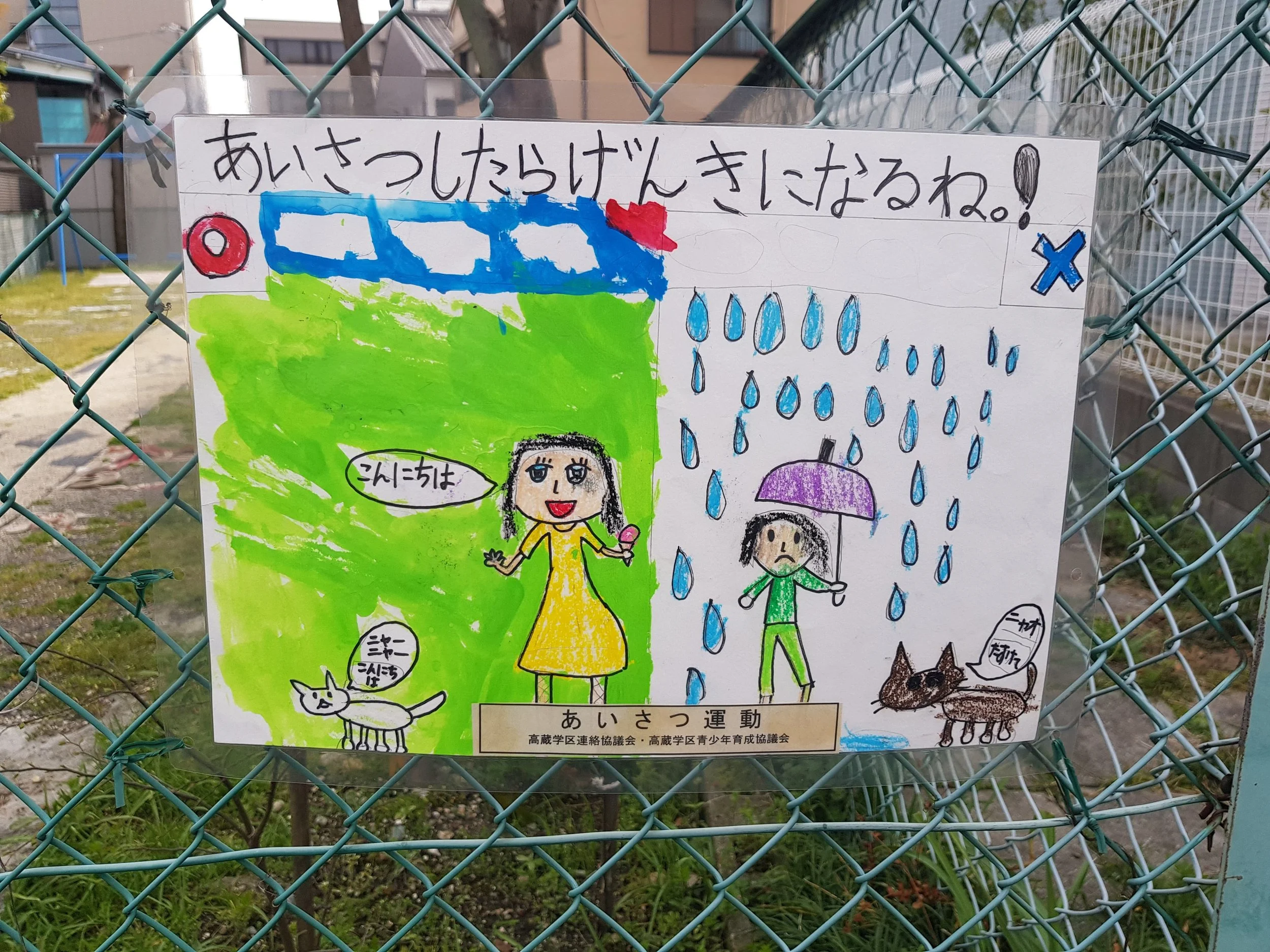
“Ohayo gozaimasu!” other teachers would say back, at varying volumes and with varying degrees of enthusiasm. Good morning!
A few minutes later, the vice principal passed by my desk:
フラン先生は、挨拶がいつも元気ですね。
Fran-sensei wa, aisatsu ga itsumo genki desu ne.
(“Your morning greetings are always so cheerful!”)
そうですか。ありがとうございます。
Sou desu ka. Arigatou gozaimasu.
(“Is that so? Thank you.”)
I smiled all day.














Like many people in the UK, I studied French in school. I liked French. I thought it was really fun to speak another language, to talk with people, and to try and listen to what was going on in a new country. (Still do!)
When I was 14 we went on a school exchange to the city of Reims, in northeastern France. I was paired with a boy, which I’m sure some 14-year-olds would find very exciting but which I found unbearably awkward. He was very sweet and we completely ignored each other.
That was nearly 20 years ago, and I didn’t learn or use any more French until, at some point in lockdown, I decided on a whim to take some one-to-one lessons with online teachers. Here are some things I learned about French, about language learning, and about myself.