
Welcome to the Step Up Japanese blog archive!
Although I’m not currently adding new posts to the blog, you’ll find plenty of Japanese learning tips, study advice, and resources to explore here.
Browse the blog index to view a complete list of posts.
For the latest news, course updates, and Japanese learning tips from Step Up Japanese, sign up for my newsletter.
Search this blog:

Games in Japanese - Course Introduction Video (and transcript)
On Games in Japanese (日本語でゲーム), we practise communicating in Japanese by playing games!
This footage is from the 2019 Games in Japanese Summer Course at Step Up Japanese in Brighton, UK. In summer 2020, we also held our first Online Games in Japanese course.
Thanks to Daniel Sheen for making this video!
Watch the video, or scroll down to read a transcript.
On Games in Japanese (日本語でゲーム), we practise communicating in Japanese by playing games!
This footage is from the 2019 Games in Japanese Summer Course at Step Up Japanese in Brighton, UK. In summer 2020, we also held our first Online Games in Japanese course.
Thanks to Daniel Sheen for making this video!
Watch the video, or scroll down to read a transcript. Click "CC" to turn on the subtitles 👍
What is Games in Japanese?
David: In 日本語でゲーム (Games in Japanese), we play a variety of games, only ever using the Japanese language.
Showing students how to play:
Fran: どれですか。(Which one is it?)
Fran: そうですね。木が同じです。(That’s right! KI [tree] is the same)
Fran: 3,2,1、はい。(3, 2, 1, go!)
Fran: あ!あ!ハサミ!(Ah! “Scissors!”)
Fran: 私は取ります。(So, I take the card)
Sara: You’ve got all the numbers, the names out on the floor, and it’s the reading and trying to get to it before everyone else, which is quite funny.
N: クエスチョン、はてなマーク (“question mark”)
What do you like about “Games in Japanese”?
David: I find it difficult to play games in only Japanese, but I really relish the challenge to speak only Japanese. It really makes me have to think in a way that maybe I wouldn't have the opportunity to do if I wasn't taking the course.
David: サングラス (“sunglasses”) (Laughter)
Sara: It’s very good vocab practice. I think it’s more, the games we have, it’s a lot more sort of random words so I feel like you’re a lot faster with it, so you tend to do a bit less thinking about the words that you want, you just kind of go like “that word, quick!”
Fran: はい (OK, let’s go)
A:ピエロ (“clown”)
Sara: So you’re trying to beat everyone else to it, so it's a bit more, a bit more silly.
Fran: 音楽 (“music”)…音楽 (“music”) (Laughter)
A: クモ (“spider”)
Sara: ドラゴン (“dragon”)
B: 花 (“flower”)
Sara: I quite like that game, it was funny.
Would you recommend Step Up Japanese?
Sara: I think Step Up Japanese is really good way to go, it’s really good practice, it’s a really relaxed atmosphere, and Fran’s such a good teacher. I’ll go home and I’m like, right, “I’m gonna do this”, I feel motivated to keep going at the weekends.
How Sara Gained Confidence Speaking Japanese | Step Up Japanese Student Interview
Sara joined Step Up Japanese wanting one thing: more confidence speaking Japanese. Although she had studied on and off for years and knew some Japanese, she found that her mind went blank whenever she tried to speak.
After completing my beginner course, Sara shares how regular conversation practice helped her start using Japanese more confidently, including her favourite question for starting conversations!
In this interview, Sara shares:
Why she wanted more speaking practice
How conversation classes helped her gain confidence
Her favourite question for starting conversations in Japanese
How she practises Japanese outside class
Sara joined Step Up Japanese wanting one thing: more confidence speaking Japanese. Although she had studied on and off for years and knew some Japanese, she found that her mind went blank whenever she tried to speak.
After completing my beginner course, Sara shares how regular conversation practice helped her start using Japanese more confidently, including her favourite question for starting conversations!
In this interview, Sara shares:
Why she wanted more speaking practice
How conversation classes helped her gain confidence
Her favourite question for starting conversations in Japanese
How she practises Japanese outside class
Want to build your confidence speaking Japanese too?
Find out more about my Japanese conversation courses and one-to-one lessons:
Watch the video, or scroll down to read a transcript:
“I knew the question, but as soon as I would go to say it to someone, my brain went blank. So I was like: ‘I need to practise!’”
Why did you start learning Japanese?
I’m a long time anime fan, basically I started watching it as a teenager, and always found little bits online – back when downloading PDFs was a thing I got a hiragana and katakana chart for a dollar online, and printed them out, and I was quite excited about it, and kind of did all bits and pieces but never actually was able to keep on it, and that’s when I chose to come to classes.
I really wanted the speaking practice, which is what I was very much missing.
And as I found out when I went on holiday there to Japan, I knew the question, but as soon as I would go to say it to someone, my brain went blank. So I was like: “I need to practise!”
I’m getting more confident in my speaking, and I’m learning more words.
“And then you think ‘I’ve just spoken in Japanese for ten minutes!’”
What are the classes like?
It’s informal chat at first, and then you give us a good idea of what we’re going to do that day, and how long it’s going to be, so we’re mentally prepared for what we’re doing.
It’s a lot of talking which is quite nice, it’s not you standing [at the whiteboard] and going “and this means this, and this means this”. It’s actually putting it into practise, and having things to talk about with people.
I do like the ‘Free Talk’ section, as well – we’re getting there. It’s hard. I’ve learned a question, and I always open with that question:
週末は何をしますか。(Shuumatsu wa nani wo shimasu ka? What will you do at the weekend?)
Then your partner has a few extra questions, and they kind of push you to go a bit further.
And then you think “I’ve just spoken in Japanese for ten minutes!”
How do you practise Japanese outside of class?
Out of class it’s mostly writing, so I tend to use the apps, like duolingo and memrise, and then I’ve just got folders where I try and write things down to cement them into my head. And then hopefully I’m going to start practising kanji as well.
So [outside of class] it’s more reading and writing, and then class is more, chatting and learning vocab, and taking that home with me.
Will you be using your Japanese in Japan on your upcoming trip? How will that be?
A bit easier now. I think I’ll feel more confident going into a shop and asking for things we’re looking for. When you go in and everything’s labelled up with kanji, you feel a bit…
But it will help me more, when I go to Tower Records and I’m looking for things via alphabetical order. I know hiragana now, so I can look for the ones I want.
“It’s not like school, where everyone’s like: ‘Don’t make a mistake.’”
How does it feel when you use Japanese to communicate with someone?
It’s rewarding, actually.
It’s one of those things where, it’s quite hard at first and then you push yourself.
That’s one of the things I like about the classes, it’s not like school, where everyone’s like: “don’t make a mistake, don’t say anything if you don’t know exactly 100% what it means, or what it is. Whereas we’re just, nope, we’ll just say it. If it’s wrong it’s wrong. I think we’re right most of the time.
How was today’s class?
Very good vocab practice. I did something that, I’m not entirely sure why I made Jaye [Sara’s classmate!] laugh so much, but he found it very entertaining whatever it was I said. I quite like that game. It was funny.
And I still remember the new word from last week which was shippo (尻尾, tail).
Ok, let’s talk in Japanese!
日本に行ったことがありますか。(Have you ever been to Japan?)
東京行きました。 (Toukyou ikimashita = I went to Tokyo.)
たくさん歩き[ました]。(Takusan arukimashita = I walked a lot.)
何を食べましたか。(Nani o tabemashita ka? = What did you eat?)
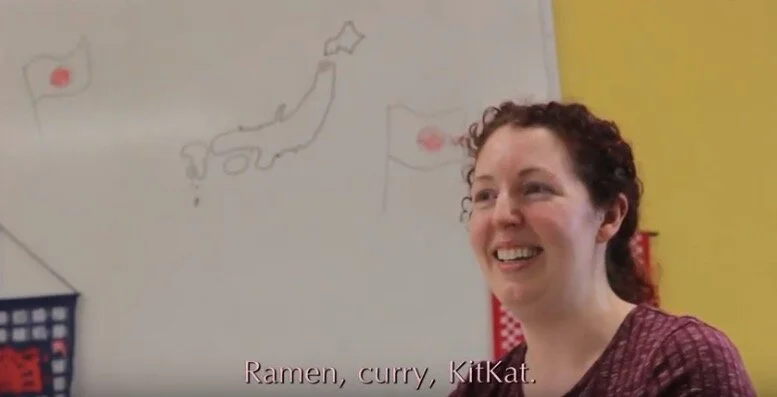
ラーメン、カレー、キットカット。(Raamen, karee, kitto katto = ramen, curry, and kit-kats!)
どうしてステップアップジャパニーズで日本語を勉強しようと思ったんですか。 (Doushite Step Up Japanese de nihongo o benkyou shiyou to omotta n desu ka? = Why did you decide to study Japanese at Step Up Japanese?)
話す練習をします。(Hanasu renshuu o shimasu = To get speaking practice.)
日本語のレッスンはどんな感じですか。(Nihongo no ressun wa donna kanji desu ka? = What are the lessons like?)
皆さん楽しい。(Mina san, tanoshii = Everybody is fun.)
Would you recommend Step Up Japanese?
I think Step Up Japanese is a really good way to go, it’s really good practice, it’s a really relaxed atmosphere, and Fran’s such a good teacher.
I have fun, and then I go home and think: “right I’m gonna do this!” I feel motivated to keep going at the weekends.
Thanks very much to Step Up Japanese student Daniel Sheen for making this video! I edited the Japanese slightly in the transcription of some of these answers for clarity.
Ready to start speaking Japanese with more confidence?
Explore Step Up Japanese courses and find the right option for you:

Gachapon: Capsules of Joy, ¥300 a pop (GUEST POST!)
This week - a guest post from Step Up Japanese student David Sharp!
I have a bit of a gachapon obsession. There are so many things I love about Japan, but my eyes light up when I see a gachapon machine. I’ve got a sixth sense specifically dedicated to locating gachapon machines and you can guarantee I’ll make a beeline for it, or forever regret not seeing what mysteries they might hold. There’s something very Japanese about gachapon: compact, transient, novel and convenient.
But let’s back up for a second – what is gachapon?

This week - a guest post from Step Up Japanese student David Sharp!
I have a bit of a gachapon obsession. There are so many things I love about Japan, but my eyes light up when I see a gachapon machine. I’ve got a sixth sense specifically dedicated to locating gachapon machines and you can guarantee I’ll make a beeline for it, or forever regret not seeing what mysteries they might hold. There’s something very Japanese about gachapon: compact, transient, novel and convenient.
But let’s back up for a second – what is gachapon?
A gachapon machine is a small box, with a mechanism a bit like a gumball machine that dispenses little plastic capsules with some sort of ‘prize’ in them. You’ll usually see them stacked two or three high and accompanied by some either side. You may even find them stretching out across an entire wall, or filling up what might otherwise be wasted space.
To operate them is pretty simple: drop the correct coins into the coin slot and then turn the crank on the front, after a few turns your prize will drop out!
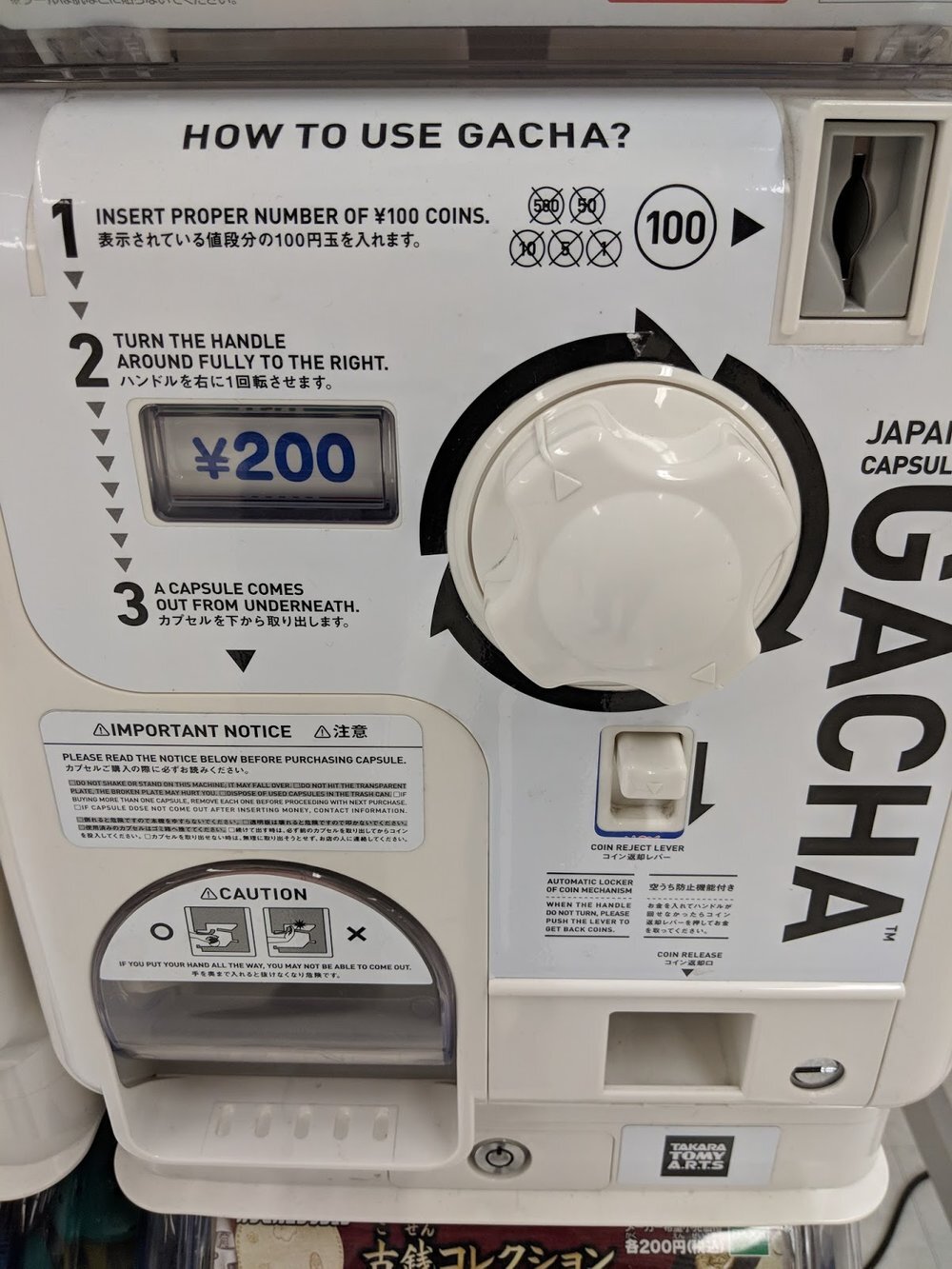
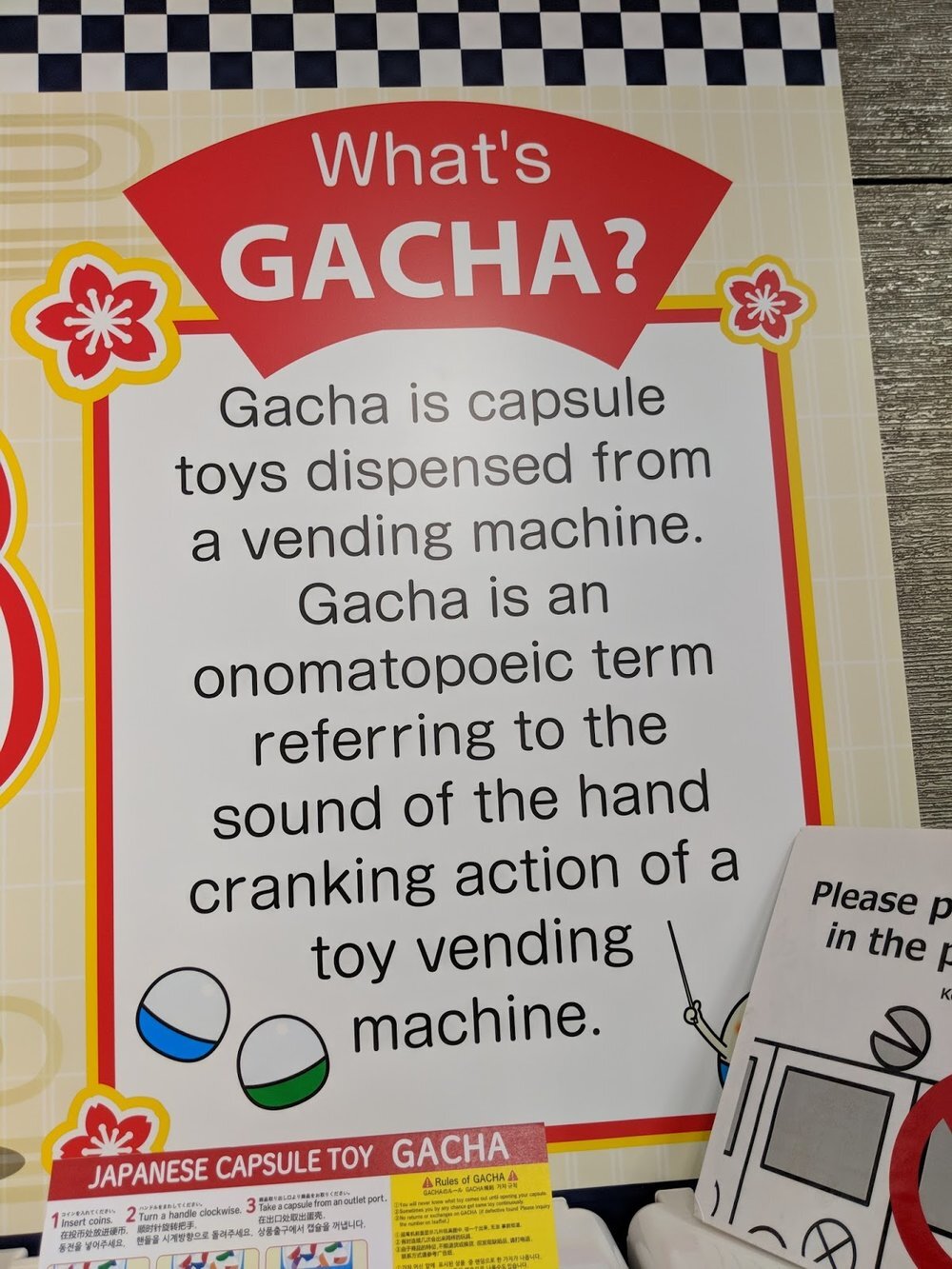
Gachapon 「ガチャポン」as a word comes from the “gacha gacha” 「ガチャガチャ」sound the machine makes as you turn the crank to release your prize. What people actually call them tends to differ.
From my experience "gachapon" is pretty common, however you’re also likely to see “gashapon"「ガシャポン」 or simply “gacha”「ガチャ」 (which are Bandai and Tomy trademarks, respectively), both of which derive from the same onomatopoeia.
Typically, a gachapon prize comprises of three components: the capsule, a little scrap of paper with all the prizes you could have won and your prize itself!
Here's what to expect from your average gachapon machine: a capsule, your prize (in this case a Pokémon pin) and the "here's what you could have won" scrap of paper:

So now we know what gachapon is, let's have a look at some of the prizes on offer!
Phone danglers are quite a common find:


Those on the left are actually designed to fit onto a bottle cap, which is a trend I'm not sure I understand ↓


Sometimes you'll find something a little more traditional ↓

Souvenir gacha aimed at tourists, which look a bit more like gumball machines ↓

Turns out you can even get watches in gachapon ↓

Deep down I regret not getting a Gudetama watch for 300¥ ↓

Magic sand and pots of slime are pretty common in kid-friendly places ↓

If you're happy to pay a bit more, you might find some of these sofubi (ソフビ "soft plastic") designer toys ↓

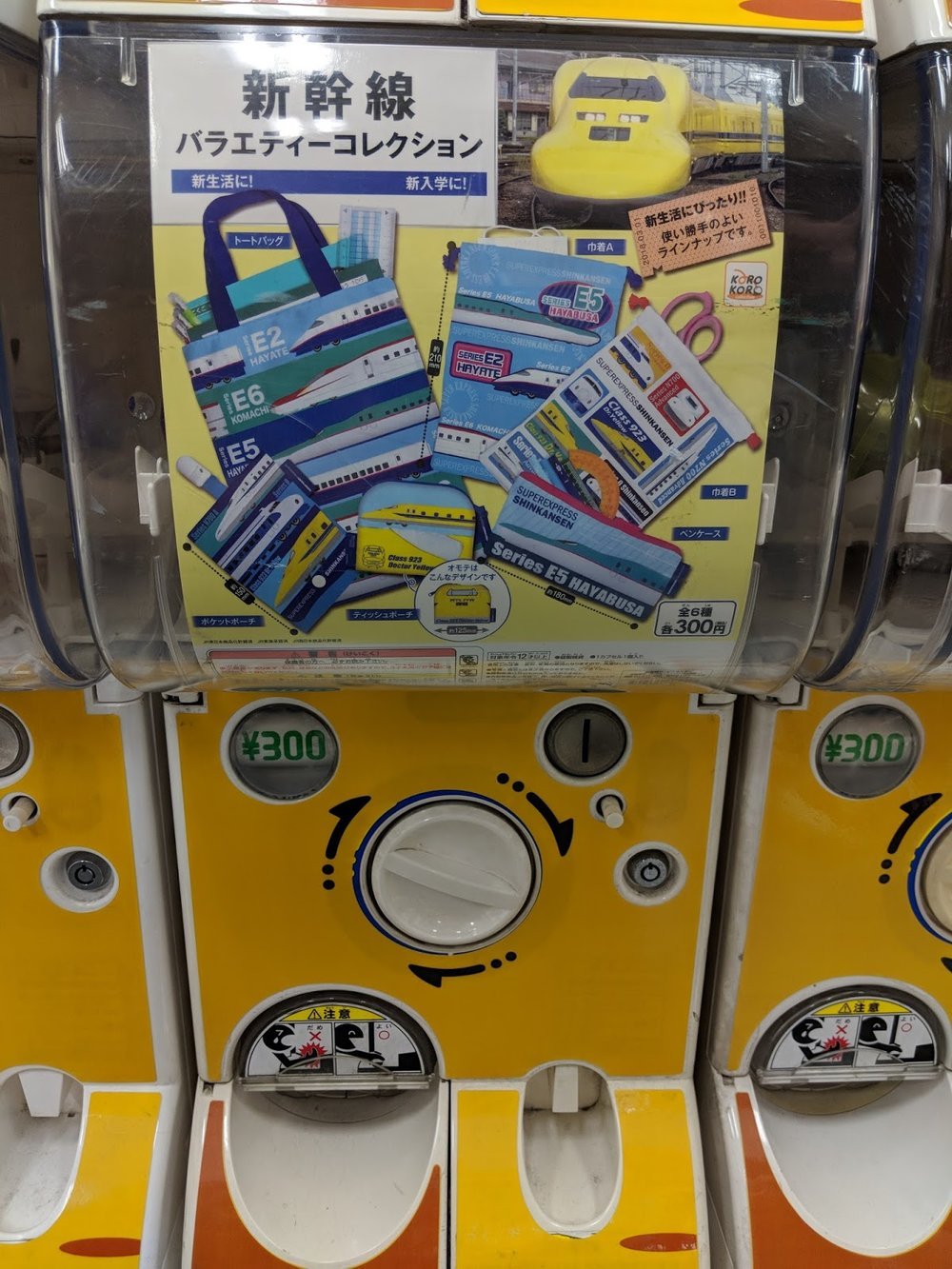
Shinkansen themed bags, purses and pouches ↓
Hopefully you'll find some cat hats ↓

...and more cat hats...

...and dog hats...

...and yet more cat hats...

...and cat wings...

...and somehow still find more cat hats!

In the contents of gachapon machines, there is a spectrum of target audiences and of usefulness, but one thing all the prizes have in common is the capsule they come in (hence sometimes being referred to as “capsule toys” 「カプセルトイ」)
“But, David”, I hear you say, “if you’re buying so many gachapon, what happens to all the empty capsules?”
Well, while not entirely universal, most places you’ll be able to get gachapon will also have a little basket or bin to dispose of your unwanted capsules.

But if you do find yourself taking them away with you, Bandai’s capsules are all recyclable, and most others will at least be half recyclable. Occasionally though you’ll find a capsule toy where you should keep hold of the capsule, because the capsule is the toy!
The capsule of these gachapon are maneki neko (招き猫; Lucky Cat) torsos! ↓

“I’m sold”, you say, metaphorically, “how much do will these fancy-schmancy capsules set me back?”
Gachapon machines (almost) always only accept 100¥ coins, so will cost a multiple of 100¥. A price tag of 300¥ is most common (approx. £2, at the time of writing) but you’ll likely see a lot of 200¥ and 400¥ machines too.
You might also stumble across a 500¥ gachapon machine, in which case don’t be surprised if it’s bordering on risque!
The only 500¥ gachapon here are these swimsuit-clad women ↓

While it’s certainly a matter of opinion, individual gachapon prizes tend to be good value for money. No matter how goofy a gachapon purchase may be, I find it difficult to be disappointed in the prize! Say you find a machine full of cute phone danglers; the quality will be comparable to one you might buy in a souvenir shop, but for cheaper!
However, if there’s one you’re really keen to own, or you want to collect the whole set, you run the risk of ending up with a lot of duplicates! (Although I’m sure you’ll be able to find an unsuspecting friend to offload them onto as “thoughtful gifts” from your travels.)
If you see a machine full of trinkets that you must have in your life and are keen on collecting a whole set– or there’s only one in a set you like the look of and don’t want to risk winning a dud– you may be able to buy it elsewhere. Akihabara, for example, has a number of shops that sell rows and rows of loose figures usually with very little markup (sometimes you’ll practically just be paying the tax). However, something truly sought after might set you back up to double what you would’ve paid for from the machine!
But now you've booked your flights to Japan and you're wondering “Where can I even find gachapon?”
Everywhere! Although they’re not as common as vending machines, you’ll find gachapon at tourist attractions, train stations, airports, convenience stores, arcades, shopping areas, department stores, sometimes even in temples. The beauty of gachapon is that you don’t need to dedicate a chunk of your day searching for them, or venture too far out of your way to find them. While there are dedicated stores you could keep an eye out for, the truth is there’s such a variety that over your trip you’ll hopefully stumble upon a wide range of potential prizes. (That said– if, at the end of your trip, you find yourself at Narita Airport’s Terminal 2 with pockets full of leftover coins, they have a huge selection just outside the 7-Eleven).
Narita Airport's terminal 2 wants your coins! (Fun fact: I had to get money out so I could get a few more gacha before heading home) ↓

The gachapon on offer are constantly changing and vary from place to place, so I wouldn’t get your hopes up about finding anything in particular, but there’s so much choice you’re bound to find something cool, cute, weird or that makes you chuckle!
Happy hunting!
Find David and tell him what your favourite gachapon prize is at davidsharp.codes. Or check out more of his Japan pics (including even more gachapon photos!) on his instagram.
P.S. Would you like to write a guest blog post for Step Up Japanese? Get in touch! :)















Like many people in the UK, I studied French in school. I liked French. I thought it was really fun to speak another language, to talk with people, and to try and listen to what was going on in a new country. (Still do!)
When I was 14 we went on a school exchange to the city of Reims, in northeastern France. I was paired with a boy, which I’m sure some 14-year-olds would find very exciting but which I found unbearably awkward. He was very sweet and we completely ignored each other.
That was nearly 20 years ago, and I didn’t learn or use any more French until, at some point in lockdown, I decided on a whim to take some one-to-one lessons with online teachers. Here are some things I learned about French, about language learning, and about myself.