
Hi! This blog is no longer updated, but on this page you can find an archive of my blog posts, 2016-2022. Click here to view the blog index (a list of all posts).
For the latest news about Step Up Japanese, sign up to my newsletter.
Search this blog:
Walking the Shikoku 88 Pilgrimage (Part 5) - Signs of Shikoku
"Gambatte kudasai" is sort of untranslatable but also extremely translatable. (The best kind of Japanese phrase!)
Gambatte kudasai means "do your best!" or "go for it!"
When I started learning Japanese at university in 2008, my classmates and I thought the phrase gambatte kudasai was quite funny for some reason ...

"Gambatte kudasai"
is sort of untranslatable but also extremely translatable. (The best kind of Japanese phrase!)
Gambatte kudasai
means
"do your best!"
or
"go for it!"
When I started learning Japanese at university in 2008, my classmates and I thought the phrase
gambatte kudasai
was quite funny for some reason. So when we had to write a short dialogue about a holiday and commit it to memory as part of a speaking test, my partner and I shoehorned in a bunch of "
gambatte kudasai"s.
My partner showed our work to his (Japanese) mum, who sent it back covered in red corrections and with all our "
gambatte kudasai
"s crossed out. Apparently they didn't work in context.
The problem is, I knew that
gambatte kudasai
means "try your best", but I didn't know it sounds weird if you're talking about buying a plane ticket...
I heard lots of "
gambatte kudasai"
walking the first leg of the Shikoku 88 pilgrimage this spring. It was written everywhere too - in fact there were lots of interesting signs.
The pilgrimage trail is pretty well marked. Signage is consistently spaced, and in many places there's a way-marker every 100 metres.
But it's also endearingly inconsistent in design - on some stretches every sign is different, and many are handmade.
There are these little
aruki-henro
(歩き遍路
;
walking pilgrims) to mark the way:

Red is the dominant colour - sometimes just a red arrow, like this stone below. Actually, there's kanji (Chinese characters) carved into the stone too, but it's difficult to see:

Some signs are in English as well as Japanese, although this was less common:

Some show you which way to turn at an upcoming junction. This took a bit of getting used to, but was very useful. Even in rural areas, I didn't get lost once.

Sometimes, the signs just said 道しるべ (
michi-shirube;
guidepost).
Note that many of these handwritten signs are in vertical text, and from right to left:

This next sign packs a lot of meaning into a few kanji characters:
空海
kūkai
(aka Kōbō Daishi, the Buddhist monk in whose footsteps pilgrims walk)
遍路道
henro michi
(pilgrimage trail)
同行二人
dougyou ni-nin
("two people going together" - the idea that the walking pilgrim is never alone, as Kōbō Daishi is walking with you)

The tough parts of the trail are called
henro korogashi
(遍路ころがし; "the place where the pilgrim falls down").
This bit of
henro korogashi
had even more signposts throughout, so you know how far you have left to go. There's a 1/6 sign to let you know when you are one-sixth of the way through; then 2/6 for two-sixths, and so on.
This picture was taken just before the last stretch, when I was a bit tired:

And of course there are plenty of little signs saying がんばって下さい
gambatte kudasai
(
"keep going!"
.
This made me smile, and was genuinely quite encouraging.

We all need a bit of encouragement sometimes!
Related posts:
Walking the Shikoku 88 Pilgrimage (Part 1) - Plan, plan, plan!
Walking the Shikoku 88 Pilgrimage (Part 2) - The Best First Day in Japan
Walking the Shikoku 88 Pilgrimage (Part 3) - What To Wear
Walking the Shikoku 88 Pilgrimage (Part 4) - How to Talk to Strangers in Japanese
P.S.
If you can't read Japanese, but you want to recognise common signs and notices before your holiday to Japan, you should check out my new
Survival Japanese for Beginners
-
, it starts Thursday 26th July in central Brighton.
Or if you do read Japanese but want to get better, join us for
- a summer course in learning Japanese by reading lots of easy books.
Walking the Shikoku 88 Pilgrimage (Part 4) - How to Talk to Strangers in Japanese
A stranger, they say, is just a friend you haven't met yet.
And talking to strangers is a great way to speak lots of Japanese. I did lots of this while walking the first section of the Shikoku pilgrimage this spring.
But how do you start a conversation with a stranger? Here are some ideas to get you going, even if you're a beginner at Japanese.
1) the weather
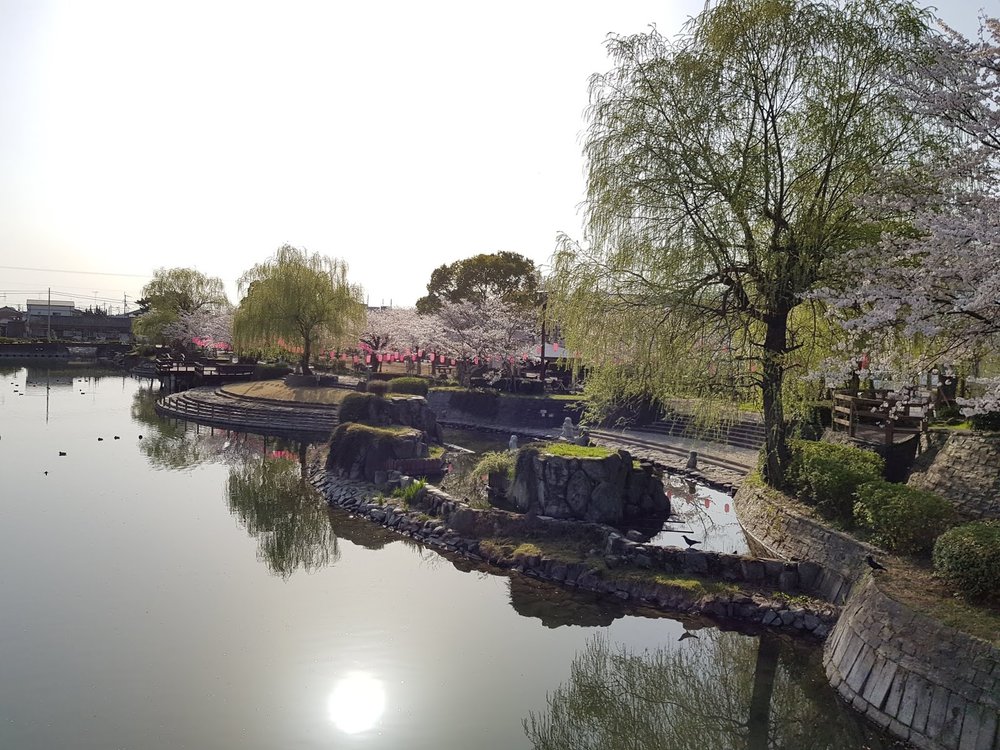
Brits love to talk about the weather. Luckily, so do people in Japan. It's almost like a greeting.
Chuck one of these out and start the conversation:
暑いですね atsui desu ne! "Hot, isn't it?"
寒いですね samui desu ne! "Cold, isn't it?"
Very possibly, you'll get a そうですね sou desu ne; "Isn't it just", in response, and you can start the conversation from there.
2) things you can see
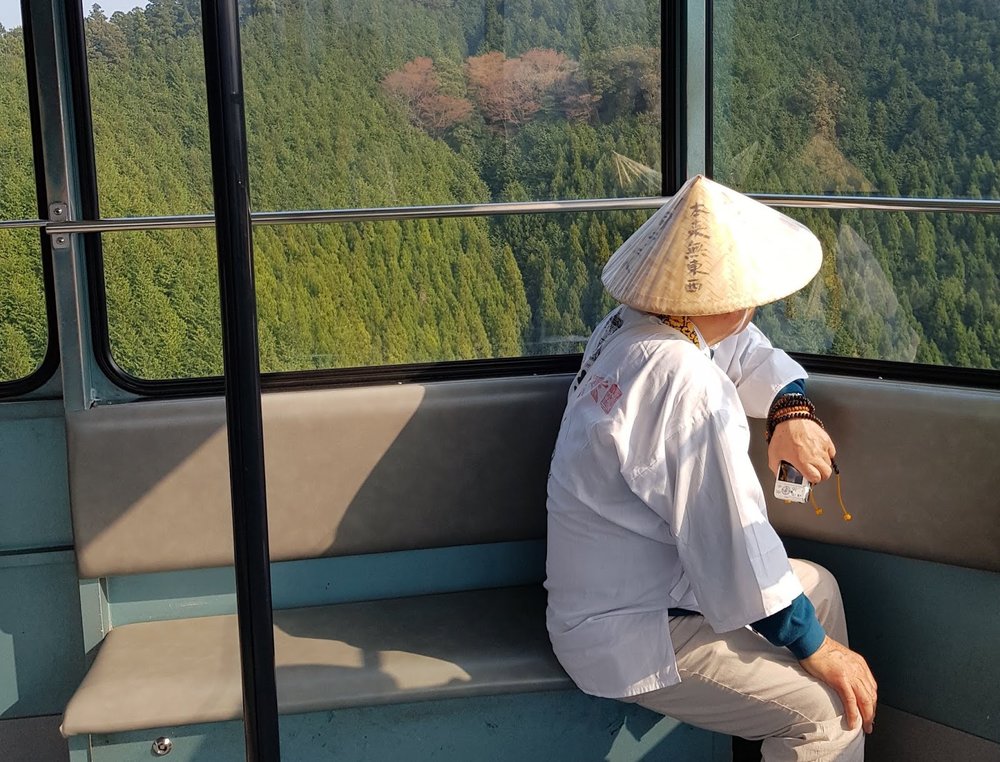
You reach the top of a hill and sit on a bench. The person on the adjacent seat turns to greet you.
You can start a conversation easily by simply pointing and commenting on what you can see:
すごいですね Sugoi desu ne. "Amazing, isn't it?"
綺麗ですね Kirei desu ne. "Isn't it lovely?"
美しいですね。Utsukushii desu ne. Beautiful, isn't it?

3) ask simple questions
What about if you don't know what you're looking at? Just ask.すみませんが、それはなんですか。 Sumimasen ga, sore wa nan desu ka.
"Excuse me, but what's that?"
これは日本語でなんと言いますか。 Kore wa nihongo de nan to iimasu ka. "What do you call this in Japanese?"
4) start in Japanese
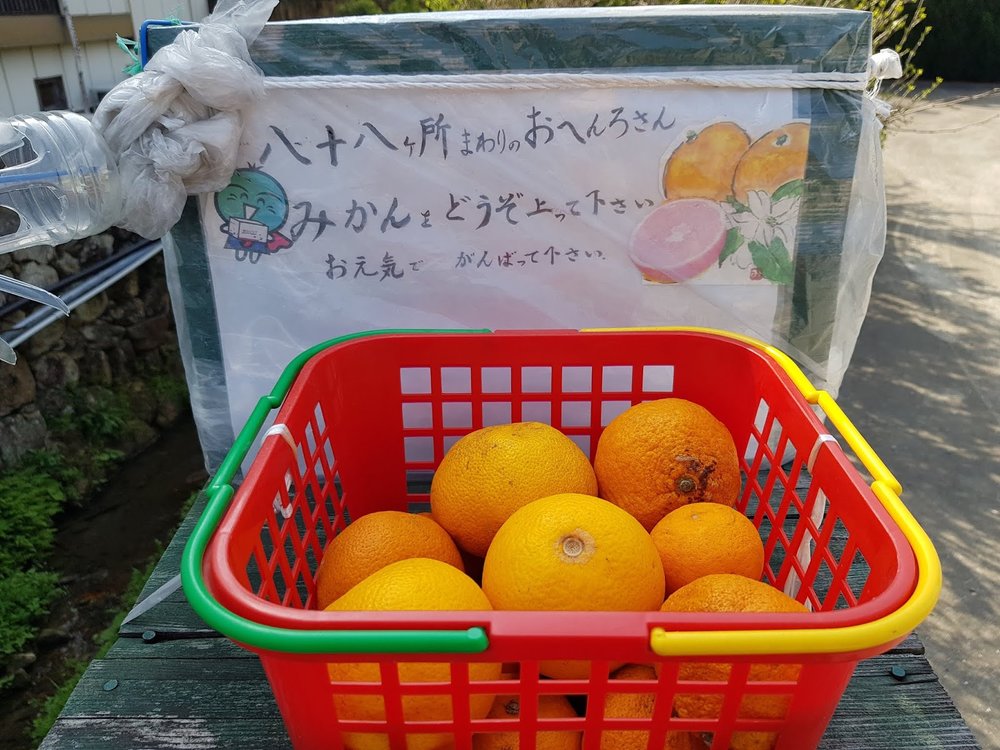
If your Japanese is limited, and you speak English, it might be tempting to walk into a hotel or restaurant and start the conversation in English - or to ask if the person speaks Japanese.Even if you're a beginner, try and start the conversation in Japanese, with a greeting:
こんにちは! konnichiwa! "hello"
こんばんは! kombanwa! "good evening"
おはようございます! ohayou gozaimasu! "good morning"
Remember, if you start the conversation in English (or another language), the chances of getting some Japanese practice are virtually zero. Try and at least start in Japanese.

5) smile
You might be nervous about speaking Japanese. But the absolute best way to get someone to speak with you is to smile while talking with them!
Hopefully, you can put them at ease that you're a friendly, wonderful person. Someone worth talking to. Which, of course, you are.
After all, you're just a friend they haven't met yet too.
Related posts:
Walking the Shikoku 88 Pilgrimage (Part 1) - Plan, plan, plan!
Walking the Shikoku 88 Pilgrimage (Part 2) - The Best First Day in Japan
Walking the Shikoku 88 Pilgrimage (Part 3) - What To Wear
P.S. If you liked this post on talking to strangers in simple Japanese, check out my new course Survival Japanese for Beginners - starts July 26th 2018, in central Brighton. It's ideal for anyone planning a trip to Japan soon!
Walking the Shikoku 88 Pilgrimage (Part 3) - What To Wear

When I told my Japanese friends I was planning to walk the Shikoku Henro trail, several of them said the same thing. "Are you going to wear a hat?"
For many people, the image of a walker in a bamboo hat is the first thing that comes to mind when they think of the pilgrimage.
But what "should" you wear on the Shikoku 88, a Buddhist pilgrimage trail?
Some pilgrims don't wear any special gear at all - just normal walking clothes. That's fine. But some walkers choose to wear special clothes, many of which have symbolic significance.
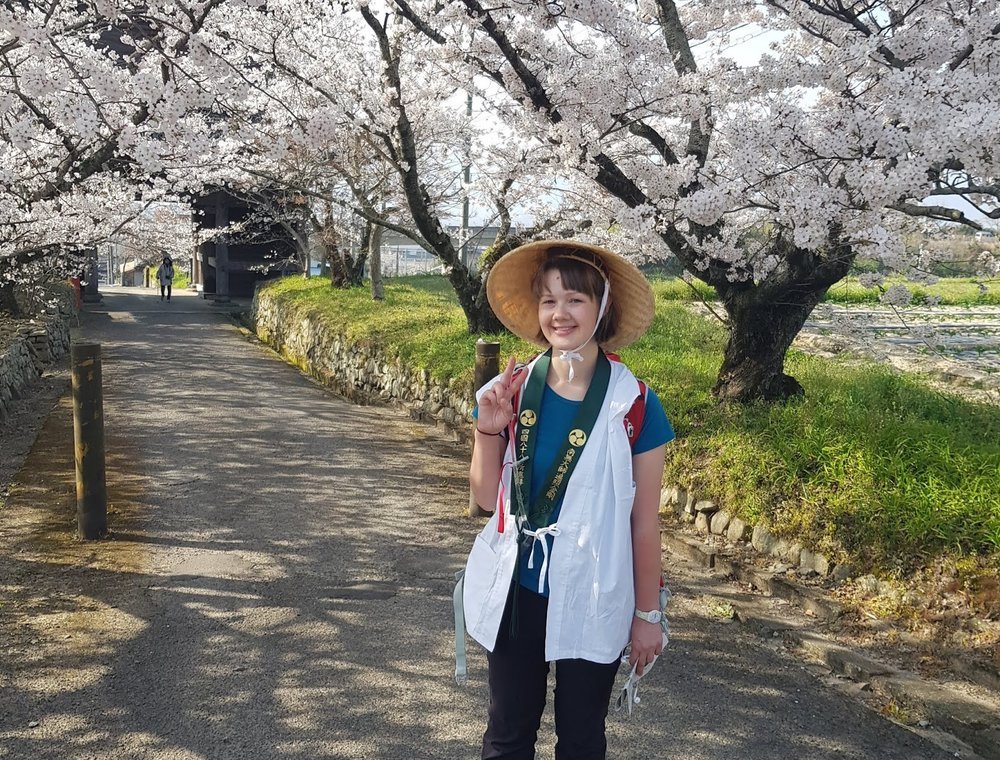
Many people wear a white jacket to walk the trail. It's called a 白衣 hakui. This is the first piece of pilgrim garb I bought, at temple number 1. Some have sleeves; mine is sleeveless.
Wearing the white jacket signals to people that you are a pilgrim. So if you want to talk with lots of people on Shikoku, wearing pilgrim clothes is a great conversation starter.

Actually, some pilgrims wear all white. I met a lovely older gentleman several times on the trail, who had just turned 80. He was all in bright white, and looked very striking.
According to Nippon.com:
"White is worn because long ago some pilgrims would collapse from the physical exertion and die during the pilgrimage, and the white robes could serve as their burial clothes.I prefer the second meaning, I think!
The colour white also carries the meaning that all pilgrims are equal in front of the Buddha."
Even if you don't wear white, it's be good to wear lighter colours - I saw a lot of people in light coloured clothes. I didn't know this when I planned my trip, so my walking clothes are all dark.
If I buy new kit before I go back, I might try and buy lighter coloured clothes. I didn't get the impression it matters too much though.

I met another lovely Japanese man named Shinichi, who kindly showed me around various rituals, explaining aspects of the temple and the praying process to me.
I'm not Buddhist, but I really enjoyed and appreciated the ritual of praying at each temple. I found it fascinating, and very calming.

After lighting incense and a candle, you give an offering at each hall of an osamefuda (納め札), a slip of paper onto which you can write your name, address and a message of good will.
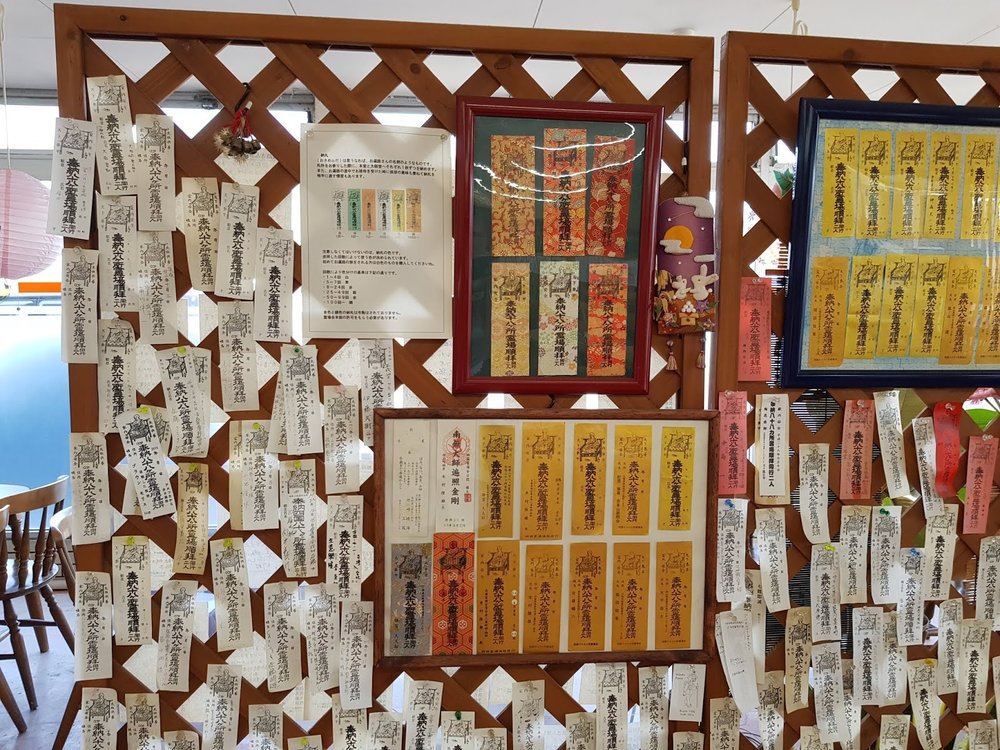
In the stamp office, the staff doing calligraphy were often surprised to see a non-Japanese visitor, and would usually ask where I was from and if I was walking the whole route.
I had a lot of pleasant conversations with the men and women in the stamp offices. Again, I think wearing the pilgrim kit helps here.
Later on, I got a 菅笠 suge-gasa, a bamboo sedge hat. This conical hat keeps the sun out of your eyes, and it works as a rain-hat too.
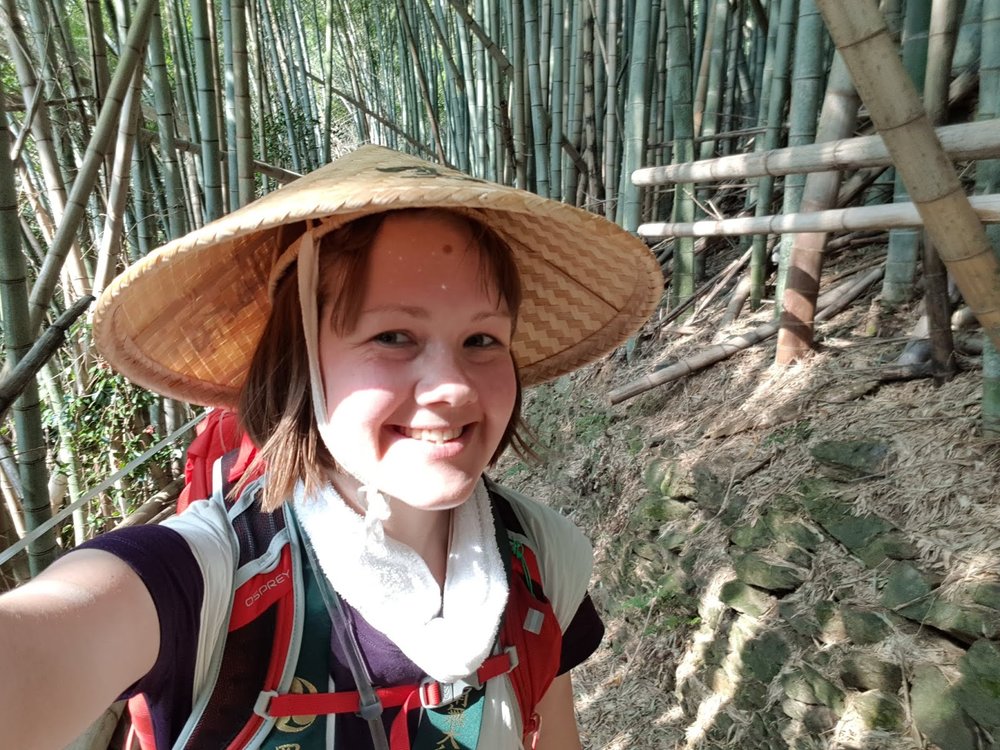
The suge-gasa was surprisingly sturdy - when I wasn't wearing it, I strapped it to the back of my backpack, and despite getting bashed about a bit (sorry, hat!) it still looks as good as new.
Now, back in England, it's sitting in my office waiting for my next trip...
A bit further into the week, I acquired a 輪袈裟 wagesa, a kind of stole or scarf . Traditionally, this is an item worn by monks, but now it just symbolises that the wearer is a pilgrim.
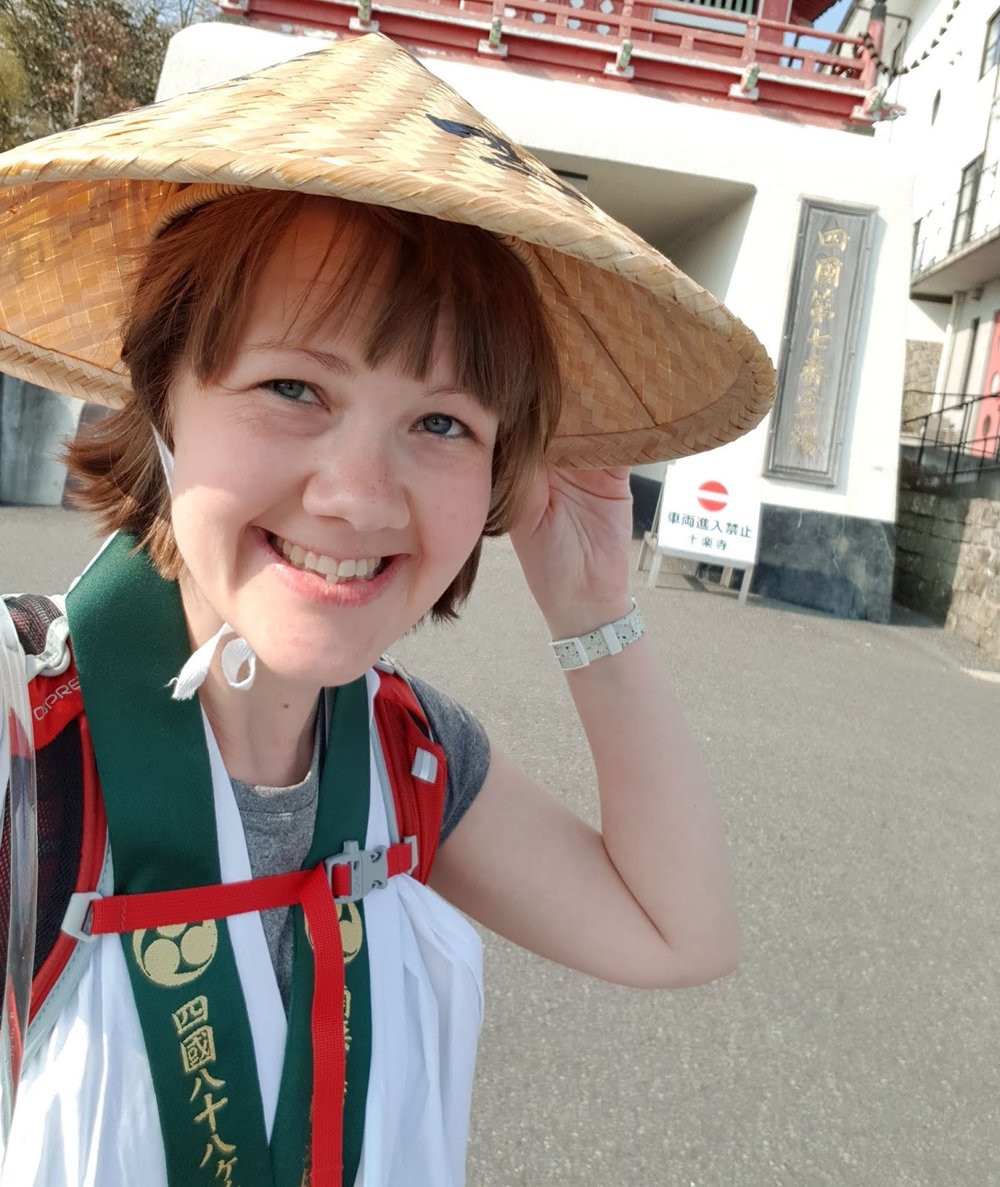
↓ You have to take the wagesa off when eating or washing. This public toilet even had a hook outside to hang your stole on.

Many people also walk with a 金剛杖 kongou-zue, a wooden walking stick. The stick symbolises Kōbō Daishi himself, the monk in whose footsteps pilgrims walk.
Pilgrims are supposed to take care of the stick before they care for themselves - washing the bottom of the stick before washing your own feet, and so forth.
The nicer sticks have a bell hanging from the top, and according to the fantastic site Shikoku Henro Trail:
"The intent of the bell is to keep pulling your attention back to the present; back to reality and what you are doing so that you don't just day dream all day as you walk."The bell is also good for alerting bears and wild boar to your presence, so they won't be startled by you. And you can hit the stick on the ground as you walk to scare away snakes.
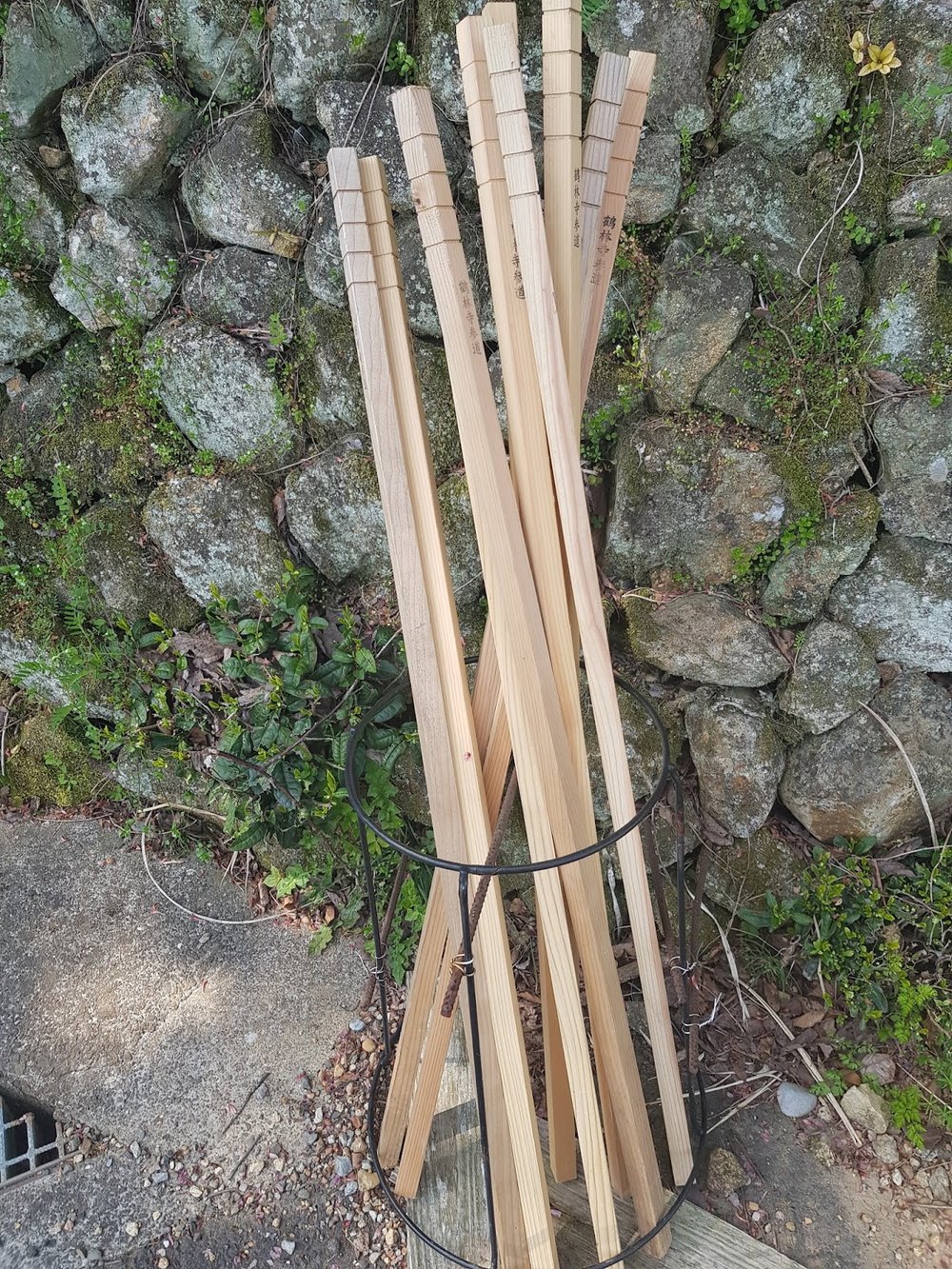
I didn't get a stick (personally I don't really like walking with a stick, even a spiritually significant one). But I might get one next time, or just a bell, to scare off wild animals.
People seem to pick and choose from the pilgrimage clothes available. I saw many tour groups wearing full and matching outfits. They looked good, but the set-up costs are expensive.
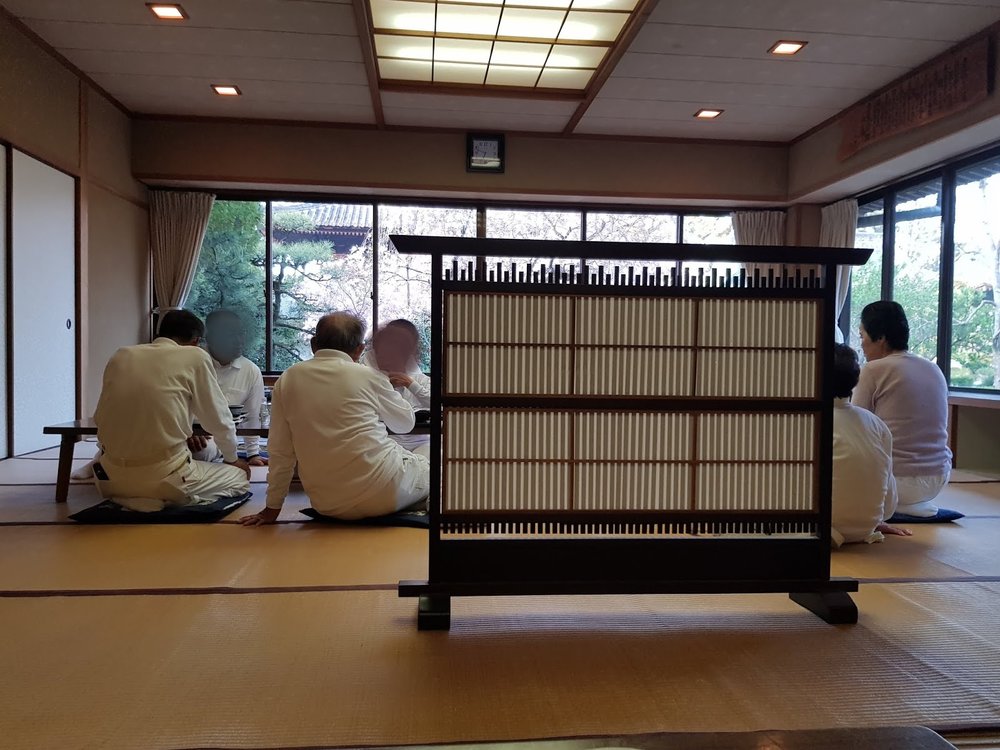
The white jacket and hat are definitely a really good conversation starter though.

Related posts:
Walking the Shikoku 88 Pilgrimage (Part 1) - Plan, plan, plan!
Walking the Shikoku 88 Pilgrimage (Part 2) - The Best First Day in Japan
Walking the Shikoku 88 Pilgrimage (Part 2) - The Best First Day in Japan
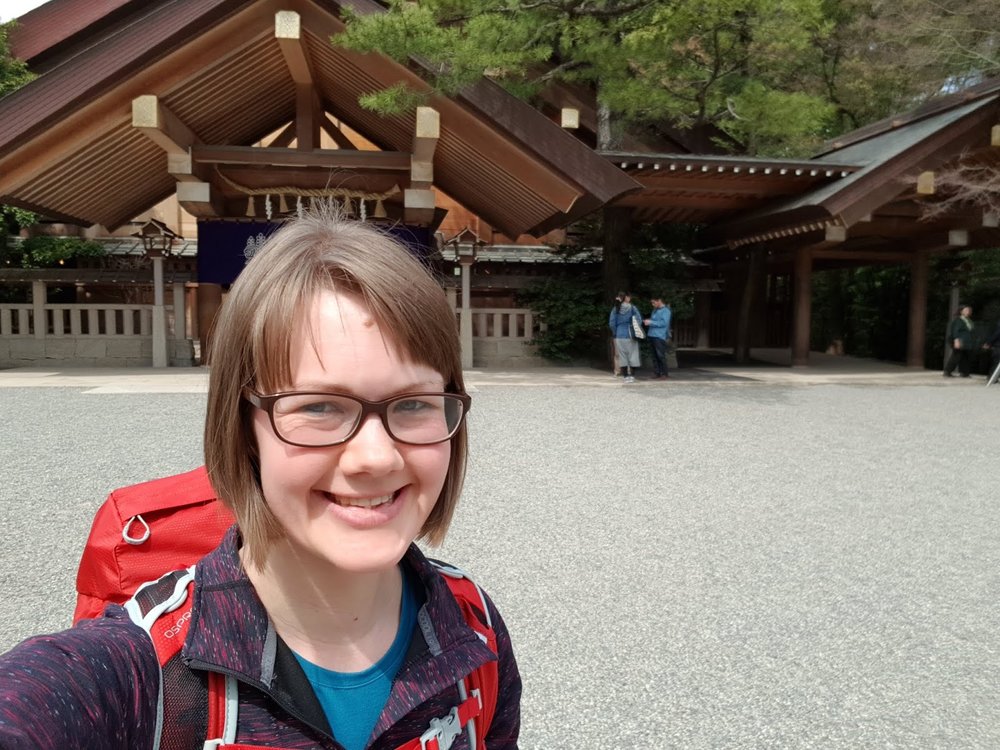
Spoiler alert: this post isn't about the Shikoku pilgrimage, although it is about the same trip. It's about what I did with my spare first day in Nagoya: the lost day...
Arriving first thing in the morning on a long-haul flight is not ideal. You're tired, jet-lagged and yet you need to stay awake until a normal bedtime, so you can adjust your body clock.
I had almost 12 hours to kill on that first day, and was waiting for my friends to finish work.
So what do you do with a whole day to yourself?
, so I made a plan. It went pretty well.

I know Nagoya well, as I used to live there. My first thought was to go to Komeda, a coffee chain I like that's originally from Nagoya, for モーニング (
mо̄ningu
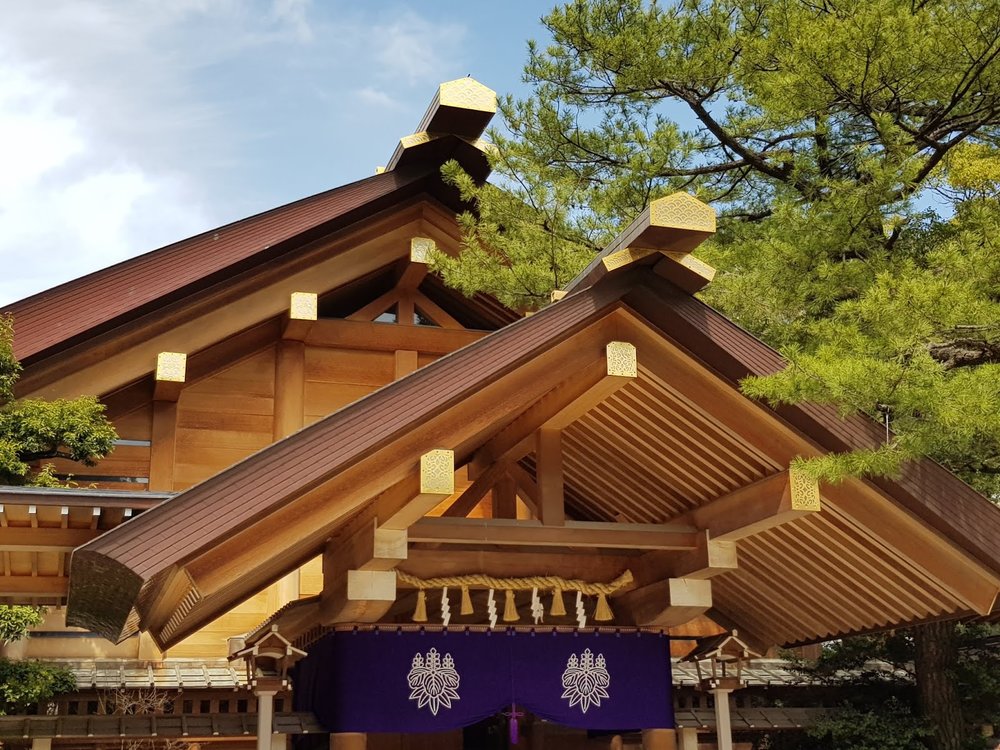
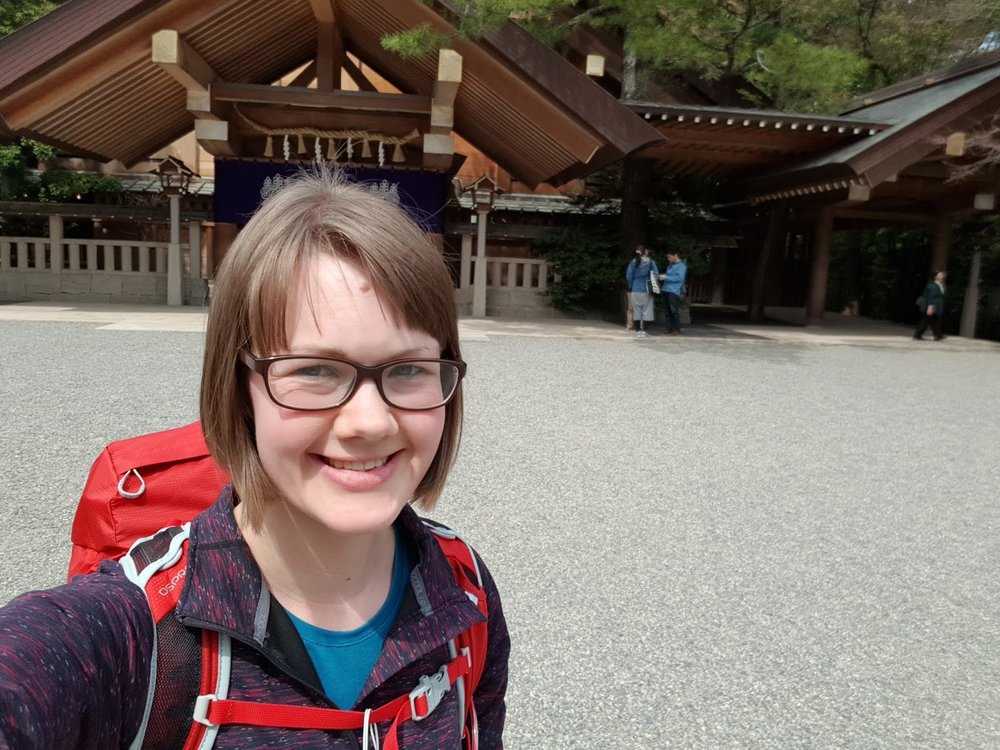
; breakfast set). But I'd already had breakfast on the plane, so I resisted the temptation to have a second breakfast, and went straight to Atsuta Shrine instead.
熱田神宮 (
Atsuta Jingū
; Atsuta Shrine) is a beautiful and important Shinto shrine. It's right by 神宮前 (
Jingūmae)
station, which makes sense seeing as
jingū-mae
means "in front of the shrine".
The train from the airport stops at Jingūmae, so I got off there and headed straight to a
depachika
(デパ地下
). Depachika
is the (often amazing) basement floor of a department store, where the food is, and I wanted sushi and cold green tea. I bought lunch there and then went to the shrine.
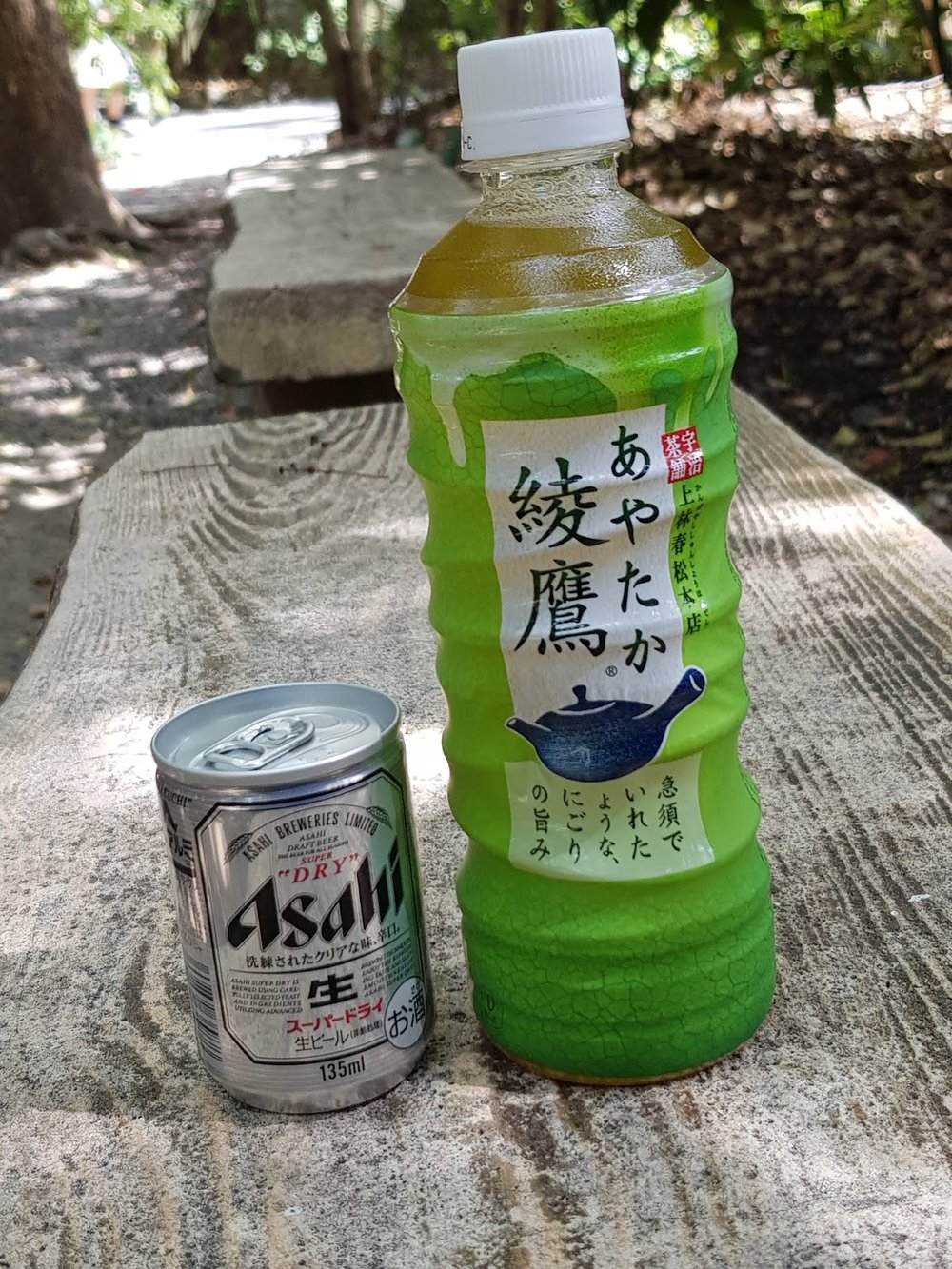
It's not really ok to eat in temple or shrine grounds, but there was a rest area with vending machines, so I sat there and had my mackerel sushi.
I also had this tiny beer (to celebrate being in Japan after almost two years). I had a good feeling about this day already.
↓ Atsuta Shrine
There was a wedding going on, too:
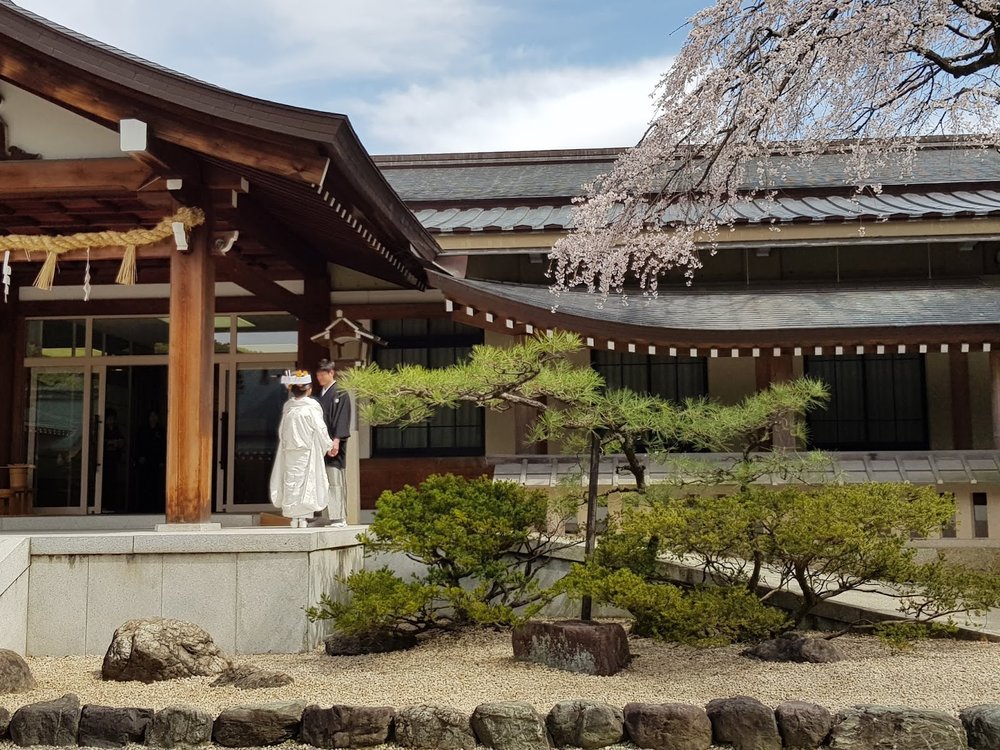
↓ Yay!
Next up, I headed to the onsen (温泉; hot spring). I picked this for two reasons - the first is that I love
onsen,
and I couldn't wait to go back to one and relax.
The second reason I wanted to go to the onsen is that I'd been on a long-haul flight since 7am UK time, and I really wanted a shower.
Onsen is also a pretty good solo activity - assuming you find being naked with strangers less embarrassing than being naked with friends (I do). Japanese hot springs are a communal affair; separated by gender, but no swimsuits allowed.
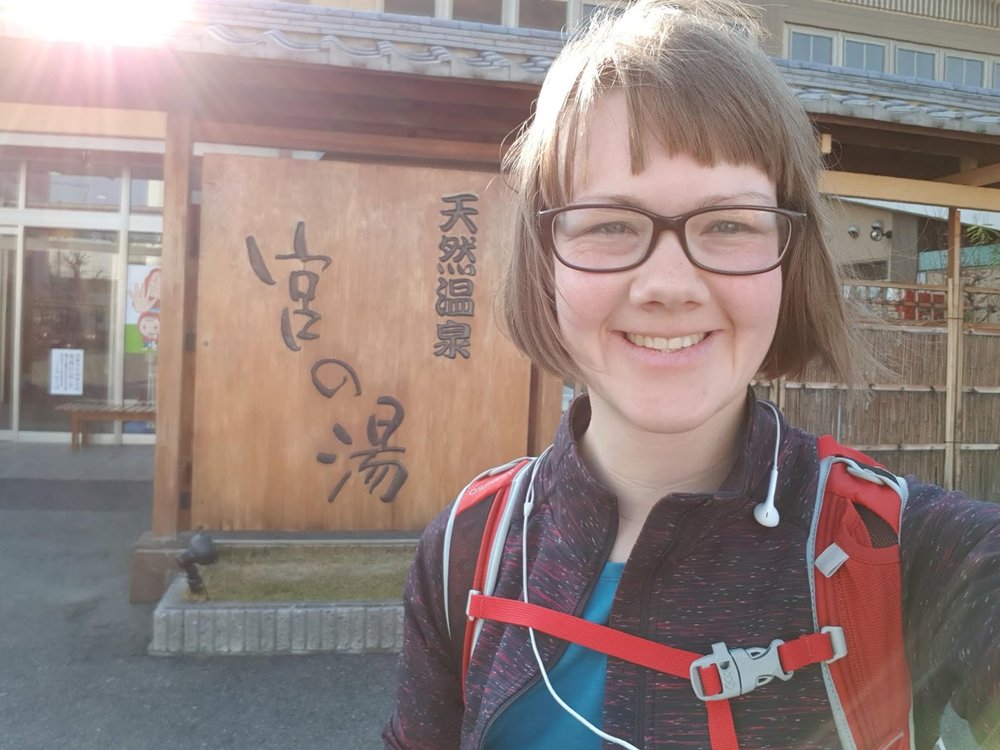
I'd used the airport wifi to look up some reviews, and decided on Miya no yu (宮の湯). It was about a half-hour walk from the shrine, and I could walk there along the river. There were late plum blossoms, and some sprinklings of cherry blossoms too.
↓ At the
onsen
(no pictures in the bath, for obvious reasons)
There were a bunch of different baths, including a 電気風呂 (
denki-buro
) which literally translates as "electric bath", and is - yikes - a hot bath with low-level electric current running through it.
You might think that electricity and water don't mix, and you'd be right. The
denki-buro
is worth a try though - unless you have a pacemaker, in which case give it a miss. It feels a bit like prickly pins and needles.
There was also a smaller bath with "water of the month". This month's special water was よもぎ (
yomogi
; Japanese mugwort). The water was a vivid bright green and looked like melon soda.
After a long soak in various entertaining baths, I got dressed and had a lie down and a bottle of milk.
Milk is a surprisingly popular post-bath drink, considering Japan doesn't have a long history of dairy consumption. お風呂上がりの牛乳 (
ofuro agari no gyuunyuu;
milk after a bath) is almost as good as お風呂上がりのビール (
ofuro agari no biiru;
beer after a bath
).
I'd already had one tiny beer though and was fighting off jet lag, so I stuck to milk. There's something very satisfying about glass bottles of milk.
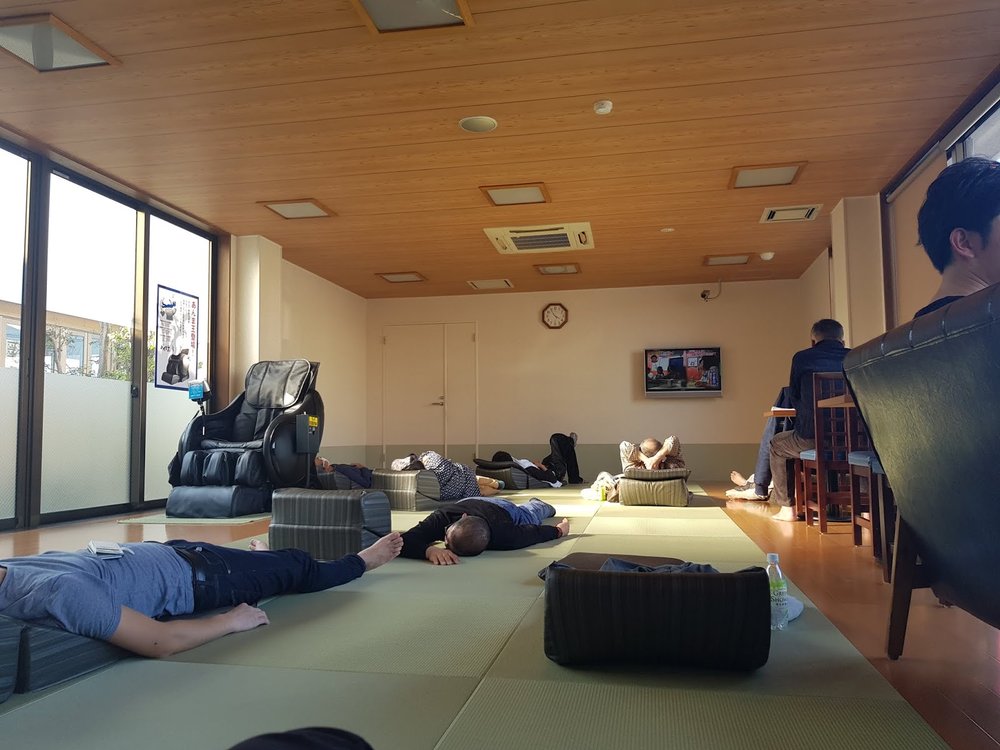
I lay down in this tatami mat rest area, and watched some Japanese variety shows on a distant TV:
It was 4pm. I still had two hours to kill before my friends finished work, so I went to karaoke.
There's even a special word for "going to karaoke by yourself" in Japanese: ヒトカラ (
hito-kara
), which is short for 一人カラオケ (
hitori karaoke
).
Don't get me wrong - karaoke is fun with friends. But it's super fun by yourself too, and in a different way.
You can hog the microphone, and practice the same song three times in a row without anyone complaining. And you don't have to listen to other people's dubious song choices and dodgy singing.
↓ It's all your own dubious song choices and dodgy singing!

After an hour of singing and all-you-can-drink soft drinks from the ドリンクバー (
dorinku baa
; self-service drink bar), I got the subway to meet my friends.
We went to Minoji, a 焼き鳥屋 (yakitori-ya), a restaurant serving yakitori aka "things on sticks". Finally, some hot Japanese food!
I got to eat a lot of different things, old and new. But more importantly, I got to catch up with old friends. I was having so much fun I forgot to take a picture of the outside of the restaurant, with its red lanterns and moody lighting.
I didn't realise until afterwards, but the first time I ever went to Minoji was actually my very first night in Nagoya, after I moved there in 2011.
It made me pretty happy to be back there in 2018. The perfect end to a perfect first day back in Japan.
I wasn't sure how relaxing the rest of the trip would be, but that first day in Nagoya, I was so relaxed!
Not bad for a "lost day", right?
Click here to read part 1 (which is actually about the Shikoku 88 pilgrimage!)

Walking the Shikoku 88 Pilgrimage (Part 1) - Plan, plan, plan!
Are you a planner? Or a no-planner?
Some people like to "wing it" when they travel. They book a ticket and turn up, deciding what to do once they arrive.
Me, I like to have things planned out. Especially when the trip involves a week of solo walking in Japan!
I've always wanted to do a long-distance walk in Japan. And the Shikoku 88 pilgrimage is Japan's most famous pilgrimage trail.
This page contains affiliate links, which means I may earn a small commission, at no extra cost to you, when you click through and buy the book. Thanks for your support!
Are you a planner? Or a no-planner?
Some people like to "wing it" when they travel. They book a ticket and turn up, deciding what to do once they arrive.
Me, I like to have things planned out. Especially when the trip involves a week of solo walking in Japan!
I've always wanted to do a long-distance walk in Japan. And the Shikoku 88 pilgrimage is Japan's most famous pilgrimage trail.
My original plan was to walk the trail when I lived in Japan. I hoped to squeeze it in before returning to the UK in 2014, but that never quite happened. I figured maybe I'd go back and do it someday though.
The Shikoku 88 pilgrimage (known in Japanese as 四国八十八ヶ所巡り Shikoku hachijuu hakkasho meguri) is a 1200km (750 mile) walking route around the southern island of Shikoku. It's an ancient Buddhist pilgrimage trail, taking in 88 temples.
Shikoku ↓

(Image: Wikipedia)
Many of the temples are connected to Kōbō Daishi, 8th-century Buddhist monk and the founder of Shingon Buddhism.
It's said that Kōbō Daishi spent time on Shikoku in training, and that those who walk the pilgrimage are therefore walking in his footsteps.
↓ Kōbō Daishi, also known as Kūkai

Image: Wikipedia
I'd never been to Shikoku before. But late last year I decided 2018 would be the year that I start the Shikoku pilgrimage.
Spring seemed like the perfect time - we have two weeks off from class at Easter. I decided to spend one week walking, with a few days on either side catching up with old friends.
One week doesn't get you very far into a 750-mile pilgrimage, but I calculated I could at least walk the first 21 temples (even at a fairly leisurely pace).
My planned route from temples 1 to 21 ↓

Original image: Nippon.com
There's a lot of information about the pilgrimage online, but I wasn't sure I'd have internet access while I was actually in Japan, so the first thing I did was buy a guidebook.
Well actually, I bought three.
First, this マップル (mappuru) travel magazine. This was fun to read, picture-heavy, and got me excited about the trip. But it wasn't specific enough to help me work out how long I could walk for or where to stay.

Next, and determined to use a Japanese-language guidebook, I ordered this route guide. This had great maps, and details about the temples, but not much else.

What I was hoping for was maps and travel information. And eventually I found it, Goldilocks-style, in the third place I looked.
The Shikoku 88 Route Guide* is a pocket-sized guidebook with detailed maps, information about each temple, and lots of useful before-you-go tips. Perfect!

It even contains this guide to temple etiquette, and a romaji version of the hannya shingyou (Heart Sutra):

↓ Detailed bilingual maps and temple info

Unfortunately for me (I really wanted to use a Japanese guidebook!), it's in English. But if you don't read Japanese, obviously that's really useful.
Armed with information, I set about making a plan. As I would be going by myself, I wanted to book all my accommodation in advance.
I planned to walk between 10 and 15 miles a day. (Compared to most pilgrims, that's pretty easy going). Using the guidebook, a lot of google, and a bit of guessing, I worked out where I wanted to stay.
I booked some of my accommodation online, but some places didn't have websites, so I called them. With the time difference, this meant making phone calls at 6am UK time.
(Talking on the phone in Japanese at 6am is not my favourite activity, but it needed to be done.)
To my surprise, some accommodation was already booked up four months in advance! That made me a bit nervous. Conversely, other places said they didn't take bookings in advance, and asked me to call back closer to the time.
Soon, I had a long and extremely detailed word document full of crossed out and rewritten accommodation names, distances between temples, and even possible places to get lunch.
I had a plan.

Coming up in part 2: A Perfect Day in Japan!
Click here to read Hiking the Shikoku 88 Pilgrimage Trail in 2018 - A Round-Up.
Links with an asterisk* are affiliate links, which means I may earn a small commission, at no extra cost to you, when you click through and buy the book. Thanks for your support!
First published 25th May 2018; updated 10th November 2021

Gachapon: Capsules of Joy, ¥300 a pop (GUEST POST!)
This week - a guest post from Step Up Japanese student David Sharp!
I have a bit of a gachapon obsession. There are so many things I love about Japan, but my eyes light up when I see a gachapon machine. I’ve got a sixth sense specifically dedicated to locating gachapon machines and you can guarantee I’ll make a beeline for it, or forever regret not seeing what mysteries they might hold. There’s something very Japanese about gachapon: compact, transient, novel and convenient.
But let’s back up for a second – what is gachapon?

This week - a guest post from Step Up Japanese student David Sharp!
I have a bit of a gachapon obsession. There are so many things I love about Japan, but my eyes light up when I see a gachapon machine. I’ve got a sixth sense specifically dedicated to locating gachapon machines and you can guarantee I’ll make a beeline for it, or forever regret not seeing what mysteries they might hold. There’s something very Japanese about gachapon: compact, transient, novel and convenient.
But let’s back up for a second – what is gachapon?
A gachapon machine is a small box, with a mechanism a bit like a gumball machine that dispenses little plastic capsules with some sort of ‘prize’ in them. You’ll usually see them stacked two or three high and accompanied by some either side. You may even find them stretching out across an entire wall, or filling up what might otherwise be wasted space.
To operate them is pretty simple: drop the correct coins into the coin slot and then turn the crank on the front, after a few turns your prize will drop out!
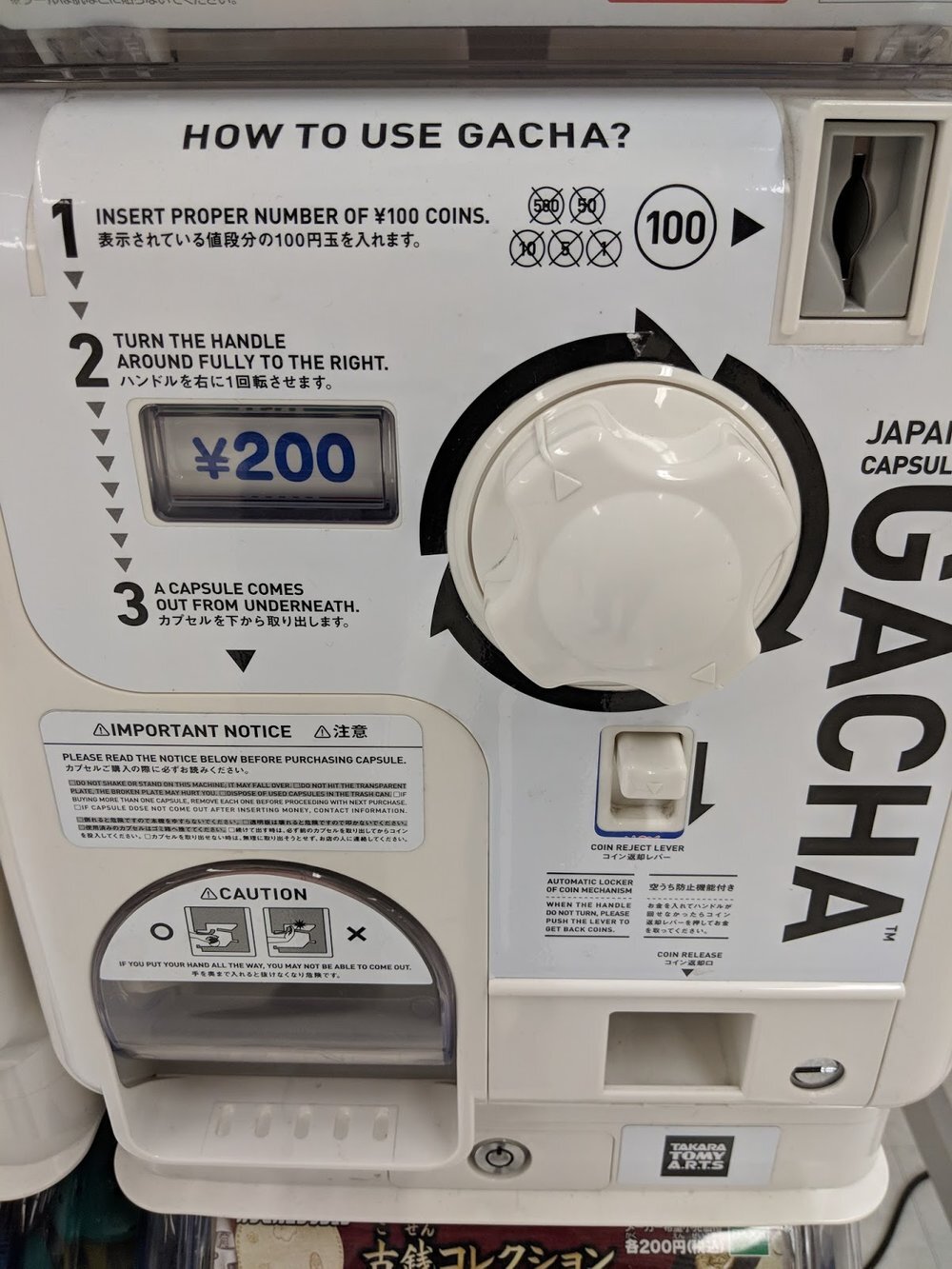
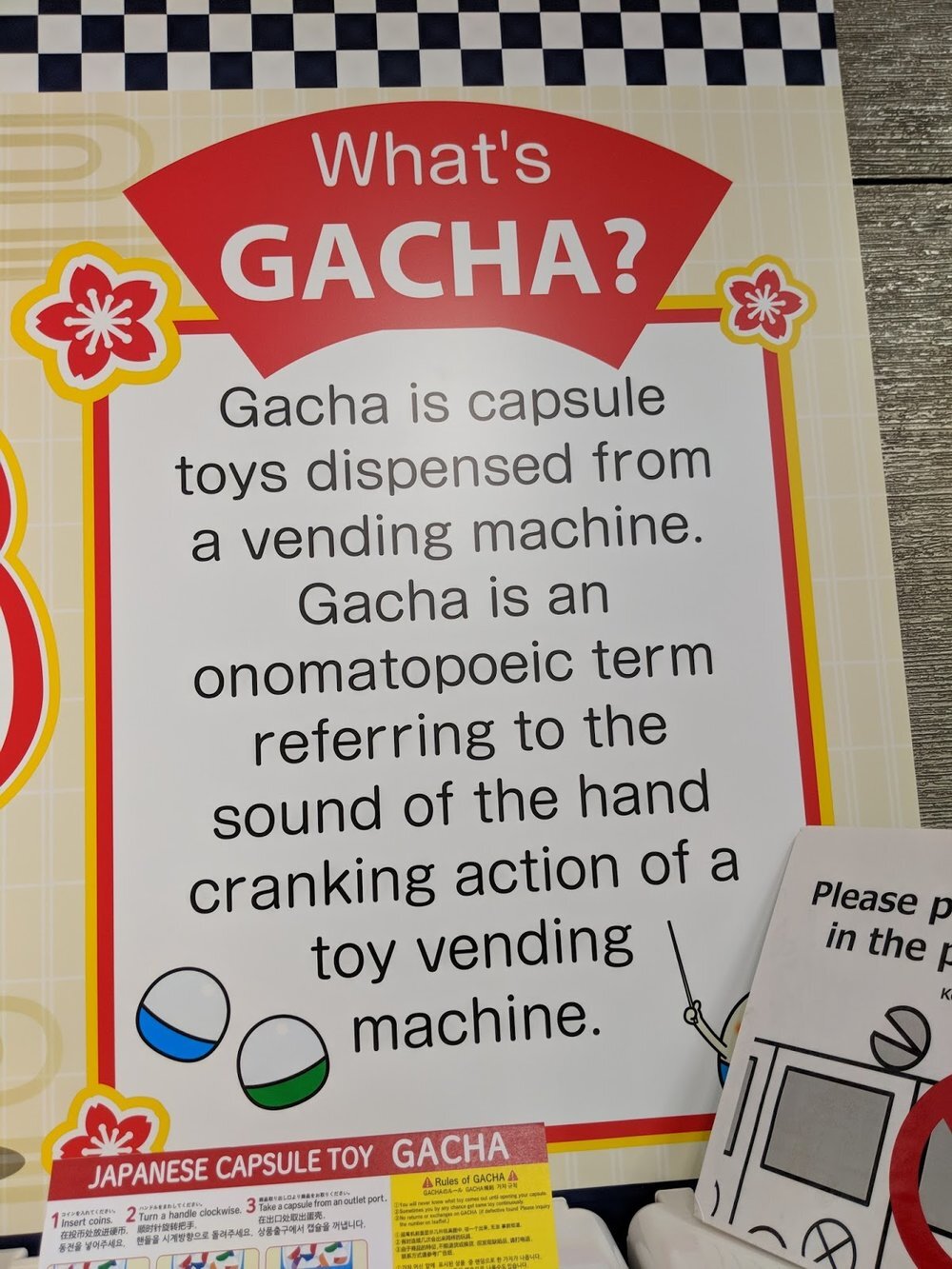
Gachapon 「ガチャポン」as a word comes from the “gacha gacha” 「ガチャガチャ」sound the machine makes as you turn the crank to release your prize. What people actually call them tends to differ.
From my experience "gachapon" is pretty common, however you’re also likely to see “gashapon"「ガシャポン」 or simply “gacha”「ガチャ」 (which are Bandai and Tomy trademarks, respectively), both of which derive from the same onomatopoeia.
Typically, a gachapon prize comprises of three components: the capsule, a little scrap of paper with all the prizes you could have won and your prize itself!
Here's what to expect from your average gachapon machine: a capsule, your prize (in this case a Pokémon pin) and the "here's what you could have won" scrap of paper:

So now we know what gachapon is, let's have a look at some of the prizes on offer!
Phone danglers are quite a common find:


Those on the left are actually designed to fit onto a bottle cap, which is a trend I'm not sure I understand ↓


Sometimes you'll find something a little more traditional ↓

Souvenir gacha aimed at tourists, which look a bit more like gumball machines ↓

Turns out you can even get watches in gachapon ↓

Deep down I regret not getting a Gudetama watch for 300¥ ↓

Magic sand and pots of slime are pretty common in kid-friendly places ↓

If you're happy to pay a bit more, you might find some of these sofubi (ソフビ "soft plastic") designer toys ↓

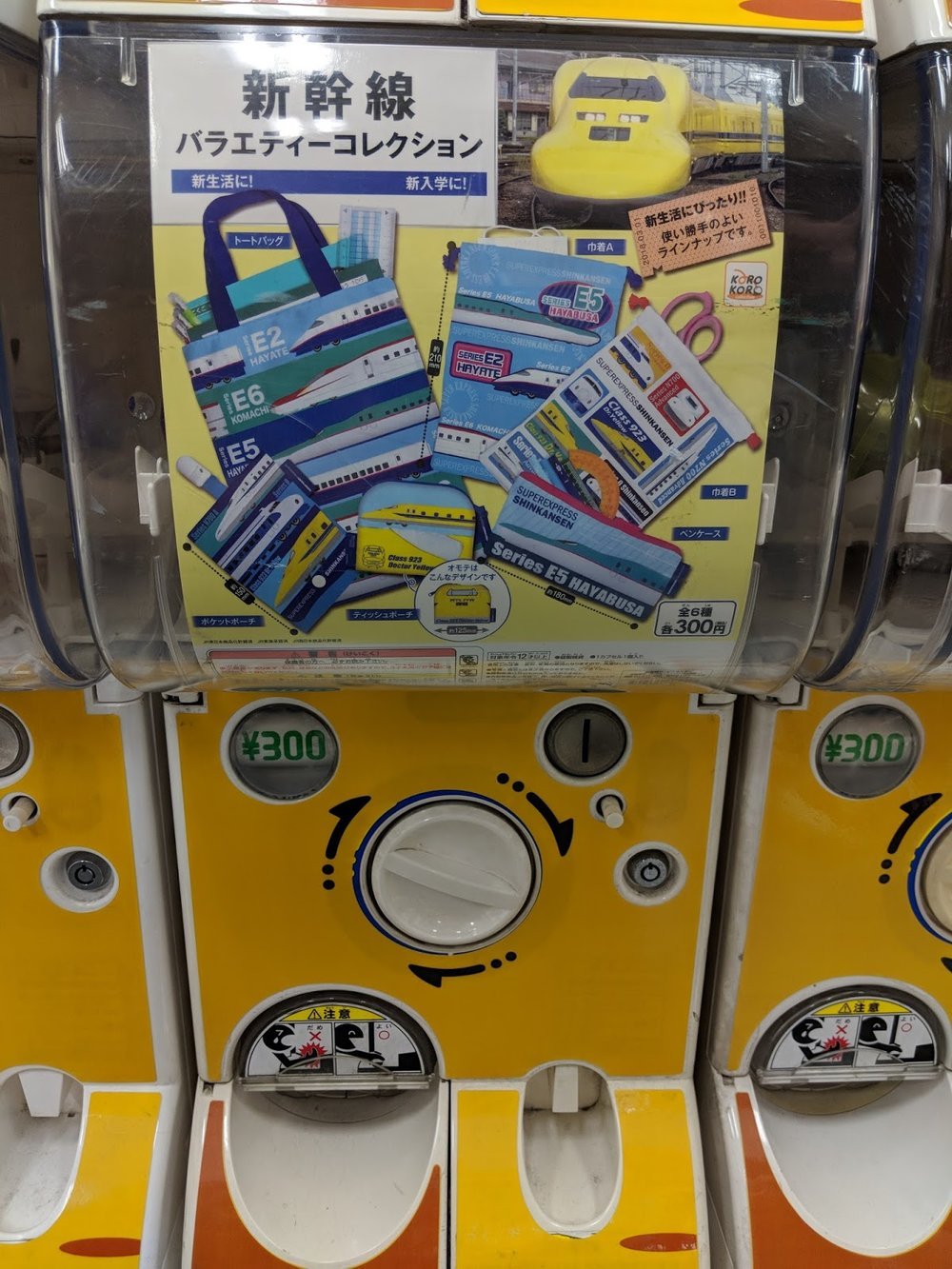
Shinkansen themed bags, purses and pouches ↓
Hopefully you'll find some cat hats ↓

...and more cat hats...

...and dog hats...

...and yet more cat hats...

...and cat wings...

...and somehow still find more cat hats!

In the contents of gachapon machines, there is a spectrum of target audiences and of usefulness, but one thing all the prizes have in common is the capsule they come in (hence sometimes being referred to as “capsule toys” 「カプセルトイ」)
“But, David”, I hear you say, “if you’re buying so many gachapon, what happens to all the empty capsules?”
Well, while not entirely universal, most places you’ll be able to get gachapon will also have a little basket or bin to dispose of your unwanted capsules.

But if you do find yourself taking them away with you, Bandai’s capsules are all recyclable, and most others will at least be half recyclable. Occasionally though you’ll find a capsule toy where you should keep hold of the capsule, because the capsule is the toy!
The capsule of these gachapon are maneki neko (招き猫; Lucky Cat) torsos! ↓

“I’m sold”, you say, metaphorically, “how much do will these fancy-schmancy capsules set me back?”
Gachapon machines (almost) always only accept 100¥ coins, so will cost a multiple of 100¥. A price tag of 300¥ is most common (approx. £2, at the time of writing) but you’ll likely see a lot of 200¥ and 400¥ machines too.
You might also stumble across a 500¥ gachapon machine, in which case don’t be surprised if it’s bordering on risque!
The only 500¥ gachapon here are these swimsuit-clad women ↓

While it’s certainly a matter of opinion, individual gachapon prizes tend to be good value for money. No matter how goofy a gachapon purchase may be, I find it difficult to be disappointed in the prize! Say you find a machine full of cute phone danglers; the quality will be comparable to one you might buy in a souvenir shop, but for cheaper!
However, if there’s one you’re really keen to own, or you want to collect the whole set, you run the risk of ending up with a lot of duplicates! (Although I’m sure you’ll be able to find an unsuspecting friend to offload them onto as “thoughtful gifts” from your travels.)
If you see a machine full of trinkets that you must have in your life and are keen on collecting a whole set– or there’s only one in a set you like the look of and don’t want to risk winning a dud– you may be able to buy it elsewhere. Akihabara, for example, has a number of shops that sell rows and rows of loose figures usually with very little markup (sometimes you’ll practically just be paying the tax). However, something truly sought after might set you back up to double what you would’ve paid for from the machine!
But now you've booked your flights to Japan and you're wondering “Where can I even find gachapon?”
Everywhere! Although they’re not as common as vending machines, you’ll find gachapon at tourist attractions, train stations, airports, convenience stores, arcades, shopping areas, department stores, sometimes even in temples. The beauty of gachapon is that you don’t need to dedicate a chunk of your day searching for them, or venture too far out of your way to find them. While there are dedicated stores you could keep an eye out for, the truth is there’s such a variety that over your trip you’ll hopefully stumble upon a wide range of potential prizes. (That said– if, at the end of your trip, you find yourself at Narita Airport’s Terminal 2 with pockets full of leftover coins, they have a huge selection just outside the 7-Eleven).
Narita Airport's terminal 2 wants your coins! (Fun fact: I had to get money out so I could get a few more gacha before heading home) ↓

The gachapon on offer are constantly changing and vary from place to place, so I wouldn’t get your hopes up about finding anything in particular, but there’s so much choice you’re bound to find something cool, cute, weird or that makes you chuckle!
Happy hunting!
Find David and tell him what your favourite gachapon prize is at davidsharp.codes. Or check out more of his Japan pics (including even more gachapon photos!) on his instagram.
P.S. Would you like to write a guest blog post for Step Up Japanese? Get in touch! :)
Fun and games at the Brighton & Hove Japanese Club Open Day
If you have children while living abroad, or you move with your kids to a country where a different language is spoken, how do you expose them to your native language?
One option is to join a club of people in the same situation. (Or, if there isn't a club, to start one!)
The Brighton & Hove Japanese Club runs a Saturday school for children from Japanese-speaking and bilingual families. The club exists to promote cultural exchange between Japan and the UK.
Every year they have a well-attended Open Day to celebrate the school's successes, and welcome visitors in to see what the club has to offer. And there's a LOT on offer.
I went along this year with my students again. Here's what we got up to!
The open day has two parts - workshops in the classrooms, and demonstrations and performances on the stage. The club makes really good use of the space, with lots to see and do.
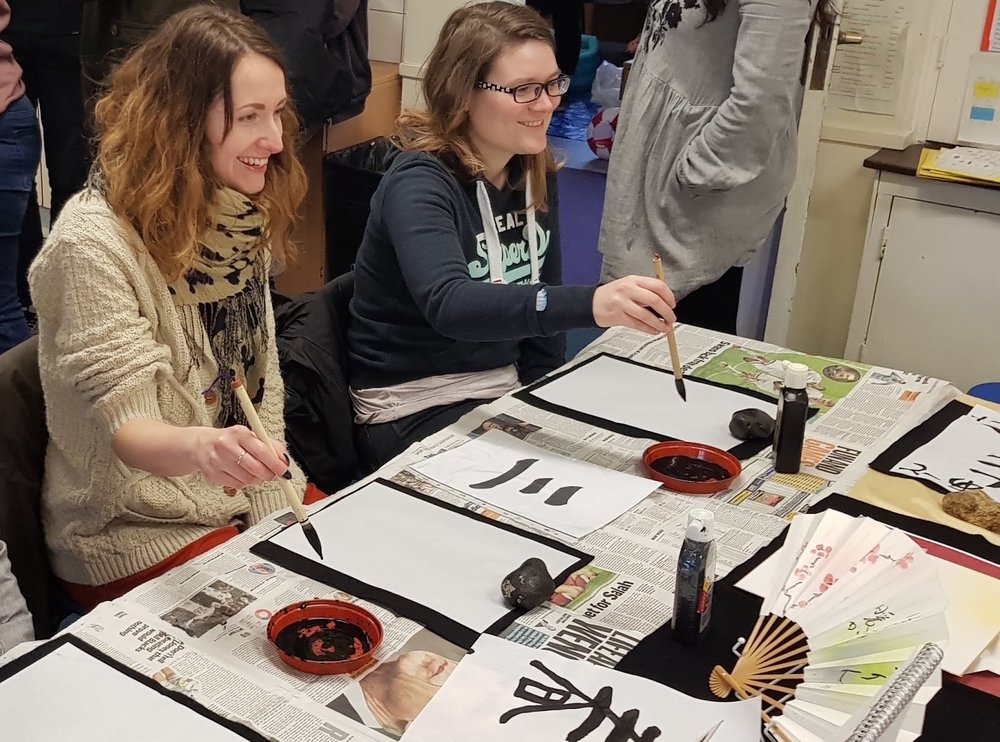
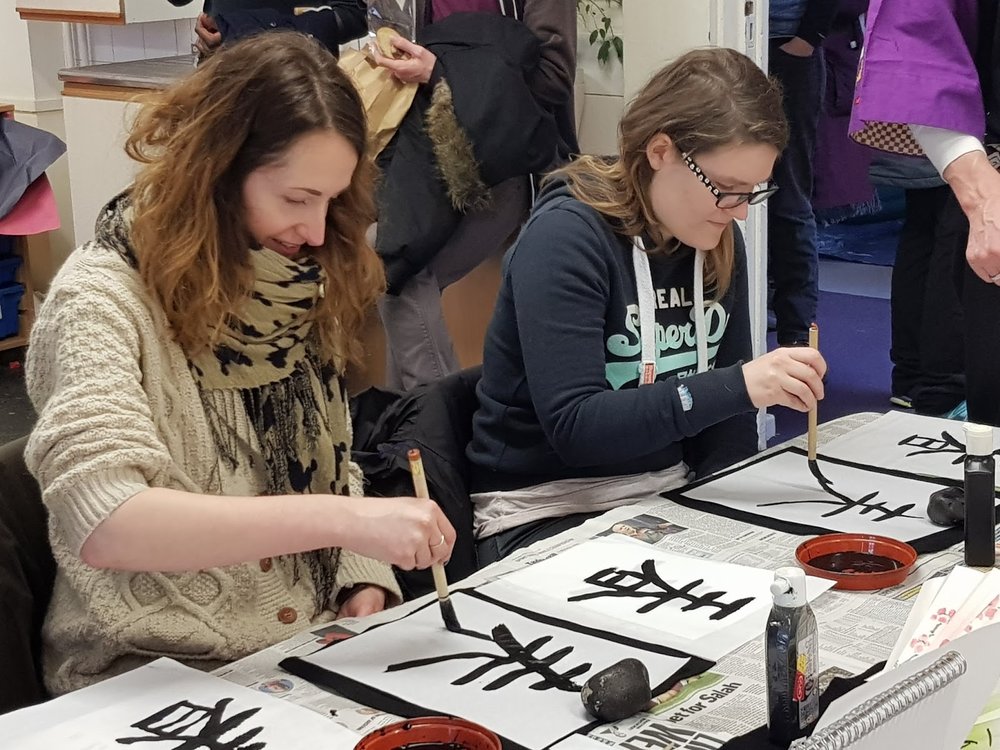
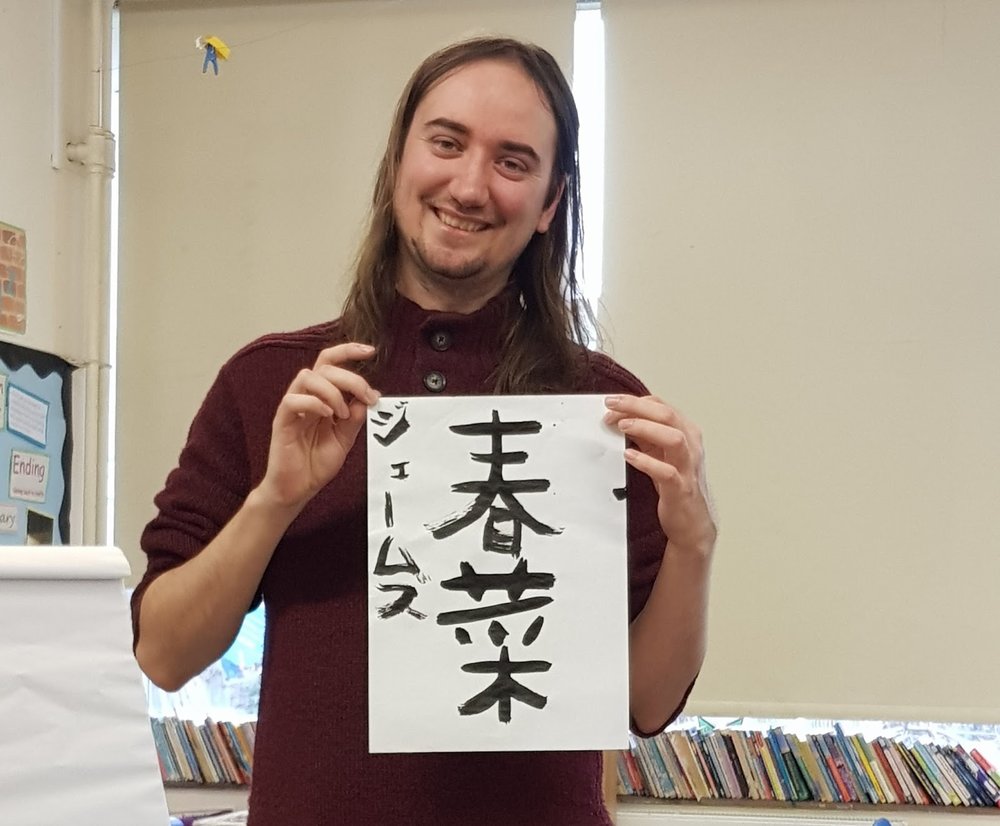
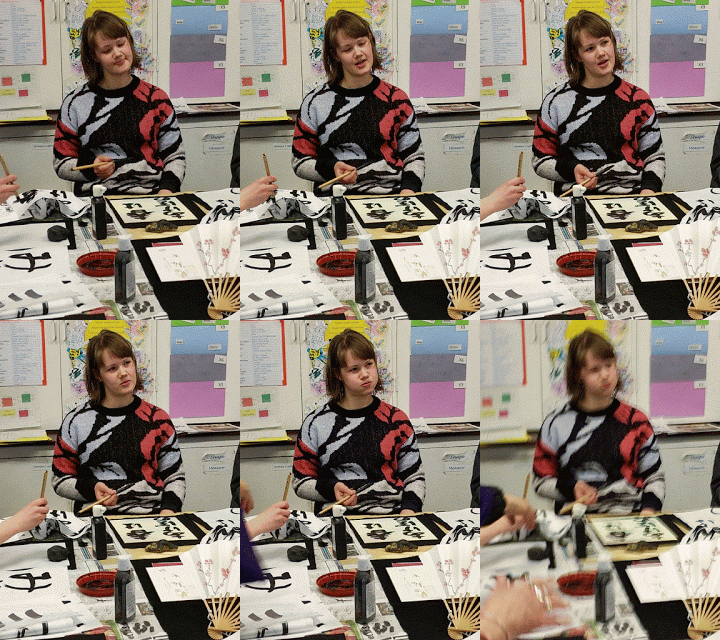
We started with a calligraphy lesson, having a go at writing 春 (haru), the kanji for Spring:
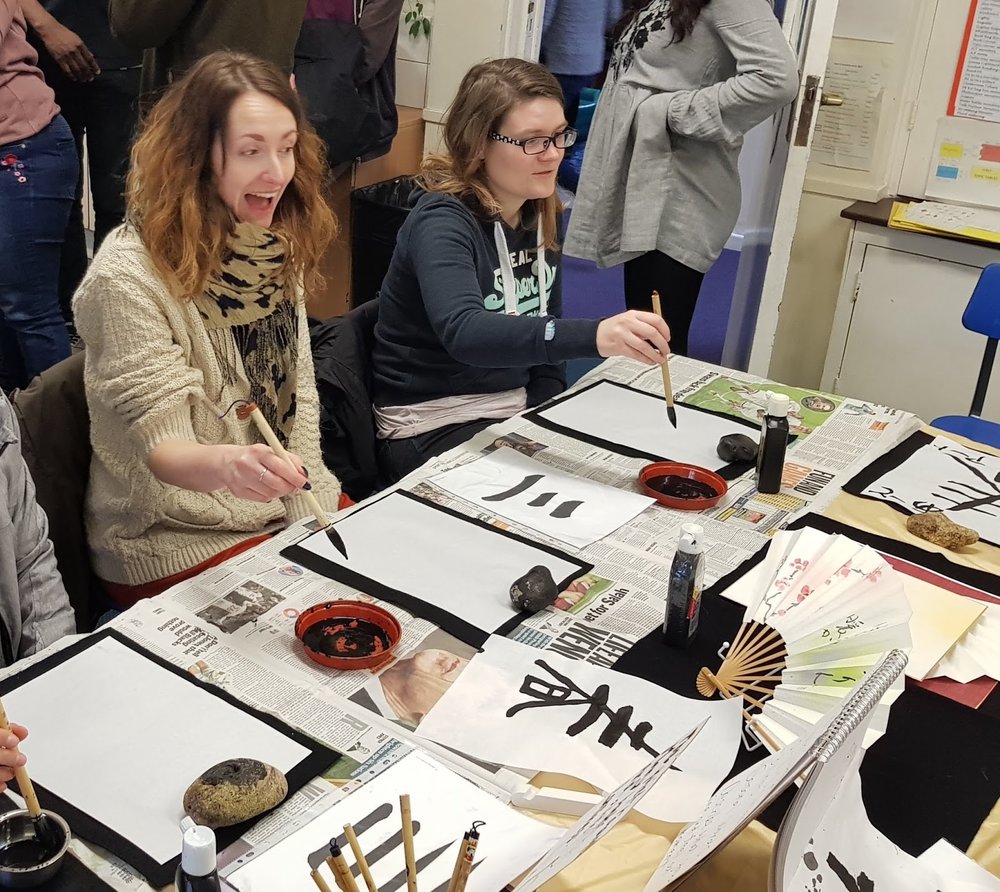
Diligent students!
Dan likes a challenge, so he wrote the most difficult kanji he could think of: 鬱 (utsu).
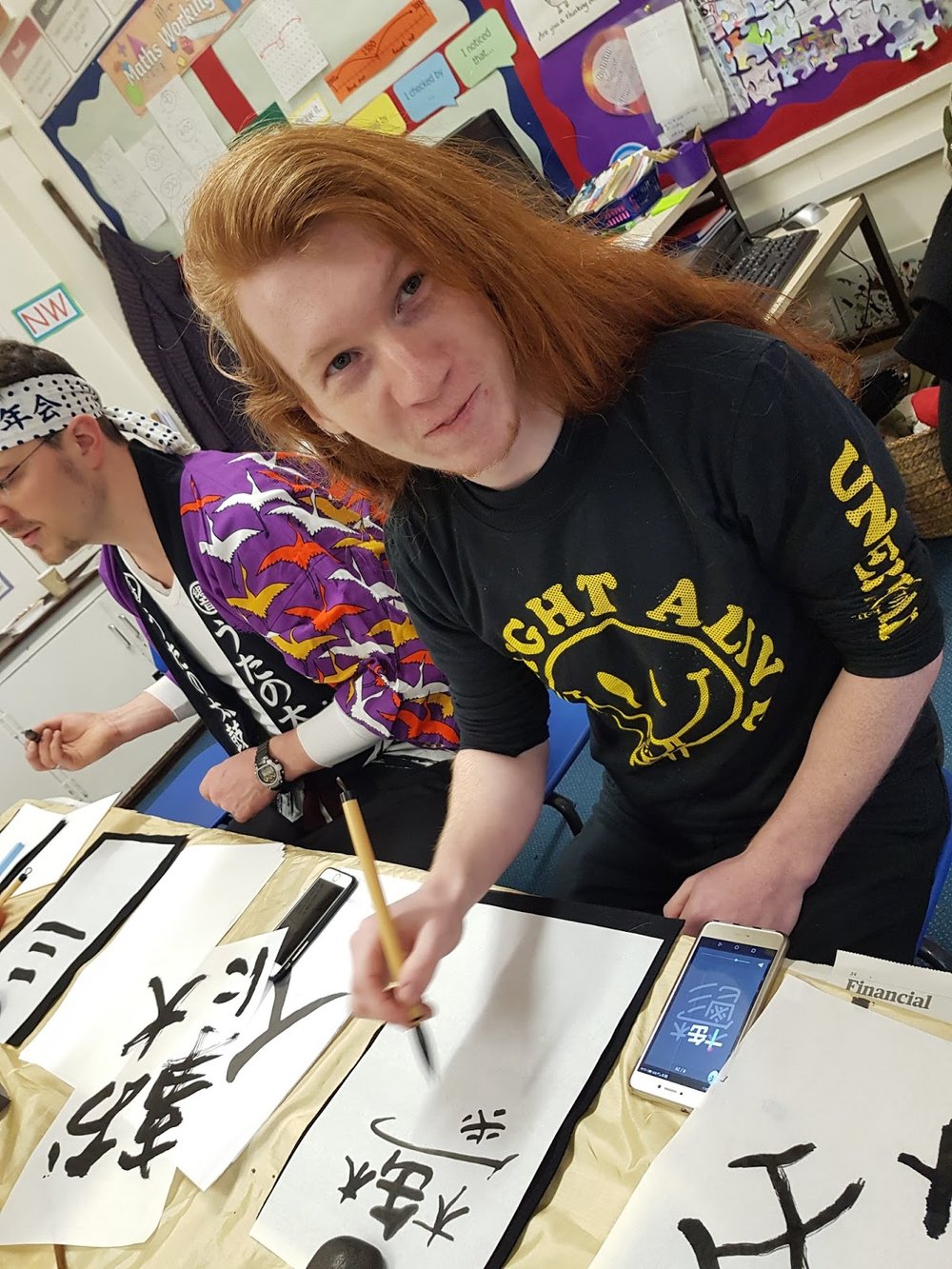
This character means depression, or "low spirits", which is also how you might feel after trying to write a kanji with 29 strokes!
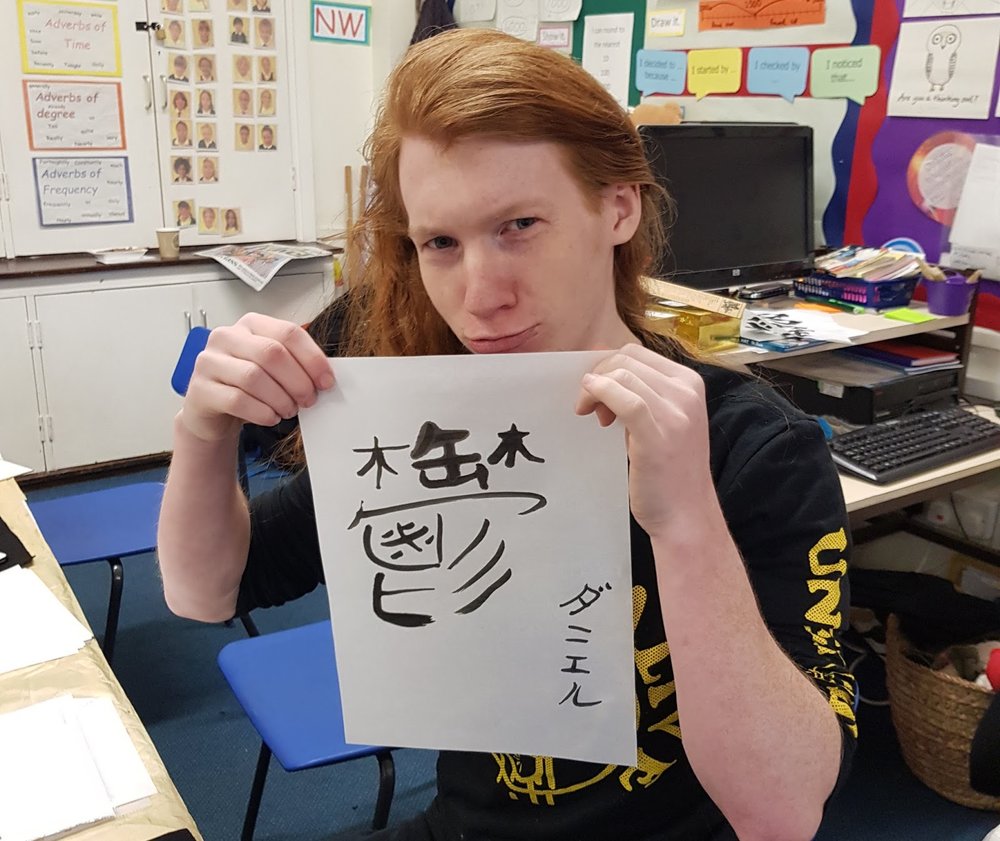
James showing off his handiwork:
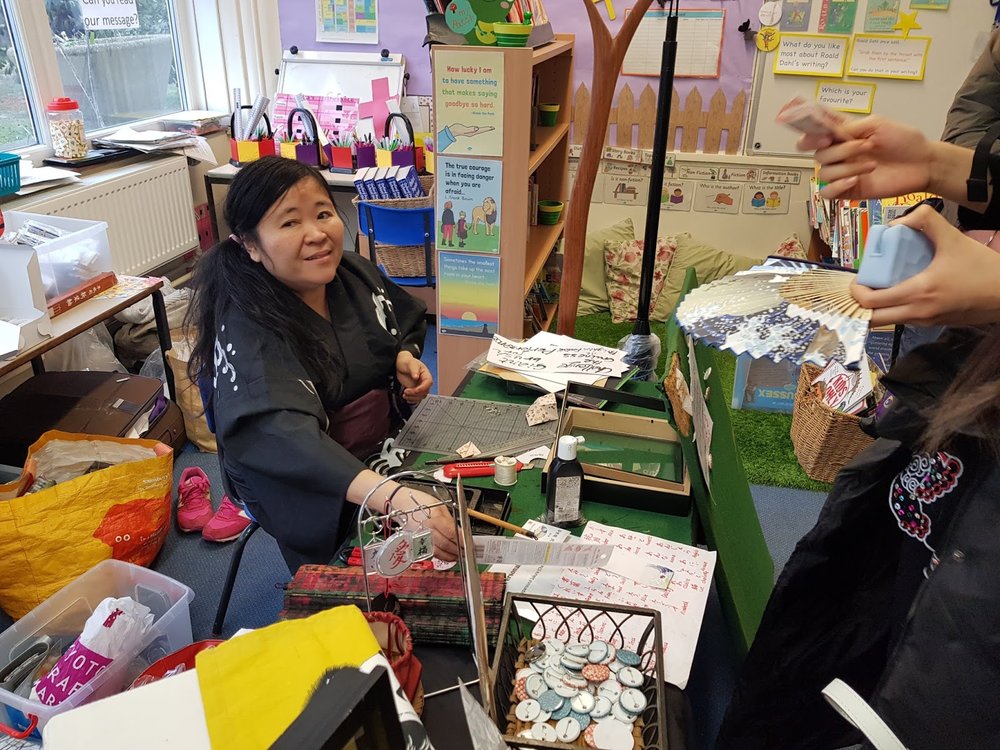
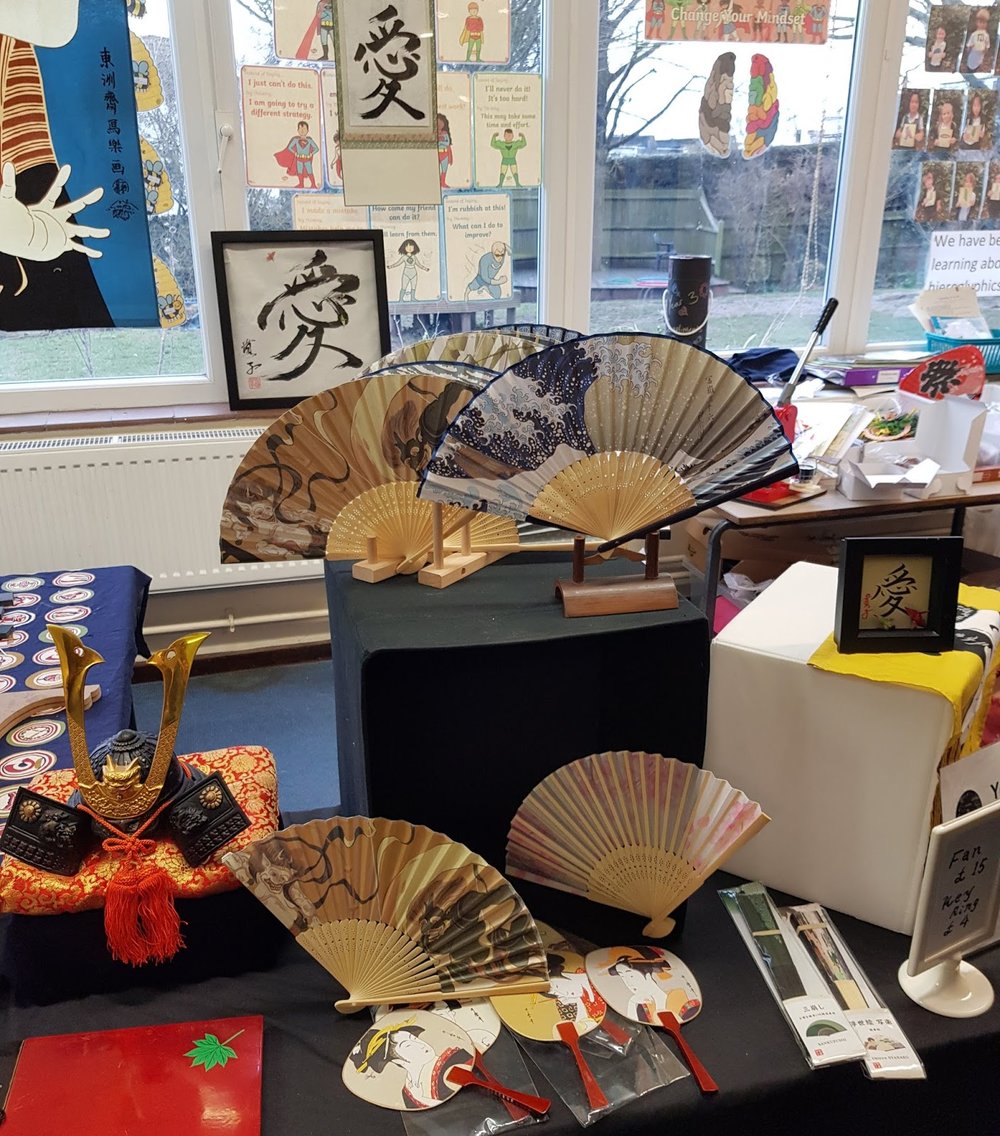
When she's not doing large-scale calligraphy demonstrations or teaching calligraphy, Takako sells beautiful Japanese goods, personalised with your name in Japanese.
Next, we headed into the main hall to see some of the shows.
It was jam packed!
The organisers had to get an extra pole so their video camera could see over the crowd.
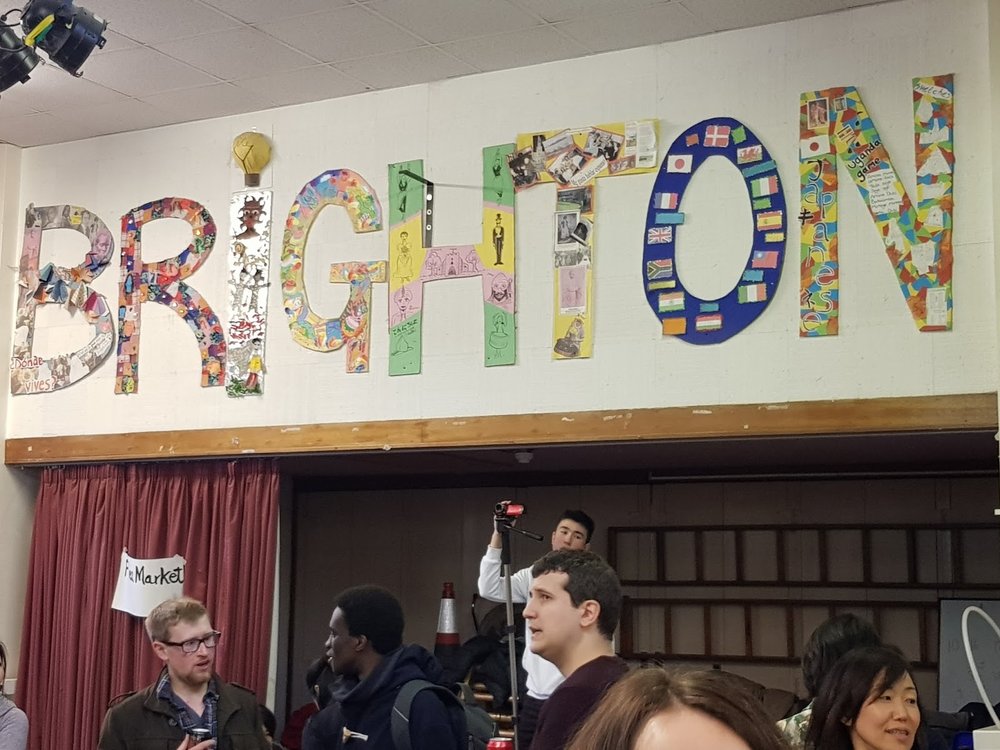
Usually my favourite bit is the second-hand book stall where I pick up something I want to read (often pretending to myself I'll use it in class...)
But I was knew I was going to Japan the following week so I didn't buy any books this year.
I did however get this adorable Anpanman cookie!

I sat on him later and squashed him, but he still tasted great.
I also got some melon pan from this cute bakery stand.
("Gu choki pan ya" is the name of the bakery from the Ghibli film Kiki's Delivery Service).
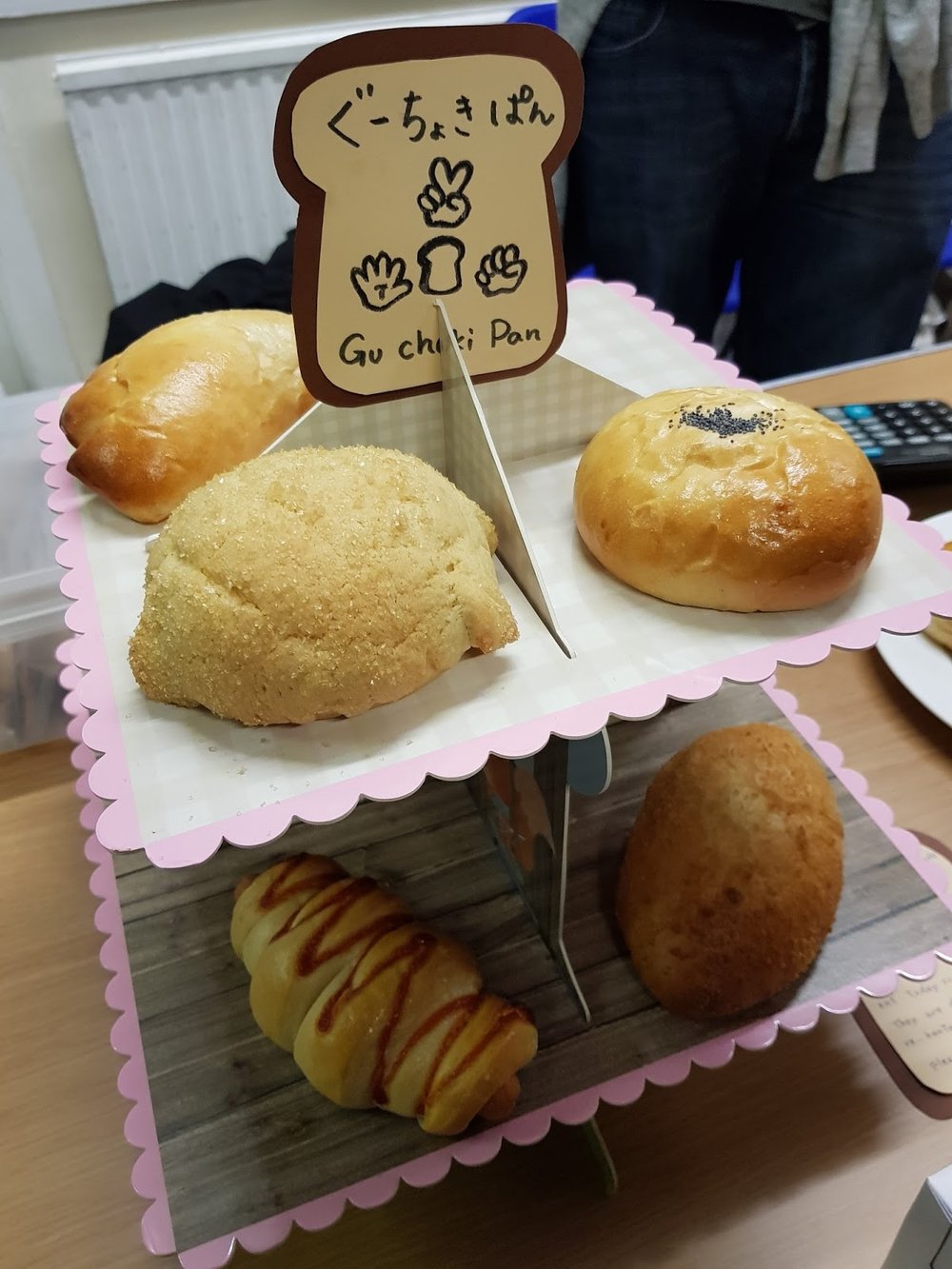
(No photo of An-an's stall I'm afraid, I was too busy chatting to Noriko, the owner, to remember to take a picture).
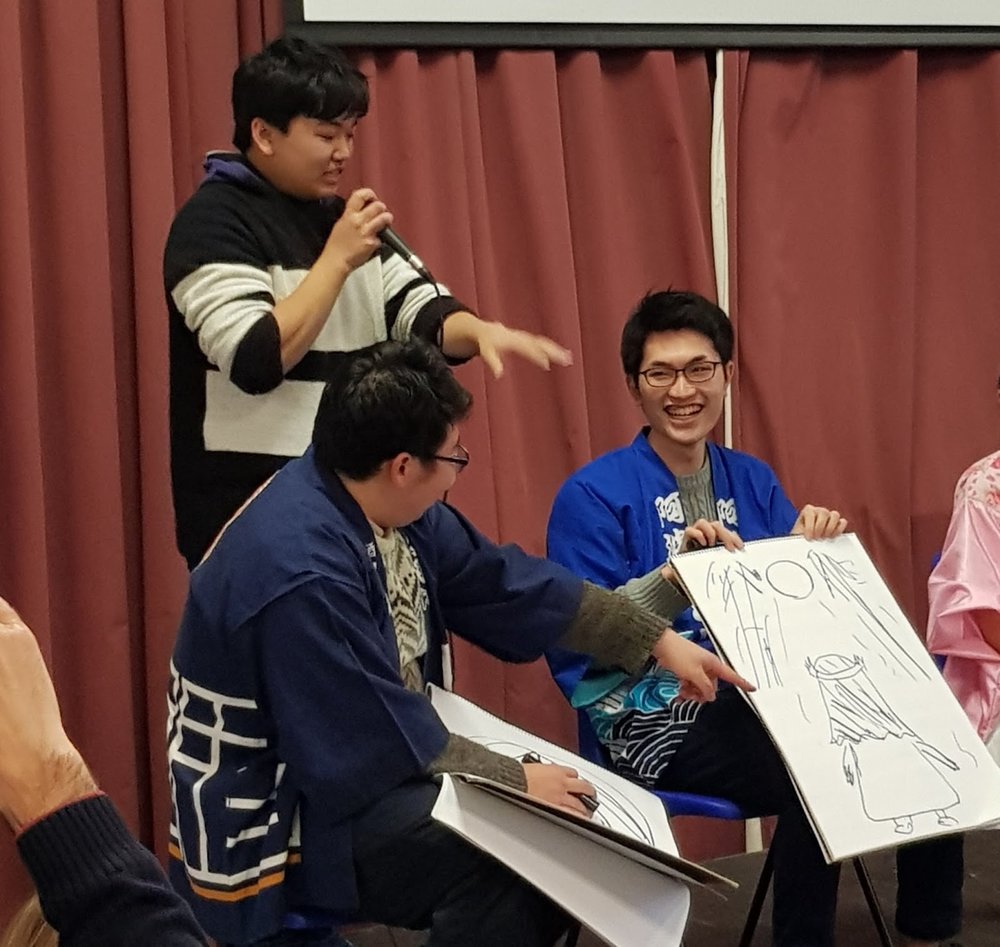
While eating some of the sweet Japanese treats I'd bought, we watched the manga drawing contest.
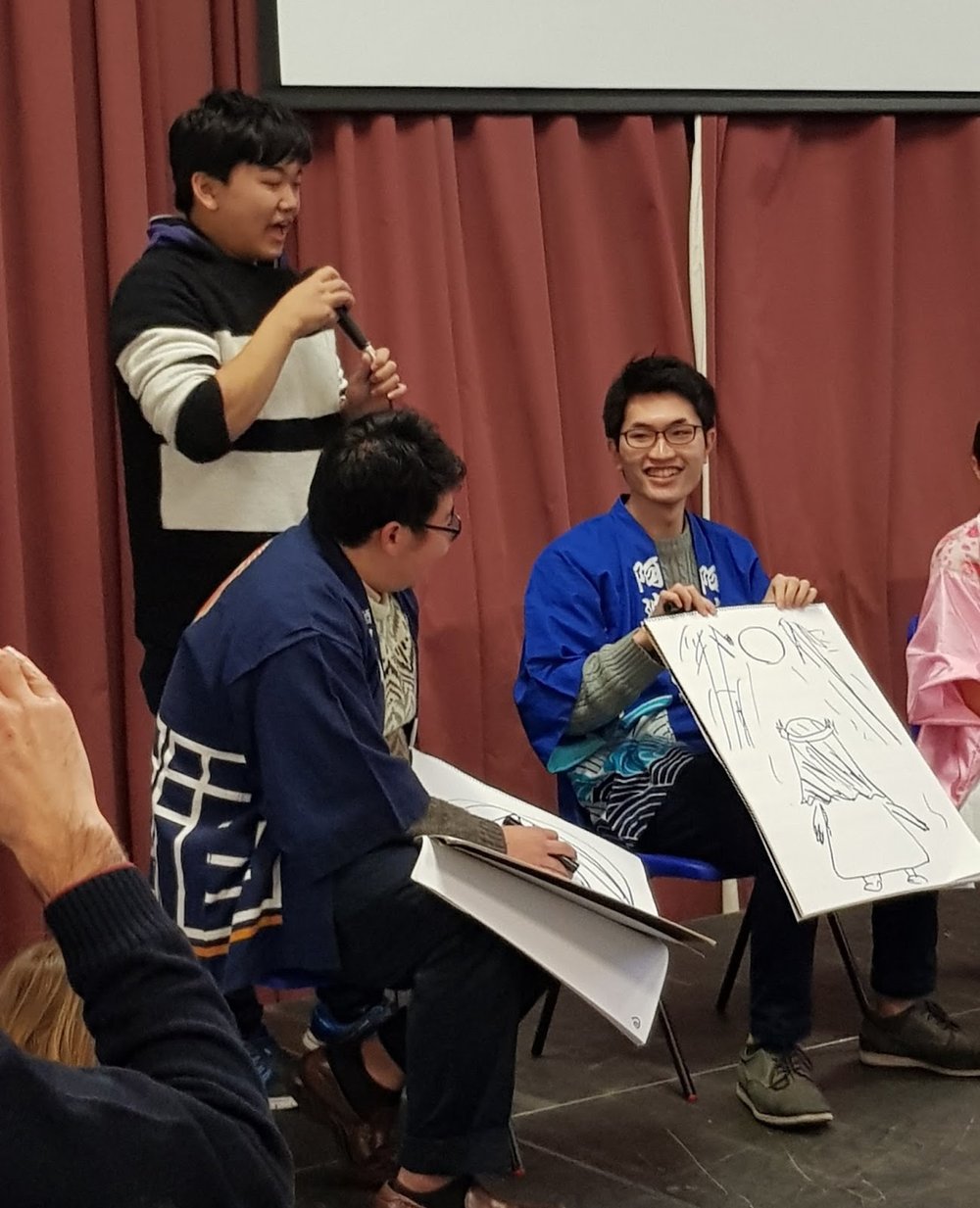
The contestants were given the name of a manga character and had to draw them. The kids could peek at the screen, but the adults had to draw from memory.
Two of the adults participating are professional manga artists, so that was fun too.
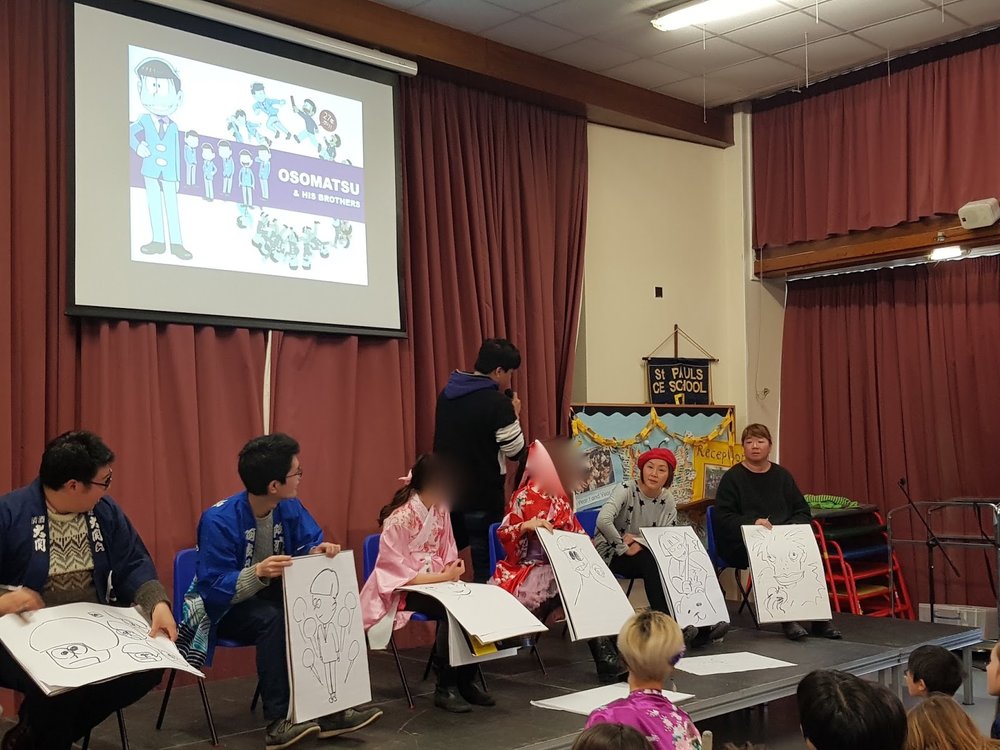
The event is presented in English and in Japanese, with speakers switching between languages.
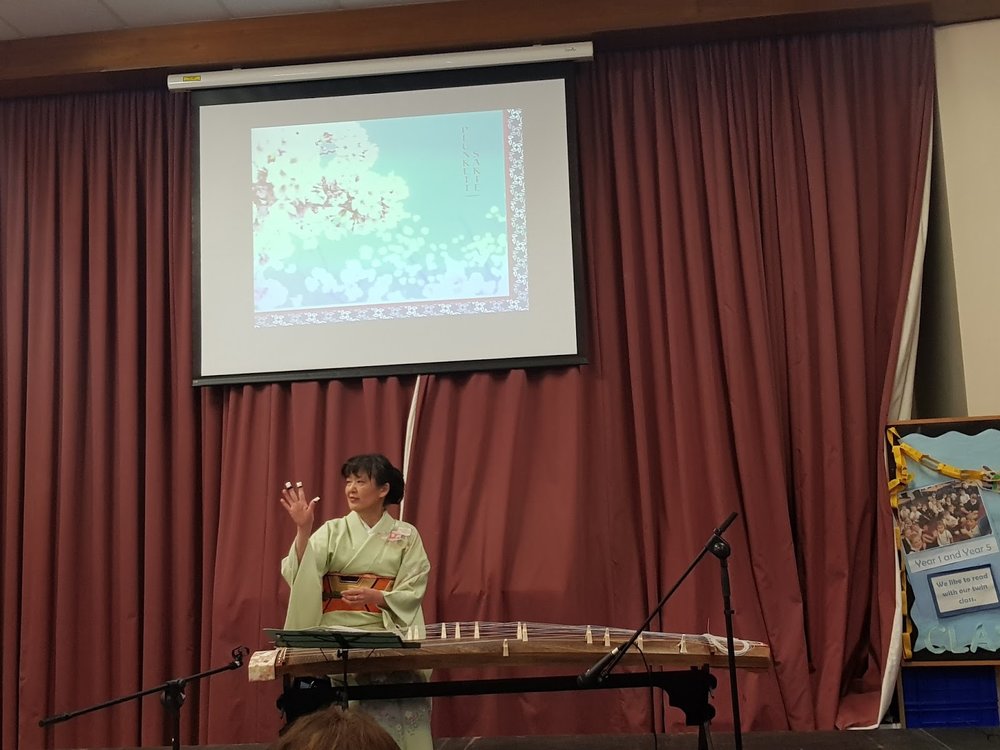
We also watched a koto (Japanese harp) performance by Sakie Plunkett.
And some students had their portraits drawn by manga artists Inko and Chie Kutsuwada.
Here Inko hard at work:
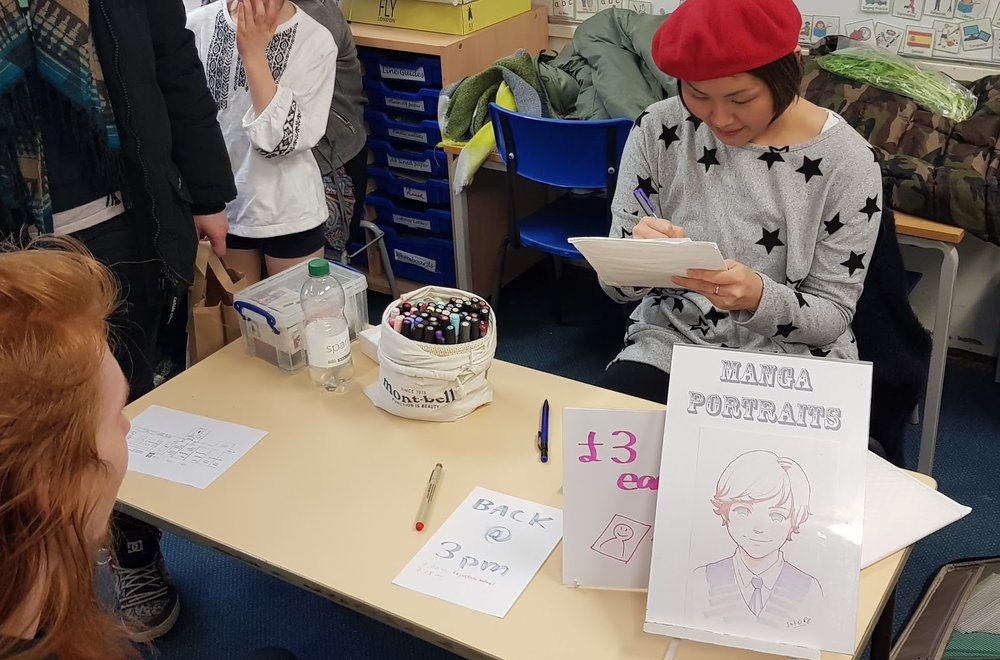
And the finished result!


I always meet someone new and interesting at the Open Day, and the organisers are very friendly and welcoming.
Why don't you come along next year?
Find out more about the Brighton & Hove Japanese Club on their website (click here).
More links:
- Brighton-based manga artist Inko (Ai Takita-Lucas)
- Manga artist Chie Kutsuwada - also Brighton-based
- Takako Higgs, calligraphy artist and teacher in (you guessed it) Brighton
- Cafe an-an, Japanese cafe and wagashi (Japanese sweets) shop in Portslade















Like many people in the UK, I studied French in school. I liked French. I thought it was really fun to speak another language, to talk with people, and to try and listen to what was going on in a new country. (Still do!)
When I was 14 we went on a school exchange to the city of Reims, in northeastern France. I was paired with a boy, which I’m sure some 14-year-olds would find very exciting but which I found unbearably awkward. He was very sweet and we completely ignored each other.
That was nearly 20 years ago, and I didn’t learn or use any more French until, at some point in lockdown, I decided on a whim to take some one-to-one lessons with online teachers. Here are some things I learned about French, about language learning, and about myself.