
Welcome to the Step Up Japanese blog archive!
Although I’m not currently adding new posts to the blog, you’ll find plenty of Japanese learning tips, study advice, and resources to explore here.
Browse the blog index to view a complete list of posts.
For the latest news, course updates, and Japanese learning tips from Step Up Japanese, sign up for my newsletter.
Search this blog:

How Do I Know if a Group Language Class is For Me?
If you’re thinking about taking Japanese lessons, one of the first things you’ll have to decide is whether you want to join a group class, or take one-to-one lessons.
There are pros and cons to all methods of learning a language. Here, I’ll look at some of the key advantages of joining a group.

If you’re thinking about taking Japanese lessons, one of the first things you’ll have to decide is whether you want to join a group class, or take one-to-one lessons.
There are pros and cons to all methods of learning a language. Here, I’ll look at some of the key advantages of joining a group.
1) Meet other language learners
Classes give you access to a teacher, but a group class also provide you with an instant group of other people with the same interest as you.
You can speak in your target language together, go out for dinner and order in Japanese, and message each other asking "what was last week's homework again?"
(Just kidding - thanks to the course outline I'll provide you with, you'll always know what this week's homework is.)
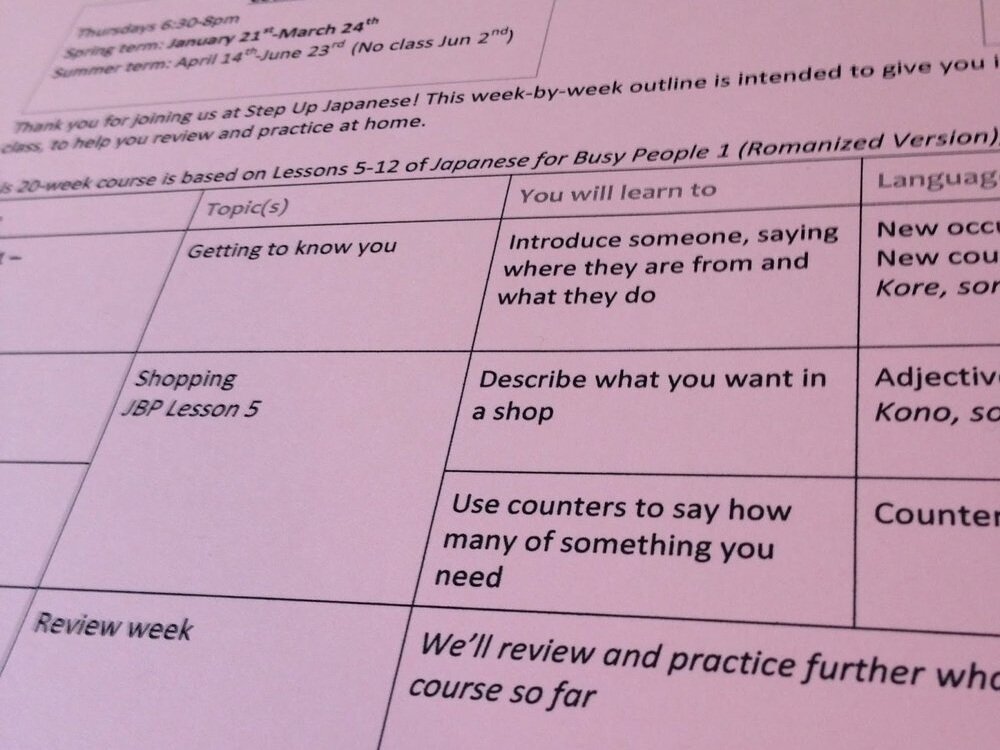
In a group class, students can support and help each other. It's obvious to me that my lovely students gain a lot from each others' support!
2) Keep a regular schedule
To gain any skill, you need to practice regularly. The great thing about having class on a regular day is it forces you to practice. Unlike exclusive self-study where you'll always have an excuse to procrastinate, weekly classes require you to be prepared for every class so you can get the most out of it.
Practice makes perfect, after all.
3) It's your class
You might feel like the only way to get a class tailored to your needs is to take one-to-one lessons. But a good group class - especially one for a small group of students - should be tailored to the students in it as much as a private lesson would be.
That's why I ask my students to give me regular feedback (informally, and through anonymous questionnaires) about how class is going and where you want it to go next.
It's your class, not mine, and we can focus on what you want to focus on.
That doesn't mean I'm going to do the hard work for you. If you want to get good at Japanese, you'll need to find ways of practicing and exposing yourself to the language as much as possible outside of class too.
But a group class can provide the basis of your knowledge, a structure to work with, and a group of friendly faces to answer your questions.
It also gives you a great excuse to go to that great Japanese restaurant again with your classmates.




First published June 2016; updated 9th January 2020.

Even More Japanese Loanwords From Languages That Aren't English
Last time I talked about Japanese loanwords - words that Japanese has “borrowed” from other languages - which come from languages other than English.
But there are also some tricky loanwords that look and sound like they came from English - but they didn’t!

Last time I talked about Japanese loanwords - words that Japanese has “borrowed” from other languages - which come from languages other than English.
But there are also some tricky loanwords that look and sound like they came from English - but they didn’t!
Challenge time!
Don’t be fooled. These loanwords look and sound a bit like they came from English - but they didn’t! Can you guess what languages these loanwords come from?
(Hint: not English!)
Koohii コーヒー coffee
Zero ゼロ zero
Pompu ポンプ pump
Botan ボタン button
Koppu コップ cup
Sarada サラダ salad
Kokku コック cook
Scroll down for the answers…!

The Answers:
Did you guess what non-English languages these loanwords come from?
Koohii コーヒー coffee - Portuguese
Zero ゼロ zero - French
Pompu ポンプ pump - Dutch; Flemish
Botan ボタン button - Portuguese
Koppu コップ cup - Dutch; Flemish
Sarada サラダ salad - Portuguese
Kokku コック cook - Dutch; Flemish
Students often ask why there are so many Portuguese and Dutch loanwords in Japanese. Words from these two languages have been used as loanwords in Japanese since the 16th and 17th centuries, when both countries established trade with Japan.
So, just because that katakana word you’ve learned looks like English, doesn’t mean it came from English!

Useful Apps to Download Before Your Trip To Japan (2019 Update)
If you just love missing your bus because you waited in the wrong place, overpaying for things because you can't remember the exchange rate, or wandering around for hours looking for a wi-fi spot in vain - stop reading now, because this one's not for you.
I'd like to share with you five super-useful apps to download before you travel to Japan!
Whatever you've got planned in Japan, these apps should get you well-prepared.

If you just love missing your bus because you waited in the wrong place, overpaying for things because you can't remember the exchange rate, or wandering around for hours looking for a wi-fi spot in vain - stop reading now, because this one's not for you.
I'd like to share with you some super-useful apps to download before you travel to Japan!
Whatever you've got planned in Japan, these apps should get you well-prepared.
1) Norikae Annai - in English!

Norikae Annai is Japan's most-downloaded travel app. It's easier to navigate than Hyperdia, much more nicely designed and more user-friendly. The catch used to be that it was only available in Japanese. But now it’s available in an English version too, called Norikae Annai - Japan Transit Planner.
Norikae Annai - Japan Transit Planner: App Store | Google Play
2) Tokyo Subway Navigation

I LOVE the Tokyo Subway Navigation app, because as well as transfer information it also has a fully offline, pinch-and-zoom map of - you guessed it - Tokyo's metro system.
Good for getting to grips with (what often seems like) the world's most complex underground rail system!
Tokyo Subway Navigation: App Store | Google Play
3) Apps for Free Wi-Fi

Even if you don't want to be connected all the time, you'll probably want wifi at some point on your travels. Japan Travel by Navitime is an app with an offline map showing free wifi spots. It also has free downloadable offline maps of all the major cities in Japan.
Japan Connected-free Wi-Fi, similarly, has an offline map showing free wifi.
(Or you could just do what I do on holiday and stand outside McDonalds pretending to wait for someone while actually using the free internet. That's cool too, right?)
Japan Travel by Navitime: App Store | Google Play
Japan Connected-free Wi-Fi: App Store | Google Play
4) XE Currency

Not Japan-specific, but definitely useful.
Until the exchange rate hits a nice easy number like 100 yen to the pound, you'll probably want a currency converter so you can figure out how far your spending money's going to go. And the XE converter works offline, too.
XE Currency: App Store | Google Play
So that's what's in my "essential Japan travel apps" folder! What's in yours? Let me know in the comments.
First published March 2016; updated 15 October, 2019




















Want to buy Japanese lessons for a friend or relative? Send a gift card