
Welcome to the Step Up Japanese blog archive!
Although I’m not currently adding new posts to the blog, you’ll find plenty of Japanese learning tips, study advice, and resources to explore here.
Browse the blog index to view a complete list of posts.
For the latest news, course updates, and Japanese learning tips from Step Up Japanese, sign up for my newsletter.
Search this blog:

Dr. Anki or, How I Learned to Stop Worrying and Embrace Multiple Decks (GUEST POST!)
A special guest post from Step Up Japanese student Phil Kinchington!
Anki is a flashcard app that uses a Spaced Repetition System (SRS) to help you learn and memorise information by creating strong, long-lasting memories. It does this by aiming to present you with a flashcard exactly at the point you were about to forget it.
You should be able to recall the information, but at a slight stretch. If you remember the card correctly, it will increase the length of time before it shows it to you again. If you can’t remember (or remember incorrectly) it will show it to you again sooner. It was originally developed for language learning (being named after the Japanese word for ‘memorisation’) but has since been applied to many subjects, including medical studies…
A special guest post from Step Up Japanese student Phil Kinchington!
Anki is a flashcard app that uses a Spaced Repetition System (SRS) to help you learn and memorise information by creating strong, long-lasting memories. It does this by aiming to present you with a flashcard exactly at the point you were about to forget it.
You should be able to recall the information, but at a slight stretch. If you remember the card correctly, it will increase the length of time before it shows it to you again. If you can’t remember (or remember incorrectly) it will show it to you again sooner. It was originally developed for language learning (being named after the Japanese word for ‘memorisation’) but has since been applied to many subjects, including medical studies.
While I saw Anki mentioned and recommended everywhere, I could never figure out a way to use it that really worked for me. Some people recommended that you should download a pre-made deck to match the textbook you are using (there is a huge library of decks submitted by users accessible from within Anki.) But I felt this would mean that it would start automatically adding vocabulary past the point I’d got to in the book.
(Note from Fran - you can “suspend” all the cards and manually “unsuspend” them as you work your way through a textbook, although I appreciate this is a bit fiddly!)
A lot of people recommended that you should use a single deck, and dump everything you came across into it, which seems a bit too messy for my liking. Also, I'd then be constantly having the dilemma of "do I put this in, or is it not worth it, or how can I add this in a meaningful way, that I'd understand why it was there when I came back to it?"
A big part of the problem is how open and flexible the system is. Anki doesn’t guide you or force you to work with it in a specific way, and the design of the cards is almost infinitely configurable. Of course, this is also the reason it has been possible to adapt it for so many different subjects.
I’d pretty much given up trying, and then I discovered the Alivia’s Japanese Nook YouTube channel. On that channel Alivia has a video specifically about using Anki to study Japanese that has been very useful to me. It's a bit long, as it covers every detail of how to use it, and exactly how she has all the settings configured. But if you’ve never used Anki at all, it’s a very good guide to getting it set up and starting to use it.
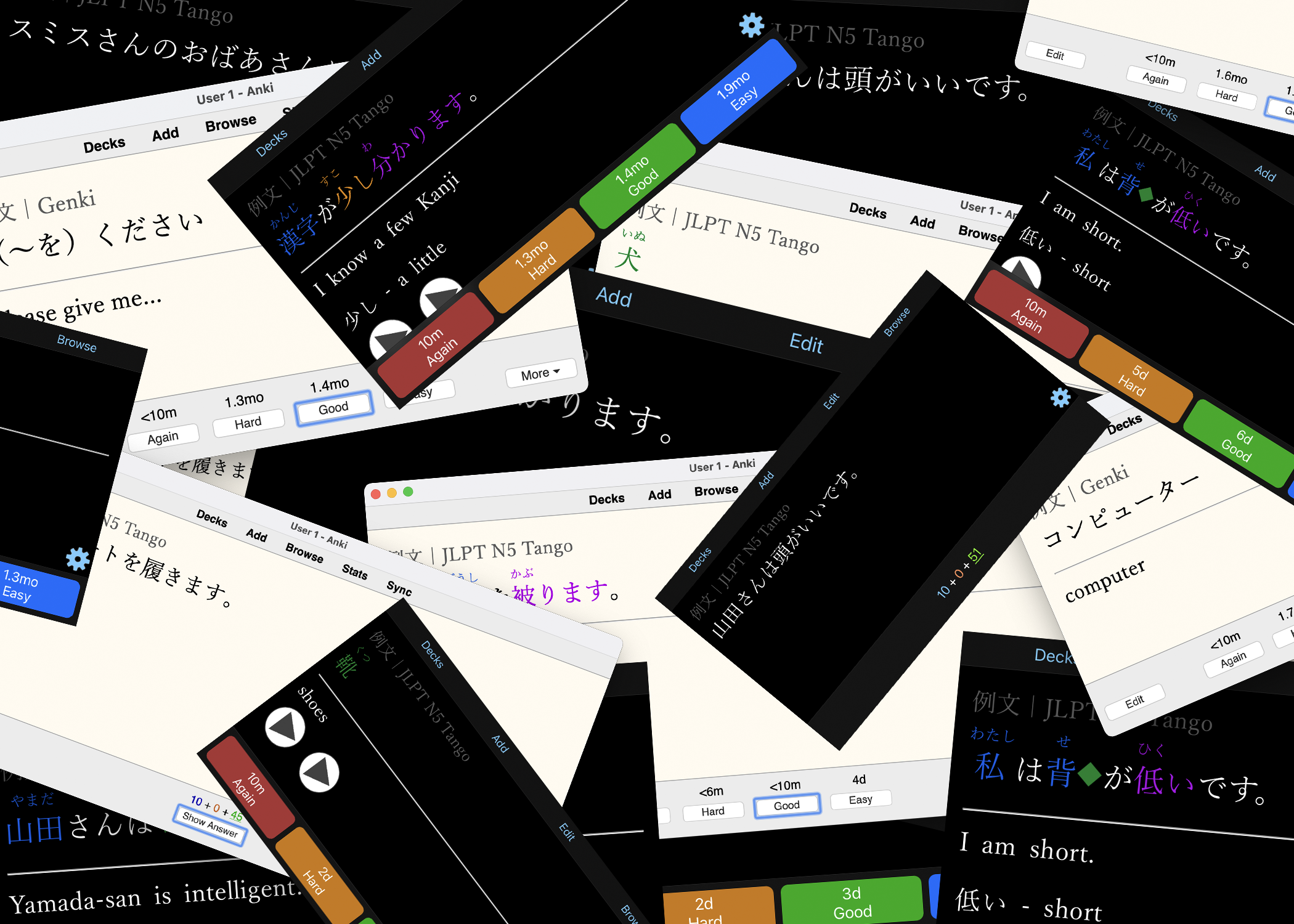
As a result of watching this video, I have developed a way of using Anki that seems to be working for me. I have multiple decks. Firstly I have a 'Genki' deck, which I'm manually populating with the vocabulary from the vocab pages in each chapter. This way, I can control how far ahead it goes. The other deck is the one recommended in this video called 'JLPT Tango N5 MIA Japanese' (it is a deck that has been built to go along with the JLPT Tango N5 study book*.) Over a month later and it still seems to be working for me, which is better than I've ever managed with it - every time I've tried, I've bounced off pretty hard and pretty fast.
The JLPT deck mostly uses the vocabulary in phrases, which is more useful for remembering and understanding the usage (although, I've just been through a batch where it felt it was essential to go through every month of the year, and also a whole load of one person, two people, three people, six people, etc.)
It also uses kanji from the start, and you don't get the furigana until you click through to the answer, which could be a bit harsh depending on how many kanji you‘ve already been exposed to. But so far they've all been pretty common kanji that I was already comfortable with. Each card also has full voice recordings that automatically play when you click to show the answer. Sometimes several versions with different voices.
So now my method is: look at the card, read the phrase aloud, then say aloud "that means" followed by saying my translation aloud. When I click through to the answer, depending on whether I've got it right or not I'll click either 'Good' or ‘Again’. I don't use the ‘Easy’ or 'Hard' options at all. As far as I'm concerned it was either Good/Satisfactory or Again/Wrong.
I give myself a bit more leeway on the translation of, for example, words like 'international/foreign student' or 'nice/pleased to meet you, how do you do, etc.' But when it comes to the Japanese, I try to be pretty hard on myself regarding kanji recognition, pronunciation, etc. Better to practice something a little more than you needed to, rather than less than you required.
Now that I’ve found that there’s no need to worry about getting overwhelmed by having multiple decks, I’m thinking of adding more. First candidate is all of the sentences from the first book or two in the Unko Sensei series. This will have the advantage that it will force me to develop my own English translations, adding an extra layer of study.
How do you study Japanese with Anki? How are your decks set up? Let us know in the comments!
Links with an asterisk* are affiliate links, which means I (Fran) may earn a small commission, at no extra cost to you, when you click through and buy the book. Thanks for your support!
Click here for more guest posts from Step Up Japanese students!
How to Use Anki to Not Forget Vocabulary
Lots of you probably use flashcards already. Why not use really, really clever ones?
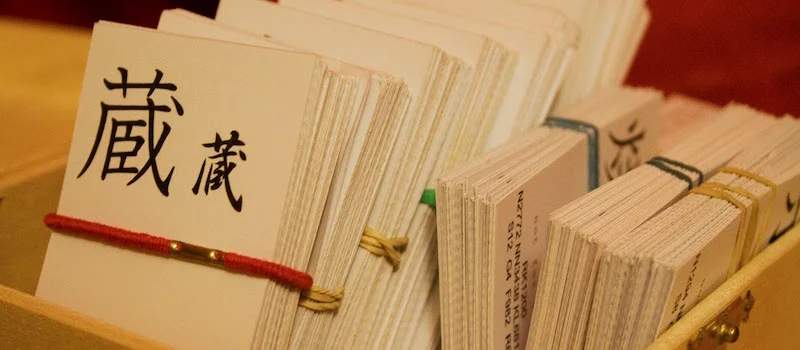
Imagine you're studying Japanese vocabulary with a set of flashcards. You go through the cards one by one, putting them into a "pass" pile if you remembered them, and a "fail" pile if you didn't.
When you finish, you work through the "fail" pile again. You get about half of them right.
The next day, you go through all the cards again. It takes ages, and it's boring - you did all these yesterday…

You want to use flashcards. Why not use really, really clever ones?
Imagine you're studying Japanese vocabulary with a set of paper flashcards. You go through the cards one by one, putting them into a "pass" pile if you remembered them, and a "fail" pile if you didn't.
When you finish, you work through the "fail" pile again. You get about half of them right.
The next day, you go through all the cards again. It takes ages, and it's boring - you did all these yesterday.
Or maybe you start with the "fail" pile. But this card pile is smaller, so when the cards come up, you just remember the fact that you failed them yesterday!
This approach is okay, if you’re enjoying yourself. (Anything is okay, as long as you're having fun. This is my basic approach to language learning).
But you can make flashcards much more efficient - and stop wasting your time - with a spaced repetition system like Anki.
The power of active recall
When you use flashcards to test yourself, you're engaging in active recall - you're pushing your brain to remember something. This is the most effective way to commit things to memory.
You know that feeling when you're struggling to remember a word, and then finally get to it? That's active recall.
At that moment, you've just cemented the correct meaning of the word in your mind. And you'll remember it much quicker next time.
What is Anki?
Anki is a spaced repetition system (SRS) - a system for remembering things. It's free for PC / Mac, and Android. The iPhone app is not free (it’s £23.99), so I'd try it out on a computer first and see if you like it.
(Then again, it might be the best £23.99 you ever spend...)
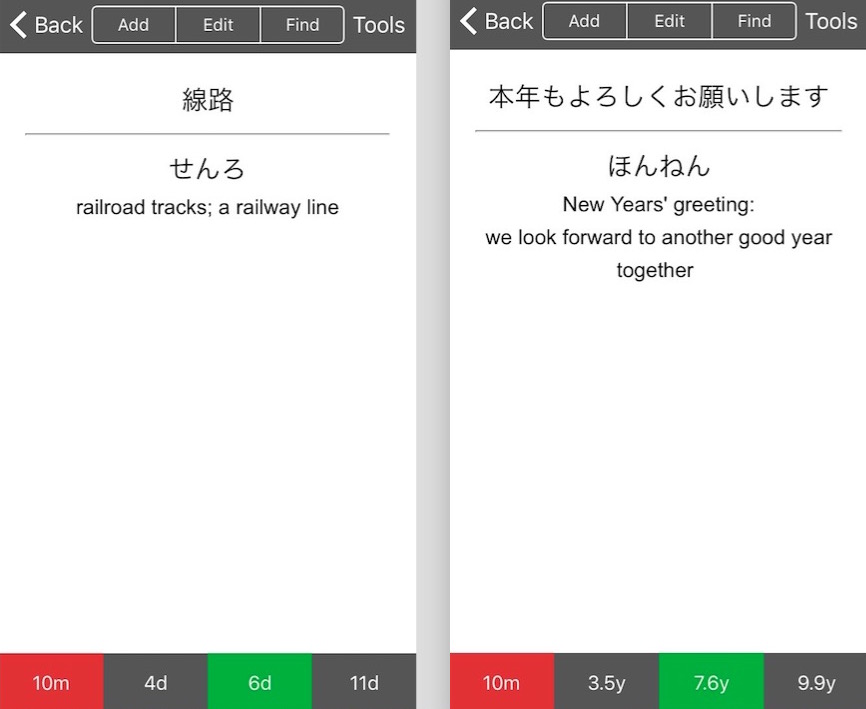
Anki shows you digital flashcards and tests you. It then spaces out the cards into the future, depending on how difficult you found them.
If you don't remember a word, Anki shows you it again in 10 minutes.
If you said it's easy, it might show you in three days. If in three days it's still easy, it waits seven days before it tests you on that word again.
If you keep getting it right, the interval increases exponentially, until Anki knows it'll be years before you forget that word. When you get it wrong, Anki knows you need to practice that word again soon.
So Anki sorts the “piles” of flashcards for you, testing you on material just as it thinks you're about to forget it.
I told you it was clever.
What to study?
Anki has shared decks that you can download - sets of flashcards made by other users.
If you're studying for the JLPT, there are loads of decks for that. And whatever Japanese textbook you're using, there'll be an Anki deck for it.
You probably don’t want to memorise every word in your textbook - maybe you don't think you need the word for "municipal hospital", or you want to focus on certain areas. Just delete the cards you don't need.
Or you can make your own decks by adding your own material. That's probably the best approach.
Maybe you want to memorise verb conjugations (masu form to -te form; -nai form, etc). Or maybe you just can't remember the difference between ウ and ワ. Stick it in your Anki deck, and forget about forgetting things.

What not to study
A word of caution - don't try and memorise things you don't understand yet.
For example, let's say in your textbook there's a chart giving the -nai forms of common verbs. You could put those in your anki deck and memorise them, I guess.
But it's no use if you don't know what the -nai form is and how it's used. Learn what it is - practice it, speak it, own it - and use spaced repetition to help you remember.
A useful companion
I tried to use Anki to re-learn some French last year (my high school French class was a long time ago).
I downloaded a beginner French deck, and I'd sit on the train testing myself on vocabulary. It helped a bit, but I didn't magically learn to speak French! That's basically because I never tried to produce any French in that time. I didn't speak with anyone or write down anything in French...
To master a language, you need to speak out loud, and listen a lot.Spaced repetition is a brilliant tool and a companion to learning. But it's not everything... you need to actually practice too.
I'd love to know how you're getting on with Anki. Do you love it or hate it? Tweet me a screenshot of your cards, or let me know in the comments.
First published May 08, 2017
Updated October 09, 2018














Like many people in the UK, I studied French in school. I liked French. I thought it was really fun to speak another language, to talk with people, and to try and listen to what was going on in a new country. (Still do!)
When I was 14 we went on a school exchange to the city of Reims, in northeastern France. I was paired with a boy, which I’m sure some 14-year-olds would find very exciting but which I found unbearably awkward. He was very sweet and we completely ignored each other.
That was nearly 20 years ago, and I didn’t learn or use any more French until, at some point in lockdown, I decided on a whim to take some one-to-one lessons with online teachers. Here are some things I learned about French, about language learning, and about myself.