
Welcome to the Step Up Japanese blog archive!
Although I’m not currently adding new posts to the blog, you’ll find plenty of Japanese learning tips, study advice, and resources to explore here.
Browse the blog index to view a complete list of posts.
For the latest news, course updates, and Japanese learning tips from Step Up Japanese, sign up for my newsletter.
Search this blog:

Dr. Anki or, How I Learned to Stop Worrying and Embrace Multiple Decks (GUEST POST!)
A special guest post from Step Up Japanese student Phil Kinchington!
Anki is a flashcard app that uses a Spaced Repetition System (SRS) to help you learn and memorise information by creating strong, long-lasting memories. It does this by aiming to present you with a flashcard exactly at the point you were about to forget it.
You should be able to recall the information, but at a slight stretch. If you remember the card correctly, it will increase the length of time before it shows it to you again. If you can’t remember (or remember incorrectly) it will show it to you again sooner. It was originally developed for language learning (being named after the Japanese word for ‘memorisation’) but has since been applied to many subjects, including medical studies…
A special guest post from Step Up Japanese student Phil Kinchington!
Anki is a flashcard app that uses a Spaced Repetition System (SRS) to help you learn and memorise information by creating strong, long-lasting memories. It does this by aiming to present you with a flashcard exactly at the point you were about to forget it.
You should be able to recall the information, but at a slight stretch. If you remember the card correctly, it will increase the length of time before it shows it to you again. If you can’t remember (or remember incorrectly) it will show it to you again sooner. It was originally developed for language learning (being named after the Japanese word for ‘memorisation’) but has since been applied to many subjects, including medical studies.
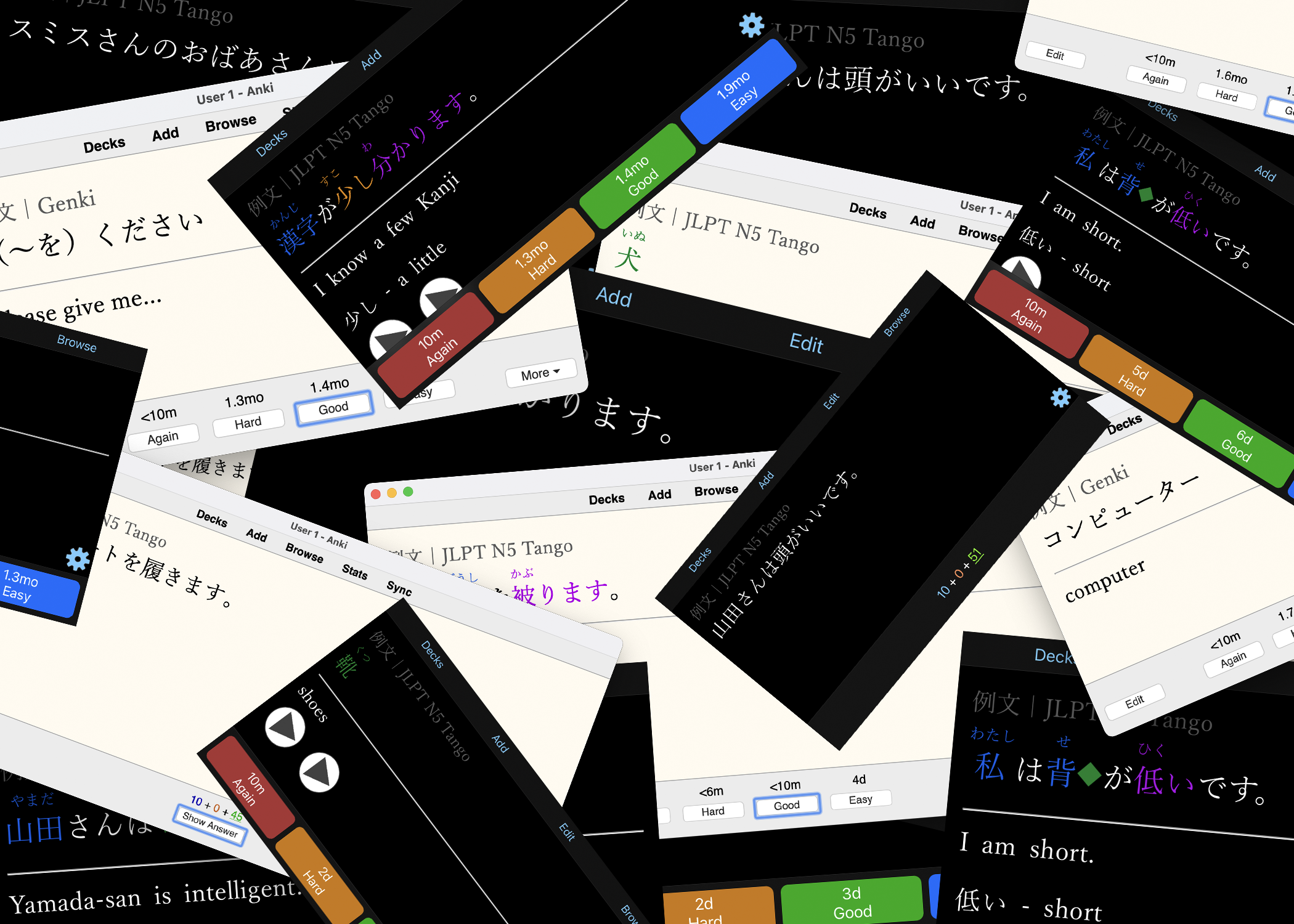
While I saw Anki mentioned and recommended everywhere, I could never figure out a way to use it that really worked for me. Some people recommended that you should download a pre-made deck to match the textbook you are using (there is a huge library of decks submitted by users accessible from within Anki.) But I felt this would mean that it would start automatically adding vocabulary past the point I’d got to in the book.
(Note from Fran - you can “suspend” all the cards and manually “unsuspend” them as you work your way through a textbook, although I appreciate this is a bit fiddly!)
A lot of people recommended that you should use a single deck, and dump everything you came across into it, which seems a bit too messy for my liking. Also, I'd then be constantly having the dilemma of "do I put this in, or is it not worth it, or how can I add this in a meaningful way, that I'd understand why it was there when I came back to it?"
A big part of the problem is how open and flexible the system is. Anki doesn’t guide you or force you to work with it in a specific way, and the design of the cards is almost infinitely configurable. Of course, this is also the reason it has been possible to adapt it for so many different subjects.
I’d pretty much given up trying, and then I discovered the Alivia’s Japanese Nook YouTube channel. On that channel Alivia has a video specifically about using Anki to study Japanese that has been very useful to me. It's a bit long, as it covers every detail of how to use it, and exactly how she has all the settings configured. But if you’ve never used Anki at all, it’s a very good guide to getting it set up and starting to use it.
As a result of watching this video, I have developed a way of using Anki that seems to be working for me. I have multiple decks. Firstly I have a 'Genki' deck, which I'm manually populating with the vocabulary from the vocab pages in each chapter. This way, I can control how far ahead it goes. The other deck is the one recommended in this video called 'JLPT Tango N5 MIA Japanese' (it is a deck that has been built to go along with the JLPT Tango N5 study book*.) Over a month later and it still seems to be working for me, which is better than I've ever managed with it - every time I've tried, I've bounced off pretty hard and pretty fast.
The JLPT deck mostly uses the vocabulary in phrases, which is more useful for remembering and understanding the usage (although, I've just been through a batch where it felt it was essential to go through every month of the year, and also a whole load of one person, two people, three people, six people, etc.)
It also uses kanji from the start, and you don't get the furigana until you click through to the answer, which could be a bit harsh depending on how many kanji you‘ve already been exposed to. But so far they've all been pretty common kanji that I was already comfortable with. Each card also has full voice recordings that automatically play when you click to show the answer. Sometimes several versions with different voices.
So now my method is: look at the card, read the phrase aloud, then say aloud "that means" followed by saying my translation aloud. When I click through to the answer, depending on whether I've got it right or not I'll click either 'Good' or ‘Again’. I don't use the ‘Easy’ or 'Hard' options at all. As far as I'm concerned it was either Good/Satisfactory or Again/Wrong.
I give myself a bit more leeway on the translation of, for example, words like 'international/foreign student' or 'nice/pleased to meet you, how do you do, etc.' But when it comes to the Japanese, I try to be pretty hard on myself regarding kanji recognition, pronunciation, etc. Better to practice something a little more than you needed to, rather than less than you required.
Now that I’ve found that there’s no need to worry about getting overwhelmed by having multiple decks, I’m thinking of adding more. First candidate is all of the sentences from the first book or two in the Unko Sensei series. This will have the advantage that it will force me to develop my own English translations, adding an extra layer of study.
How do you study Japanese with Anki? How are your decks set up? Let us know in the comments!
Links with an asterisk* are affiliate links, which means I (Fran) may earn a small commission, at no extra cost to you, when you click through and buy the book. Thanks for your support!
Click here for more guest posts from Step Up Japanese students!

A Visit to Yokohama's Unko Museum (GUEST POST!)
I am delighted to introduce this guest post from Step Up Japanese student Philip Kinchington!
When I (Fran) heard that Phil was going to Yokohama's new poop museum on his recent trip to Japan, I knew there'd be some good photos in the pipeline...
I am delighted to introduce this guest post from Step Up Japanese student Philip Kinchington!
When I (Fran) heard that Phil was going to Yokohama's new poop museum on his recent trip to Japan, I knew there'd be some good photos in the pipeline...
So I was really pleased that he agreed to share these photos with you and this report from the Unko Museum.
(We got his friends' permission to use their photos too. When you’ve seen the photos, it'll be clear why this was important.)
Over to you, Phil! Yoroshiku ne!
On my recent visit to Tokyo I managed to meet up with my friends Tomo and Taka. They have a knack for sniffing out the most interesting and bizarre places to visit (the last time I met up with them they took me to the Monster Kawaii Cafe in Harajuku and then the Ramen Museum in Yokohama).
This time I was given the choice between the Kaiju Cafe in Kawasaki, or the Unko Museum (うんこミュージアム) in Yokohama. I had already been instructed by the mutual friend who introduced me to Tomo and Taka that I had to go to the Unko Museum or they would very disappointed in me, so the choice was simple (we ended up going to the Kaiju Cafe anyway, so it turned out to be a consequence free choice.)
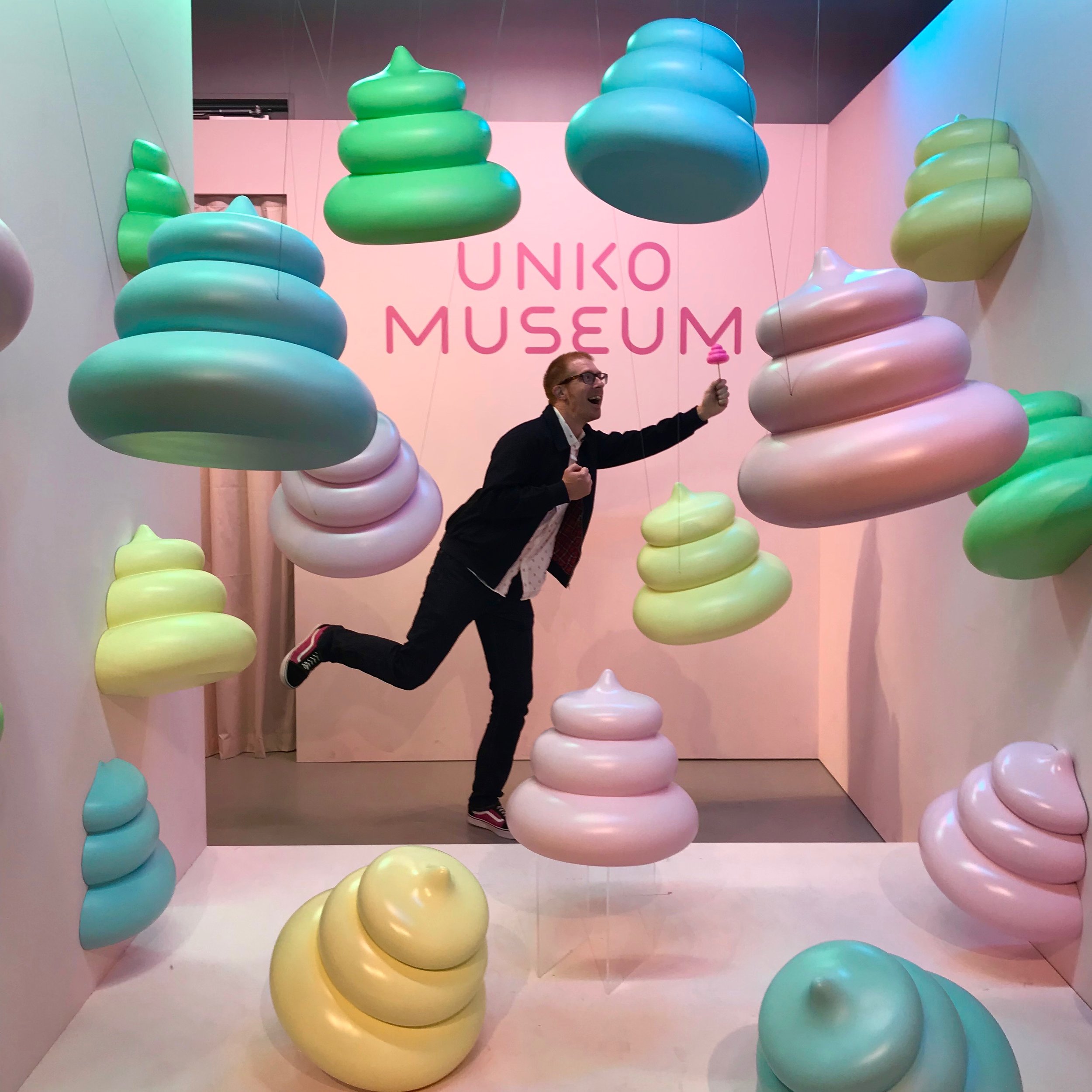
うんこ (unko) is the Japanese equivalent word for poo-poo or poop, often used by small children. And while it is called a museum, it is more of a kind of crazy art installation with photo opportunities and a few interactive exhibits. There is very little of educational value beyond a display of some poop-themed toys from around the world.
While waiting for entry to the Museum, we were given the leaflet for the museum which doubled as a little spot-the-differences puzzle. We were also encouraged to don a 'poop-hat' for a photo opportunity (this will become a recurring theme.)
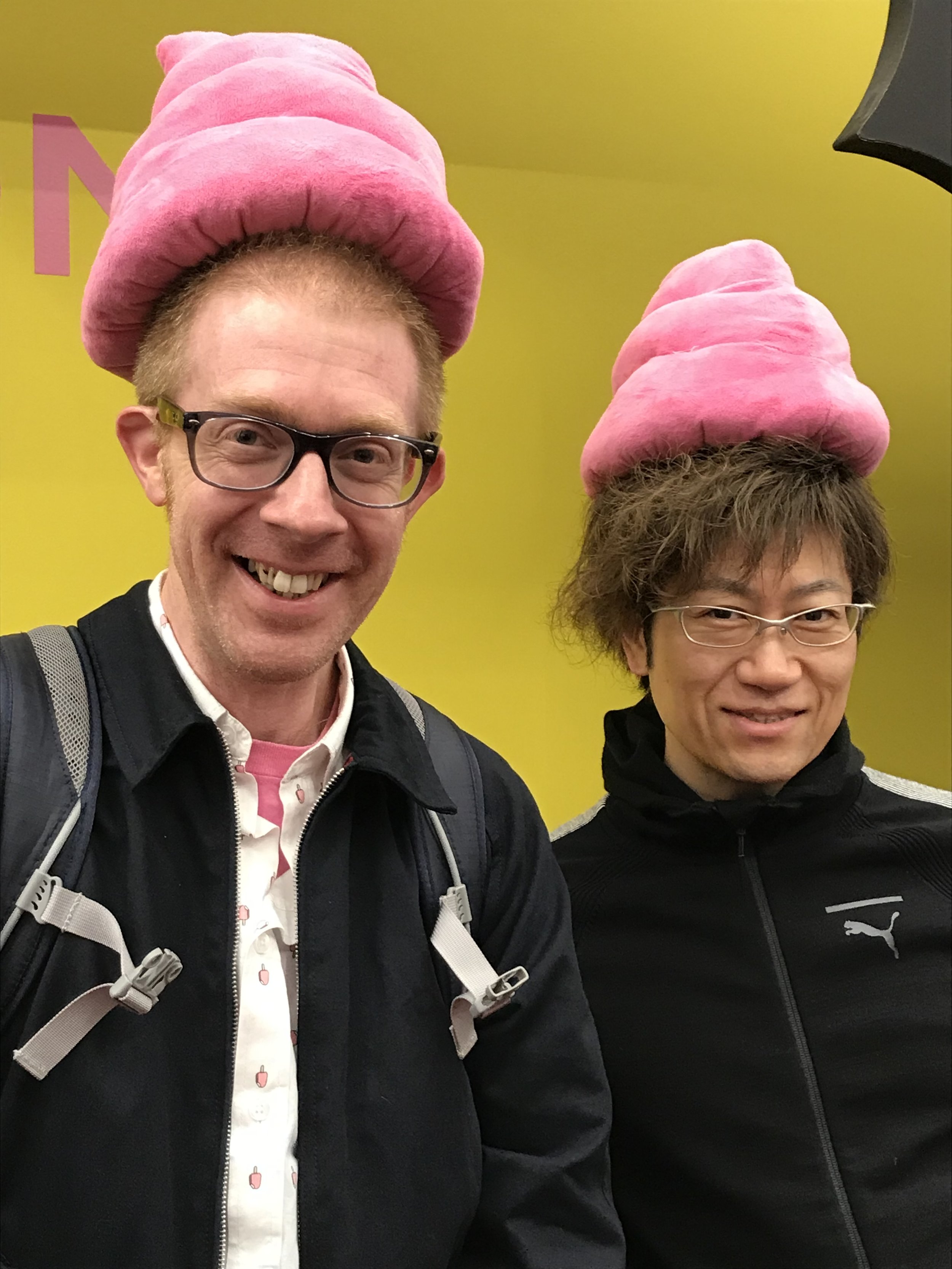
All photos courtesy of Phil Kinchington 💩
After queuing we were gathered into a group of about a dozen people and escorted into a small ante-chamber for instruction (none of which I understood.) Once the instructions had been delivered, we were encouraged to shout "UNKO!!" in unison before being directed through a curtain into the next room.
We found ourselves in a long, narrow room with half a dozen pastel-coloured thrones along one wall. We were directed to take our places on a throne and to make 'straining' faces for the obligatory photo opportunity.

Once they felt that enough photos had been taken, we were told to stand up and look into the bowl of the throne.
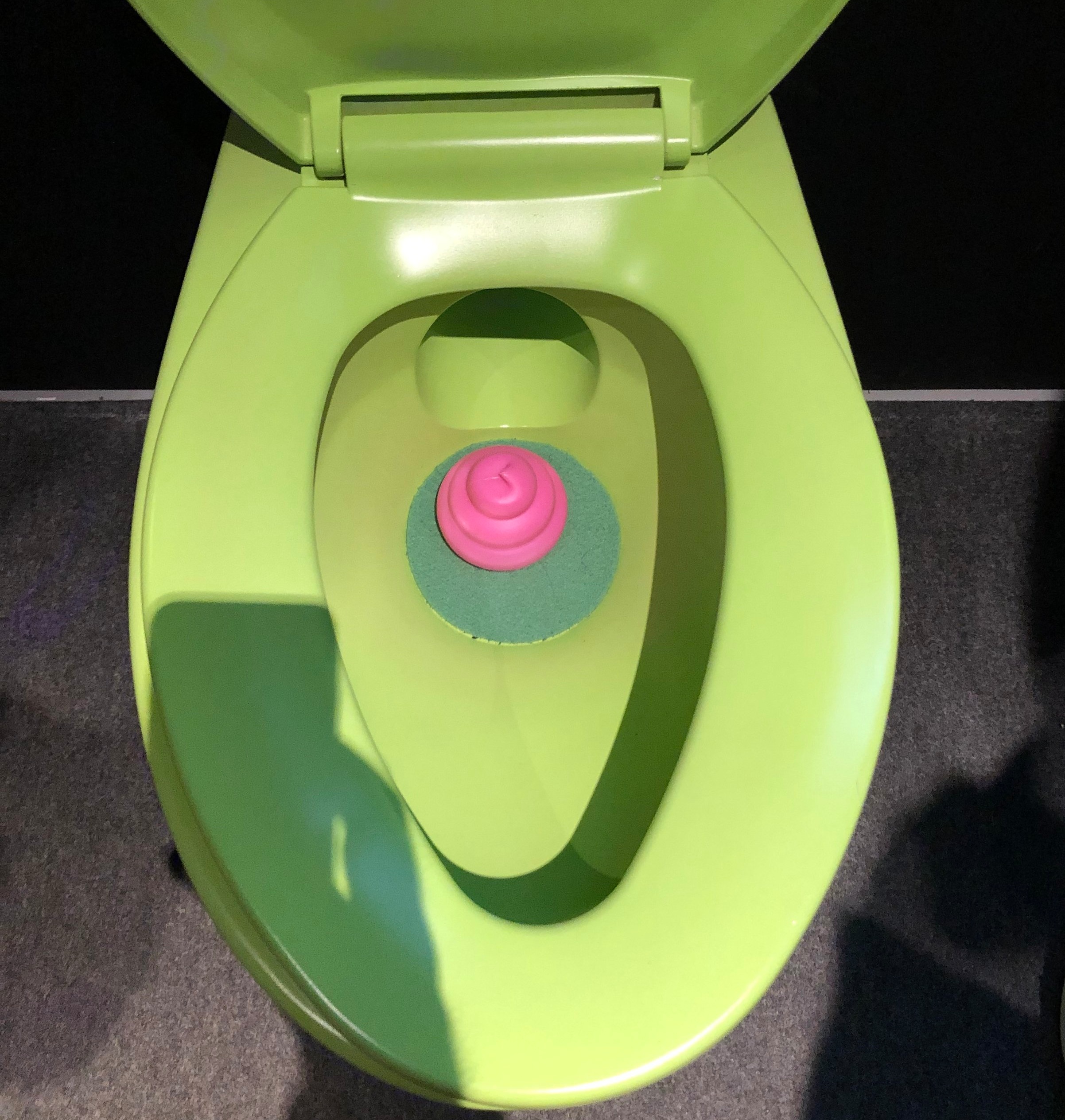
A souvenir poop to take away as a gift from the Museum. We were then funnelled from this room into the main Museum area. As we left the room, we were each handed a stick to place our souvenir poop onto for the convenience of carrying.
On entering the main room of the exhibition, we came face-to-face with a ball pit, at the centre of which was a giant poop sculpture (the Poop Volcano, apparently.) As we entered, a countdown was projected onto the side of the Poop Volcano.
10...9...8...7...6...5...4...3...2...1...0…
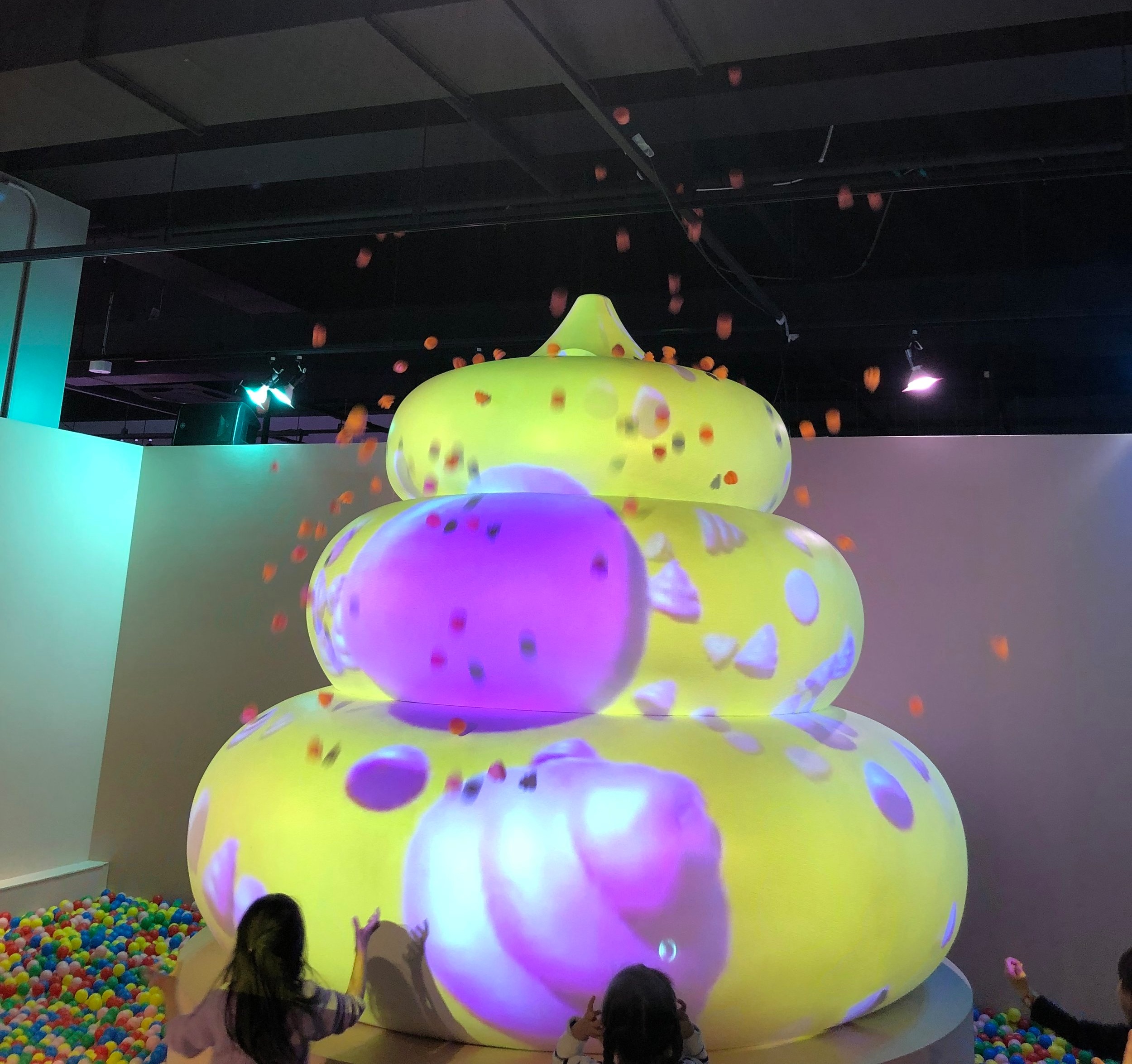
...and a fountain of small foam poops spray out of the top of the volcano. Two attendants came over to the edge of the ball pit carrying a giant, lidded potty. The children in the ball pit were then told to gather all of the foam poops and deposit them in the potty as quickly as they could. I have no idea what the purpose of this exercise was.
From here we worked our way around the other areas of the exhibition in a clockwise direction. First up was a handful of video games repurposed with a poop theme, or some kind of poop element.
Around the corner from the video games was another game, but one that was more physically interactive.
Near the end of the video I ask the rhetorical question "how old am I?" The official answer to this is (nearly) 44, but that's only because was a bit nervous and stuttered when asked my age.
Next was a room (sadly no photo) with three microphones and a large screen. The screen displayed what looked like a hosepipe pointing upwards from the bottom of the screen in front of each microphone. The instructions said to shout "UNKO!!" into the microphone. On doing this a poop was produced out of the appropriate hosepipe on the screen. It appeared that the louder you shouted, the larger the poop that was summoned, and the longer you held the shout, the poop would continue to float above the end of the hosepipe.
The remainder of the Museum was really just a series of photo opportunities (one of which looked worryingly like my Drawing Room at home.)


The Unko Museum is currently open in the Aso Building a short walk from Yokohama Station. The exhibition opened on 15th March 2019, but it is only open until 15th July, so you'd better be quick if you want to visit. You can find more information on their website (日本語だけ).
After the Unko Museum, we went to the zoo. They only had one animal, a small dog. It was a Shitzu.
P.S. Have you been somewhere cool and Japan-related that you’d like to share with us? Perhaps you have an interesting Japanese hobby or interest? Would you like to write a guest blog post for Step Up Japanese? I’d love to hear from you! Click here to get in touch!

Gachapon: Capsules of Joy, ¥300 a pop (GUEST POST!)
This week - a guest post from Step Up Japanese student David Sharp!
I have a bit of a gachapon obsession. There are so many things I love about Japan, but my eyes light up when I see a gachapon machine. I’ve got a sixth sense specifically dedicated to locating gachapon machines and you can guarantee I’ll make a beeline for it, or forever regret not seeing what mysteries they might hold. There’s something very Japanese about gachapon: compact, transient, novel and convenient.
But let’s back up for a second – what is gachapon?

This week - a guest post from Step Up Japanese student David Sharp!
I have a bit of a gachapon obsession. There are so many things I love about Japan, but my eyes light up when I see a gachapon machine. I’ve got a sixth sense specifically dedicated to locating gachapon machines and you can guarantee I’ll make a beeline for it, or forever regret not seeing what mysteries they might hold. There’s something very Japanese about gachapon: compact, transient, novel and convenient.
But let’s back up for a second – what is gachapon?
A gachapon machine is a small box, with a mechanism a bit like a gumball machine that dispenses little plastic capsules with some sort of ‘prize’ in them. You’ll usually see them stacked two or three high and accompanied by some either side. You may even find them stretching out across an entire wall, or filling up what might otherwise be wasted space.
To operate them is pretty simple: drop the correct coins into the coin slot and then turn the crank on the front, after a few turns your prize will drop out!
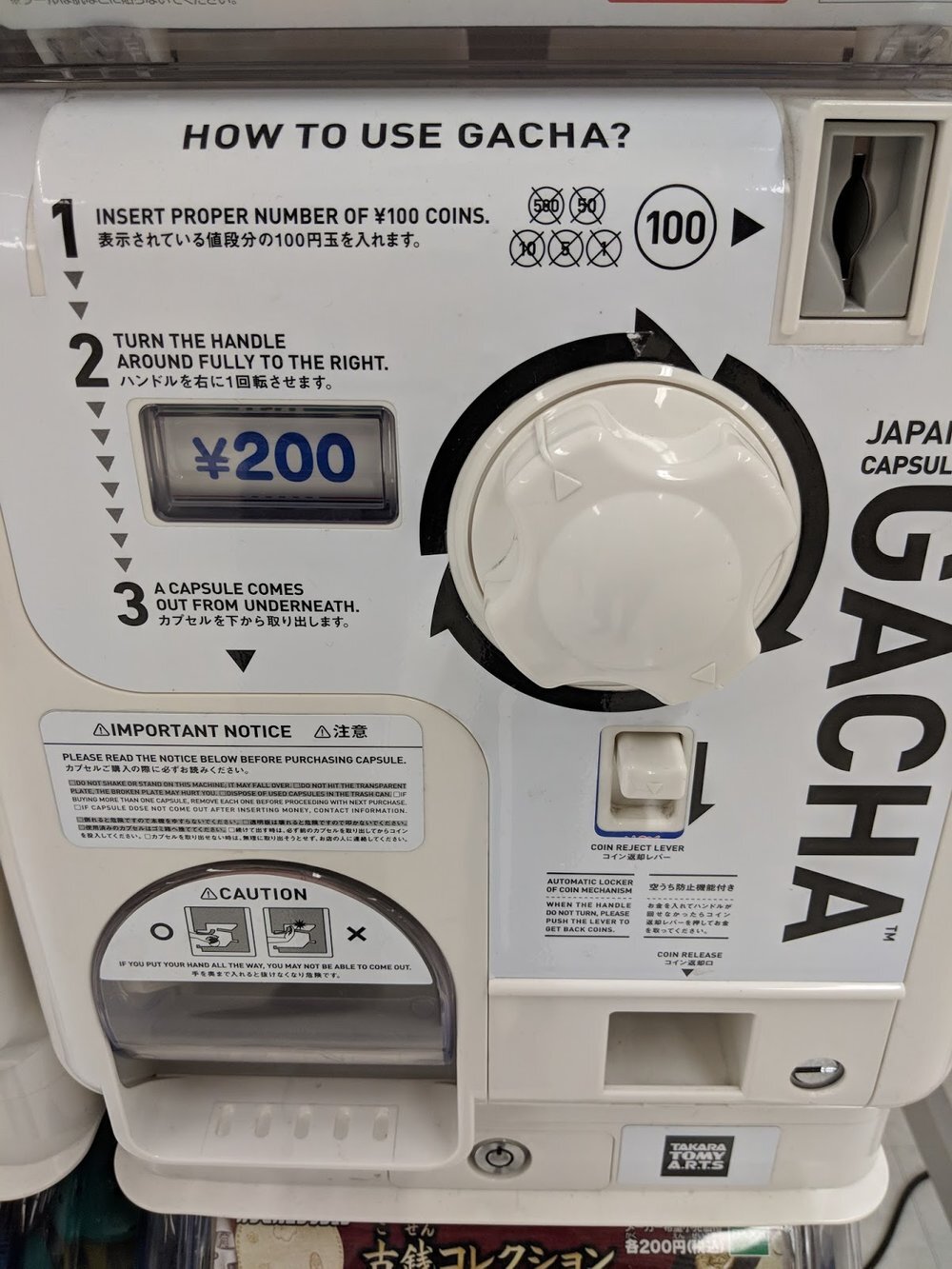
Gachapon 「ガチャポン」as a word comes from the “gacha gacha” 「ガチャガチャ」sound the machine makes as you turn the crank to release your prize. What people actually call them tends to differ.
From my experience "gachapon" is pretty common, however you’re also likely to see “gashapon"「ガシャポン」 or simply “gacha”「ガチャ」 (which are Bandai and Tomy trademarks, respectively), both of which derive from the same onomatopoeia.
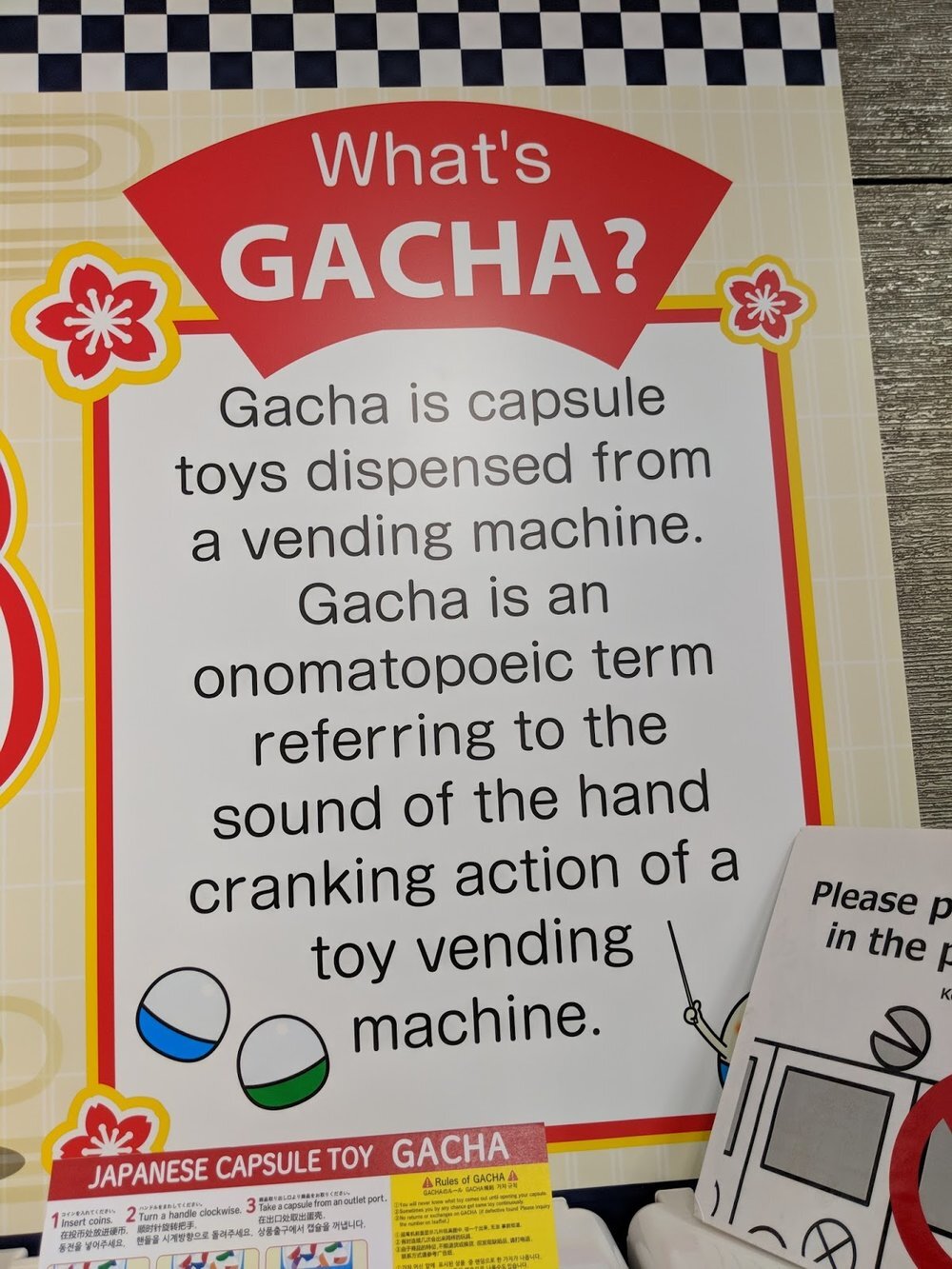
Typically, a gachapon prize comprises of three components: the capsule, a little scrap of paper with all the prizes you could have won and your prize itself!
Here's what to expect from your average gachapon machine: a capsule, your prize (in this case a Pokémon pin) and the "here's what you could have won" scrap of paper:

So now we know what gachapon is, let's have a look at some of the prizes on offer!
Phone danglers are quite a common find:


Those on the left are actually designed to fit onto a bottle cap, which is a trend I'm not sure I understand ↓


Sometimes you'll find something a little more traditional ↓

Souvenir gacha aimed at tourists, which look a bit more like gumball machines ↓

Turns out you can even get watches in gachapon ↓

Deep down I regret not getting a Gudetama watch for 300¥ ↓

Magic sand and pots of slime are pretty common in kid-friendly places ↓

If you're happy to pay a bit more, you might find some of these sofubi (ソフビ "soft plastic") designer toys ↓

Shinkansen themed bags, purses and pouches ↓
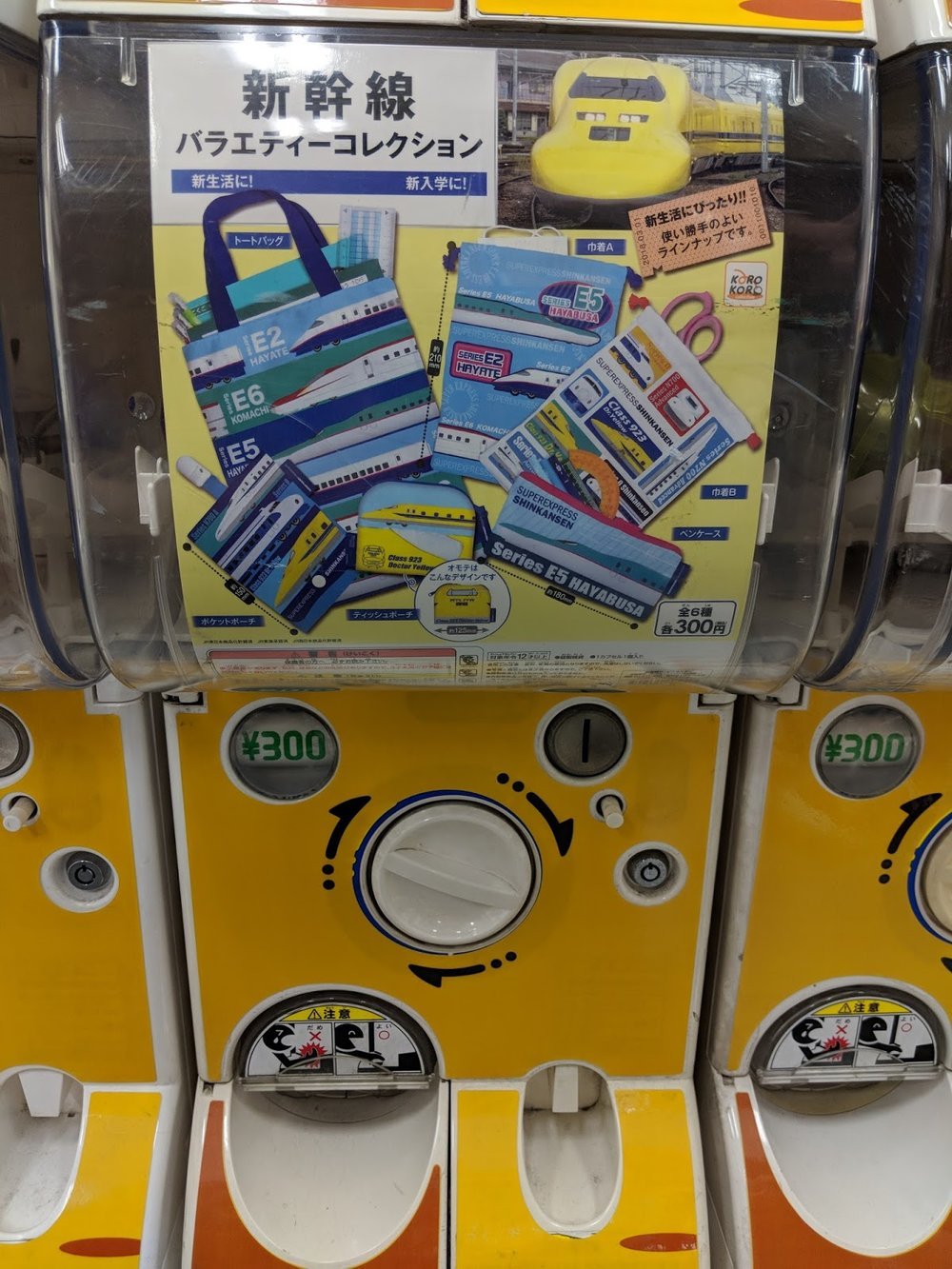
Hopefully you'll find some cat hats ↓

...and more cat hats...

...and dog hats...

...and yet more cat hats...

...and cat wings...

...and somehow still find more cat hats!

In the contents of gachapon machines, there is a spectrum of target audiences and of usefulness, but one thing all the prizes have in common is the capsule they come in (hence sometimes being referred to as “capsule toys” 「カプセルトイ」)
“But, David”, I hear you say, “if you’re buying so many gachapon, what happens to all the empty capsules?”
Well, while not entirely universal, most places you’ll be able to get gachapon will also have a little basket or bin to dispose of your unwanted capsules.

But if you do find yourself taking them away with you, Bandai’s capsules are all recyclable, and most others will at least be half recyclable. Occasionally though you’ll find a capsule toy where you should keep hold of the capsule, because the capsule is the toy!
The capsule of these gachapon are maneki neko (招き猫; Lucky Cat) torsos! ↓

“I’m sold”, you say, metaphorically, “how much do will these fancy-schmancy capsules set me back?”
Gachapon machines (almost) always only accept 100¥ coins, so will cost a multiple of 100¥. A price tag of 300¥ is most common (approx. £2, at the time of writing) but you’ll likely see a lot of 200¥ and 400¥ machines too.
You might also stumble across a 500¥ gachapon machine, in which case don’t be surprised if it’s bordering on risque!
The only 500¥ gachapon here are these swimsuit-clad women ↓

While it’s certainly a matter of opinion, individual gachapon prizes tend to be good value for money. No matter how goofy a gachapon purchase may be, I find it difficult to be disappointed in the prize! Say you find a machine full of cute phone danglers; the quality will be comparable to one you might buy in a souvenir shop, but for cheaper!
However, if there’s one you’re really keen to own, or you want to collect the whole set, you run the risk of ending up with a lot of duplicates! (Although I’m sure you’ll be able to find an unsuspecting friend to offload them onto as “thoughtful gifts” from your travels.)
If you see a machine full of trinkets that you must have in your life and are keen on collecting a whole set– or there’s only one in a set you like the look of and don’t want to risk winning a dud– you may be able to buy it elsewhere. Akihabara, for example, has a number of shops that sell rows and rows of loose figures usually with very little markup (sometimes you’ll practically just be paying the tax). However, something truly sought after might set you back up to double what you would’ve paid for from the machine!
But now you've booked your flights to Japan and you're wondering “Where can I even find gachapon?”
Everywhere! Although they’re not as common as vending machines, you’ll find gachapon at tourist attractions, train stations, airports, convenience stores, arcades, shopping areas, department stores, sometimes even in temples. The beauty of gachapon is that you don’t need to dedicate a chunk of your day searching for them, or venture too far out of your way to find them. While there are dedicated stores you could keep an eye out for, the truth is there’s such a variety that over your trip you’ll hopefully stumble upon a wide range of potential prizes. (That said– if, at the end of your trip, you find yourself at Narita Airport’s Terminal 2 with pockets full of leftover coins, they have a huge selection just outside the 7-Eleven).
Narita Airport's terminal 2 wants your coins! (Fun fact: I had to get money out so I could get a few more gacha before heading home) ↓

The gachapon on offer are constantly changing and vary from place to place, so I wouldn’t get your hopes up about finding anything in particular, but there’s so much choice you’re bound to find something cool, cute, weird or that makes you chuckle!
Happy hunting!
Find David and tell him what your favourite gachapon prize is at davidsharp.codes. Or check out more of his Japan pics (including even more gachapon photos!) on his instagram.
P.S. Would you like to write a guest blog post for Step Up Japanese? Get in touch! :)















Like many people in the UK, I studied French in school. I liked French. I thought it was really fun to speak another language, to talk with people, and to try and listen to what was going on in a new country. (Still do!)
When I was 14 we went on a school exchange to the city of Reims, in northeastern France. I was paired with a boy, which I’m sure some 14-year-olds would find very exciting but which I found unbearably awkward. He was very sweet and we completely ignored each other.
That was nearly 20 years ago, and I didn’t learn or use any more French until, at some point in lockdown, I decided on a whim to take some one-to-one lessons with online teachers. Here are some things I learned about French, about language learning, and about myself.