
Welcome to the Step Up Japanese blog archive!
Although I’m not currently adding new posts to the blog, you’ll find plenty of Japanese learning tips, study advice, and resources to explore here.
Browse the blog index to view a complete list of posts.
For the latest news, course updates, and Japanese learning tips from Step Up Japanese, sign up for my newsletter.
Search this blog:

"Does Japanese Have Plurals?"
After the excitement of our first school Summer Barbecue, I spent the day in bed watching one of my favourite films in Japanese.
It wasn’t a Japanese film though. I watched Hot Fuzz (or to give its Japanese title ホット・ファズ -俺たちスーパーポリスメン "Hot Fuzz: We Are The Super-Policemen!")
Watching British comedies dubbed into Japanese might not be the "purest" way to listen to Japanese. But if you enjoy it, it's definitely worth doing. Dubbed films are easy to watch, too, assuming you've seen the film before and know the plot already.
Anyway, there's a little scene in the Hotto Fazzu dub that's a nice example of Japanese plurals in action, so I thought I'd share it with you.

After the excitement of our first school Summer Barbecue (back in 2017), I spent the day in bed watching one of my favourite films in Japanese.
It wasn’t a Japanese film though. I watched Hot Fuzz (or to give its Japanese title ホット・ファズ -俺たちスーパーポリスメン "Hot Fuzz: We Are The Super-Policemen!")
Watching British comedies dubbed into Japanese might not be the "purest" way to listen to Japanese. But if you enjoy it, it's definitely worth doing. Dubbed films are easy to watch, too, assuming you've seen the film before and know the plot already.
Anyway, there's a little scene in the Hotto Fazzu dub that's a nice example of Japanese plurals in action, so I thought I'd share it with you.
Angel and Danny are in the corner shop, and the shopkeeper asks them:
殺人犯たち捕まらないの?
satsujinhan tachi tsukamaranai no?
"No luck catching them killers then?"
"Killers" is translated as 殺人犯たち satsujinhan-tachi. You take the word 殺人犯 satsujinhan (murderer) and add the suffix たち (tachi) - which makes it plural.
See? Japanese does have plurals! ... when it needs them.

Danny doesn't notice the shopkeeper's slip-up (she knows more than she's letting on), and replies:
人しかいないんだけど。
hitori shika inai n da kedo.
"It's just the one killer actually."

PC Angel, of course, mulls over the shopkeeper's words, and realises their significance: there's more than one killer on the loose.
It's a turning point of the movie, and it rests on a plural. Yay!
You can use たち like this when you need to indicate plurality:
私たち watashi-tachi we, us (plural)
あなたたち anata-tachi you (plural)
ジョンたち jon-tachi John and his mates
It's not that common, but it does exist. Keep an eye out for it! You never know, you might just solve a murder case.

First published 8th Sept 2017
Updated 11th Dec 2020

Plateaus in Language Learning and How to Overcome Them
Do you remember the first conversation you ever had in a foreign language?
The first three years I was learning Japanese I basically studied quite hard for tests and barely opened my mouth. I liked kanji, and what I saw as the oddness of the Japanese language. Three "alphabets"! A million different ways of counting things! I liked hiragana - so pretty! I studied hard and thought my university Japanese exams were easy.
Then, on holiday in China, I met a Japanese woman (at a super-interesting Sino-Japanese cultural exchange club, but that's a story for another time). I tried to speak to her in Japanese. And I couldn't say anything.

Do you remember the first conversation you ever had in a foreign language?
The first three years I was learning Japanese I basically studied quite hard for tests and barely opened my mouth.
I liked kanji, and what I saw as the oddness of the Japanese language. Three "alphabets"! A million different ways of counting things! I liked hiragana - so pretty! I studied hard and thought my university Japanese exams were easy.
Then, on holiday in China, I met a Japanese woman (at a super-interesting Sino-Japanese cultural exchange club, but that's a story for another time). I tried to speak to her in Japanese. And I couldn't say anything.
I told this nice, patient lady that I was studying Japanese and she asked me how long I was staying in China for. I wanted to tell her I was going back to England next Thursday, but instead I said 先週の水曜日に帰ります (senshuu no suiyoubi ni kaerimasu) - "I'll go back last Wednesday."
OOPS.
I think about this day quite a lot because it shows, I think, that although I'd studied lots of Japanese at that point my communicative skills were pretty poor. I considered myself an intermediate learner, but I couldn't quickly recall the word for Wednesday, or the word for last week.
I realised at that point that I hadn't made much real progress in the last two years. The first year I zipped along, memorising kana and walking around my house pointing at things saying "denki, tsukue, tansu" (lamp, desk, chest of drawers) But after that my Japanese had plateaued.
So, I started actively trying to speak - I took small group lessons, engaged in them properly, did the prep work. I wrote down five sentences every day about my day and had my teacher check them. I met up with a Japanese friend regularly and did language exchange - he corrected my grammar and told me when I sounded odd (thanks, Kenichi!)
(Most of this happened in Japan, but like I said, you don't need to live in Japan to learn Japanese.)
And I came out of the plateau. I set myself a concrete goal - to pass the JLPT N3. The JLPT (Japanese Language Proficiency Test) is a standardised test in Japanese, for non-native speakers. N3 is the middle level - intermediate.
Once I’d passed that, I started aiming for N2, the next level up. I had some job interviews in Japanese, a terrifying and fascinating experience.
I wanted to get a job with a Board of Education, and a recruiter told me you needed N1 - the highest level of the JLPT - for that, so I started cramming kanji and obscure words. I was back on the Japanese-learning train.
I didn't pass N1 though, not that time.
And I was bored of English teaching and didn't want to wait to pass the test before I got a job using Japanese - that felt a bit like procrastinating - so I quit my English teaching job and got a job translating wacky entertainment news.
And after six months translating oddball news I passed the test.
That's partly because exams involve a certain amount of luck and it depends what comes up. But I also believe it's because using language to actively do something - working with the language - is a much, much better way of advancing your skills than just "studying" it.
Thanks to translation work, I was out of the plateau again. Hurrah!
When you're in the middle of something - on the road somewhere - it's hard to see your own development.
Progress doesn't move gradually upwards in a straight line. It comes in fits and starts.
Success doesn't look like this:

It looks like this:

And if you feel like you're in a slump at the moment, there are two approaches.
One is to trust that - as long as you're working hard at it - if you keep plugging away, you'll suddenly notice you've jumped up a level without even realising. You're working hard? You got this.
The other approach is to change something. Make a concrete goal. Start something new. Find a new friend to talk to or a classmate to message in Japanese. Talk to the man who owns the noodle shop about Kansai dialect. Write five things you did each day in Japanese. Take the test. Apply for the job. がんばる (gambaru; “try your best”).
Originally posted February 2017
Updated 7th April 2020

Three Favourite Japanese Jokes
The worst job interview I ever had started with the interviewer asking me to tell him a joke.
I sat there flustered for a while before mumbling something about a man walking into a bar. The interviewer rolled his eyes.
I didn't get the job.
Sitting in a smokey cafe after the interview I remembered The Michael Jackson Joke which is probably the best beginner-Japanese joke of all time. I should've told him that one! Although he probably would have rolled his eyes at that too...
Help launch something new! Join our pilot round and be among the first to master Hiragana with our course.
👉 Join the Hiragana course as a beta tester!
The worst job interview I ever had started with the interviewer asking me to tell him a joke.
I sat there flustered for a while before mumbling something about a man walking into a bar. The interviewer rolled his eyes.
I didn't get the job.
Sitting in a smokey cafe after the interview I remembered The Michael Jackson Joke which is probably the best beginner-Japanese joke of all time. I should've told him that one! Although he probably would have rolled his eyes at that too...
They say explaining a joke is like dissecting a frog - you understand it better but the frog dies in the process. So with that in mind, here are my three favourite, brilliant, terrible Japanese jokes.
The Michael Jackson Joke
「マイケルジャクソンの好きな色は何ですか。」
「青」
Maikeru Jakkuson no sukina iro wa nan desu ka.
Ao!
"What's Michael Jackson's favourite colour?"
"Blue."
You have to really commit to the punchline for this one. You can even tell the question in English and the punchline in Japanese, as long as the person you're speaking to knows the Japanese word ao.
I once told The Michael Jackson Joke to a friend while standing at a traffic light in Nagoya and a stranger in front of us burst out laughing. True story.
↓ (Skip to 1:05)
2. The Hawaiian Dentist Joke
「どうしてハワイ人は歯医者に行かないの? 」
「歯はいいから!」
Doushite Hawaii jin wa haisha ni ikanai no?
Ha wa ii kara.
"Why don't Hawaiians go to the dentist?"
"Because their teeth (=ha) are good (=ii)"
My friend Kendal sent me this one last week. ありがとうケンダル!
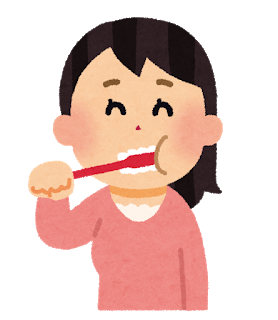
3. The Panda Joke
パンダの好きな餌は?
パンだ。
Panda no sukina esa wa?
Pan da.
"What's a panda's favourite food?"
"Bread (=pan)"
Pandas and puns are probably two of my favourite things. This joke has both.
What's your favourite Japanese joke? Have you ever told a joke in a job interview? Let me know in the comments!
First published 10 Feb 2017
Updated 31 March 2020

"How Did You Learn Japanese?"
When I tell people I'm a Japanese teacher they quite often ask: how did you learn Japanese? And I don't find this question particularly easy to answer.
Sometimes I give a quick answer which is that I used to live there.
But you can live in Japan for years and not learn Japanese.
I've met lots of people like this (and there's nothing wrong with that, unless learning Japanese is the reason you moved to Japan).
The long and more honest answer to "how come you speak Japanese?":

When I tell people I'm a Japanese teacher they quite often ask: how did you learn Japanese? And I don't find this question particularly easy to answer.
Sometimes I give a quick answer which is that I used to live there.
But you can live in Japan for years and not learn Japanese.
I've met lots of people like this (and there's nothing wrong with that, unless learning Japanese is the reason you moved to Japan).
The long and more honest answer to "how come you speak Japanese?" is that I studied a bit in university, then studied a LOT in my free time, got slightly obsessed with kanji, spent a lot of time with Japanese-speaking friends, avoided English-only situations and people who wanted to learn English from me for free, took all the JLPTs, went to Japanese language school full-time for a bit, read books and manga and newspapers (even when I couldn't read them yet), and watched a lot of Japanese TV.

You don't need to be in Japan to do any of those things:
listen to Japanese audio all day
learn kanji on the bus (with Anki. Use anki. I wrote a post about that too)
find friends who speak Japanese
watch Japanese TV on Netflix (seriously, there's loads)
Being in Japan was great motivation to learn Japanese for me because I hate not understanding things and find it incredibly frustrating.
If you're in Japan and you want to know what's in your lunch or what that sign over there says or what the person next to you on the train is saying, you need to understand Japanese. That was a big push for me.
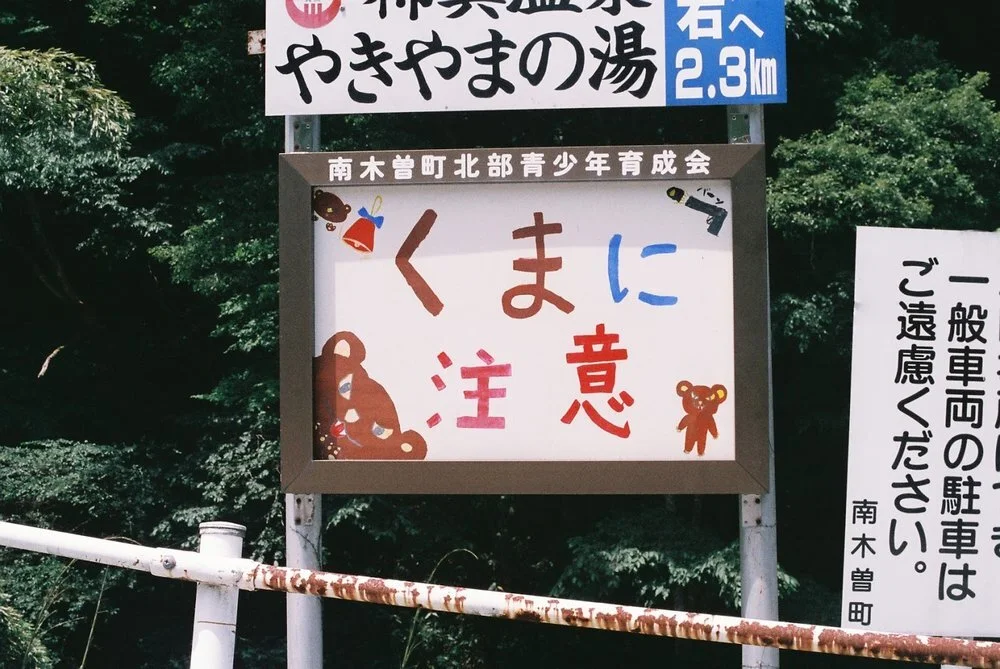
But you definitely don't need to live in Japan to get motivated.
I also started off working in English conversation school which was a good opportunity to listen to the kind of Japanese that five-year-olds speak. And one of the many good things about conversation school is you have the mornings off so I would get up and STUDY. Every day. Forever.
But I also probably have more free time now than I did in Japan.
You don't need to live in Japan to learn Japanese.
There are people all over the world who learn languages without living in the country the language comes from. I've met lots of people like this and had the pleasure of teaching some of them.
(The other thing I tell people when they ask how I learned Japanese is that I didn't learn it. I'm still learning.)
First published 17th Feb 2017
Updated 2nd March 2020

Why Does The Japanese Language Have So Many Alphabets?
My students ask a lot of good questions. And one that sent us off on a bit of a tangent a few weeks ago was: “how old is Japanese writing?”
So, let’s take a whistle-stop tour of Japanese history with a very brief introduction to the Japanese writing system!
My students ask a lot of good questions. And one that sent us off on a bit of a tangent a few weeks ago was: “how old is Japanese writing?”
So, let’s take a whistle-stop tour of Japanese history with a very brief introduction to the Japanese writing system!
Until the 1st or 2nd century, Japan had no writing system. Then, sometime before 500AD, kanji - Chinese characters - made its way to Japan from China (probably via Korea).
These characters were originally used for their meaning only - they weren't used to write native Japanese words.
↓ And at that time, Japanese writing looked like this. Look, it looks like Chinese!

(Image Source - Nihon Shoki, Wikipedia)
But it was inconvenient not being able to write native Japanese words down, and so people began to use kanji to represent the phonetic sounds of Japanese words, not only the meaning. This is called manyougana and is the oldest native Japanese writing system.
For example, in manyougana the word asa (morning) was written 安佐 (that's a kanji for the “a” sound - 安 - and another for the “sa” sound - 佐). These characters indicate the sound of the word - “asa” - but not its meaning.
In modern Japanese we'd use 朝, the kanji that means "morning" for asa. This character shows its meaning AND its sound.
The problem was, manyougana used multiple kanji for each phonetic sound - over 900 characters for the 90 phonetic sounds in Japanese - so it was inefficient and time-consuming.
Gradually, people began to simplify kanji characters into simpler characters - that's where hiragana and katakana came from.
Katakana means "broken kana" or "fragmented characters". It was developed by monks in the 9th century who were annotating Chinese texts so that Japanese people could read them. So katakana was really an early form of shorthand.
Each katakana character comes from part of a kanji: for example, the top half of the kanji 呂 became katakana ロ (ro), and the left side of the kanji 加 became katakana カ (ka).
↓ Each katakana comes from part of a kanji.
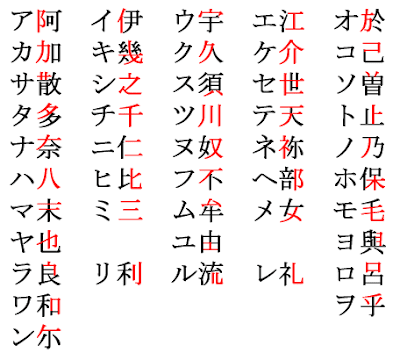
(Source - Katakana origins, Wikipedia)
Women in Japan, on the other hand, wrote in cursive script, which was gradually simplified into hiragana. That's why hiragana looks all loopy and squiggly. Like katakana, hiragana characters don't have meaning - they just indicate sound.
↓ How kanji (top) evolved into manyougana (middle in red), and then hiragana (bottom).

(Source - Hiragana evolution, Wikipedia)
Because it was simpler than kanji, hiragana was accessible for women who didn't have the same education level as men. The 11th-century classic The Tale of Genji was written almost entirely in hiragana, because it was written by a female author for a female audience.
Modern Japanese writing uses all three of these “alphabets” - hiragana, katakana, and kanji - often all mixed up in the same sentence.
What would 12th-century people in Japan think of my students, 900 years later, learning hiragana as they take their first steps into the Japanese language?
First published 28th Oct 2016
Updated 27th Jan 2020
How Do I Know if a Group Language Class is For Me?
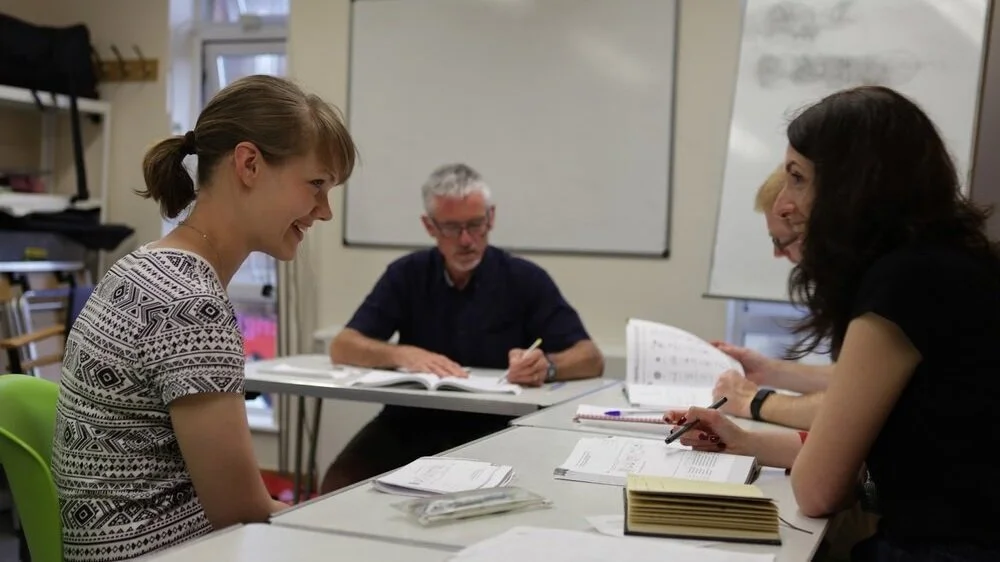
If you’re thinking about taking Japanese lessons, one of the first things you’ll have to decide is whether you want to join a group class, or take one-to-one lessons.
There are pros and cons to all methods of learning a language. Here, I’ll look at some of the key advantages of joining a group.
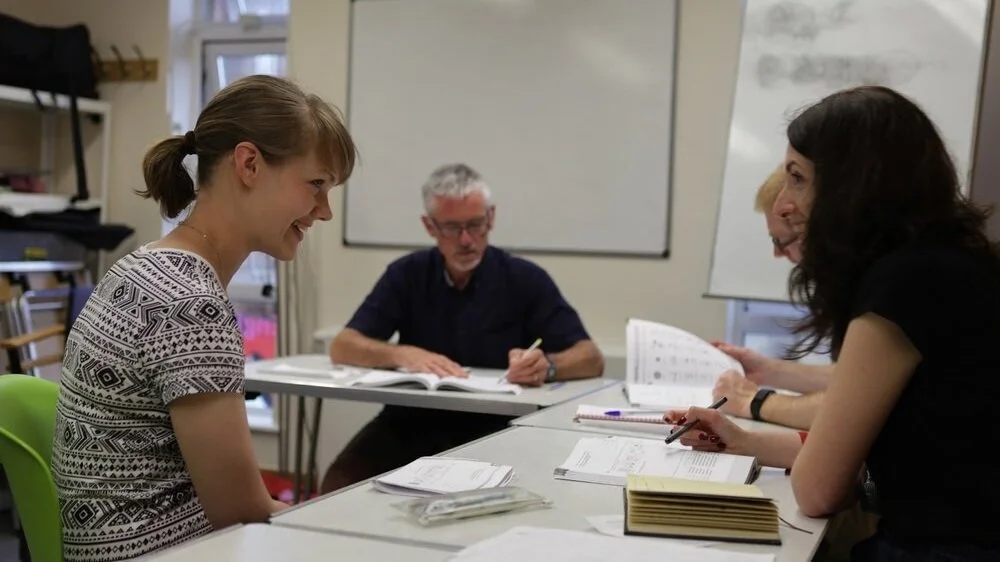
If you’re thinking about taking Japanese lessons, one of the first things you’ll have to decide is whether you want to join a group class, or take one-to-one lessons.
There are pros and cons to all methods of learning a language. Here, I’ll look at some of the key advantages of joining a group.
1) Meet other language learners
Classes give you access to a teacher, but a group class also provide you with an instant group of other people with the same interest as you.
You can speak in your target language together, go out for dinner and order in Japanese, and message each other asking "what was last week's homework again?"
(Just kidding - thanks to the course outline I'll provide you with, you'll always know what this week's homework is.)
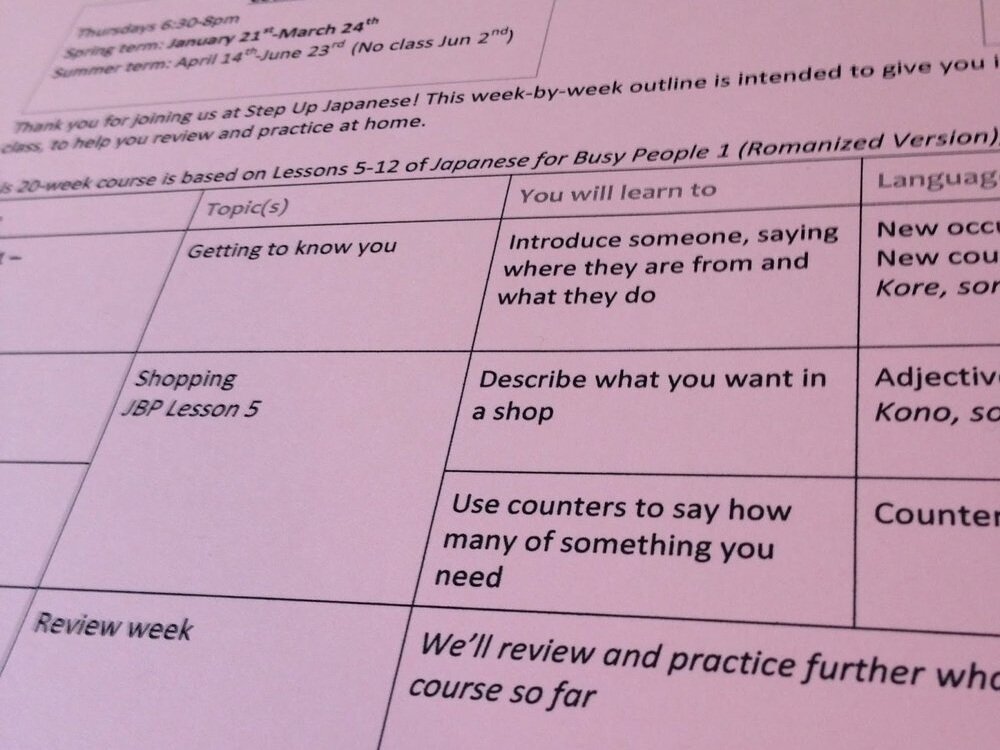
In a group class, students can support and help each other. It's obvious to me that my lovely students gain a lot from each others' support!
2) Keep a regular schedule
To gain any skill, you need to practice regularly. The great thing about having class on a regular day is it forces you to practice. Unlike exclusive self-study where you'll always have an excuse to procrastinate, weekly classes require you to be prepared for every class so you can get the most out of it.
Practice makes perfect, after all.
3) It's your class
You might feel like the only way to get a class tailored to your needs is to take one-to-one lessons. But a good group class - especially one for a small group of students - should be tailored to the students in it as much as a private lesson would be.
That's why I ask my students to give me regular feedback (informally, and through anonymous questionnaires) about how class is going and where you want it to go next.
It's your class, not mine, and we can focus on what you want to focus on.
That doesn't mean I'm going to do the hard work for you. If you want to get good at Japanese, you'll need to find ways of practicing and exposing yourself to the language as much as possible outside of class too.
But a group class can provide the basis of your knowledge, a structure to work with, and a group of friendly faces to answer your questions.
It also gives you a great excuse to go to that great Japanese restaurant again with your classmates.


First published June 2016; updated 9th January 2020.

Even More Japanese Loanwords From Languages That Aren't English
Last time I talked about Japanese loanwords - words that Japanese has “borrowed” from other languages - which come from languages other than English.
But there are also some tricky loanwords that look and sound like they came from English - but they didn’t!

Last time I talked about Japanese loanwords - words that Japanese has “borrowed” from other languages - which come from languages other than English.
But there are also some tricky loanwords that look and sound like they came from English - but they didn’t!
Challenge time!
Don’t be fooled. These loanwords look and sound a bit like they came from English - but they didn’t! Can you guess what languages these loanwords come from?
(Hint: not English!)
Koohii コーヒー coffee
Zero ゼロ zero
Pompu ポンプ pump
Botan ボタン button
Koppu コップ cup
Sarada サラダ salad
Kokku コック cook
Scroll down for the answers…!

The Answers:
Did you guess what non-English languages these loanwords come from?
Koohii コーヒー coffee - Portuguese
Zero ゼロ zero - French
Pompu ポンプ pump - Dutch; Flemish
Botan ボタン button - Portuguese
Koppu コップ cup - Dutch; Flemish
Sarada サラダ salad - Portuguese
Kokku コック cook - Dutch; Flemish
Students often ask why there are so many Portuguese and Dutch loanwords in Japanese. Words from these two languages have been used as loanwords in Japanese since the 16th and 17th centuries, when both countries established trade with Japan.
So, just because that katakana word you’ve learned looks like English, doesn’t mean it came from English!













Want to buy Japanese lessons for a friend or relative? Send a gift card