
Welcome to the Step Up Japanese blog archive!
Although I’m not currently adding new posts to the blog, you’ll find plenty of Japanese learning tips, study advice, and resources to explore here.
Browse the blog index to view a complete list of posts.
For the latest news, course updates, and Japanese learning tips from Step Up Japanese, sign up for my newsletter.
Search this blog:

What's The Difference Between Tabemono and Ryouri?
"Why does this homework say the Japanese word for food is ryouri? I thought you said the word for food was tabemono?"
I love it when students ask questions like this. It shows you’re really thinking about the language.
So, what’s the difference between ryouri and tabemono? Consider the following:
Potatoes are tabemono, but they're not ryouri.

"Why does this homework say the Japanese word for food is ryouri? I thought you said the word for food was tabemono?"
I love it when students ask questions like this. It shows you’re really thinking about the language.
So, what’s the difference between ryouri and tabemono? Consider the following:
Potatoes are tabemono, but they're not ryouri.
Fish and chips is tabemono AND ryouri.
Does that give you a clue?
食べ物 (tabemono)
Tabemono is food in quite a general sense. The unprepared ingredients in your fridge are tabemono. The food on your plate is also tabemono.
For example:
好きな食べ物は?
Suki-na tabemono wa?
What's your favourite food?
体に良い食べ物ベスト10!
Karada ni ii tabemono besuto 10!
Top ten foods that are good for you!
料理 (ryouri)
Ryouri, on the other hand, is cooking or cuisine. Specifically, it's food which has been cooked or otherwise prepared.
The food on your plate is ryouri, but the ingredients in your fridge are not ryouri yet.
Some more examples:
その店の料理は美味しかったです。
Sono mise no ryouri wa oishikatta desu.
The food at that restaurant was great.

Ryouri can be the cuisine of a whole country:
フランス料理が大好きです。
Furansu ryouri ga daisuki desu.
I love French food.
イギリス料理はまずいと言われます。
Igirisu ryouri wa mazui to iwaremasu.
It's said that British food is disgusting.
料理をする (ryouri o suru) means "to cook", too:
ロバートさんはあまり料理をしません。
Robaato san wa amari ryouri o shimasen.
Robert doesn't cook very often.
Question time!
Can you answer these questions?
1. 好きな食べ物は何ですか。
(すきな たべものは なんですか。)
2. よく料理をしますか。何を作りますか。
(よく りょうりを しますか。なにを つくりますか。)
Or, you could hop on over to Twitter and ask me a question. I love a good question 😊
Updated 10th August 2021

How to Read The Japanese News (Or Any Japanese Website!) with Rikaichan
When I first moved back to Brighton from Japan I had a lot of time on my hands. I also didn't have a job, so I was desperate for free Japanese reading material.
So I started borrowing Japanese books from the library.
This plan was not exactly a success. It turns out reading Twilight in Japanese is only slightly more entertaining than reading it in English.
But we are really lucky to live in a world where, if you have internet access, you can read just about anything you want in Japanese online. And the news is a great place to start.

When I first moved back to the UK from Japan I had a lot of time on my hands. I also didn't have a job, so I was desperate for free Japanese reading material.
So I started borrowing Japanese books from the library.
This plan was not exactly a success. It turns out reading Twilight in Japanese is only slightly more entertaining than reading it in English.
But we are really lucky to live in a world where, if you have internet access, you can read just about anything you want in Japanese online. And the news is a great place to start.
If you can't read fluently yet, looking at a page of Japanese text can be intimidating. You don't know the meaning of the word, or even how to sound it out.
You need a dictionary - a really smart free one like Rikaichan. Rikaichan is a browser add-on that works as a pop-up dictionary. I used it every day for years, and I love it. Let's take a look at how it works, and start reading the news!
How Rikaichan works

Here we are on the website of the Asahi Shimbun, one of Japan's largest national newspapers.
I hover the cursor over the word 音楽. Rikaichan's little blue pop up tells me the reading of the word (おんがく ongaku) and what it means - "music".
Rikaichan also shows us the dictionary entries for individual kanji (Chinese characters).
Here, it's showing 音, the first character in the word 音楽, and telling us that 音 means "sound".
Learn where words begin and end
Standard written Japanese doesn't have spaces between words so if you're looking at unfamiliar words, it can be hard to know where each word starts and finishes.
Rikaichan is pretty smart at doing that bit for you.
Here, in the below example, it knows that 九州 (Kyushu island) is one word, and 豪雨 (torrential rain) is the next, separate word.

How to get it
So that's what Rikaichan does. Here's how to get started with it!
1) Get the right browser
Rikaichan and its "little brother" Rikaikun are for the web browsers Firefox and Chrome. If you're not using one of those, you'll need to download the browser first.
It's worth it. I used Firefox religiously for years just so I could use Rikaichan to get my morning news.
As far as I know the add-on doesn't work on mobile, unfortunately. (There's a similar-looking app called Wakaru for iOS - if you've used it, let me know what you think.)
2) Install Rikaichan or Rikaikun
Which one do you need? Rikaichan and Rikaikun are the same add-on, but for Firefox and Chrome. So, download and install Rikaichan from the Mozilla add ons page, or Rikaikun from the Chrome Web Store.

3) Download a dictionary
Rikaichan needs a dictionary to pull readings and meanings from, so after you've installed the add-on, you'll be prompted to install at least one dictionary file. If English is your first language, you want the "Japanese - English" dictionary.
I recommend installing the "Japanese Names" dictionary too, so that Rikaichan can identify common names when they pop up. That way, it'll know that 中田 is Nakada, a common Japanese surname, and doesn't just mean "middle of the ricefield".
4) Turn Rikaichan on
You probably won't want Rikaichan on all the time. Sometimes you'll want to read without a dictionary, and sometimes you won't be reading Japanese. You can turn it off and on when you like. Turn Rikaichan on, and let's give it a go.
Read everything!
Years ago when I started using Rikaichan, I set myself a challenge to read one headline with it every day.
Next, I made myself read three headlines per day. Then five. Then the first paragraph of an article. Eventually I was reading entire news articles, and using the dictionary less and less.
These days I get the Asahi Shimbun news straight to my inbox, because I don't need to look up words often enough to use Rikaichan any more.
But it was a completely invaluable part of my language learning journey. And it's definitely more interesting than reading Twilight in Japanese.
Updated 23rd Oct 2020

How to Learn Hiragana and Katakana using Mnemonics
I finally got around to going through the mid-course feedback from my students and drawing up plans to incorporate some of what you asked for into the rest of the course. Several learners mentioned the importance of learning the kana early on.
Learning to read Japanese can be a daunting task. The Japanese language has three distinct "alphabets" (four if you count romaji!) and learning kanji is a task that takes years. You can learn the kana (hiragana and katakana) pretty quickly, though, if you use the most efficient way to memorise them - mnemonics.
Hi! This article was first published in April 2017. I updated it recently (April 2020) and fixed some broken links.
This week I finally got around to going through the mid-course feedback from my students and drawing up plans to incorporate some of what you asked for into the rest of the course.
Several learners mentioned the importance of learning the kana early on.
Learning to read Japanese can be a daunting task. The Japanese language has three distinct "alphabets" (four if you count romaji!) and learning kanji is a task that takes years.
You can learn the kana (hiragana and katakana) pretty quickly, though, if you use the most efficient way to memorise them - mnemonics.
Hiragana and Katakana are the "building blocks" of the Japanese written language. Students in my beginner Japanese classes mostly start with the romaji edition of 'Japanese For Busy People'*, because my priority is to get you speaking from day one, and to spend class time on speaking as much as possible. Reading and writing is mostly set as homework.
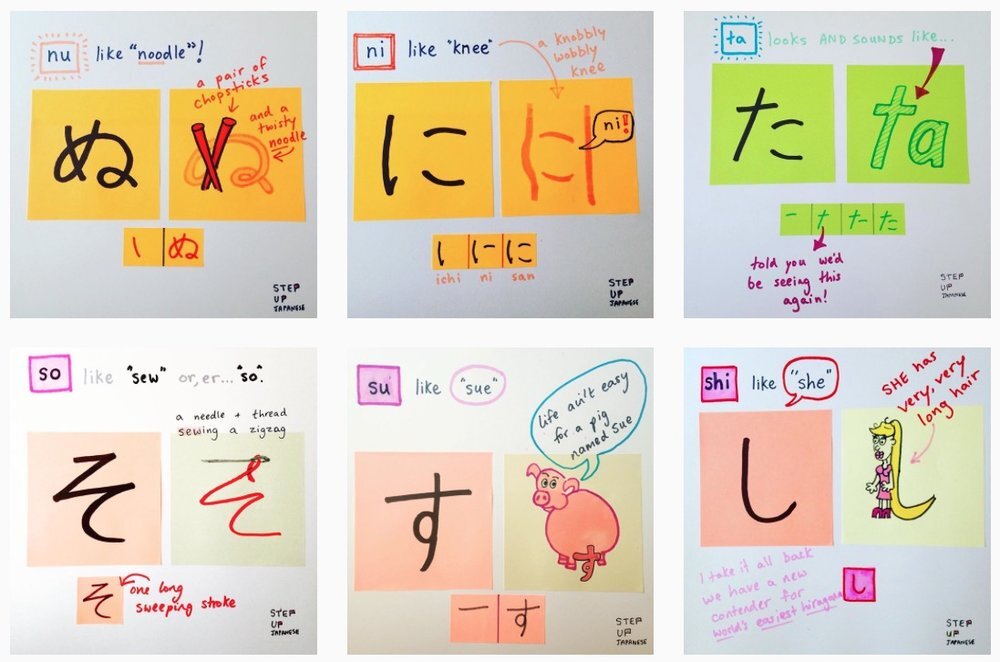
But if you want to learn to read Japanese, you definitely need to start by learning hiragana - the 46 characters that make up the first basic Japanese “alphabet”. But how to remember them?
The best, quickest, most fun method is to associate each character with a picture that it (clearly or vaguely) looks like, ideally also using the sound of the letter.
Hiragana and katakana are pretty simple, so associating each character with a picture is super easy.
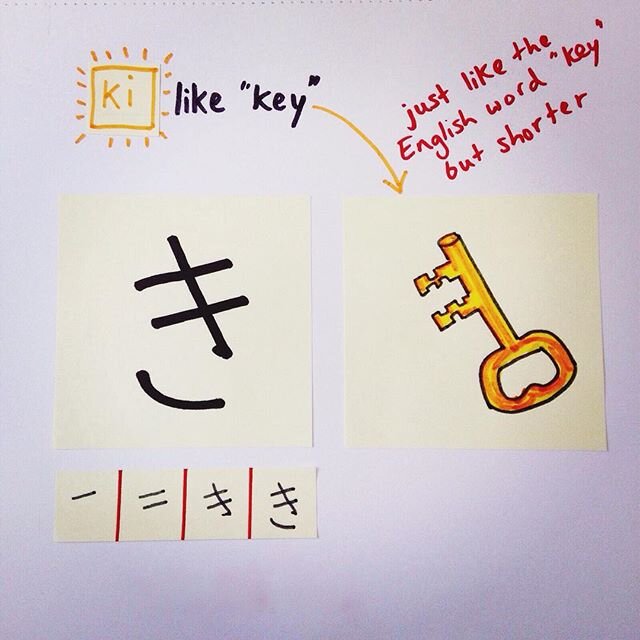
Here's hiragana き (ki), which we can imagine is a picture of a KEY. My image of akey is an old-fashioned one. Yours might be modern and spiky. Or it might have wings on it and be flying about getting chased by Harry Potter on a broomstick.
The point is to think of a strong visual image that makes the picture of the key stick in your mind:
Of course, you need to learn to read words and sentences too. So as well as learning each letter, you need to practice writing and reading. This where the mnemonic really sinks in.
Memorisation doesn't help you remember. What helps you remember is active recall.
Let me give you an example.
You're reading a sentence and come across the word きのこ (kinoko, mushroom). You're staring at the letter き - "which one was that again?" and struggle a little bit to remember it.
Then you remember - aha! it's the KEY! This is ki.
This process of active recall - pushing a little bit to remember something - is the process that cements the mnemonic in your mind.
For me, one of the great thing about using mnemonics to remember the kana is that when I explain the system to learners, they often tell me that's what they're doing anyway, even if they don't have a name for what they're doing:
"Oh yes, that's how I remember む too - it's a funny cow's face! MOO"
"No, む is a man saying MO-ve!"
I've also found - luckily for me - it doesn't matter seem to matter if the actual picture is rubbish. (You don't even have to draw them, I just did this to help my students out and to share the idea).

What's important is that the picture in your head is super clear.
...and once you finish hiragana, you can do the whole thing again for katakana (the second basic Japanese alphabet):

You can find the whole set of hiragana and katakana mnemonics on instagram with the hashtag #stepupkana - please check it out and let me know what you think.
I'd love to hear what mnemonics you use to help remember the kana - let me know in the comments or add your story to the instagram posts for that character.
*Links with an asterisk * are affiliate links, which means I may earn a small commission, at no extra cost to you, when you click through and buy the book. Thanks for your support!
First published April 2017
Updated 7th April 2020

"How Did You Learn Japanese?"
When I tell people I'm a Japanese teacher they quite often ask: how did you learn Japanese? And I don't find this question particularly easy to answer.
Sometimes I give a quick answer which is that I used to live there.
But you can live in Japan for years and not learn Japanese.
I've met lots of people like this (and there's nothing wrong with that, unless learning Japanese is the reason you moved to Japan).
The long and more honest answer to "how come you speak Japanese?":

When I tell people I'm a Japanese teacher they quite often ask: how did you learn Japanese? And I don't find this question particularly easy to answer.
Sometimes I give a quick answer which is that I used to live there.
But you can live in Japan for years and not learn Japanese.
I've met lots of people like this (and there's nothing wrong with that, unless learning Japanese is the reason you moved to Japan).
The long and more honest answer to "how come you speak Japanese?" is that I studied a bit in university, then studied a LOT in my free time, got slightly obsessed with kanji, spent a lot of time with Japanese-speaking friends, avoided English-only situations and people who wanted to learn English from me for free, took all the JLPTs, went to Japanese language school full-time for a bit, read books and manga and newspapers (even when I couldn't read them yet), and watched a lot of Japanese TV.

You don't need to be in Japan to do any of those things:
listen to Japanese audio all day
learn kanji on the bus (with Anki. Use anki. I wrote a post about that too)
find friends who speak Japanese
watch Japanese TV on Netflix (seriously, there's loads)
Being in Japan was great motivation to learn Japanese for me because I hate not understanding things and find it incredibly frustrating.
If you're in Japan and you want to know what's in your lunch or what that sign over there says or what the person next to you on the train is saying, you need to understand Japanese. That was a big push for me.
But you definitely don't need to live in Japan to get motivated.
I also started off working in English conversation school which was a good opportunity to listen to the kind of Japanese that five-year-olds speak. And one of the many good things about conversation school is you have the mornings off so I would get up and STUDY. Every day. Forever.
But I also probably have more free time now than I did in Japan.
You don't need to live in Japan to learn Japanese.
There are people all over the world who learn languages without living in the country the language comes from. I've met lots of people like this and had the pleasure of teaching some of them.
(The other thing I tell people when they ask how I learned Japanese is that I didn't learn it. I'm still learning.)
First published 17th Feb 2017
Updated 2nd March 2020

Why Does The Japanese Language Have So Many Alphabets?
My students ask a lot of good questions. And one that sent us off on a bit of a tangent a few weeks ago was: “how old is Japanese writing?”
So, let’s take a whistle-stop tour of Japanese history with a very brief introduction to the Japanese writing system!
My students ask a lot of good questions. And one that sent us off on a bit of a tangent a few weeks ago was: “how old is Japanese writing?”
So, let’s take a whistle-stop tour of Japanese history with a very brief introduction to the Japanese writing system!
Until the 1st or 2nd century, Japan had no writing system. Then, sometime before 500AD, kanji - Chinese characters - made its way to Japan from China (probably via Korea).
These characters were originally used for their meaning only - they weren't used to write native Japanese words.
↓ And at that time, Japanese writing looked like this. Look, it looks like Chinese!

(Image Source - Nihon Shoki, Wikipedia)
But it was inconvenient not being able to write native Japanese words down, and so people began to use kanji to represent the phonetic sounds of Japanese words, not only the meaning. This is called manyougana and is the oldest native Japanese writing system.
For example, in manyougana the word asa (morning) was written 安佐 (that's a kanji for the “a” sound - 安 - and another for the “sa” sound - 佐). These characters indicate the sound of the word - “asa” - but not its meaning.
In modern Japanese we'd use 朝, the kanji that means "morning" for asa. This character shows its meaning AND its sound.
The problem was, manyougana used multiple kanji for each phonetic sound - over 900 characters for the 90 phonetic sounds in Japanese - so it was inefficient and time-consuming.
Gradually, people began to simplify kanji characters into simpler characters - that's where hiragana and katakana came from.
Katakana means "broken kana" or "fragmented characters". It was developed by monks in the 9th century who were annotating Chinese texts so that Japanese people could read them. So katakana was really an early form of shorthand.
Each katakana character comes from part of a kanji: for example, the top half of the kanji 呂 became katakana ロ (ro), and the left side of the kanji 加 became katakana カ (ka).
↓ Each katakana comes from part of a kanji.
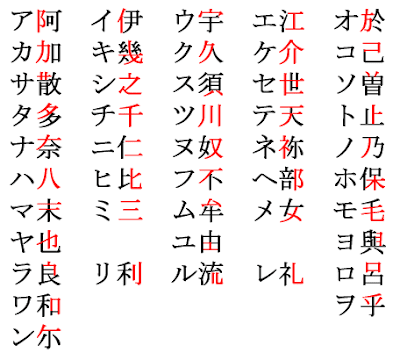
(Source - Katakana origins, Wikipedia)
Women in Japan, on the other hand, wrote in cursive script, which was gradually simplified into hiragana. That's why hiragana looks all loopy and squiggly. Like katakana, hiragana characters don't have meaning - they just indicate sound.
↓ How kanji (top) evolved into manyougana (middle in red), and then hiragana (bottom).

(Source - Hiragana evolution, Wikipedia)
Because it was simpler than kanji, hiragana was accessible for women who didn't have the same education level as men. The 11th-century classic The Tale of Genji was written almost entirely in hiragana, because it was written by a female author for a female audience.
Modern Japanese writing uses all three of these “alphabets” - hiragana, katakana, and kanji - often all mixed up in the same sentence.
What would 12th-century people in Japan think of my students, 900 years later, learning hiragana as they take their first steps into the Japanese language?
First published 28th Oct 2016
Updated 27th Jan 2020
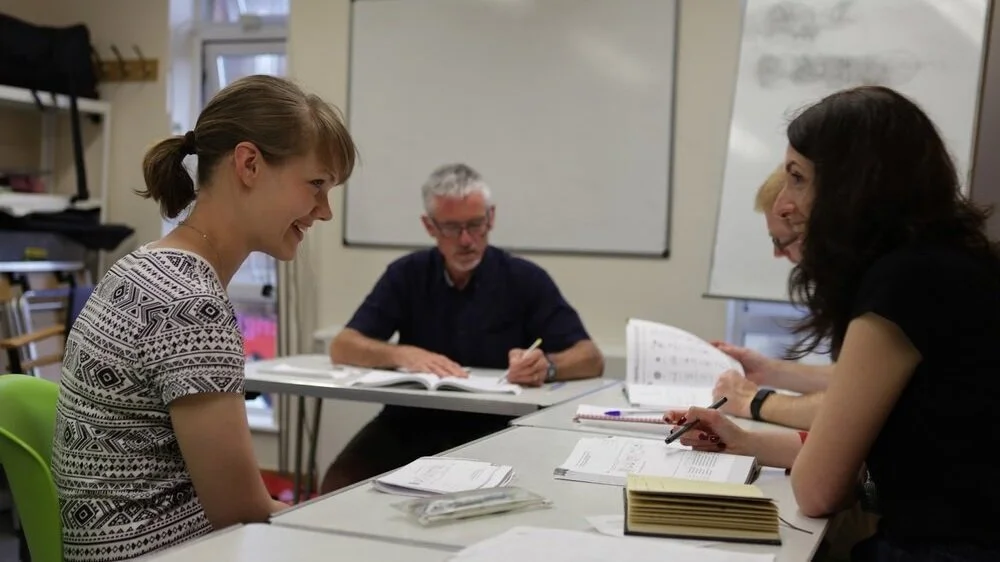
How Do I Know if a Group Language Class is For Me?
If you’re thinking about taking Japanese lessons, one of the first things you’ll have to decide is whether you want to join a group class, or take one-to-one lessons.
There are pros and cons to all methods of learning a language. Here, I’ll look at some of the key advantages of joining a group.
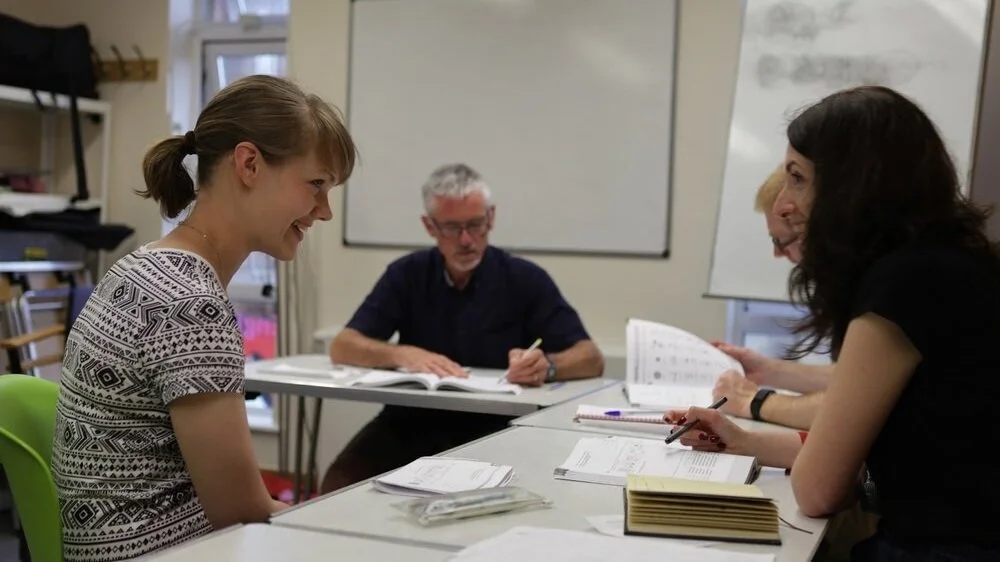
If you’re thinking about taking Japanese lessons, one of the first things you’ll have to decide is whether you want to join a group class, or take one-to-one lessons.
There are pros and cons to all methods of learning a language. Here, I’ll look at some of the key advantages of joining a group.
1) Meet other language learners
Classes give you access to a teacher, but a group class also provide you with an instant group of other people with the same interest as you.
You can speak in your target language together, go out for dinner and order in Japanese, and message each other asking "what was last week's homework again?"
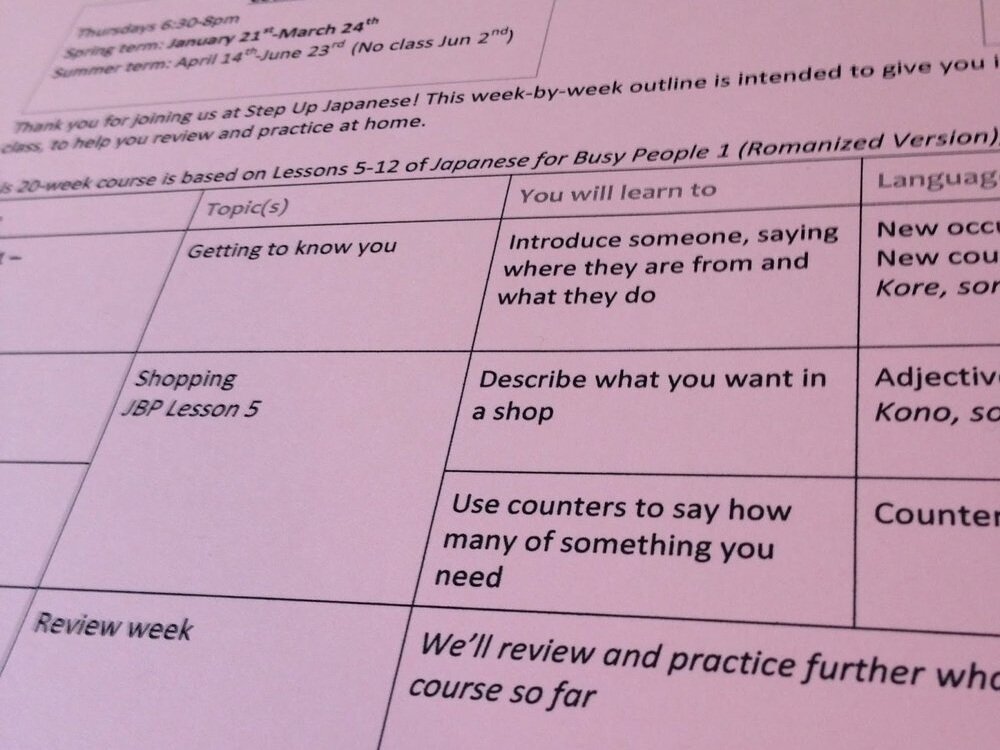
(Just kidding - thanks to the course outline I'll provide you with, you'll always know what this week's homework is.)
In a group class, students can support and help each other. It's obvious to me that my lovely students gain a lot from each others' support!
2) Keep a regular schedule
To gain any skill, you need to practice regularly. The great thing about having class on a regular day is it forces you to practice. Unlike exclusive self-study where you'll always have an excuse to procrastinate, weekly classes require you to be prepared for every class so you can get the most out of it.
Practice makes perfect, after all.
3) It's your class
You might feel like the only way to get a class tailored to your needs is to take one-to-one lessons. But a good group class - especially one for a small group of students - should be tailored to the students in it as much as a private lesson would be.
That's why I ask my students to give me regular feedback (informally, and through anonymous questionnaires) about how class is going and where you want it to go next.
It's your class, not mine, and we can focus on what you want to focus on.
That doesn't mean I'm going to do the hard work for you. If you want to get good at Japanese, you'll need to find ways of practicing and exposing yourself to the language as much as possible outside of class too.
But a group class can provide the basis of your knowledge, a structure to work with, and a group of friendly faces to answer your questions.
It also gives you a great excuse to go to that great Japanese restaurant again with your classmates.


First published June 2016; updated 9th January 2020.
Even More Japanese Loanwords From Languages That Aren't English
Last time I talked about Japanese loanwords - words that Japanese has “borrowed” from other languages - which come from languages other than English.
But there are also some tricky loanwords that look and sound like they came from English - but they didn’t!

Last time I talked about Japanese loanwords - words that Japanese has “borrowed” from other languages - which come from languages other than English.
But there are also some tricky loanwords that look and sound like they came from English - but they didn’t!
Challenge time!
Don’t be fooled. These loanwords look and sound a bit like they came from English - but they didn’t! Can you guess what languages these loanwords come from?
(Hint: not English!)
Koohii コーヒー coffee
Zero ゼロ zero
Pompu ポンプ pump
Botan ボタン button
Koppu コップ cup
Sarada サラダ salad
Kokku コック cook
Scroll down for the answers…!

The Answers:
Did you guess what non-English languages these loanwords come from?
Koohii コーヒー coffee - Portuguese
Zero ゼロ zero - French
Pompu ポンプ pump - Dutch; Flemish
Botan ボタン button - Portuguese
Koppu コップ cup - Dutch; Flemish
Sarada サラダ salad - Portuguese
Kokku コック cook - Dutch; Flemish
Students often ask why there are so many Portuguese and Dutch loanwords in Japanese. Words from these two languages have been used as loanwords in Japanese since the 16th and 17th centuries, when both countries established trade with Japan.
So, just because that katakana word you’ve learned looks like English, doesn’t mean it came from English!











Want to buy Japanese lessons for a friend or relative? Send a gift card