
Welcome to the Step Up Japanese blog archive!
Although I’m not currently adding new posts to the blog, you’ll find plenty of Japanese learning tips, study advice, and resources to explore here.
Browse the blog index to view a complete list of posts.
For the latest news, course updates, and Japanese learning tips from Step Up Japanese, sign up for my newsletter.
Search this blog:

Is it "douzo" or "dozo"?
"Wait, is it douzo? In the book it says dōzo..."
It's both. And it's neither!
In beginner classes I use often rōmaji (English letters) to write Japanese in class. This is to give you a head start in learning to speak.
Some people think you shouldn't use rōmaji at all, because it will give you bad pronunciation.
That might be true if you're studying by yourself…

"Wait, is it douzo? In the book it says dōzo..."
It's both. And it's neither!
In beginner classes I use often rōmaji (English letters) to write Japanese in class. This is to give you a head start in learning to speak.
Some people think you shouldn't use rōmaji at all, because it will give you bad pronunciation.
That might be true if you're studying by yourself.
But if you have a teacher to teach you how to pronounce Japanese words correctly, and correct your mistakes, you can learn Japanese correctly using rōmaji.
There are different systems for writing Japanese in the English alphabet. Depending on which system is being used, a word could be spelled differently.
どうぞ (do-u-zo) means "here you are" / "go ahead".
Some romanisation systems use a macron (that’s a horizontal bar over the letter) to write the long vowel sound: ā ī ū ē ō. Using the macron, the word would be written "dōzo".
Another method is to spell out the long vowel sound using double letters: aa, ii, uu, ei, ou. That gives us "douzo".
Both "dōzo" and "douzo" are correct.
Sometimes, the long vowel isn't written in: "dozo". Technically, this is wrong!
You might also see ee and oo used instead of ei and ou: "doozo".
Personally I think "doozo" is just asking for trouble. That's not how the word is spelled in Japanese (it's どうぞ do-u-zo).
Of course, the truly correct way to spell the word is to write it in Japanese characters: どうぞ.
But if you’re writing in rōmaji, both "dōzo" and "douzo" are fine too. Just don't forget the long vowel!

First published Nov 2017; updated Sept 2021

2021 Student Summer Picnic!
Thank you to everyone (including those not pictured) who came to our student picnic at the weekend!
We had fun meeting up outdoors, drinking tea, eating Japanese snacks and talking about Japan-related (and non-Japan-related) things.
It was so good to see students in person after such a long time!

Thank you to everyone (including those not pictured) who came to our student picnic at the weekend!
We had fun meeting up outdoors, drinking tea, eating Japanese snacks and talking about Japan-related (and non-Japan-related) things.
It was so good to see students in person after such a long time!
Although all my teaching is online now, I still plan to run occasional social events in Brighton for students. I’m looking forward to seeing you all again soon.

What's The Difference Between Tabemono and Ryouri?
"Why does this homework say the Japanese word for food is ryouri? I thought you said the word for food was tabemono?"
I love it when students ask questions like this. It shows you’re really thinking about the language.
So, what’s the difference between ryouri and tabemono? Consider the following:
Potatoes are tabemono, but they're not ryouri.

"Why does this homework say the Japanese word for food is ryouri? I thought you said the word for food was tabemono?"
I love it when students ask questions like this. It shows you’re really thinking about the language.
So, what’s the difference between ryouri and tabemono? Consider the following:
Potatoes are tabemono, but they're not ryouri.
Fish and chips is tabemono AND ryouri.
Does that give you a clue?
食べ物 (tabemono)
Tabemono is food in quite a general sense. The unprepared ingredients in your fridge are tabemono. The food on your plate is also tabemono.
For example:
好きな食べ物は?
Suki-na tabemono wa?
What's your favourite food?
体に良い食べ物ベスト10!
Karada ni ii tabemono besuto 10!
Top ten foods that are good for you!
料理 (ryouri)
Ryouri, on the other hand, is cooking or cuisine. Specifically, it's food which has been cooked or otherwise prepared.
The food on your plate is ryouri, but the ingredients in your fridge are not ryouri yet.
Some more examples:
その店の料理は美味しかったです。
Sono mise no ryouri wa oishikatta desu.
The food at that restaurant was great.

Ryouri can be the cuisine of a whole country:
フランス料理が大好きです。
Furansu ryouri ga daisuki desu.
I love French food.
イギリス料理はまずいと言われます。
Igirisu ryouri wa mazui to iwaremasu.
It's said that British food is disgusting.
料理をする (ryouri o suru) means "to cook", too:
ロバートさんはあまり料理をしません。
Robaato san wa amari ryouri o shimasen.
Robert doesn't cook very often.
Question time!
Can you answer these questions?
1. 好きな食べ物は何ですか。
(すきな たべものは なんですか。)
2. よく料理をしますか。何を作りますか。
(よく りょうりを しますか。なにを つくりますか。)
Or, you could hop on over to Twitter and ask me a question. I love a good question 😊
Updated 10th August 2021

The One Million Meanings of Yoroshiku
So, you’ve learned different ways to say "Nice to meet you!" in Japanese. One way to say “nice to meet you” is “yoroshiku onegai shimasu”.
But yoroshiku onegai shimasu isn't just for the first time you meet someone. It has a whole host of different uses.
Let's look at the main different meanings of this magical, multipurpose Japanese word.
1. Yoroshiku means "Please!"…

So, you’ve learned different ways to say "Nice to meet you!" in Japanese. One way to say “nice to meet you” is “yoroshiku onegai shimasu”.
But yoroshiku onegai shimasu isn't just for the first time you meet someone. It has a whole host of different uses.
Let's look at the main different meanings of this magical, multipurpose Japanese word.
1. Yoroshiku means "Please!"
Yoroshiku, as we learned before, can be used when meeting new people, and means "please be kind to me", or "please look favourably upon me":
初めまして。フランです。よろしくお願いします。
"Hajimemashite. Furan desu. Yoroshiku onegaishimasu."
Nice to meet you. I'm Fran. Please look favourably upon me!
2. Yoroshiku means "Thank you!"
As well as please, yoroshiku can mean thank you. Specifically, it can often mean “thank you in advance”. Said when giving someone work to do:
とじまり、よろしくね。
Tojimari, yoroshiku ne.
"I'll leave you to lock up. Thanks."
娘をよろしくお願いします。
Musume o yoroshiku onegaishimasu.
"Thanks in advance for taking care of my daughter."
Shop “Yoroshiku ne” T-shirts:

3. Yoroshiku means "Hi!"
This is one of my favourites. Yoroshiku can mean "regards", like "send my regards to so-and-so", or "say hi to so-and-so", or even "send my love to so-and-so":
お父さんによろしくお伝えください。
O-tou-san ni yoroshiku o tsutae kudasai.
Please send my best regards to your father.
お姉さんによろしくね。
O-nee-san ni yoroshiku ne.
Say hi to your sister for me.
What's your favourite use of yoroshiku? Did I miss any out? Let me know...yoroshiku ne!
Tuesdays, 12:00pm (UK time) | Online Group Course
Starts 15th Sept 2026 | 36 weeks
Who this course is for
This course is for true beginners or early beginners who already know a little Japanese (e.g. ~10-20 hiragana characters) and want to build a solid foundation.
If you are starting completely from zero, I recommend a few 1:1 lessons before joining.
You will already be able to:
Recognise a small number of hiragana characters (or are beginning to learn them)
Feel comfortable learning slowly and step-by-step
In this course you will learn to:
Introduce yourself and ask simple questions
Talk about family, friends, likes and dislikes
Order food and drinks in a restaurant
Ask and answer simple questions about places you are staying
Talk about where people and things are located
Build confidence reading hiragana and begin katakana
Start recognising a small number of common kanji
The focus is on practical, everyday Japanese for absolute communication basics.
Course details
Duration: 36 weeks (3 x 12-week terms)
Day/time: Tuesdays, 12pm (UK time), 55-minute lessons
Textbook: Irodori: Japanese for Life in Japan - Starter (starting from Lesson 3, free online)
Not sure if this is right for you?
Book a free 30-minute Zoom consultation or email me for advice.
Get my newsletter:
Updated 10th August 2021

"Does Japanese Have Plurals?"
After the excitement of our first school Summer Barbecue, I spent the day in bed watching one of my favourite films in Japanese.
It wasn’t a Japanese film though. I watched Hot Fuzz (or to give its Japanese title ホット・ファズ -俺たちスーパーポリスメン "Hot Fuzz: We Are The Super-Policemen!")
Watching British comedies dubbed into Japanese might not be the "purest" way to listen to Japanese. But if you enjoy it, it's definitely worth doing. Dubbed films are easy to watch, too, assuming you've seen the film before and know the plot already.
Anyway, there's a little scene in the Hotto Fazzu dub that's a nice example of Japanese plurals in action, so I thought I'd share it with you.

After the excitement of our first school Summer Barbecue (back in 2017), I spent the day in bed watching one of my favourite films in Japanese.
It wasn’t a Japanese film though. I watched Hot Fuzz (or to give its Japanese title ホット・ファズ -俺たちスーパーポリスメン "Hot Fuzz: We Are The Super-Policemen!")
Watching British comedies dubbed into Japanese might not be the "purest" way to listen to Japanese. But if you enjoy it, it's definitely worth doing. Dubbed films are easy to watch, too, assuming you've seen the film before and know the plot already.
Anyway, there's a little scene in the Hotto Fazzu dub that's a nice example of Japanese plurals in action, so I thought I'd share it with you.
Angel and Danny are in the corner shop, and the shopkeeper asks them:
殺人犯たち捕まらないの?
satsujinhan tachi tsukamaranai no?
"No luck catching them killers then?"
"Killers" is translated as 殺人犯たち satsujinhan-tachi. You take the word 殺人犯 satsujinhan (murderer) and add the suffix たち (tachi) - which makes it plural.
See? Japanese does have plurals! ... when it needs them.

Danny doesn't notice the shopkeeper's slip-up (she knows more than she's letting on), and replies:
人しかいないんだけど。
hitori shika inai n da kedo.
"It's just the one killer actually."

PC Angel, of course, mulls over the shopkeeper's words, and realises their significance: there's more than one killer on the loose.
It's a turning point of the movie, and it rests on a plural. Yay!
You can use たち like this when you need to indicate plurality:
私たち watashi-tachi we, us (plural)
あなたたち anata-tachi you (plural)
ジョンたち jon-tachi John and his mates
It's not that common, but it does exist. Keep an eye out for it! You never know, you might just solve a murder case.

First published 8th Sept 2017
Updated 11th Dec 2020

What's the Difference Between Mina and Minna (And Why Does It Matter Anyway?)
If you watch Japanese TV or anime (or are paying attention in class) you've probably come across the Japanese word mina-san (皆さん) meaning "everybody".
But what's the difference between mina and minna? What's mina-sama all about? And ... does it actually matter?

Mina-san, konnichiwa! (皆さん、こんにちは ) Hello everybody!
If you watch Japanese TV or anime (or are paying attention in class) you've probably come across the Japanese word mina-san (皆さん) meaning "everybody".
But what's the difference between mina and minna? What's mina-sama all about? And ... does it actually matter?
1.皆さん Mina-san
Mina means "everybody", and it's commonly used with "-san" (the honorific suffix you put on the end of people's names to be polite).
Mina-san is often used when addressing a group of people, especially when they don't know either other too well or the situation calls for a slightly more formal greeting.
I find myself using mina-san in class a lot, which makes sense - I’m addressing a group of people.
As you might expect, Japanese YouTubers say “mina-san konnichiwa” a lot too ("hi guys!")

These example sentences from jisho.org should give you a good idea of the kinds of situation when mina-san is used:

2.みんな Minna
Also common is minna, which is just a spoken form of mina. Minna is more casual than mina.
Examples from jisho show us that people also use minna when they talk about everyone, as well as when addressing groups:

3. Beware! It’s not みんなさん minna-san
You can't mix them up and use minna-san though. That's incorrect.
Probably no one will mind or notice in a casual situation, but if you're trying to be polite, stick with mina-san. Or you can even go more polite with...
4. 皆様 Mina-sama
In more formal situations, the -san suffix is switched up to the more polite/formal -sama.
Mina-sama functions a lot like "ladies and gentlemen", or “esteemed guests”, and is used in writing, and in announcements:

Why does this matter?
Well really, which word you use is going to depend on the situation.
Mina-sama is super formal and it would sound weird if you use it with your friends. Likewise, minna is pretty casual and might not be appropriate in a business setting.
A lot of gaining fluency in a language is about choosing the right word for the right situation. The more examples you can read, and the more you can expose yourself to the Japanese language, the more these distinctions will start to make sense.
Mina-san, if you'd like to learn more Japanese with me, click here to check out my new online Japanese language courses!
First published 9th June 2017
Updated 7th April 2020


How to Learn Hiragana and Katakana using Mnemonics
I finally got around to going through the mid-course feedback from my students and drawing up plans to incorporate some of what you asked for into the rest of the course. Several learners mentioned the importance of learning the kana early on.
Learning to read Japanese can be a daunting task. The Japanese language has three distinct "alphabets" (four if you count romaji!) and learning kanji is a task that takes years. You can learn the kana (hiragana and katakana) pretty quickly, though, if you use the most efficient way to memorise them - mnemonics.
Hi! This article was first published in April 2017. I updated it recently (April 2020) and fixed some broken links.
This week I finally got around to going through the mid-course feedback from my students and drawing up plans to incorporate some of what you asked for into the rest of the course.
Several learners mentioned the importance of learning the kana early on.
Learning to read Japanese can be a daunting task. The Japanese language has three distinct "alphabets" (four if you count romaji!) and learning kanji is a task that takes years.
You can learn the kana (hiragana and katakana) pretty quickly, though, if you use the most efficient way to memorise them - mnemonics.
Hiragana and Katakana are the "building blocks" of the Japanese written language. Students in my beginner Japanese classes mostly start with the romaji edition of 'Japanese For Busy People'*, because my priority is to get you speaking from day one, and to spend class time on speaking as much as possible. Reading and writing is mostly set as homework.
But if you want to learn to read Japanese, you definitely need to start by learning hiragana - the 46 characters that make up the first basic Japanese “alphabet”. But how to remember them?
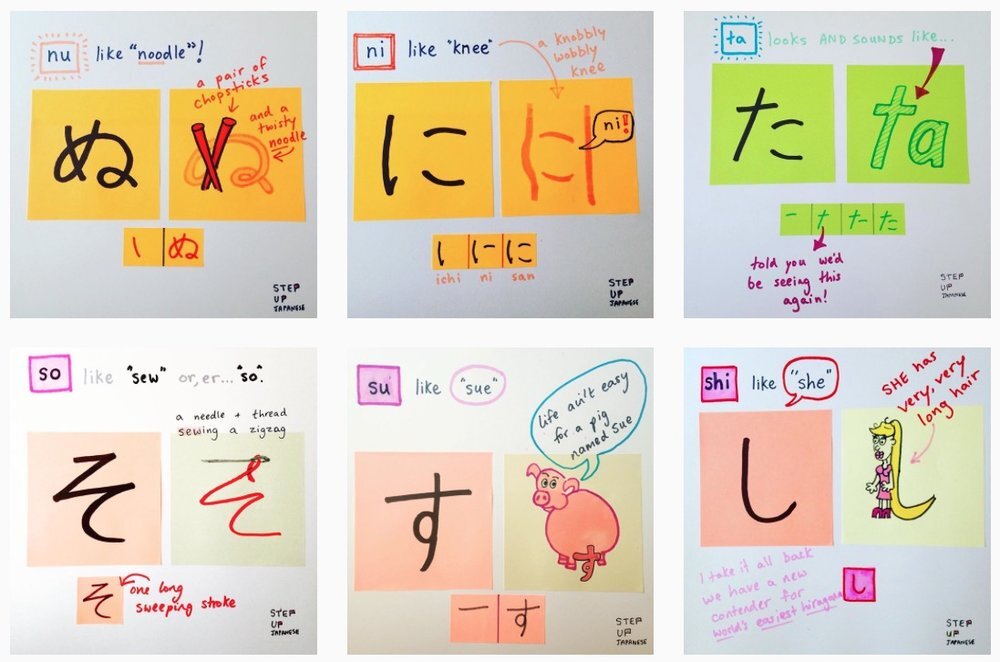
The best, quickest, most fun method is to associate each character with a picture that it (clearly or vaguely) looks like, ideally also using the sound of the letter.
Hiragana and katakana are pretty simple, so associating each character with a picture is super easy.
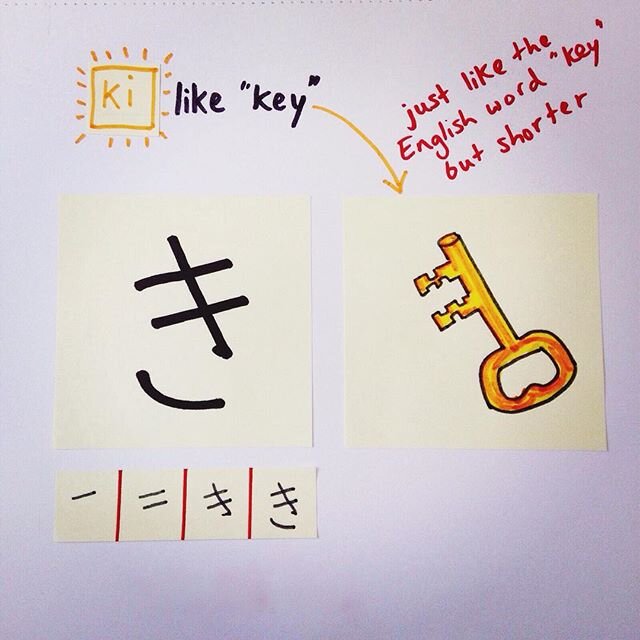
Here's hiragana き (ki), which we can imagine is a picture of a KEY. My image of akey is an old-fashioned one. Yours might be modern and spiky. Or it might have wings on it and be flying about getting chased by Harry Potter on a broomstick.
The point is to think of a strong visual image that makes the picture of the key stick in your mind:
Of course, you need to learn to read words and sentences too. So as well as learning each letter, you need to practice writing and reading. This where the mnemonic really sinks in.
Memorisation doesn't help you remember. What helps you remember is active recall.
Let me give you an example.
You're reading a sentence and come across the word きのこ (kinoko, mushroom). You're staring at the letter き - "which one was that again?" and struggle a little bit to remember it.
Then you remember - aha! it's the KEY! This is ki.
This process of active recall - pushing a little bit to remember something - is the process that cements the mnemonic in your mind.
For me, one of the great thing about using mnemonics to remember the kana is that when I explain the system to learners, they often tell me that's what they're doing anyway, even if they don't have a name for what they're doing:
"Oh yes, that's how I remember む too - it's a funny cow's face! MOO"
"No, む is a man saying MO-ve!"
I've also found - luckily for me - it doesn't matter seem to matter if the actual picture is rubbish. (You don't even have to draw them, I just did this to help my students out and to share the idea).

What's important is that the picture in your head is super clear.
...and once you finish hiragana, you can do the whole thing again for katakana (the second basic Japanese alphabet):

You can find the whole set of hiragana and katakana mnemonics on instagram with the hashtag #stepupkana - please check it out and let me know what you think.
I'd love to hear what mnemonics you use to help remember the kana - let me know in the comments or add your story to the instagram posts for that character.
*Links with an asterisk * are affiliate links, which means I may earn a small commission, at no extra cost to you, when you click through and buy the book. Thanks for your support!
First published April 2017
Updated 7th April 2020









Want to buy Japanese lessons for a friend or relative? Send a gift card