
Welcome to the Step Up Japanese blog archive!
Although I’m not currently adding new posts to the blog, you’ll find plenty of Japanese learning tips, study advice, and resources to explore here.
Browse the blog index to view a complete list of posts.
For the latest news, course updates, and Japanese learning tips from Step Up Japanese, sign up for my newsletter.
Search this blog:
Fun and games at the Brighton & Hove Japanese Club Open Day
If you have children while living abroad, or you move with your kids to a country where a different language is spoken, how do you expose them to your native language?
One option is to join a club of people in the same situation. (Or, if there isn't a club, to start one!)
The Brighton & Hove Japanese Club runs a Saturday school for children from Japanese-speaking and bilingual families. The club exists to promote cultural exchange between Japan and the UK.
Every year they have a well-attended Open Day to celebrate the school's successes, and welcome visitors in to see what the club has to offer. And there's a LOT on offer.
I went along this year with my students again. Here's what we got up to!
The open day has two parts - workshops in the classrooms, and demonstrations and performances on the stage. The club makes really good use of the space, with lots to see and do.
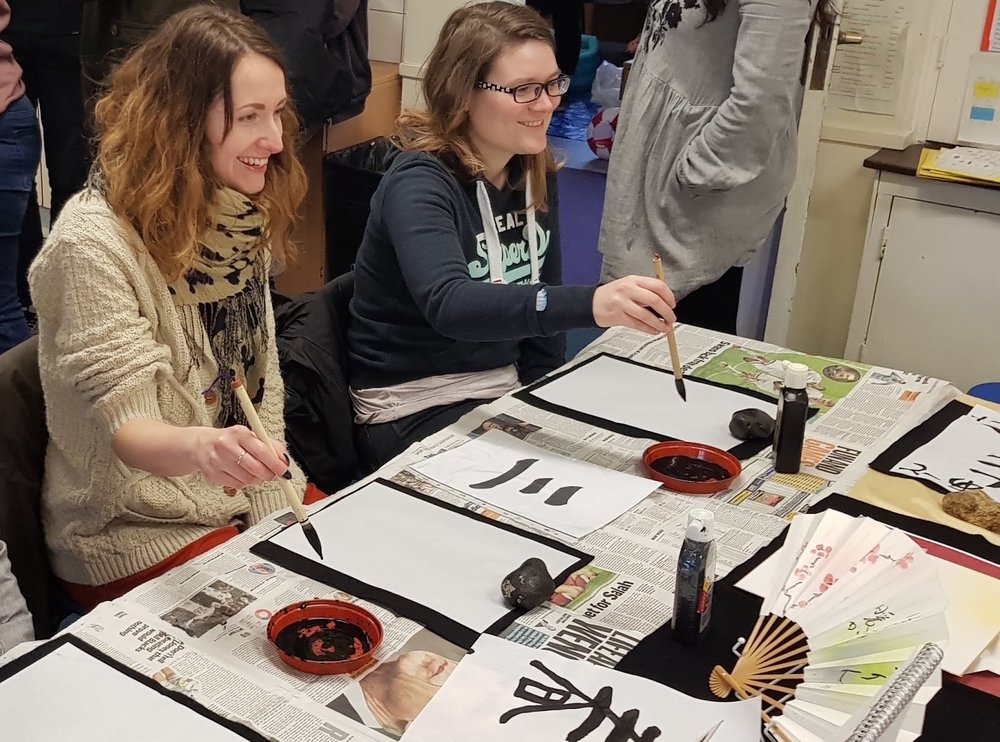
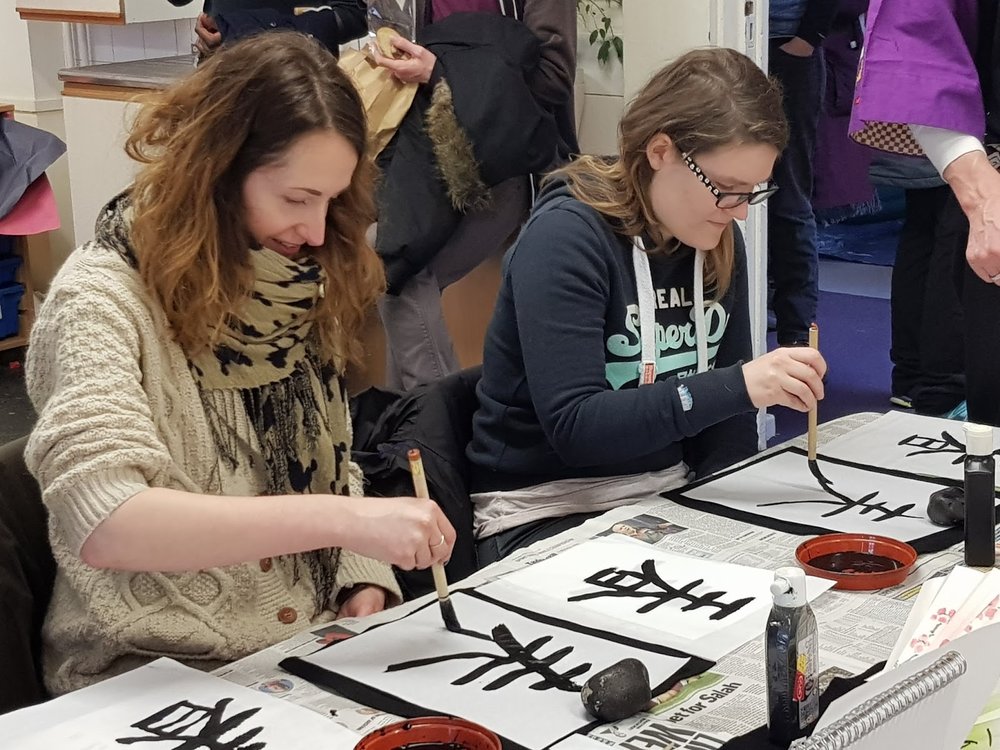
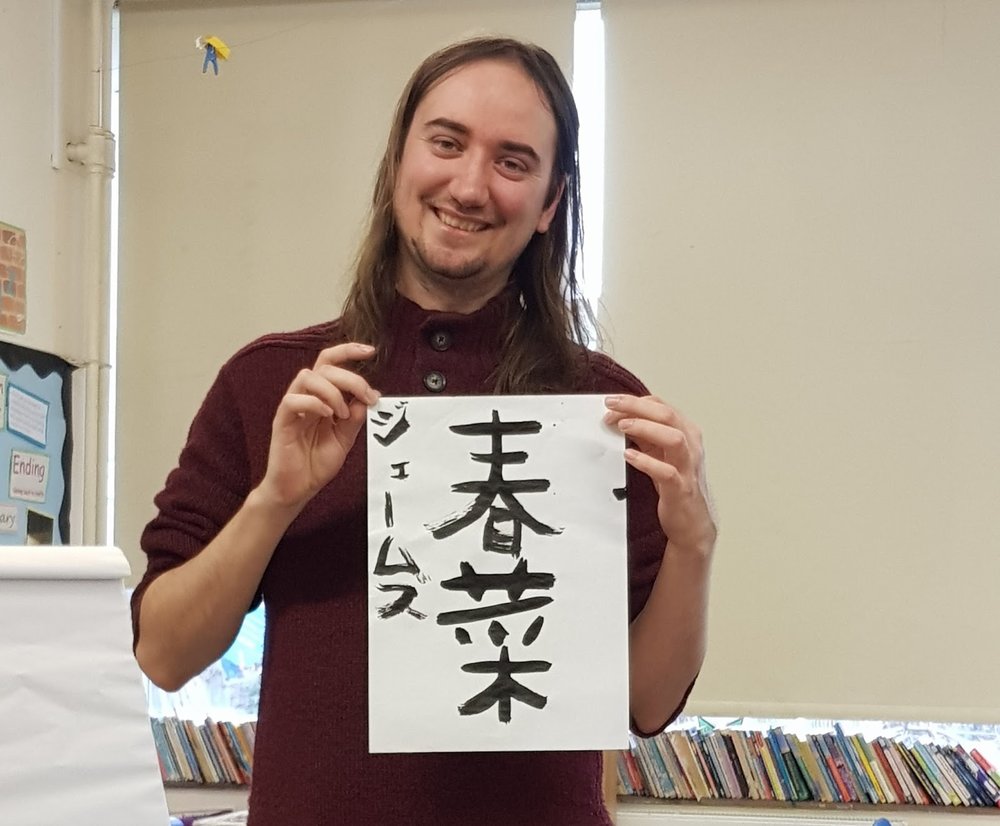
We started with a calligraphy lesson, having a go at writing 春 (haru), the kanji for Spring:
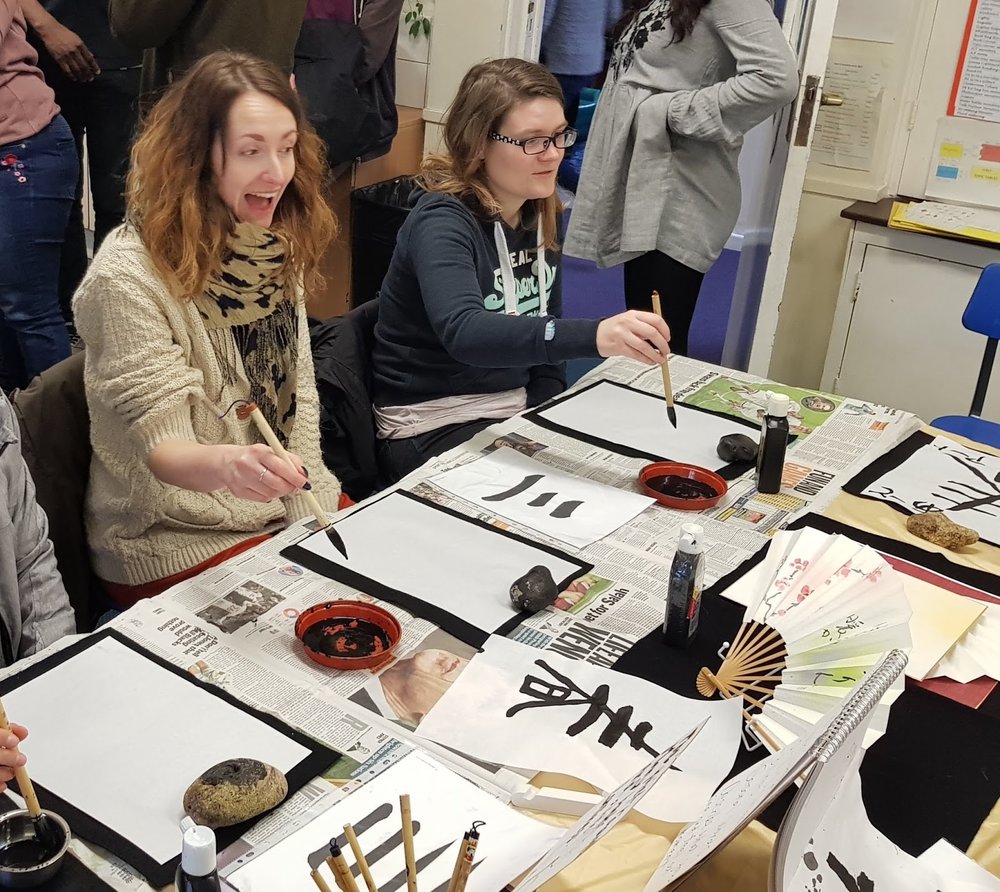
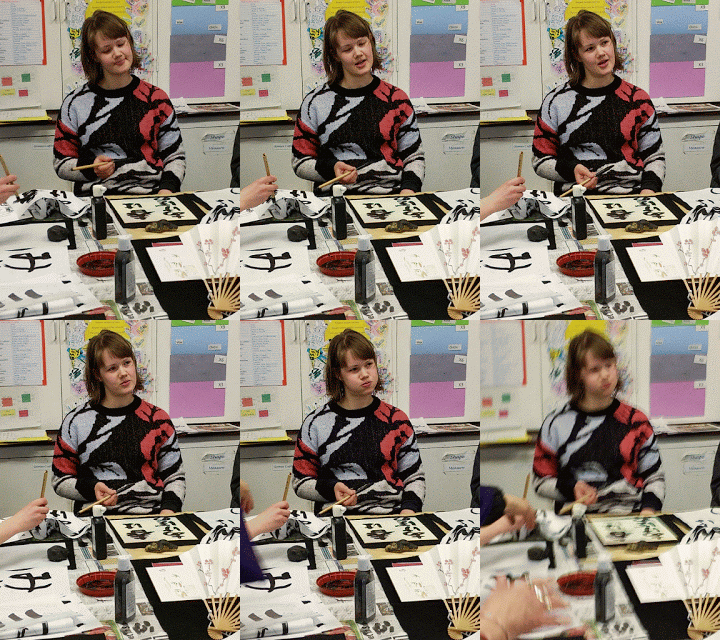
Diligent students!
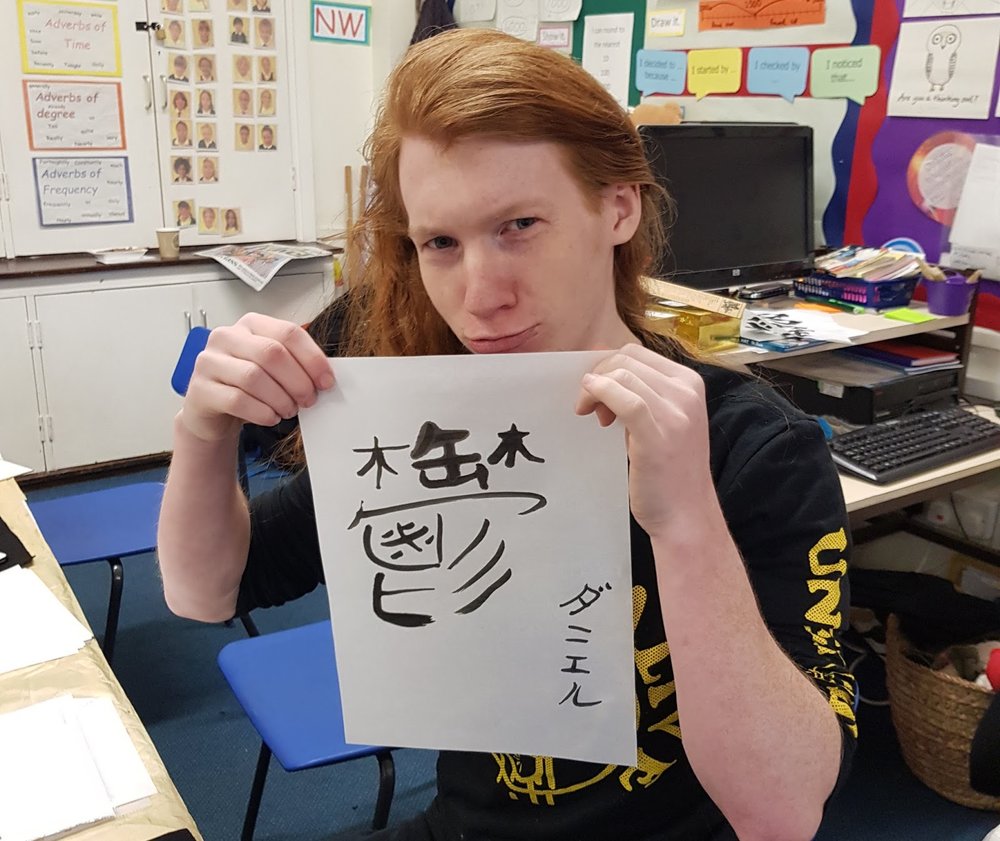
Dan likes a challenge, so he wrote the most difficult kanji he could think of: 鬱 (utsu).
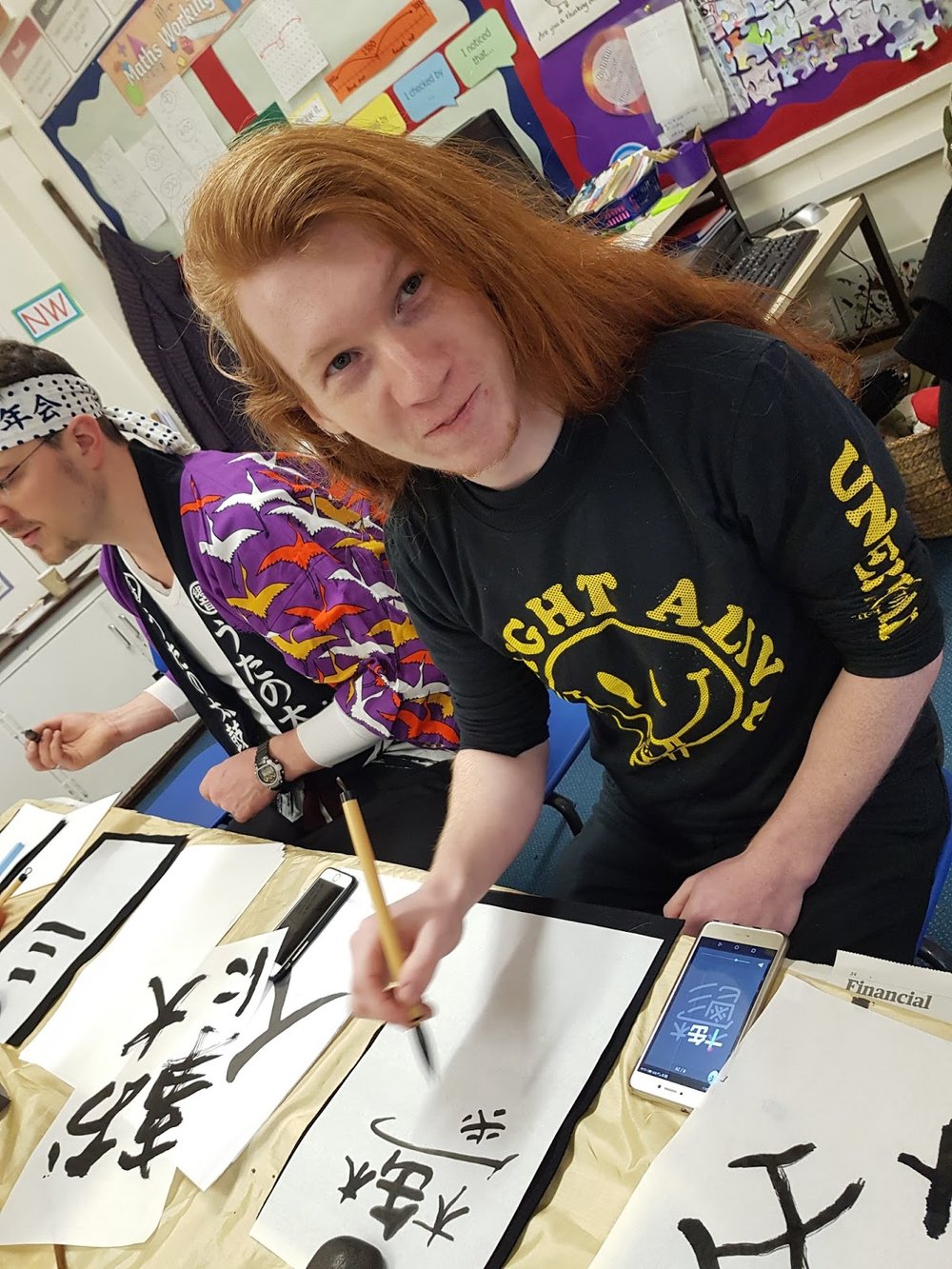
This character means depression, or "low spirits", which is also how you might feel after trying to write a kanji with 29 strokes!
James showing off his handiwork:
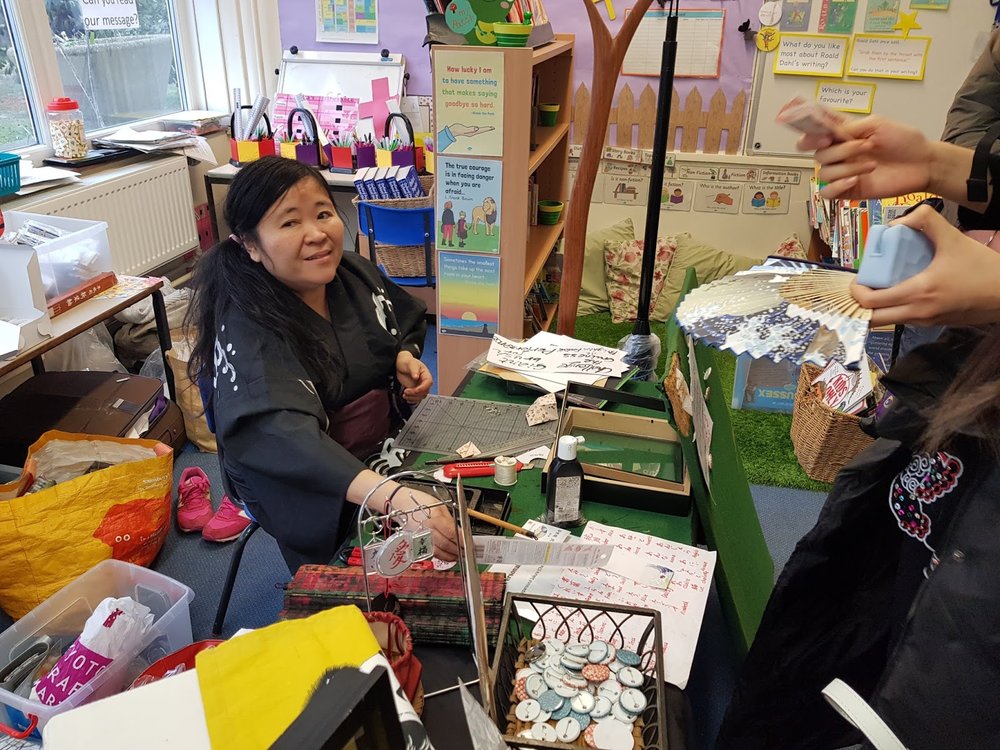
When she's not doing large-scale calligraphy demonstrations or teaching calligraphy, Takako sells beautiful Japanese goods, personalised with your name in Japanese.
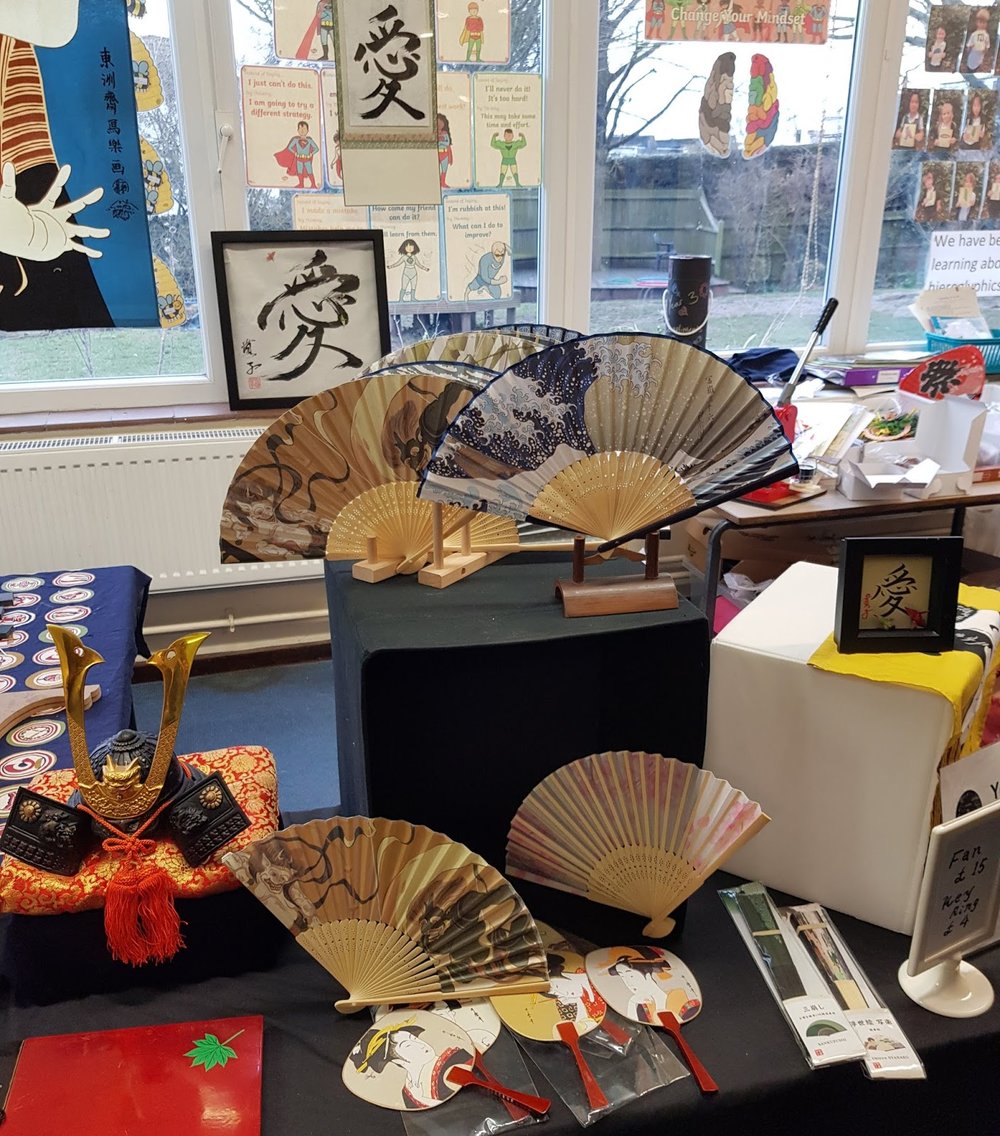
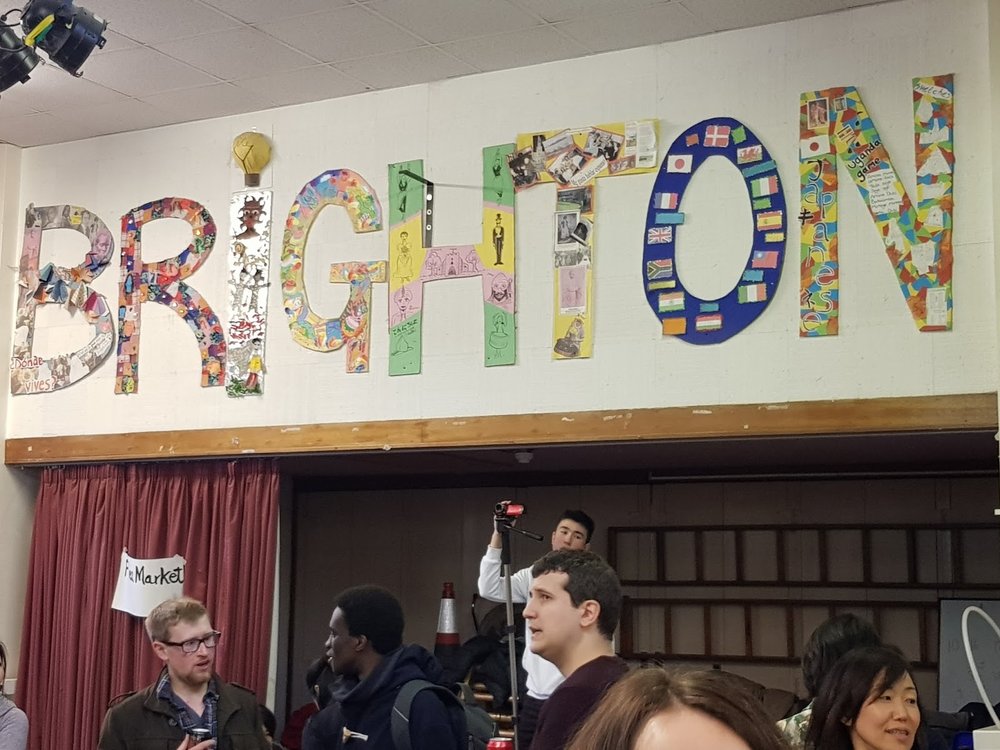
Next, we headed into the main hall to see some of the shows.
It was jam packed!
The organisers had to get an extra pole so their video camera could see over the crowd.
Usually my favourite bit is the second-hand book stall where I pick up something I want to read (often pretending to myself I'll use it in class...)
But I was knew I was going to Japan the following week so I didn't buy any books this year.
I did however get this adorable Anpanman cookie!
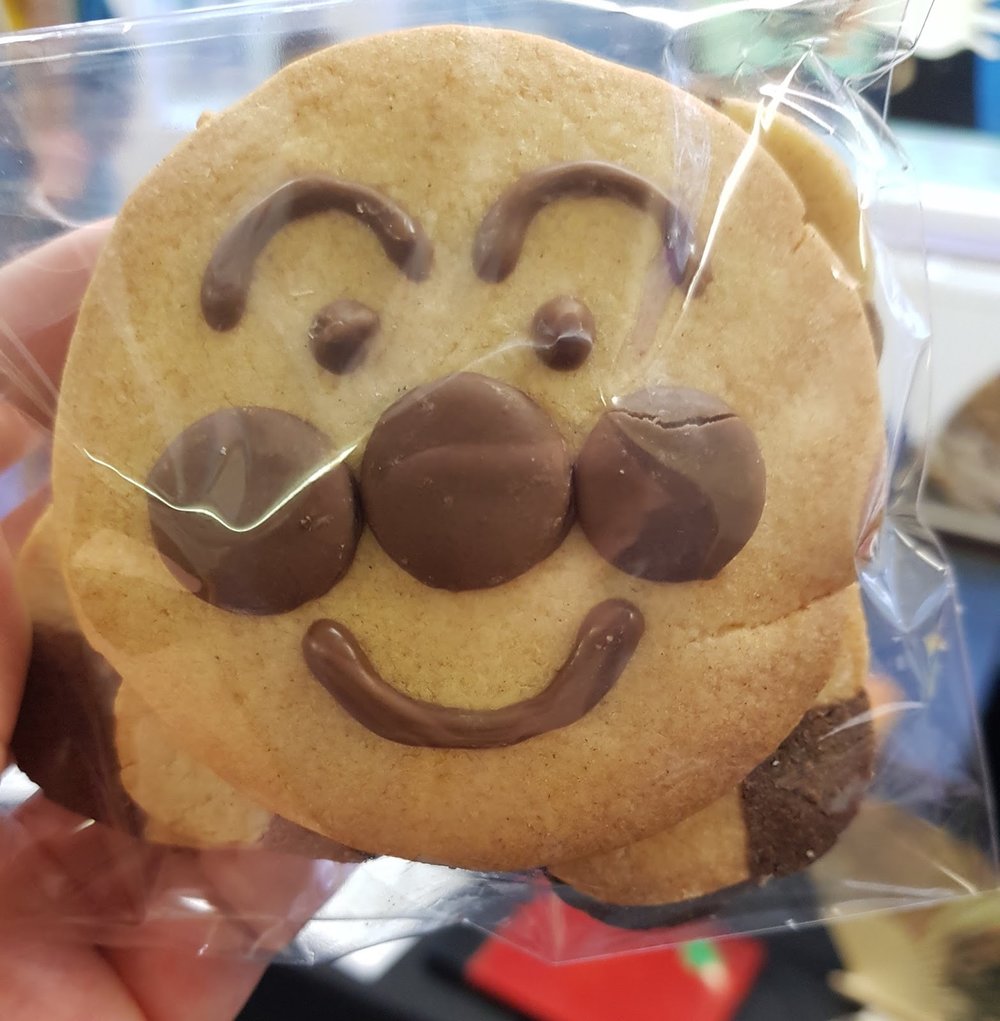
I sat on him later and squashed him, but he still tasted great.
I also got some melon pan from this cute bakery stand.
("Gu choki pan ya" is the name of the bakery from the Ghibli film Kiki's Delivery Service).
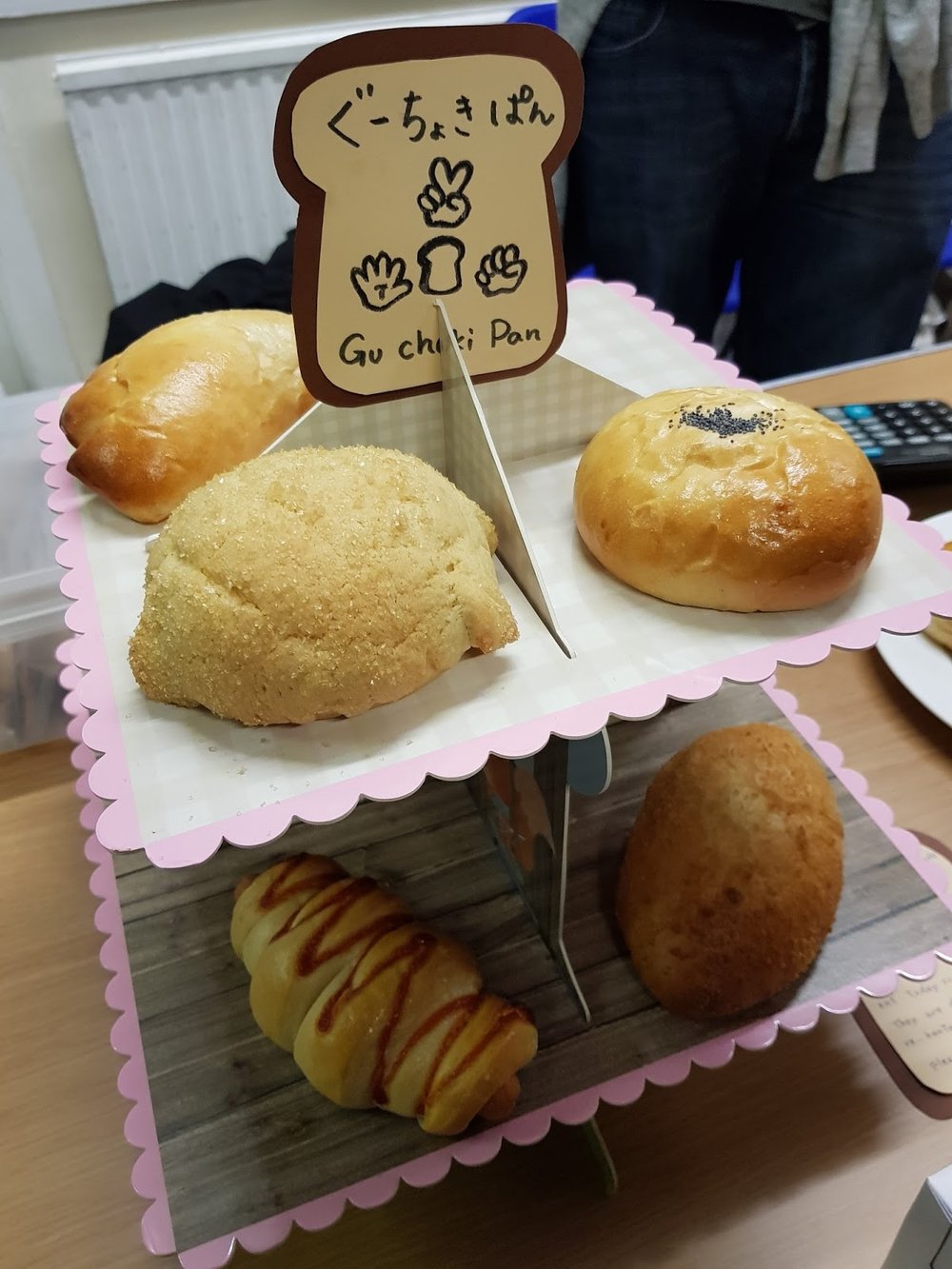
(No photo of An-an's stall I'm afraid, I was too busy chatting to Noriko, the owner, to remember to take a picture).
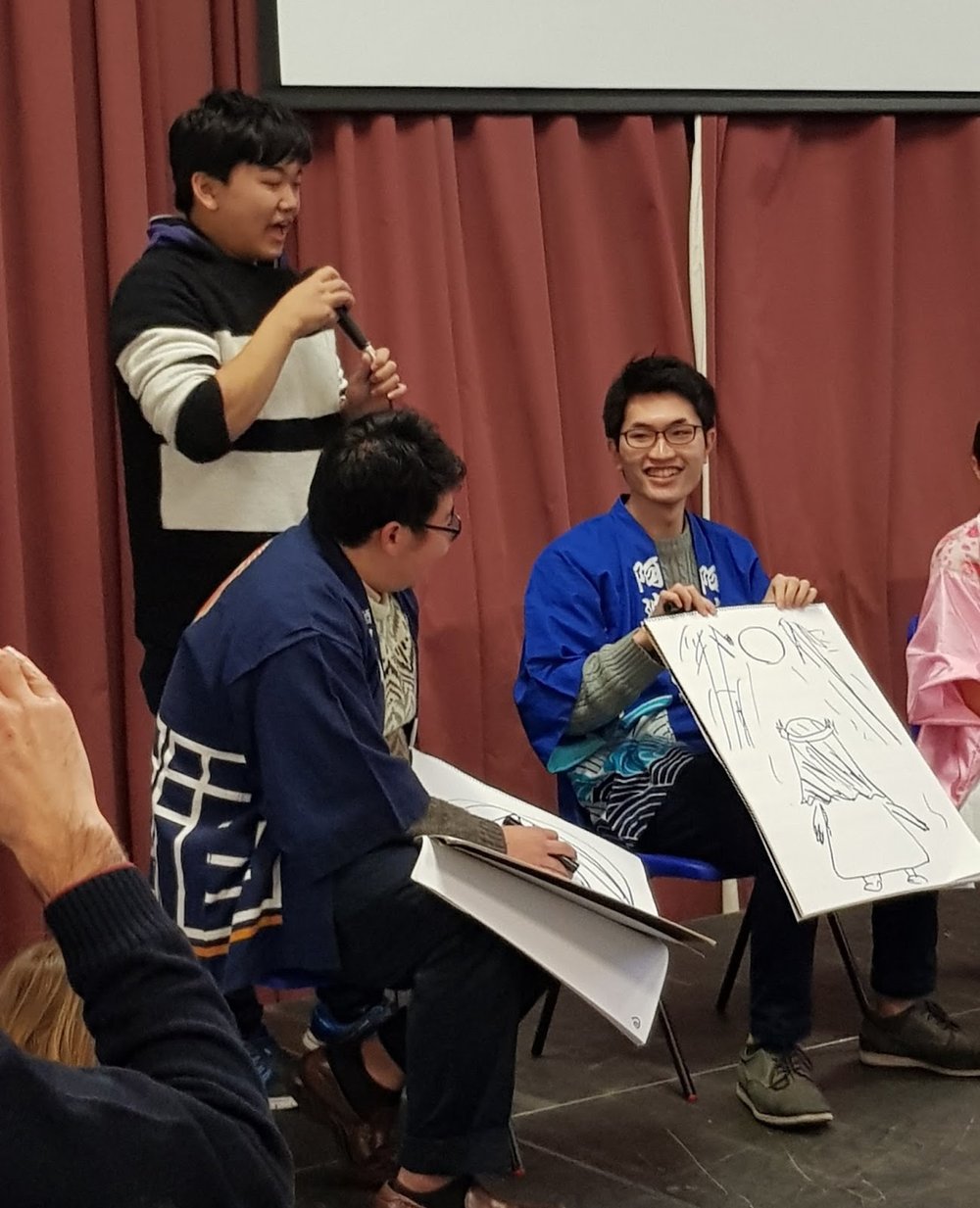
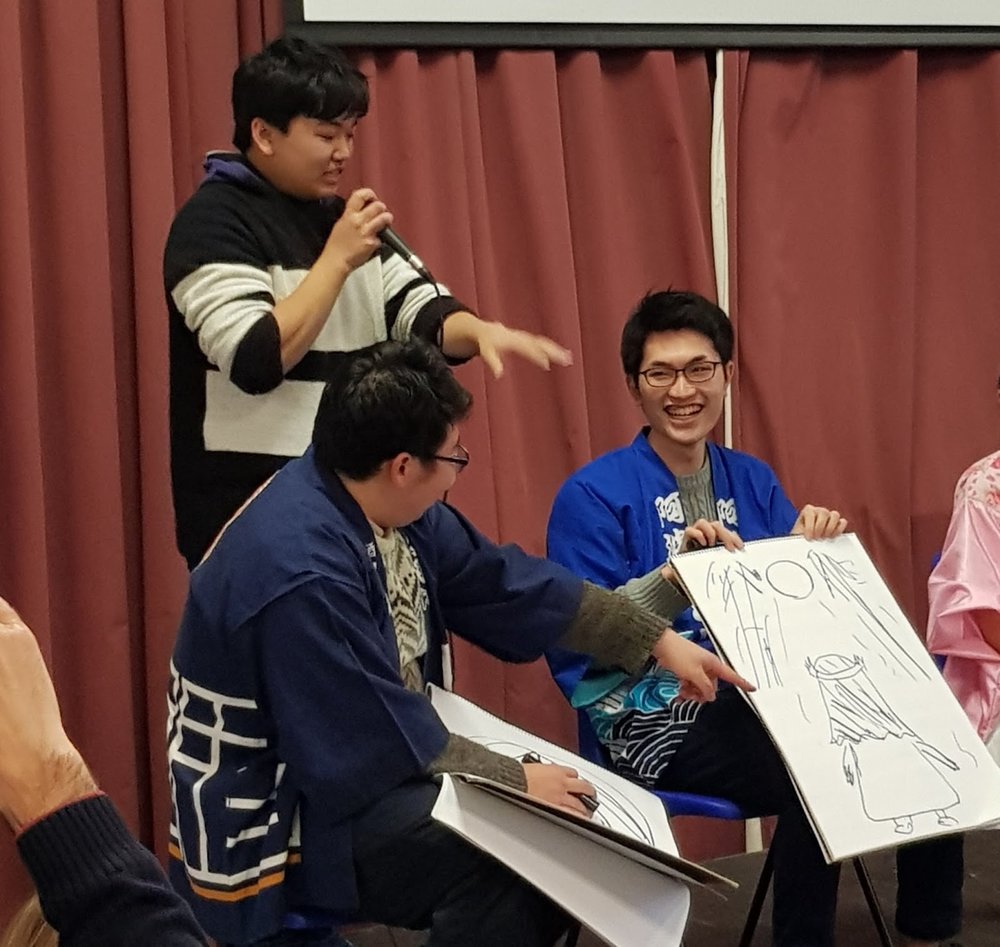
While eating some of the sweet Japanese treats I'd bought, we watched the manga drawing contest.
The contestants were given the name of a manga character and had to draw them. The kids could peek at the screen, but the adults had to draw from memory.
Two of the adults participating are professional manga artists, so that was fun too.
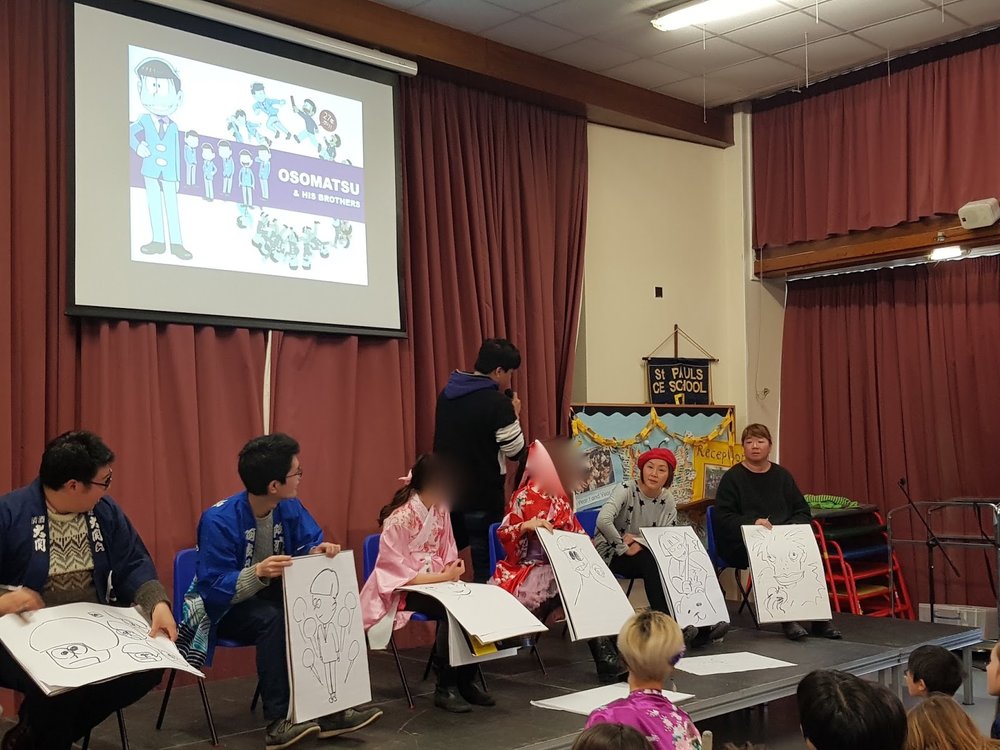
The event is presented in English and in Japanese, with speakers switching between languages.
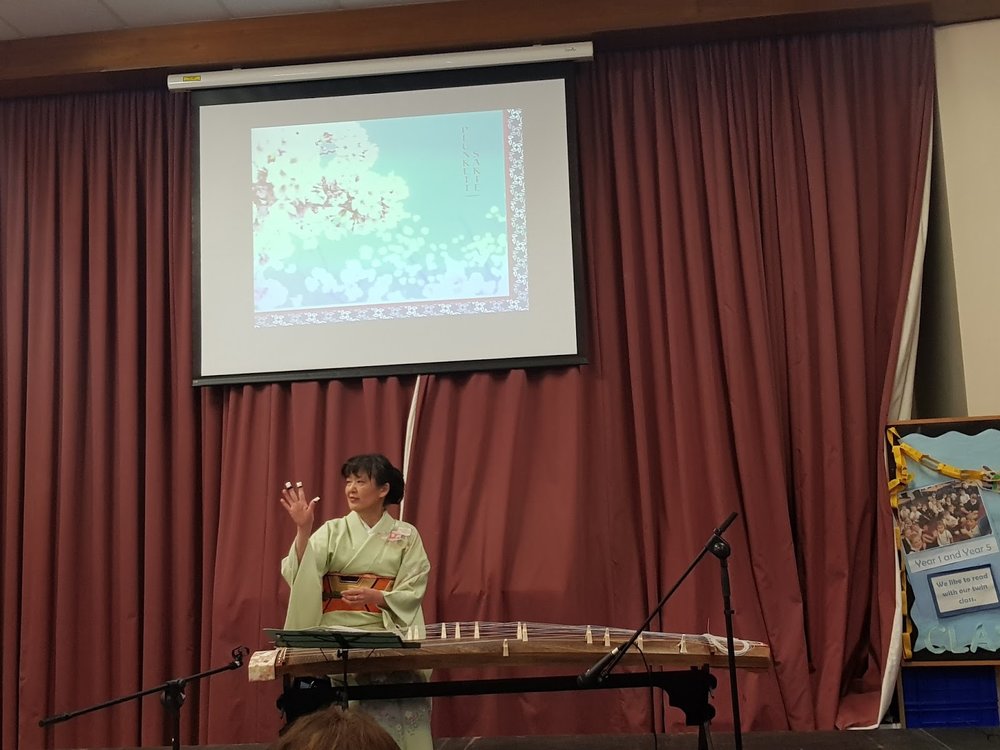
We also watched a koto (Japanese harp) performance by Sakie Plunkett.
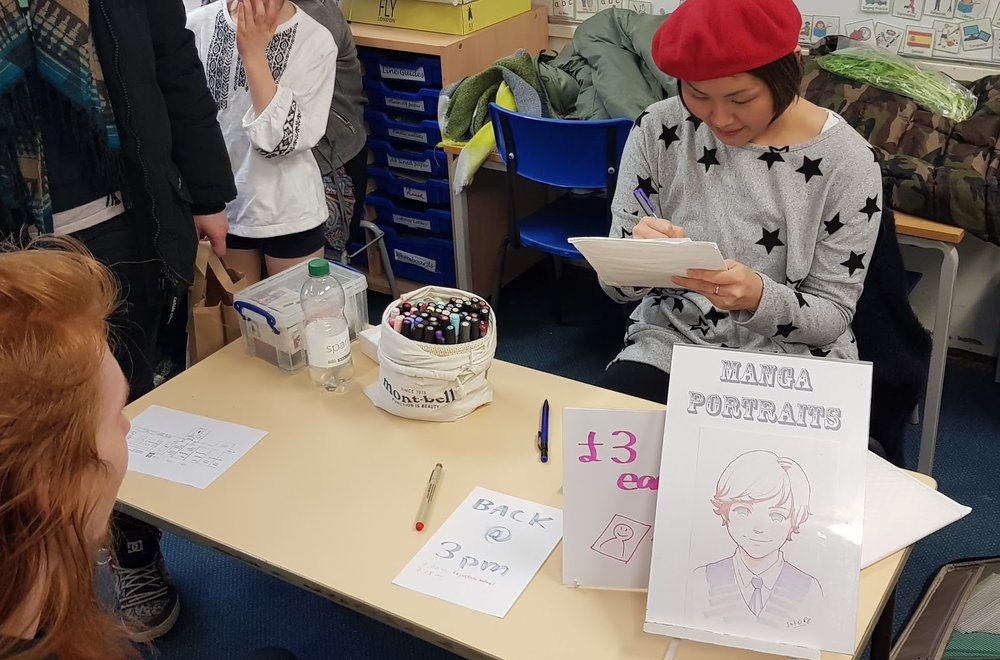
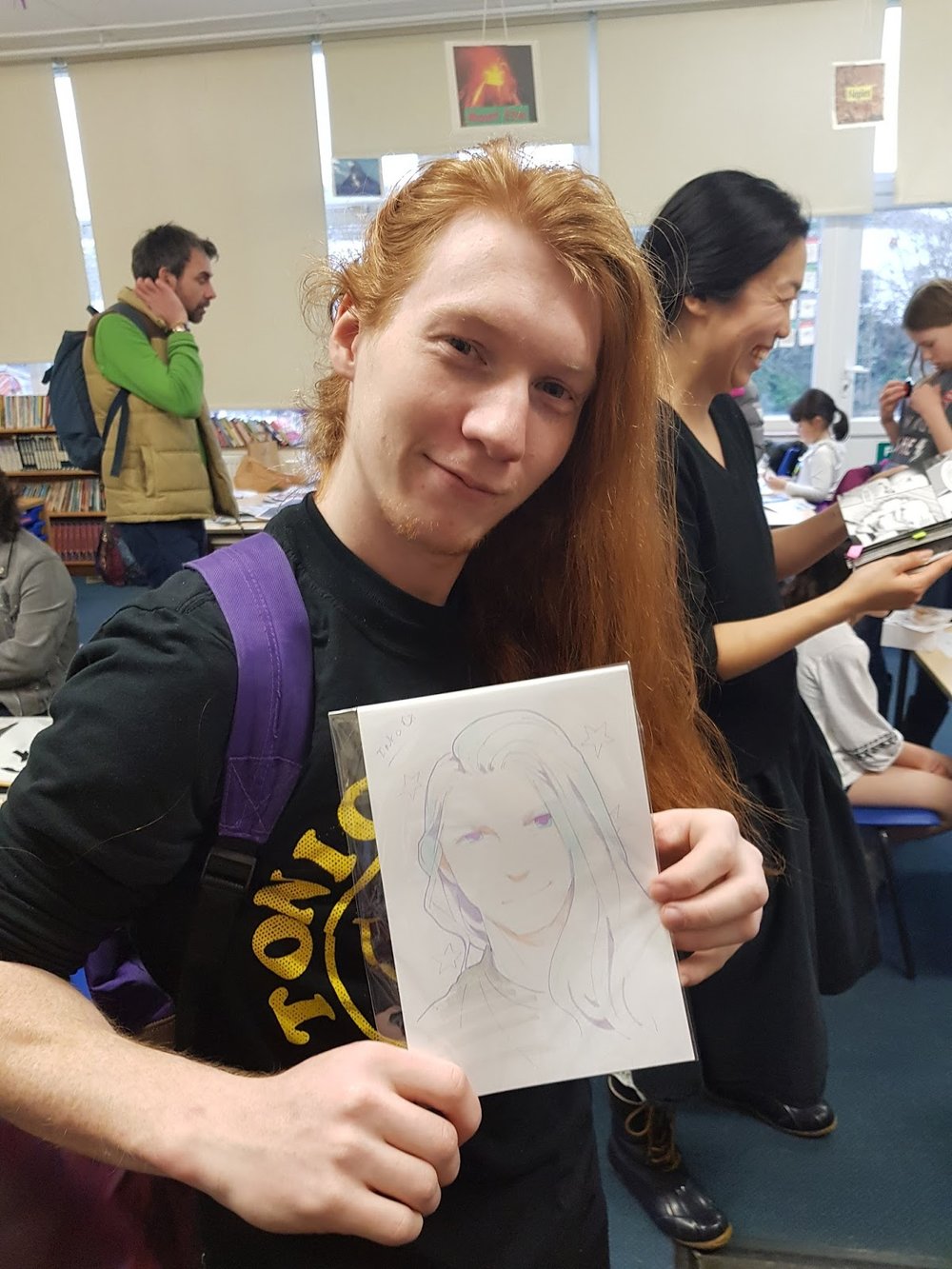
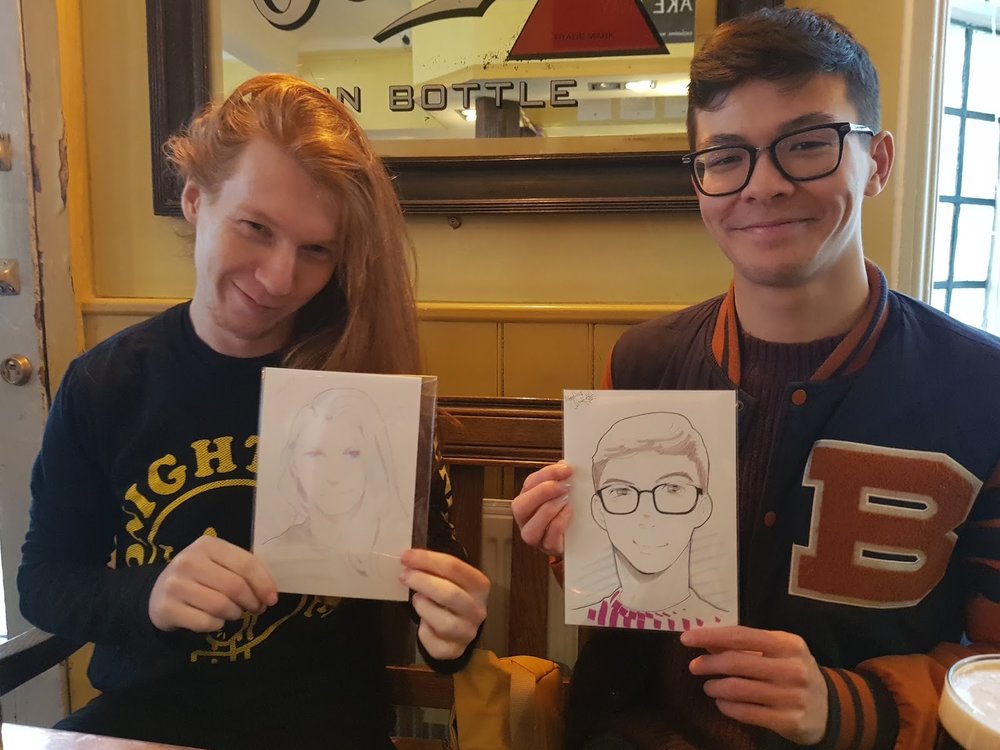
And some students had their portraits drawn by manga artists Inko and Chie Kutsuwada.
Here Inko hard at work:
And the finished result!
I always meet someone new and interesting at the Open Day, and the organisers are very friendly and welcoming.
Why don't you come along next year?
Find out more about the Brighton & Hove Japanese Club on their website (click here).
More links:
- Brighton-based manga artist Inko (Ai Takita-Lucas)
- Manga artist Chie Kutsuwada - also Brighton-based
- Takako Higgs, calligraphy artist and teacher in (you guessed it) Brighton
- Cafe an-an, Japanese cafe and wagashi (Japanese sweets) shop in Portslade
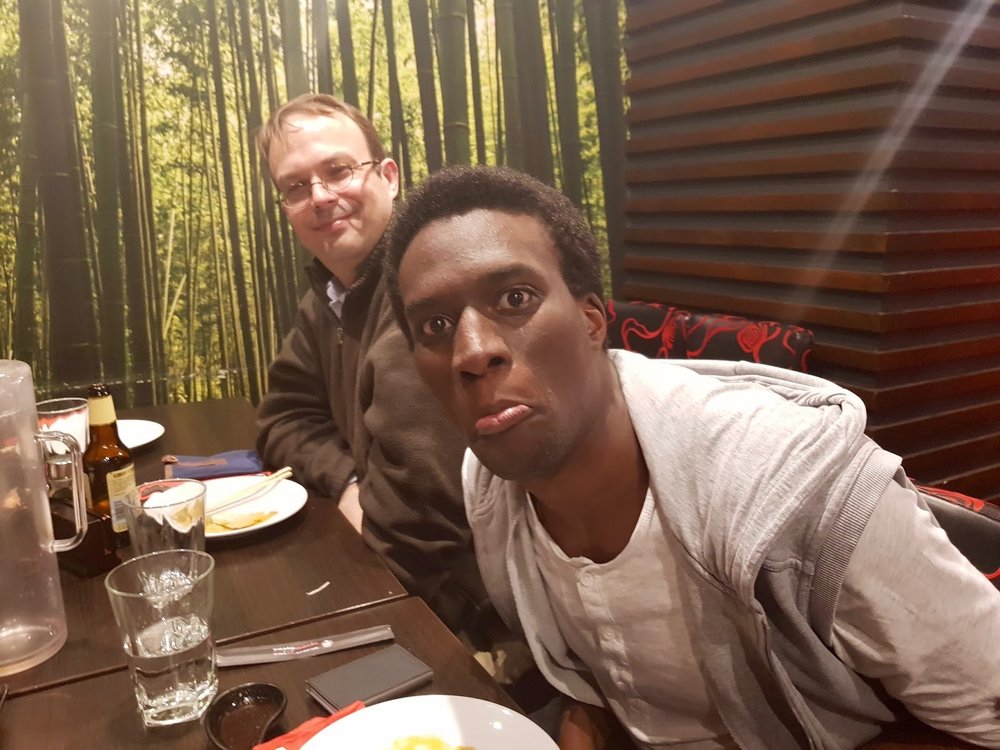
End-of-term Sushi Night! Easter 2018
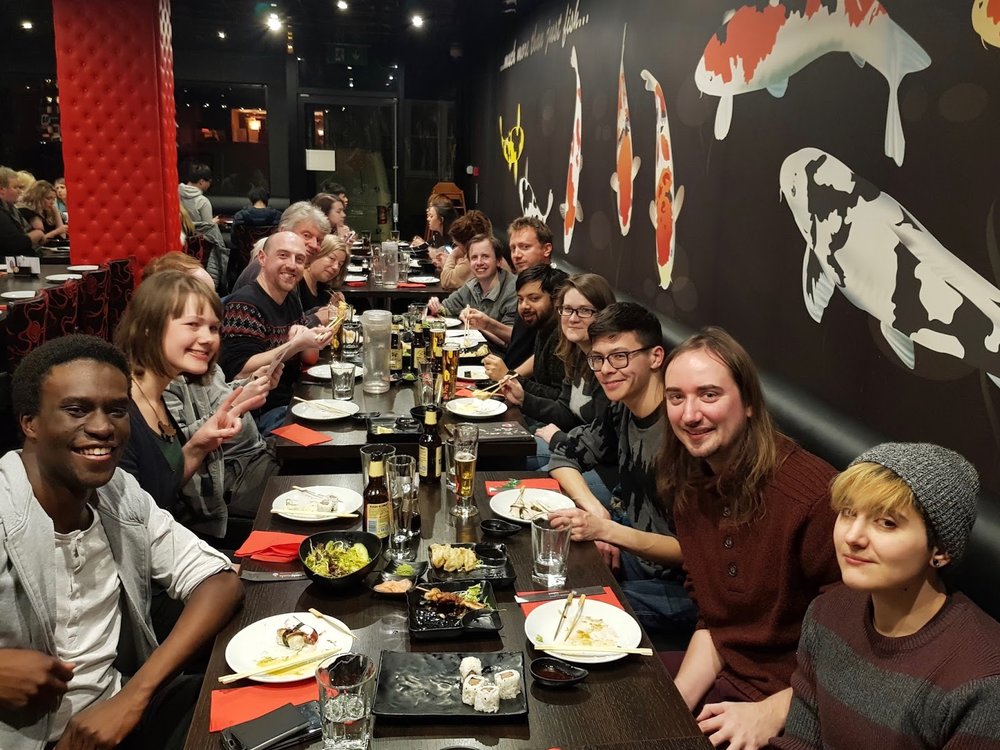
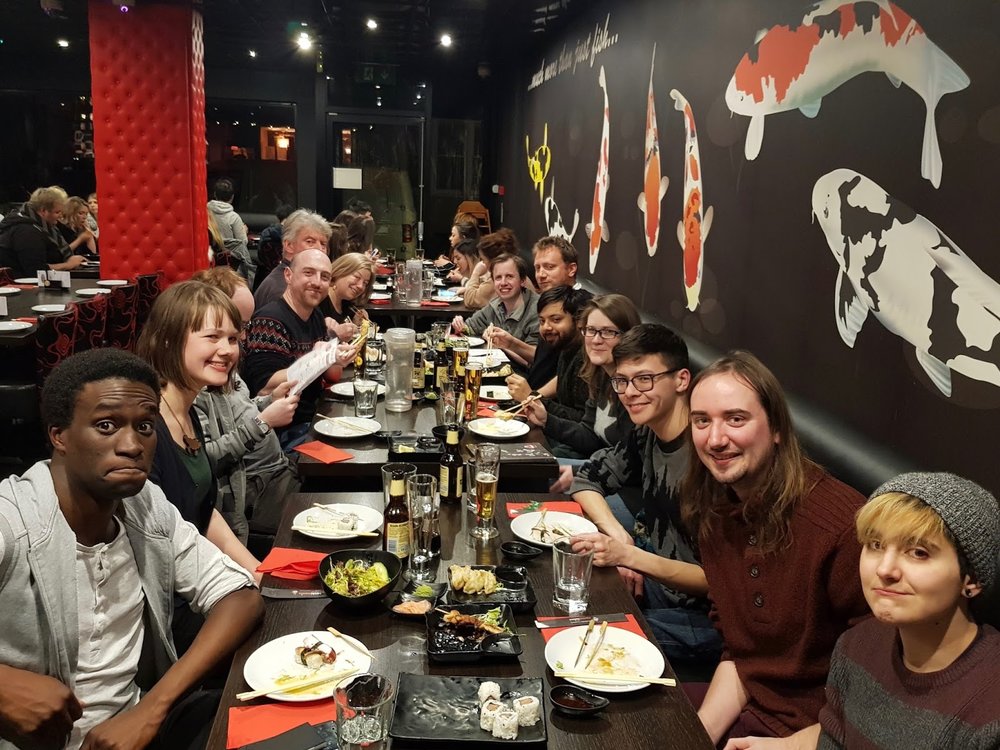

Thanks for coming!
Where shall we go for our next (non-academic) event?

Say yes!
A couple of months ago I was invited to speak online at a new event all about languages. My first thought was, heck no! That sounds utterly terrifying.
My second thought was, what would Karli Dendy do?
Karli co-runs designosaur and YEAH laser here in Brighton. We've been friends since uni, when we watched enormous amounts of bad TV, and went to every nightclub in the city in one year.

A couple of months ago I was invited to speak online at a new event all about languages. My first thought was, heck no! That sounds utterly terrifying.
My second thought was, what would Karli Dendy do?
Karli co-runs designosaur and YEAH laser here in Brighton. We've been friends since uni,when we watched enormous amounts of bad TV, and went to every nightclub in the city in one year.
Now that we are grown-ups (apparently), I proofread her copy, and she gives me great business advice.
Anyway, I knew what Karli would say. Say yes.
"I know the new mantra is to learn to say no to things, but I'm very much still in the say YES to everything phase, check your inbox every five minutes and reply to every strange direct message you get."
- Karli on the designosaur blog
Isn't that awesome advice?
I've seen what amazing exciting opportunities Karli, and her boyfriend and business partner Jacques Keogh, have had by saying yes to things.
So I said yes.
And I did it! And it was great!
My talk was titled "The Classroom is Not Dead", and I spoke about my experiences setting up an offline language school, in an increasingly online world.
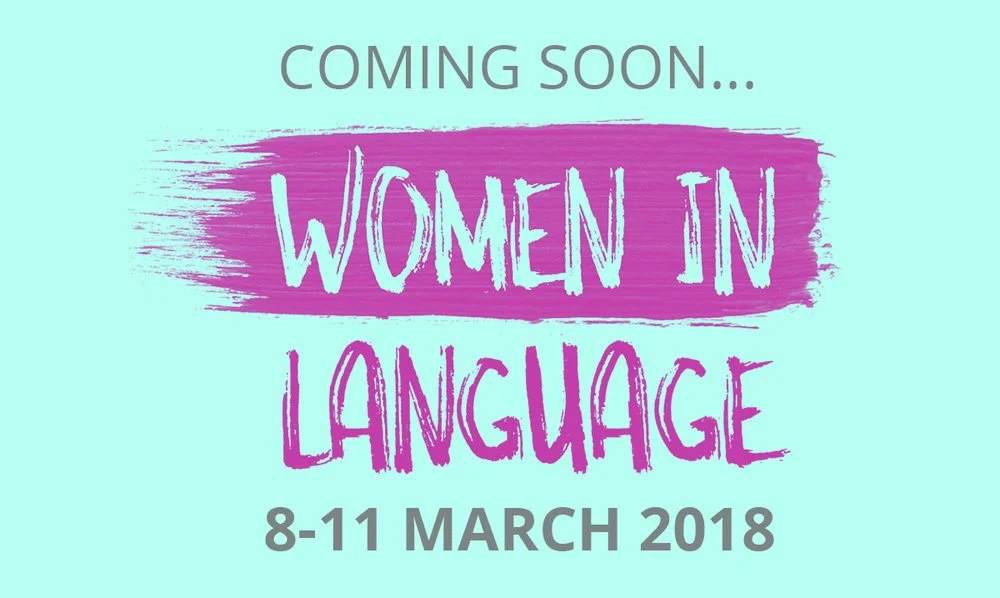
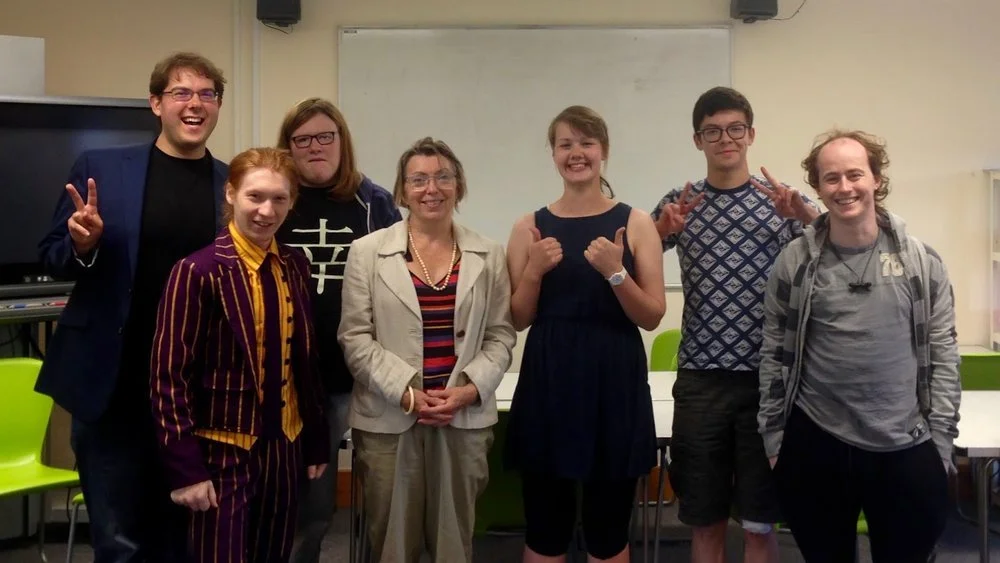
This was the first ever Women in Language event, put together by Kerstin Cable, Lindsay Williams, and Shannon Kennedy. There were 25 speakers - all women - and the online event ran from International Women's Day on March 8th to (UK) Mother's Day on March 11th.
The talks were divided up into four categories: Starting Language, Mastering Language, Living With Language, and Working With Language (that's me!)
I really enjoyed all the sessions I watched. There was a great mix of practical language learning advice, and more academic perspectives.
I missed a lot, but the talks are available online to ticket holders, so I can play catch-up over the next few weeks.
Speaking online was a new experience for me, but it was a lot of fun. I got some great questions in the Q&A too - about my experiences as a non-native teacher, and how to find a language class near you.
I also got to "meet" a bunch of new people online, and find other language teachers and learner to share experiences with.
And to think I wanted to say "heck no". It's a good thing I didn't.
So...what are you going to say yes to next?
Top photo: Lindsay Does Languages
More links: Women in Language homepage / designosaur / YEAH laser

Three Reasons Why Language Learning is Just Like Skateboarding
I bought a skateboard. And not just so I can start calling myself "the skateboarding Japanese teacher".
I've wanted to learn to skate for a long time. I'm turning 30 this year and I thought I should probably get on with it.
You know that Chinese proverb, "The best time to plant a tree was 20 years ago. The second best time is now"?
Well, I should probably have started skateboarding 20 years ago, because it turns out skateboarding is really hard. I didn't start when I was nine though, so now will have to do.

I bought a skateboard. And not just so I can start calling myself "the skateboarding Japanese teacher".
I've wanted to learn to skate for a long time. I'm turning 30 this year and I thought I should probably get on with it.
You know that Chinese proverb, "The best time to plant a tree was 20 years ago. The second best time is now"?
Well, I should probably have started skateboarding 20 years ago, because it turns out skateboarding is really hard. I didn't start when I was nine though, so now will have to do.
I'm not very good yet. In fact, I'm very bad.
I know I can do it though. It's just like learning Japanese! (Hear me out, ok...?)
1. You need to fall over a lot
You're going to fall off a skateboard, and make mistakes, and mess things up. It's going to hurt.
Sound familiar? Learning to speak a language is a process of making constant mistakes, and gradually getting better. If you don't make any mistakes when you're speaking a foreign language, you're not learning anything.
The only way to learn how to be good at something, is to first be very bad at it.
(I tell myself this constantly as I wobble around town on my little skateboard).
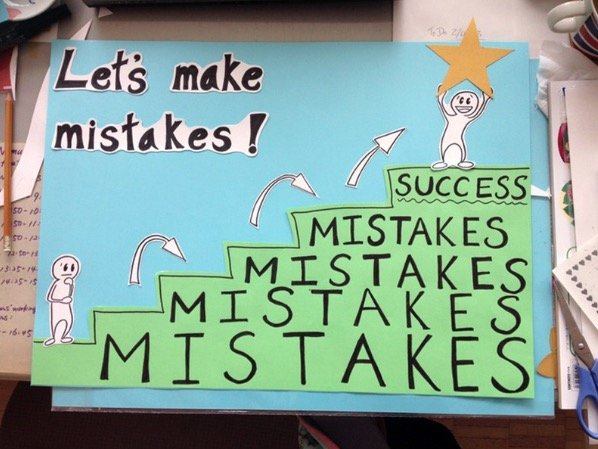
Image source: Verity Lane / Tofugu
2. It takes discipline
Learning any new skill takes considerable time and effort. You have to practice, even when you don't feel like it or when something else seems more appealing.
In a way, it's easy to be motivated, i.e. to want to do something. It's much more difficult to be disciplined - to do something even when you don't want to.
Taking your skateboard out on Saturday, even when it looks a bit windy, and you're not any good yet, and there are builders on the corner of the street who might laugh at you - that's discipline.
Studying a little bit of Japanese every day, even when you just feel like watching TV instead - that's discipline too.
Nothing that's worth doing can be learned overnight. (Unfortunately.)
3. You might feel silly
One of my students wrote this on his class feedback form last year:
"...while I feel terrible and clumsy while doing it, the speaking practice afforded by the class is something that is very difficult to get anywhere else."
I was a bit taken aback by this, because he doesn't sound terrible or clumsy when he speaks Japanese.
But a lot of people feel this way about doing something new, especially in front of other people. I certainly do.
Making mistakes can make us feel embarrassed or awkward.
(As a teacher, there's an added dynamic: I don't want my students to feel uncomfortable. But I do want to stretch them, and help them to push out of their comfort zone. It's a difficult balance, sometimes.)
I feel like very silly on my skateboard. Sometimes you've just got to push through it, I think, and focus on the goal.
"Think how good you'll feel when you can casually skateboard to work",
I tell myself. For me, it's the same feeling as:
"Think how good you'll feel when you can read a whole book in Japanese. Or have a ten-minute conversation. Or 30 minutes. Or a whole day!"
What do you think?

What is Community Interpreting and Why Does it Matter?
The dentist talked for a long time, in Japanese I didn't understand, pointing and waving his hands at the X-ray on the wall. I was completely lost.
After he'd talked for about five minutes, my Japanese boss translated for me: "He says you need to fix this tooth."
That's it? I thought. The dentist had been talking for ages. He can't possibly have only said "you need to fix this tooth".

The dentist talked for a long time, in Japanese I didn't understand, pointing and waving his hands at the X-ray on the wall. I was completely lost.
After he'd talked for about five minutes, my Japanese boss translated for me: "He says you need to fix this tooth."
That's it? I thought. The dentist had been talking for ages. He can't possibly have only said "you need to fix this tooth".
The first year I was in Japan I had a lot of dental work done.
I broke a tooth (ouch!) and then it kept breaking. It was unpleasant.
I'm very grateful that my Japanese boss came to these appointments with me. And when he couldn't come, his mum would come with me. It was really kind of them.
But I usually didn't really understand what was going on. Imagine if I'd had access to a professional interpreter instead?
I often have interpreting on the brain. My "other job" (i.e. what I do when I don't have my Step Up Japanese hat on) is working in the offices of a community interpreting service here in Brighton.
So what is Community Interpreting?
Interpreting is listening to what is said in one language, and communicating the meaning in another language. And Community Interpreting (as opposed to conference interpreting, or interpreting in business meetings etc) basically exists to enable people to access public services.
Community Interpreters attend medical, legal and housing appointments with people who have limited English, helping them to understand fully what's going on.
Using a professional interpreter guarantees that interpreting is accurate and unbiased.
The interpreter's job is to remain impartial in a three-way conversation between the person with the language need (in Japan, that was me), and the professional they're seeing (the dentist).
Ah yes, my Japanese dentist.
After a while I could understand enough to attend the appointments by myself. Sometimes, I could tell the dentist was using simple language, to ensure I understood. That was kind of him.
But some medical messages are too important to be said in simple language.
So how would my experiences in Japan have been different if I'd had access to a professional interpreter?
It would have been empowering to make decisions about my medical care, without having to ask my boss's mum. I'm sure I would have felt a little less scared of the dentist waving his hands around, too.
If you'd like to learn more about Community Interpreting from a global perspective, you should check out Madeline Vadkerty's talk "Making the World a Better Place As an Interpreter" at next week's Women in Language event.
I'm really looking forward to hearing Madeline speak about her experiences as a Community Interpreter, helping asylum seekers and survivors of torture to rebuild their lives.
(I'll be speaking too - eek!)
Your ticket for Women in Language gets you access to the entire 4-day event with over 25 awesome women speaking.
Click here to get your ticket before the event begins on Thursday 8th March 2018.
I quit my day job! (sort of...)
Don't worry mum - I haven't quit my day job. Not as such. I recently went from full time to 3 days a week though.
It's great.
One of my students mentioned this week in passing that I must be busy, working full time somewhere else, and also running Japanese courses. I realised that I haven't told a lot of my students that I no longer have a full time day job.

Don't worry mum - I haven't quit my day job. Not as such. I recently went from full time to 3 days a week though.
It's great.
One of my students mentioned this week in passing that I must be busy, working full time somewhere else, and also running Japanese courses. I realised that I haven't told a lot of my students that I no longer have a full time day job.
I now work three days a week in the offices of a community interpreting agency, here in sunny Brighton.
And I teach Japanese three nights a week, to lovely people with language-related goals and dreams. I get to share in my students' successes and triumphs, and hopefully help them through the tough bits too.
Life is more balanced now that I don't work elsewhere full time. I'm less "bad-busy" and more "good-busy".
And I get to feel part of two things - the interpreting charity, and my own little language school. That sense of community is really important to me.
Do you have a day job, and do something else on the side? If you have more than one job, how do you balance your time? I'd love to know what tips you can share. Let me know in the comments 😃

Japanese guys don’t want your Valentine’s Day chocolate anyway
ハッピーバレンタインデー! Happy Valentine's Day!
Valentine's Day in Japan is pretty different from the U.K. There's honmei choko (chocolate for someone you're into), giri choko (obligation chocolate), and even tomo choko (chocolate for friends)...
And a month later there's White Day to contend with…

ハッピーバレンタインデー! Happy Valentine's Day!
Valentine's Day in Japan is pretty different from the U.K. There's honmei choko (chocolate for someone you're into), giri choko (obligation chocolate), and even tomo choko (chocolate for friends)...
And a month later there's White Day to contend with…
One survey revealed that 90% of Japanese men said they didn't care about getting Valentine's Day chocolate, and wished women wouldn't bother.
Click here to read an article I wrote for SoraNews24 on the subject.
(It's from a couple of years ago, but I think it's still super relevant... especially on Valentine's Day).












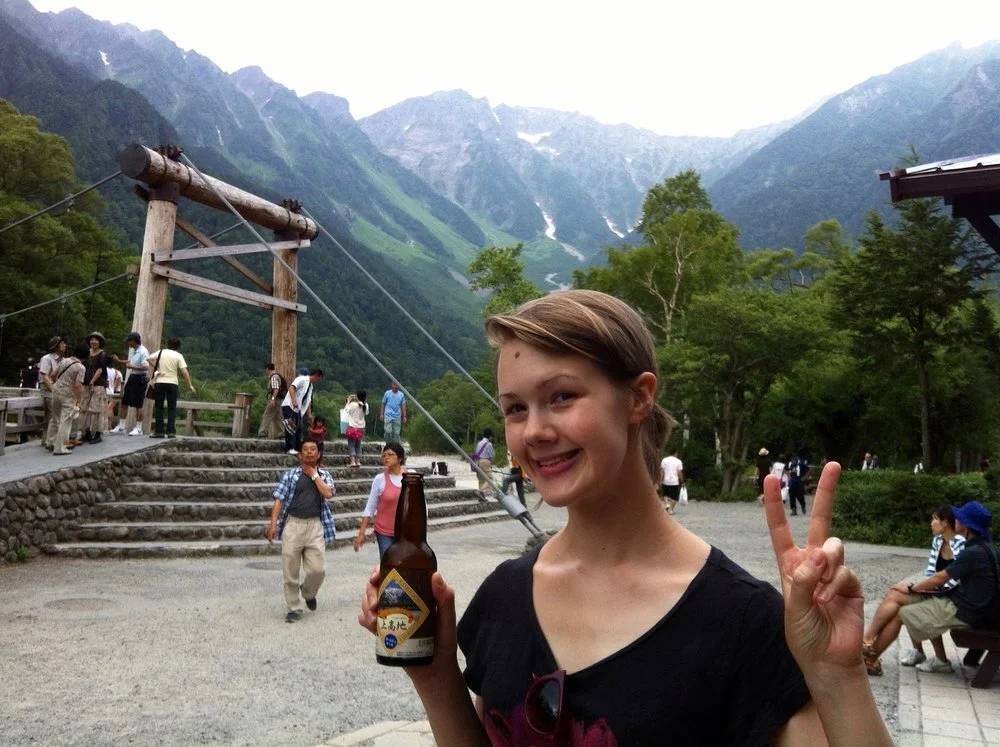
Like many people in the UK, I studied French in school. I liked French. I thought it was really fun to speak another language, to talk with people, and to try and listen to what was going on in a new country. (Still do!)
When I was 14 we went on a school exchange to the city of Reims, in northeastern France. I was paired with a boy, which I’m sure some 14-year-olds would find very exciting but which I found unbearably awkward. He was very sweet and we completely ignored each other.
That was nearly 20 years ago, and I didn’t learn or use any more French until, at some point in lockdown, I decided on a whim to take some one-to-one lessons with online teachers. Here are some things I learned about French, about language learning, and about myself.