
Welcome to the Step Up Japanese blog archive!
Although I’m not currently adding new posts to the blog, you’ll find plenty of Japanese learning tips, study advice, and resources to explore here.
Browse the blog index to view a complete list of posts.
For the latest news, course updates, and Japanese learning tips from Step Up Japanese, sign up for my newsletter.
Search this blog:

A Year of Monthly Japanese Learning Challenges
How do you keep practising Japanese, even when it doesn’t seem relevant? How do you stay motivated, when your life and your motivations change?
At the beginning of 2019, I decided to set myself a series of monthly Japanese study challenges. I’d do one every other month, and blog about it.
In January, I tried to speak Japanese every day for a month. This was probably the hardest challenge, from a logistical perspective. I don’t live in Japan, and we don’t speak Japanese at home (much). At the time, I was also working another job three days a week, where I wasn’t using Japanese at all. So speaking Japanese every day was, quite literally, a challenge.

How do you keep practising Japanese, even when it doesn’t seem relevant? How do you stay motivated, when your life and your motivations change?
At the beginning of 2019, I decided to set myself a series of monthly Japanese study challenges. I’d do one every other month, and blog about it.
In January, I tried to speak Japanese every day for a month. This was probably the hardest challenge, from a logistical perspective. I don’t live in Japan, and we don’t speak Japanese at home (much).
At the time, I was also working another job three days a week, where I wasn’t using Japanese at all. So speaking Japanese every day was, quite literally, a challenge.
But this was a great start to the year and probably one of my favourite things I’ve done using Japanese. Plus, I got to eat katsu curry at cafe an-an in Portslade and chalk it up as Japanese practice:
I Tried to Speak Japanese Every Day for a Month (Without Being in Japan)

In March, I tried shadowing every day.
What is shadowing? Most people are familiar with “listen and repeat” in language learning contexts. You listen to a conversation line-by-line and repeat each sentence after the recording.
Shadowing is different from simple “listen and repeat” in that you start speaking while the person on the audio is still talking. The goal is to be able to produce the dialogue with perfect pronunciation, as close to the recorded audio as possible.
I really enjoyed this challenge, and I also discovered that you can practise shadowing (quietly) in hotel rooms, waiting rooms, and even on the bus.
What is Shadowing and Can it Improve Your Spoken Japanese? I Tried Shadowing Every Day for a Month

In May, I read Japanese books every day. This was really fun, too, and not so hard once I got into a routine. If you get in the habit of taking a book with you everywhere you go, reading every day is relatively easy:
How to Read More in Japanese – I Tried Reading in Japanese Every Day for a Month

In July, I decided to play Japanese video games every day for a month, because who says challenges have to be challenging?
I played Japanese video games for about 20 minutes a day for a month, and here’s what I learned: six reasons to play video games in a foreign language.
This is not a “how to” post. I’m not going to tell you how to “learn Japanese in a week just by playing video games” or to claim this is a “quick route to fluency” (it’s not, namely because there is no quick route to fluency, just an endless and potentially very enjoyable road trip).
Instead, I’m just going to share some reflections on the very fun experience that was playing Japanese video games every day.
How to Practise Japanese by Playing Video Games Every Day

(IMAGE SOURCE: NINTENDO)
In September, I tried to watch Japanese TV every day. This is where the monthly challenges really started to come unstuck. September was a busy month, and life got in the way.
I also discovered that when a challenge isn’t very challenging, I don’t personally find it very motivating!
One fantastic thing that came out of this experience, however, was the idea for my new course Learn Japanese with Netflix! … but then covid-19 happened, which meant the Netflix course only ran for a few weeks. I hope to run it, or a similar course, again in the future.
Watching Japanese TV Every Day for a Month (Or, What to Do When Things Don't Go To Plan)

After that I took a two month break, and then in December, I got well and truly back on the horse, and spent a month practising handwriting kanji from memory every day.
I really enjoyed the routine of practising kanji again. I find kanji practice surprisingly relaxing - and I mentioned this to some students, who also said they find kanji writing practice relaxing, even meditative. Little and often is probably key.
"How Did You Learn Kanji?"

What next?
The process of setting bi-monthly goals was a stimulating and enjoyable experience, and I might repeat it another year, but I’m not doing monthly challenges in 2020.
We’re a few months into 2020, and due to covid-19, this year is already shaping up to be significantly more challenging than 2019.
2020 has already proved to be a year of radical change, for students at Step Up Japanese as well as for people all over the world. In March 2020 I moved all lessons online - another new challenge, but an enjoyable one.
I hope you stay healthy and safe throughout 2020, and that if Japanese study is a part of your life at the moment, that you enjoy it and have fun. And if life gets in the way sometimes….that’s okay too.
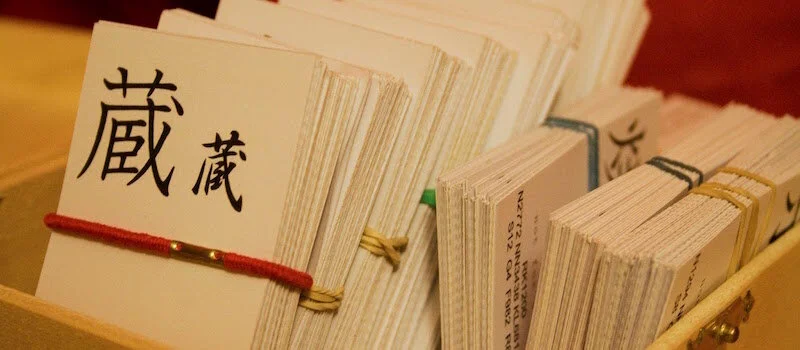
"How Did You Learn Kanji?"
I had a friend in 2011 who also lived in Japan and was also learning Japanese. Like me, he hoped to be fluent one day. I told him that I was going to learn all 2136 common-use kanji by making up a mnemonic story for each one. He laughed at me, of course. I don’t blame him.
But this slightly convoluted method is the thing that took my Japanese kanji knowledge from beginner to advanced.
So here is the story of how I studied kanji, some suggestions for kanji practice, plus some advice from another friend who took a totally different approach to me. I hope you’ll find it useful!

I had a friend in 2011 who also lived in Japan and was also learning Japanese. Like me, he hoped to be fluent one day. I told him that I was going to learn all 2136 common-use kanji by making up a mnemonic story for each one. He laughed at me, of course. I don’t blame him.
But this slightly convoluted method is the thing that took my Japanese kanji knowledge from beginner to advanced.
So here is the story of how I studied kanji, some suggestions for kanji practice, plus some advice from another friend who took a totally different approach to me. I hope you’ll find it useful!
Learning kanji takes time
Written Japanese uses a mix of three “alphabets” - hiragana, katakana, and kanji (Chinese characters).
Individual hiragana and katakana characters indicate sound only - the hiragana character あ makes the sound “a”, but it doesn’t have any meaning by itself. (Just like how the letter “B” doesn’t have any meaning by itself - it’s just a sound).
Kanji, on the other hand, indicate meaning as well as sound. For example, the kanji 木 means “tree”; 重 means “heavy”.
To read Japanese fluently, a student must be able to understand at least 2000 kanji. There is even an official list of the 2136 kanji that all Japanese children learn by the end of secondary school, called the jōyō kanji (常用漢字, meaning “regular-use kanji”).
The task of learning at least 2000 kanji is a major undertaking - even for Japanese people. That’s why students in Japan continue learning the jōyō kanji right up until the end of high school. And traditional methods of learning kanji tend to focus on rote memorisation, which is very inefficient.
The Heisig Method
When I got serious about learning kanji, in 2010, I did a bit of googling and stumbled across people talking about “the Heisig method”. This is the kanji study method introduced by James W. Heisig in his popular (and somewhat controversial) book ‘Remembering the Kanji I: A complete course on how not to forget the meaning and writing of Japanese characters’.*
The Heisig approach can be summed up as follows:
1) Learn the meaning of kanji
2) Learn the meaning of radicals
3) Memorise how to write kanji by making up descriptive mnemonic stories
You’ll note that reading kanji (how to pronounce them) does not feature on this list.
1) Learn the meaning of kanji
Heisig argues that before learning the readings of any kanji characters, it is more efficient to first learn the meanings. To this end, he gives each kanji an English keyword. For example, the kanji character 行 means “go”, so Heisig gives it the English keyword “going”.
By learning the meanings of kanji, the learner can guess at unfamiliar words.
I got to show off this ability years later in Okinawa, when my good friend Karli and I were looking at some artefact:
“What’s it made of?” she asked.
“I think it’s ivory.”
“Fran, why the hell do you know the Japanese word for ‘ivory’?”
“I don’t,” I said, pointing at the sign which had the word 象牙 on it. “But this one (象) "means ‘elephant’, and this one (牙) means ‘tusk’.”
2) Learn radicals
Heisig also puts a lot of focus on learning radicals - small parts which make up kanji. (He calls them “primitive elements”, but radicals is a more commonly-used term).
Radicals are the building blocks of kanji, and by learning to identify these constituent parts, you can “unpick” new and unfamiliar characters. Knowledge of radicals is also very helpful for looking up kanji in a dictionary.
For example, the kanji 明 (meaning “bright”) is made up of the two smaller parts 日 (“sun“) and 月 (“moon”). If the SUN and the MOON appeared in the sky together, that’d be pretty BRIGHT, right?
3) Make mnemonics
Using these radicals, Heisig argues that by making vivid and memorable stories, you can remember even complex kanji easily.
A common and simple example of a kanji mnemonic is 男, the character for “man”. The top half of this kanji is 田 “rice field“, and the bottom half is 力, “power”. So here’s the image: A MAN is someone who uses POWER in the RICE FIELD.
(If you’re not great at making up mnemonics, you can do what I did and copy other people’s funny stories from the Kanji Koohii website).
4) Practice writing by hand - from memory
Heisig says that in order to learn to read and recognise kanji characters, you should practise writing them. But rather than just copying them out endlessly, you need to use the power of active recall. He tells the student to use flashcards to test yourself on your ability to write the character from memory.
So for instance, on the front of the flashcard you have the word “man”, and then you recall the story ("oh yes, the POWER 力 in the RICE FIELD 田”) and write the kanji out from memory: 男.
The controversial part is the suggestion that you should do all of this work - make up 2000+ mnemonic stories, and learn to handwrite each kanji from memory - before learning how to read (i.e. pronounce) any of the kanji.
In practice, most students will be studying Japanese at the same time. (Who’s using the Heisig method to learn kanji, but not also learning the Japanese language? Nobody, I reckon.)
Combining the Heisig method with Anki
Heisig’s book was first published in 1977, so he suggests using paper flashcards. But the method really comes into its own when you use it with a flashcard app. I’l talk about Anki here because it’s the app I used.
Anki is a flashcard app that uses the principle of spaced repetition to make practising with flashcards as efficient as possible. Put simply, spaced repetition means the app decides when you need to see a flashcard next, based on how recently you got it right.
I used Anki for years, both for vocabulary practice and for kanji writing practice. It’s actually the reason I got a smartphone, in 2011.
You can make your own flashcard decks (a “deck” is what Anki calls a set of cards) with Anki, or you can download decks that other people have made. I used a deck that someone else made, but I edited it a bit.
On the front of the each card, I had the Heisig keyword. In this case, Heisig’s keyword is “eat”. This is a good keyword, as the kanji 食 means “eating” or “foodstuff”, and 食べる (taberu) is a verb meaning “to eat”. So, the idea is that you see the word “eat” and have to remember how to write the kanji:

How this works in practice
I probably practised writing kanji like this every day for about 15 minutes, for about a year and a half in 2010-2011. Essentially, that’s how I learned to write Japanese.
And by learning the meanings of kanji, suddenly all those signs and labels all around me (I was living in Japan by this time) started to have meaning.
Outside my flat there was a sign with the word 歩行者 on it. I knew that 歩 meant “walk”, 行 meant “go”, and 者 meant “person”. That’s how I learned that 歩行者 means “pedestrian”. I didn’t know how to read it aloud, but I knew what it meant.
The school that I worked at was an eikaiwa gakkou, an English conversation school. On the front of the school was the word 英会話. I knew that 英 could mean “English”, 会 meant “meet”, and 話 meant “talk”. I also knew that the character 英 could be read as ei, because it was in the word 英語 (eigo, the English language). And that 話 could be read as wa, because it was at the end of 電話 (denwa, telephone). So from this I could guess that 英会話 was ei-something-wa… and I knew the word eikaiwa (English conversation), so I asked my boss if 英会話 was “eikaiwa” - yes.
I was vegetarian when I first moved to Japan, so I spent some time scouring packages in supermarkets to work out whether I could eat things or not. I knew that the radical 月 could mean “meat” or “flesh”, and I knew that 豕 meant “pig”, so I could guess that 豚 was probably “pork” or “pig”. I didn’t know the word for pig, or the word for pork. But I could guess that I probably didn’t want to eat something with 豚 in it.
In other words, the Heisig method works - when combined with other Japanese study.
(Incidentally, I don’t “teach” Heisig because it’s a bit weird, and not for everyone. But I don’t teach kanji through rote memorisation either. I use an integrated approach - I want students to learn the meaning of individual kanji, and the readings of whole words, and to learn kanji in context as much as possible. But I still think that Heisig is a great self-study method, and if you’re interested, you should check out his book*).
Post-Heisig
As my Japanese got better, I no longer associated the kanji with English keywords. When I saw the kanji 食 I’d think of the meaning - something to do with eating or food - but not necessarily Heisig’s keyword. So later, on the front of each card, I added an example word containing the kanji, which is written in hiragana. In this case, the word is たべる (taberu; to eat), and to test myself, I have to write out the word 食べる (i.e., not just the individual kanji):

I also have the stroke order on the back of the card, so that I can check straight away if the stroke order I wrote out is correct or not. I added these by screenshotting the stroke order diagram in takoboto, the dictionary app I use on my phone.
(I used to be a bit lazy about stroke order, but since I started teaching Japanese I have spent some time correcting my bad habits).
The stroke order diagram is good for checking that you’re handwriting the kanji in the correct way, too. A common mistake learners make is copying typeface fonts, but many kanji look quite different when handwritten to how they look in type.
In December 2019, I decided to dust off this (very neglected) Anki deck and do some handwriting practice, every day for a month. For twenty minutes every day, I’d go through flashcards and test myself on whether I could handwrite the kanji.
I really enjoyed the routine of practising kanji again. I find kanji practice surprisingly relaxing. I mentioned this to some students, and they (well some of them anyway!) said they find kanji writing practice relaxing, even meditative. Little and often is probably key.
Find something you enjoy, and do it every day forever
Years later, I was out for dinner with an American friend in Japan. We were looking at the kanji-filled handwritten menu, and I realised that his Japanese reading was really quick - much faster than mine. “How did you learn to read kanji?” I asked him.
“Er, I dunno. Just, reading books I guess? For, like, years.”
It probably doesn’t matter too much how you study kanji. To be honest, I’m not sure that the Heisig method is better than any other. It worked for me, but if you put the time in, there are other methods of learning kanji that might work just as well.
The key thing is to find something that works for you, and spend a little time on it every day. And if your friends laugh at you, try and ignore them! One day they might be asking you how you did it.
Related posts
Links
Links with an asterisk* are affiliate links, which means I may earn a small commission, at no extra cost to you, when you click through and buy the book. Thanks for your support!














Like many people in the UK, I studied French in school. I liked French. I thought it was really fun to speak another language, to talk with people, and to try and listen to what was going on in a new country. (Still do!)
When I was 14 we went on a school exchange to the city of Reims, in northeastern France. I was paired with a boy, which I’m sure some 14-year-olds would find very exciting but which I found unbearably awkward. He was very sweet and we completely ignored each other.
That was nearly 20 years ago, and I didn’t learn or use any more French until, at some point in lockdown, I decided on a whim to take some one-to-one lessons with online teachers. Here are some things I learned about French, about language learning, and about myself.